Class I Low predicted difficulty
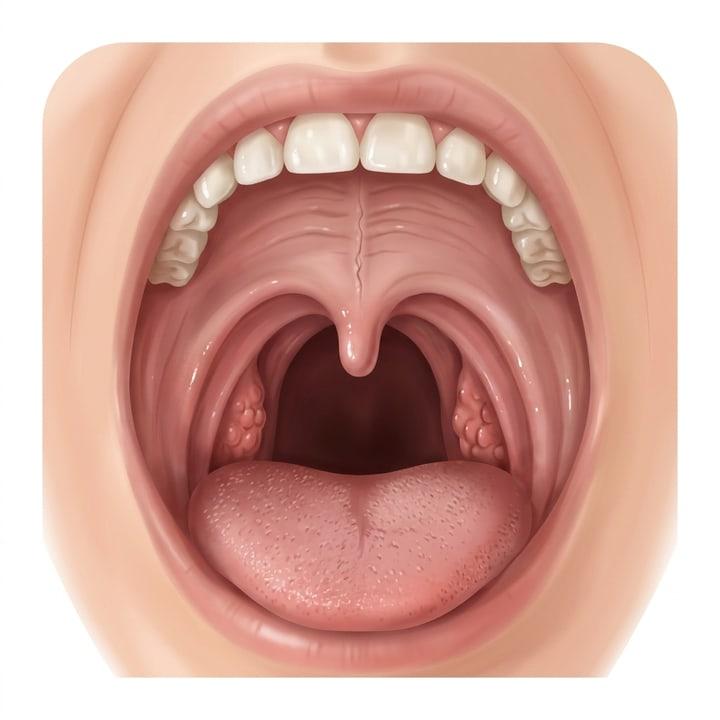
Visible: Soft palate, uvula, fauces, and pillars.
The whole uvula and both pairs of tonsil pillars are in view.
Free Tools
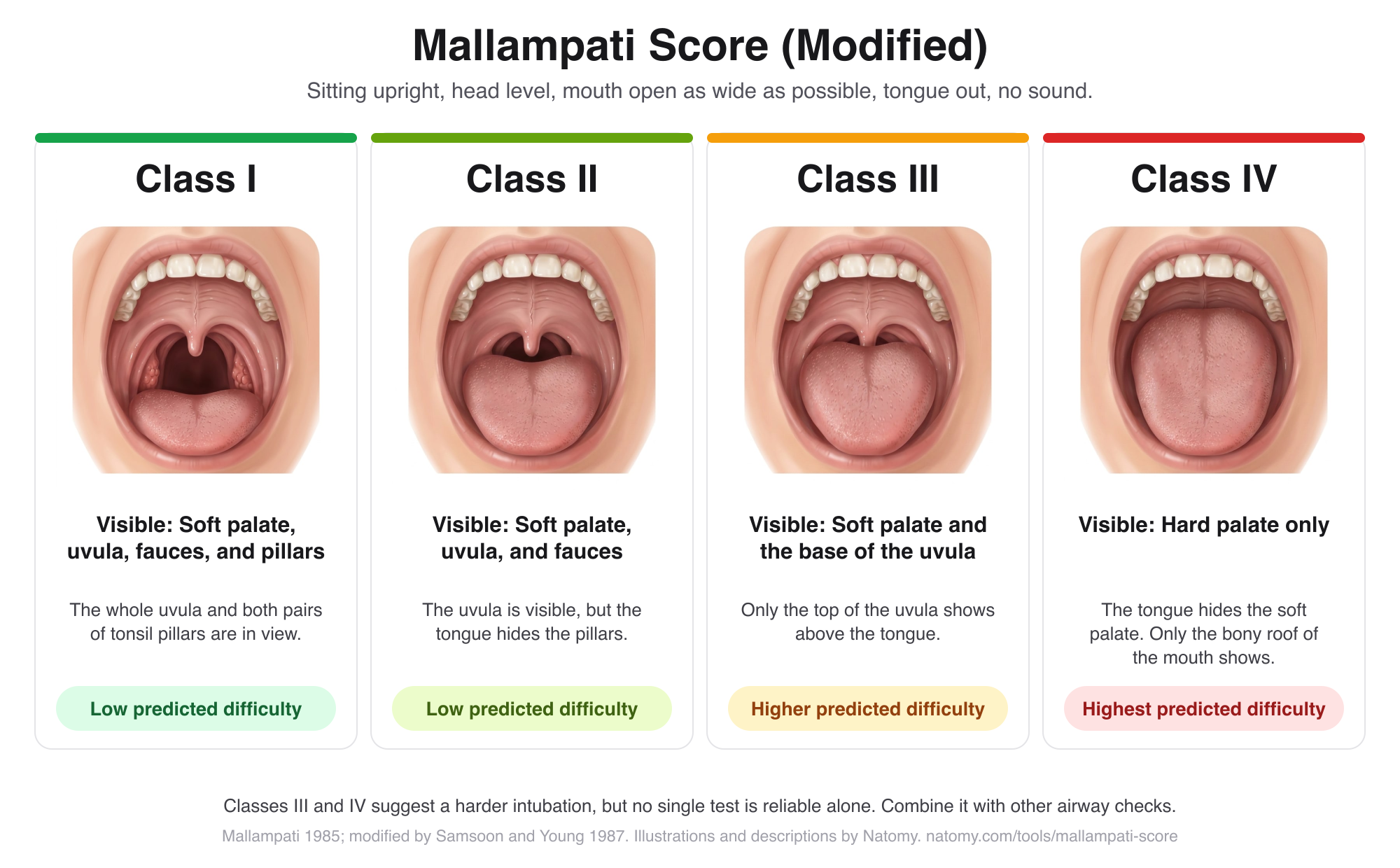
The Mallampati score grades how much of the back of the mouth you can see when a person opens wide and sticks out the tongue. Class I shows everything, including the uvula and the tonsil pillars; class IV shows only the hard palate. Higher classes suggest a harder intubation. Use the classifier below to match a view and copy an airway note.
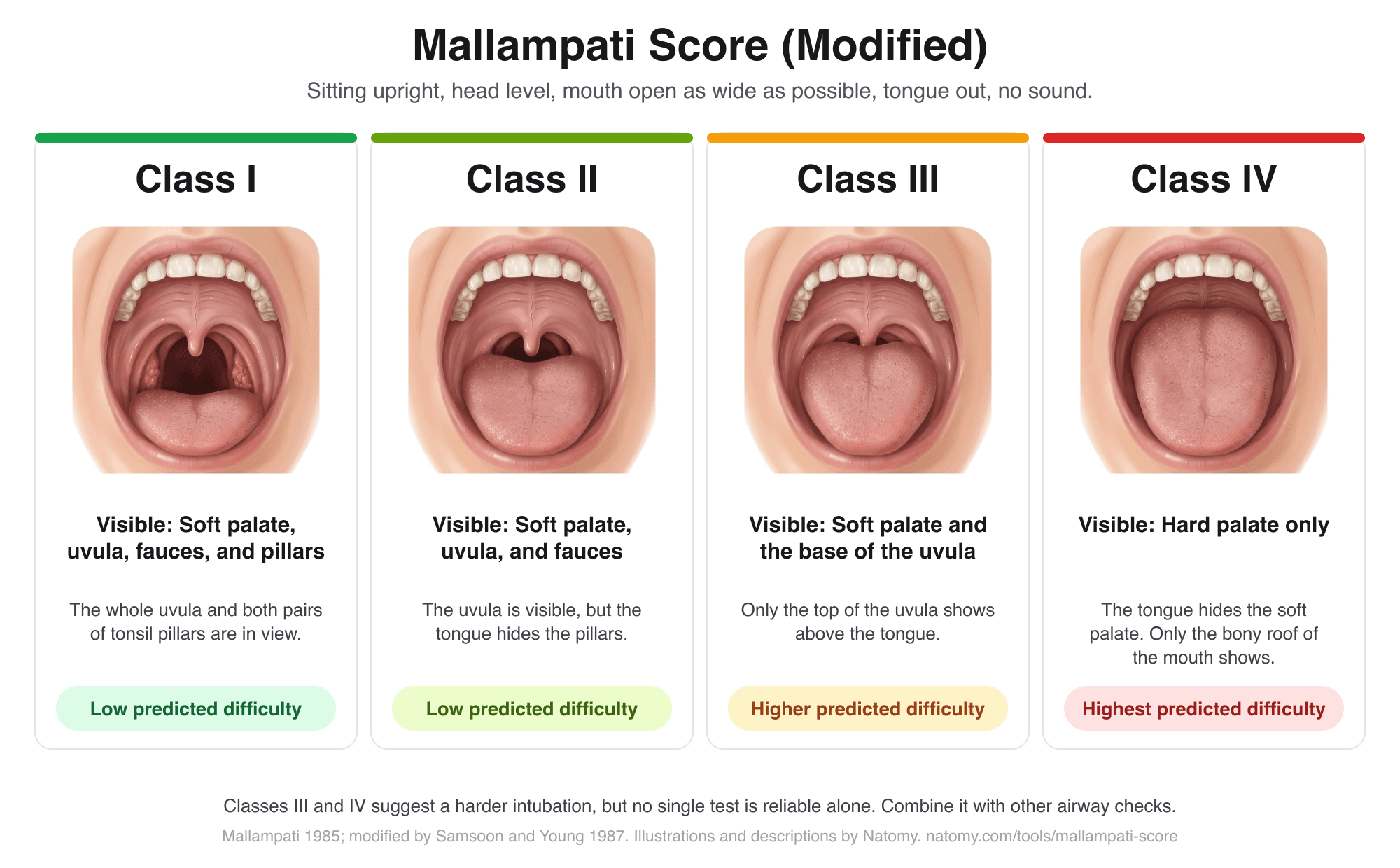
Download the chart (PNG) for teaching, the pre-anesthesia clinic, or case files.
Pick the view that matches. Add other airway findings if you want a fuller note.
The Mallampati class is more useful together with these bedside checks.
Visible: Soft palate, uvula, fauces, and pillars.
The whole uvula and both pairs of tonsil pillars are in view.
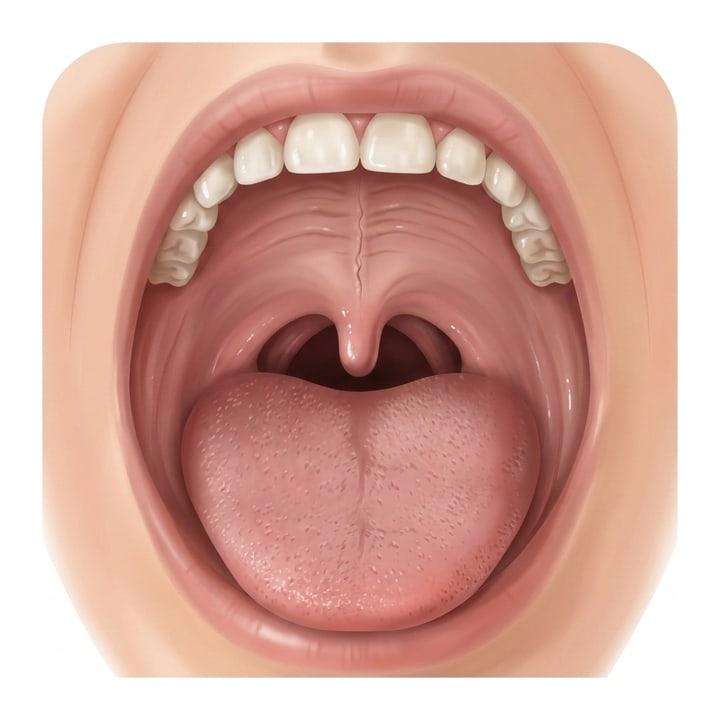
Visible: Soft palate, uvula, and fauces.
The uvula is visible, but the tongue hides the pillars.
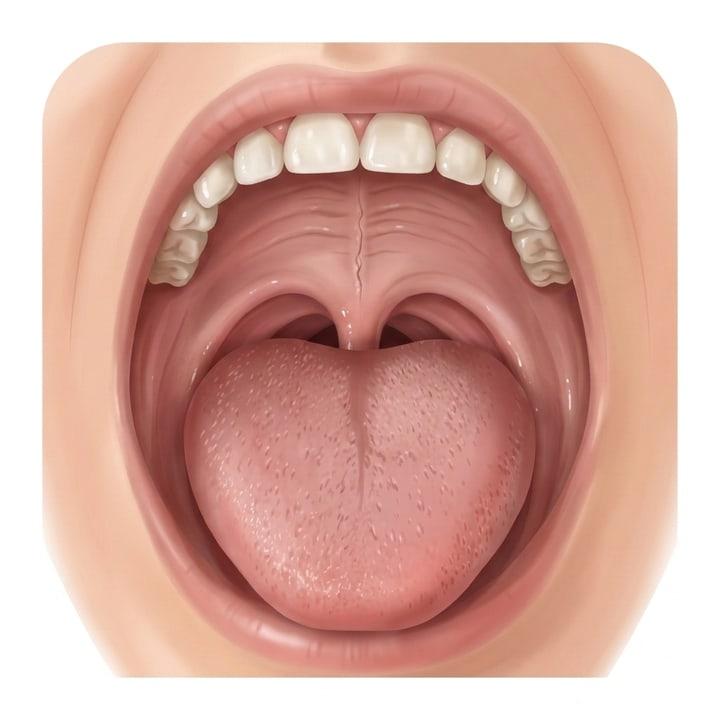
Visible: Soft palate and the base of the uvula.
Only the top of the uvula shows above the tongue.
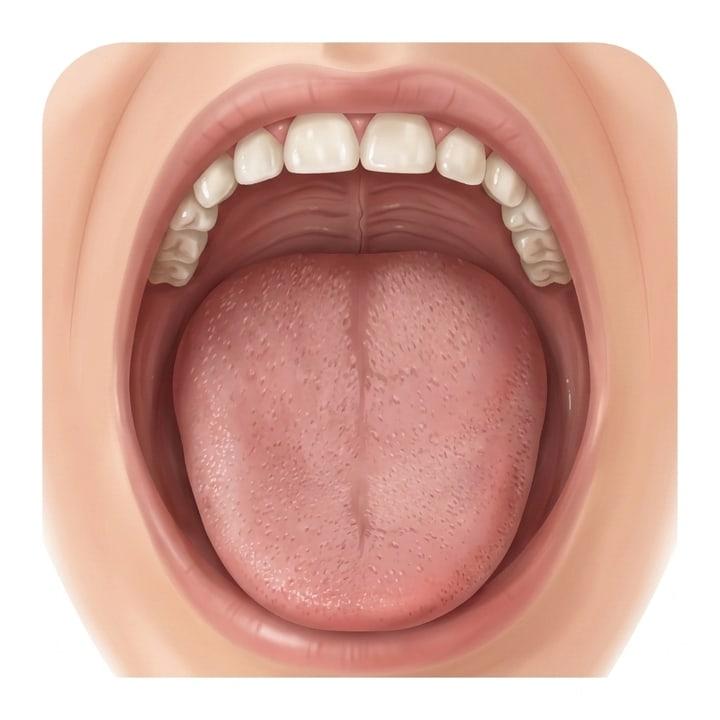
Visible: Hard palate only.
The tongue hides the soft palate. Only the bony roof of the mouth shows.
Some anesthesiologists also describe a class 0: part of the epiglottis can be seen when the tongue is out. It is uncommon and usually means an easy view of the vocal cords.
Dr. Seshagiri Mallampati and colleagues described the test in 1985 with three classes, the worst being a view of the soft palate alone (the uvula hidden). In 1987, Samsoon and Young added a fourth class for when even the soft palate is hidden and only the hard palate can be seen. This four-class version, the modified Mallampati classification, is the one used today.
The tongue sits in front of the airway. When a large tongue hides the back of the mouth, it is also more likely to get in the way of the view of the vocal cords during intubation. So higher classes are linked to:
That is why it is combined with other bedside checks: mouth opening, thyromental distance (chin to Adam's apple), neck movement, how far the lower jaw can slide forward, the upper lip bite test, neck size, and any history of a difficult airway. The more warning signs together, the higher the chance of trouble.
The Mallampati class is a prediction made while the patient is awake. The Cormack-Lehane grade is what the anesthesiologist actually sees during laryngoscopy:
A high Mallampati class makes a higher Cormack-Lehane grade more likely, but the two often do not match.
A failed or delayed intubation can starve the brain of oxygen within minutes, and hypoxic brain injury after anesthesia is one of the most serious outcomes reviewed in anesthesia malpractice claims. In those cases, the pre-anesthesia airway assessment is one of the first records examined.
Reviewers look at whether an airway exam, including the Mallampati class, was documented before the procedure; whether warning signs led to a plan, such as a video laryngoscope, a backup device, or an awake intubation; and how the team responded once trouble began, matched against the oxygen levels and times in the anesthesia record. A high Mallampati class is not proof of negligence, and a low one does not rule out a difficult airway; what matters is how the whole picture was assessed and acted on. For the outcome side, see our Glasgow Coma Scale and Rancho Los Amigos scale tools.
Natomy turns records, imaging, and prompts into clear, labeled medical illustrations of the airway, such as the larynx, the intubation view, and airway injuries, for patient education and medical-legal exhibits. See examples in the Natomy atlas.
Try Natomy TodayIt is a quick bedside check of how much of the back of the mouth you can see when a person opens wide and sticks out the tongue. It is graded from class I (everything visible) to class IV (only the hard palate visible). Anesthesia teams use it as one sign of how hard it may be to place a breathing tube.
Classes I and II are considered reassuring, though they do not rule out a difficult airway. Most adults fall into one of these two classes.
Not on its own. Class III means only the soft palate and the base of the uvula are visible, and it is linked to a higher chance of a difficult intubation. Many people with class III are intubated without trouble. It tells the anesthesia team to look at other airway signs and have a plan ready.
Class IV means the tongue hides the soft palate completely and only the hard palate, the bony roof of the mouth, is visible. It is the class most strongly linked to a difficult view of the vocal cords, so the team usually checks other airway features closely and may choose special equipment.
The person sits upright with the head level, opens the mouth as wide as possible, and sticks the tongue out as far as it will go, without saying anything. The examiner looks from the front at eye level and notes which structures can be seen. Some examiners repeat it to make sure the view is consistent.
The Mallampati class is a look into the mouth before anesthesia, with the patient awake. The Cormack-Lehane grade describes what the anesthesiologist actually sees of the vocal cords during laryngoscopy, after the patient is asleep. Mallampati is used to predict; Cormack-Lehane records the real view.
Yes. A higher Mallampati class is linked to a higher chance of obstructive sleep apnea, because a crowded mouth and throat narrow the airway during sleep. Sleep specialists often use a related check, the Friedman tongue position, which is done with the tongue relaxed inside the mouth.
On its own, only moderately. Large reviews find that it misses many difficult airways and flags some easy ones as hard. It works best combined with other checks such as mouth opening, thyromental distance, neck movement, jaw movement, and the upper lip bite test.
Yes. It can get worse with weight gain, swelling of the airway, and during pregnancy and labor, and it can change with position. That is why it is checked again shortly before anesthesia rather than relied on from an old record.
Sources: Mallampati SR, Gatt SP, Gugino LD, et al. A clinical sign to predict difficult tracheal intubation: a prospective study. Can Anaesth Soc J. 1985;32(4):429-434. Samsoon GL, Young JR. Difficult tracheal intubation: a retrospective study. Anaesthesia. 1987;42(5):487-490. Cormack RS, Lehane J. Difficult tracheal intubation in obstetrics. Anaesthesia. 1984;39(11):1105-1111. Ezri T, Warters RD, Szmuk P, et al. The incidence of class "zero" airway and the impact of Mallampati score, age, sex, and body mass index on prediction of laryngoscopy grade. Anesth Analg. 2001;93(4):1073-1075. Nuckton TJ, Glidden DV, Browner WS, Claman DM. Physical examination: Mallampati score as an independent predictor of obstructive sleep apnea. Sleep. 2006;29(7):903-908. Roth D, Pace NL, Lee A, et al. Airway physical examination tests for detection of difficult airway management in apparently normal adult patients. Cochrane Database Syst Rev. 2018;5(5):CD008874. Apfelbaum JL, Hagberg CA, Connis RT, et al. 2022 American Society of Anesthesiologists practice guidelines for management of the difficult airway. Anesthesiology. 2022;136(1):31-81. Illustrations and descriptions are by Natomy. For education and documentation only; not a substitute for clinical judgment.
Free Online DICOM Viewer (3D)
Open a CT or MRI DICOM folder in your browser and view it in 3D, with AI anatomy labeling. Nothing is uploaded.
Try it free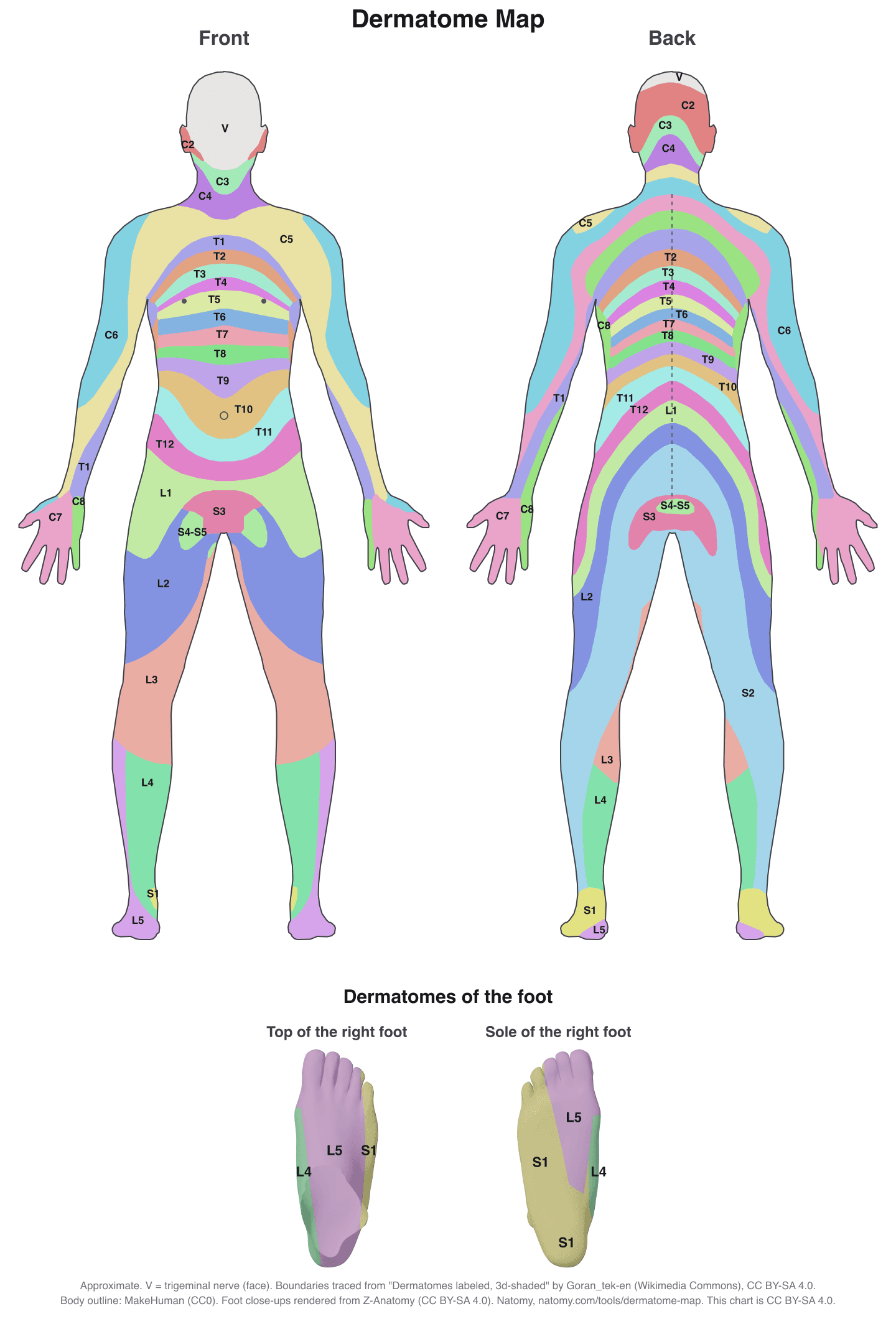
Interactive Dermatome Map
Tap the body to see each nerve root's skin area, test point, myotome, reflex, and disc level. Free printable chart.
Try it free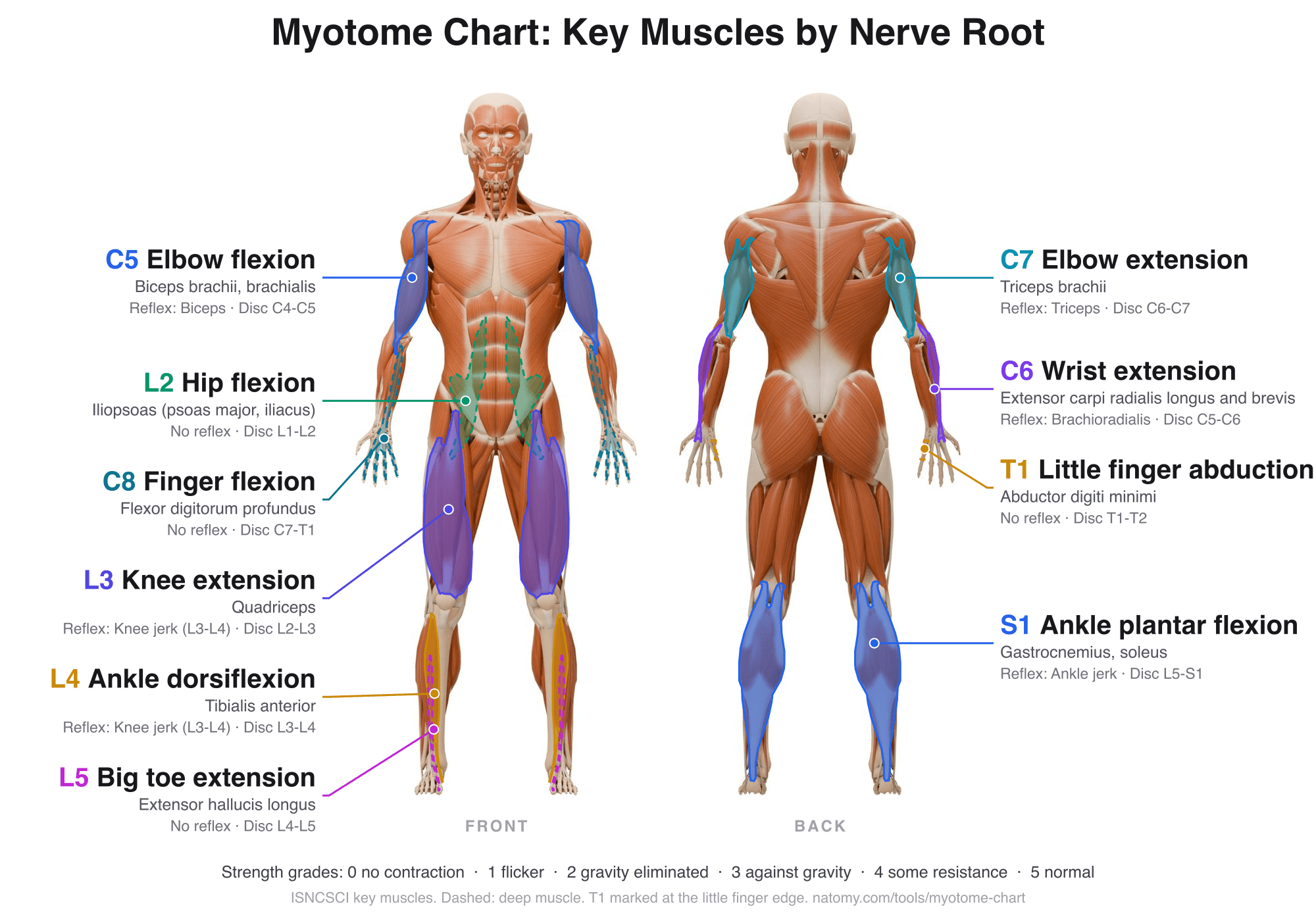
Myotome Chart and Motor Score
Tap a nerve root to see its key muscle, test position, and reflex. Grade strength 0 to 5 for the ISNCSCI motor score.
Try it free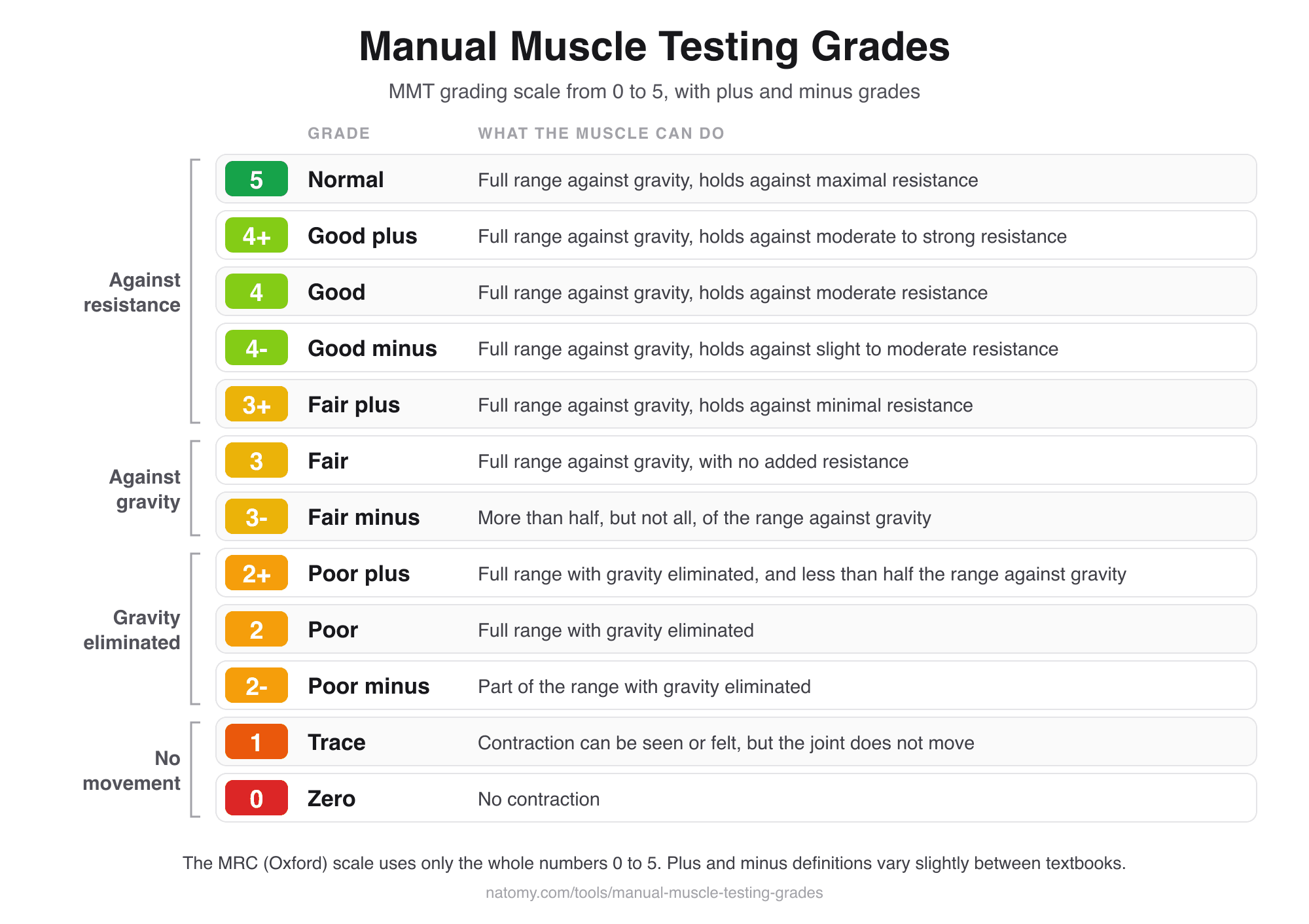
Manual Muscle Testing Grades
MMT grading scale chart from 0 to 5 with plus and minus grades, and a grade finder that writes the note for you.
Try it free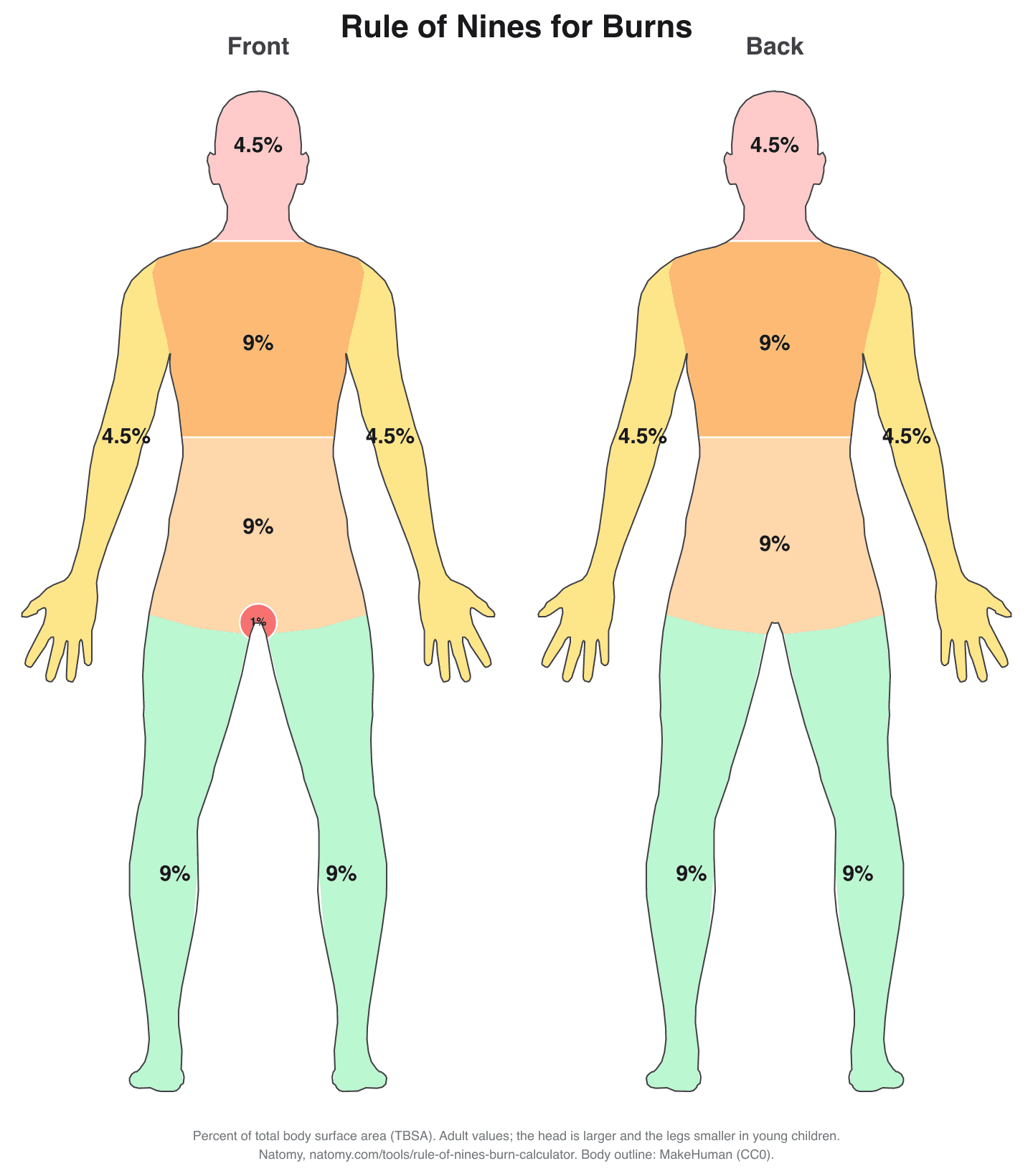
Rule of Nines Burn Calculator
Click the burned areas to get the total body surface area (TBSA), with the Parkland formula and a printable burn chart.
Try it free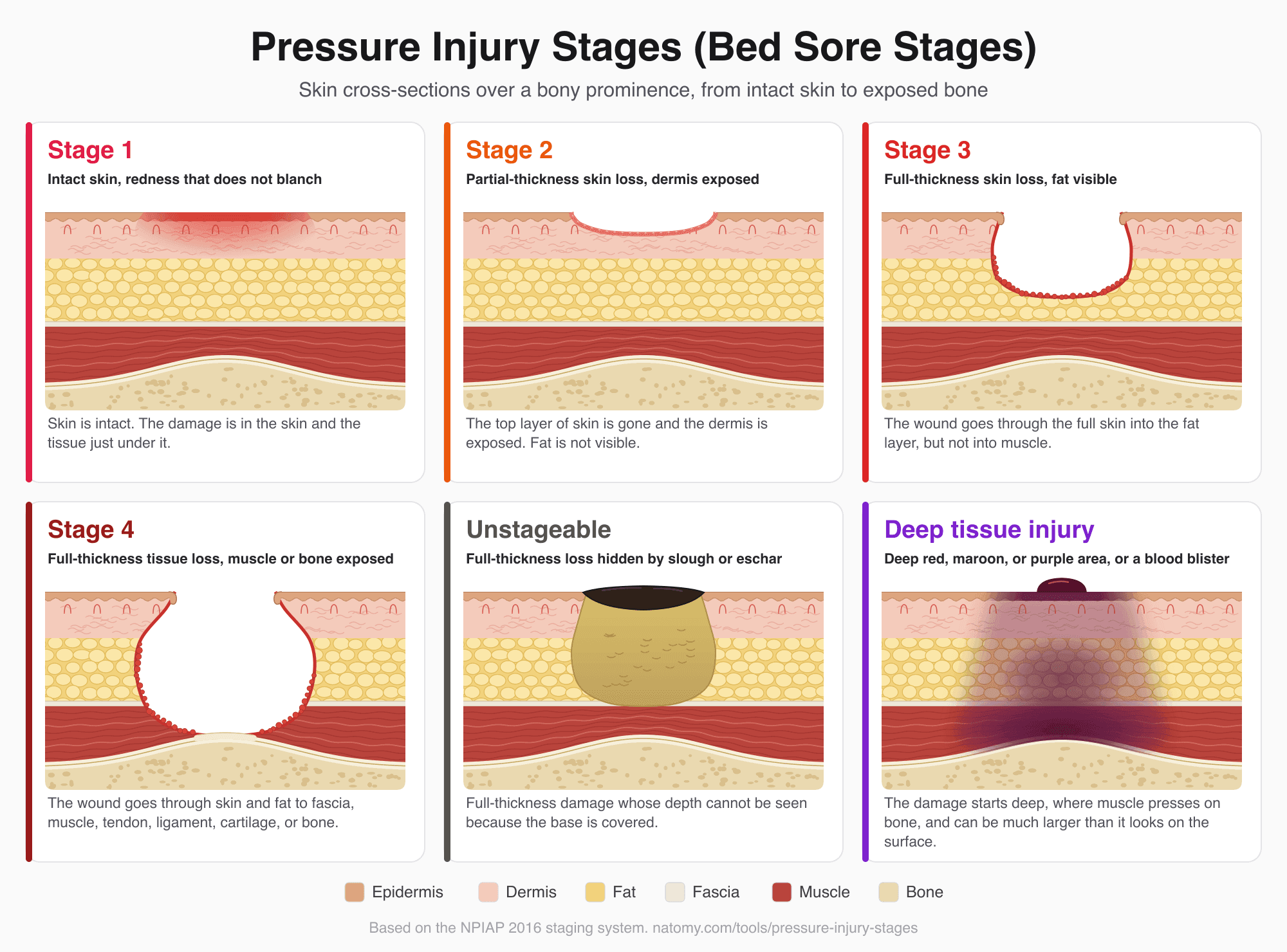
Pressure Injury (Bed Sore) Stages
Illustrated pressure ulcer stages chart, Stage 1 to 4, unstageable, and deep tissue injury, with a stage finder and wound note.
Try it free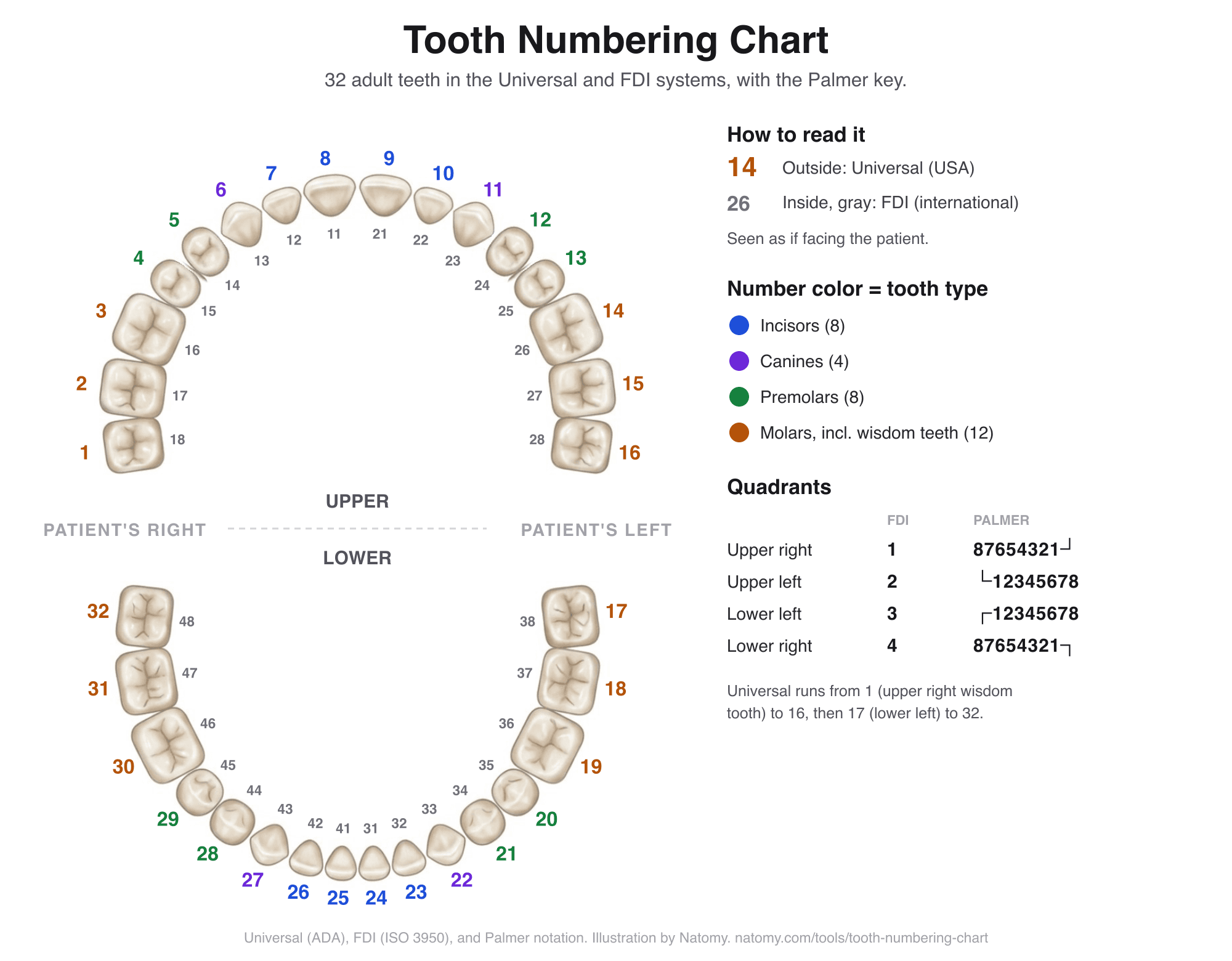
Tooth Numbering Chart
Tap any adult or baby tooth to see its Universal, FDI, and Palmer number and name, and convert numbers between systems.
Try it free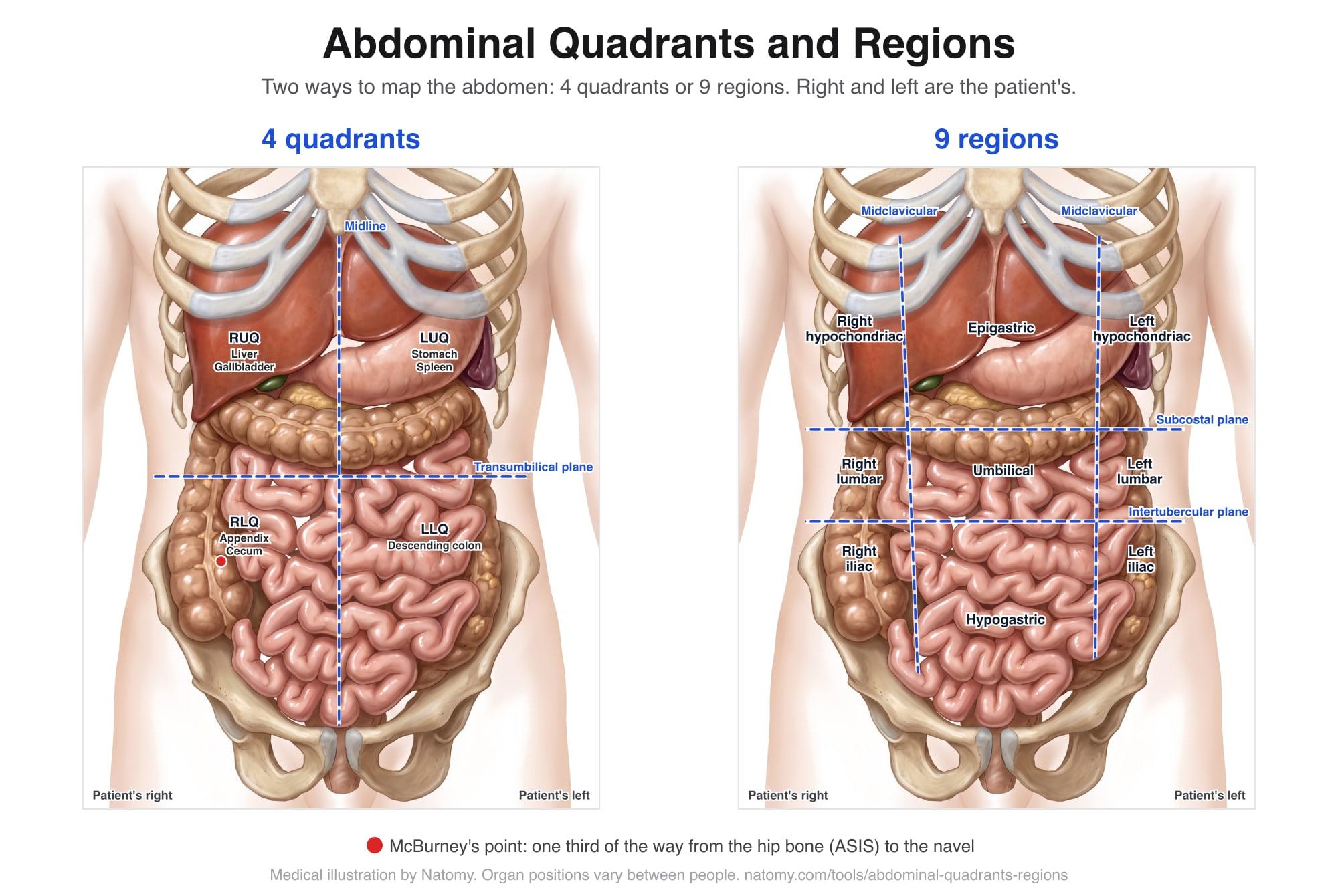
Abdominal Quadrants and 9 Regions
Tap an illustrated abdomen to see the organs in each quadrant or region and common causes of pain there. Free printable chart.
Try it free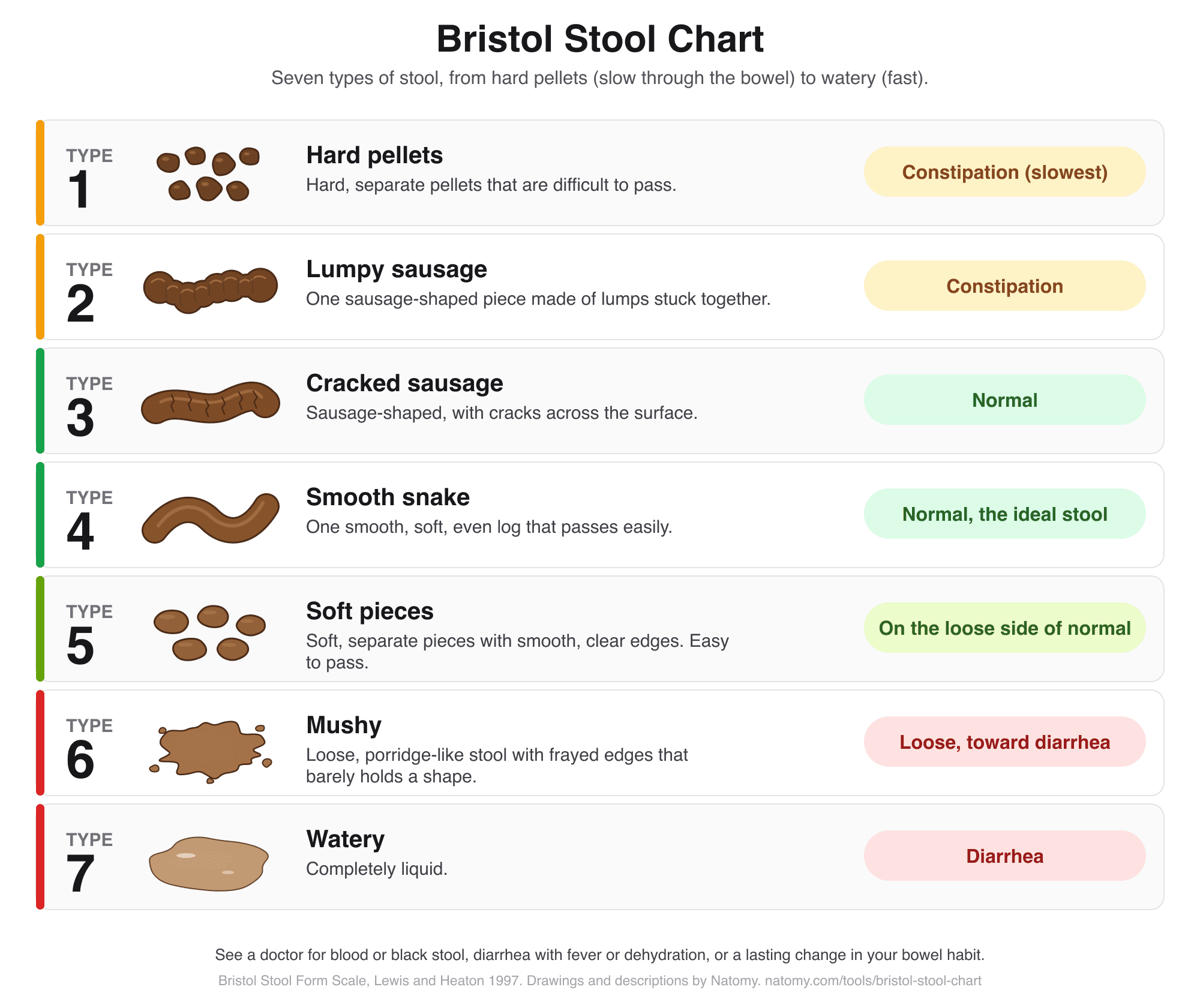
Bristol Stool Chart
Find your stool type from 1 to 7 on an illustrated chart, see what it means, and keep a simple bowel diary for your doctor.
Try it free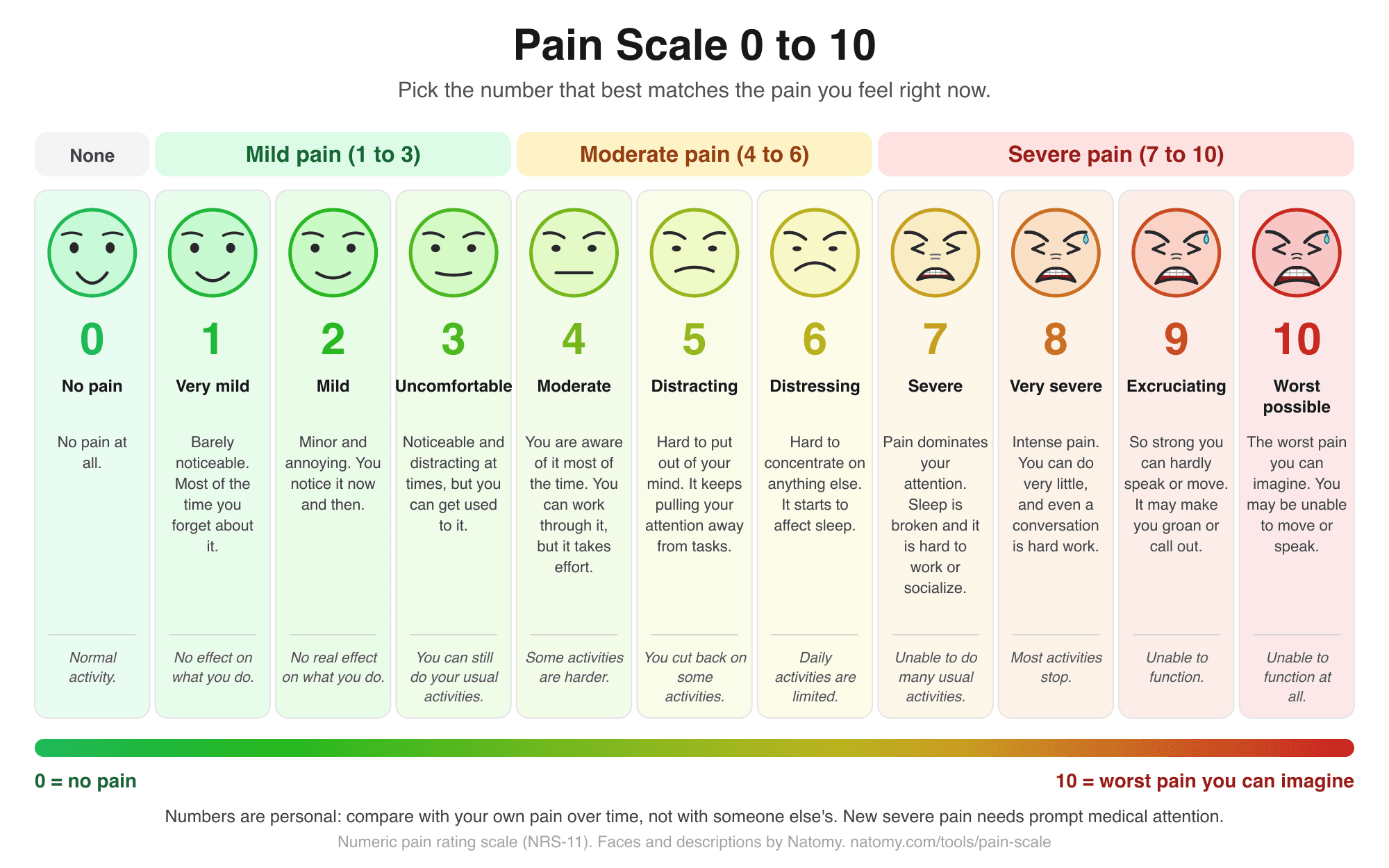
Pain Scale 0 to 10 Chart
Rate pain from 0 to 10 with drawn faces, see what mild, moderate, and severe mean, and copy a pain journal entry.
Try it free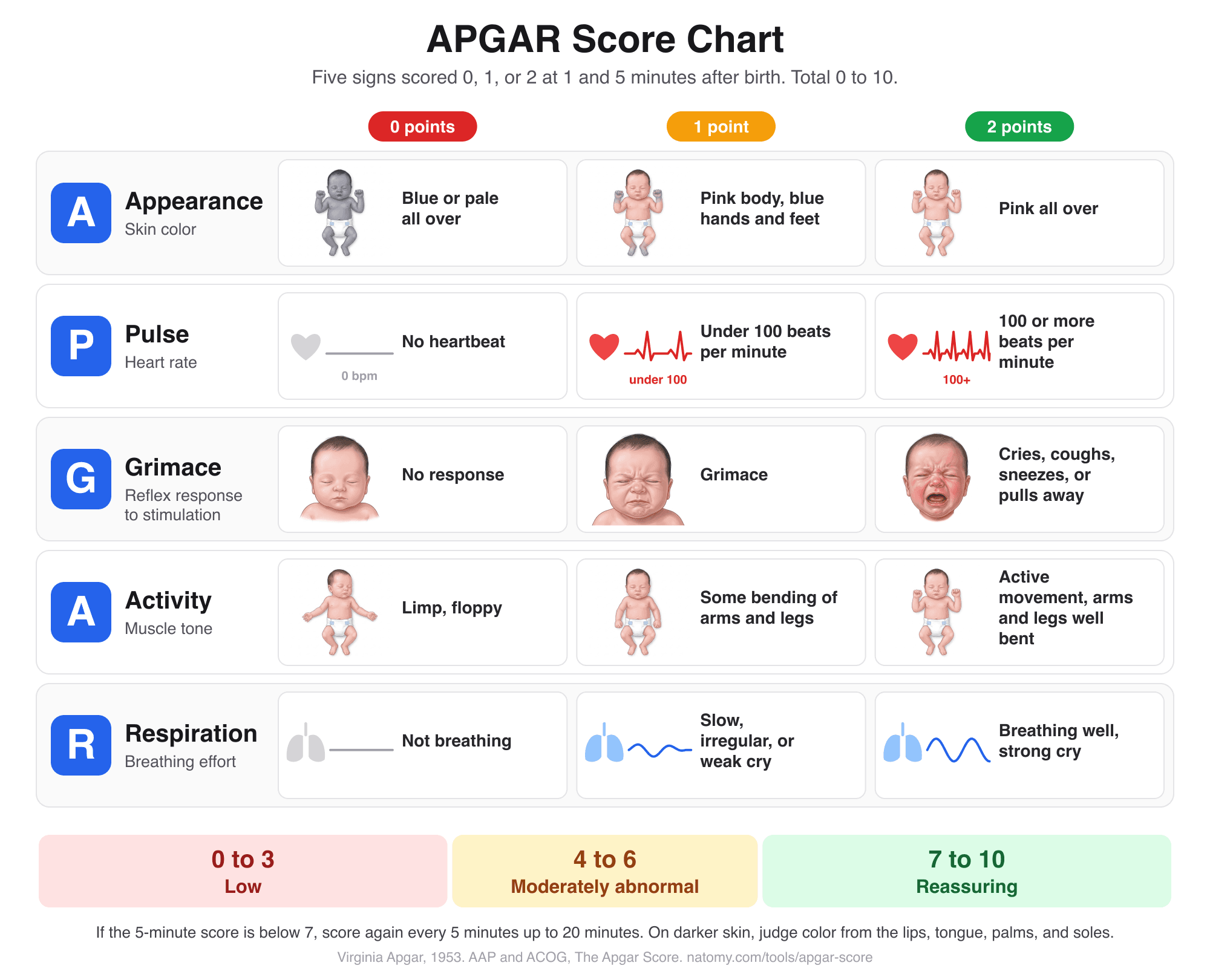
APGAR Score Chart and Calculator
Score the 5 newborn signs at 1, 5, and 10 minutes with an illustrated chart, what normal and low scores mean, and a note for the record.
Try it free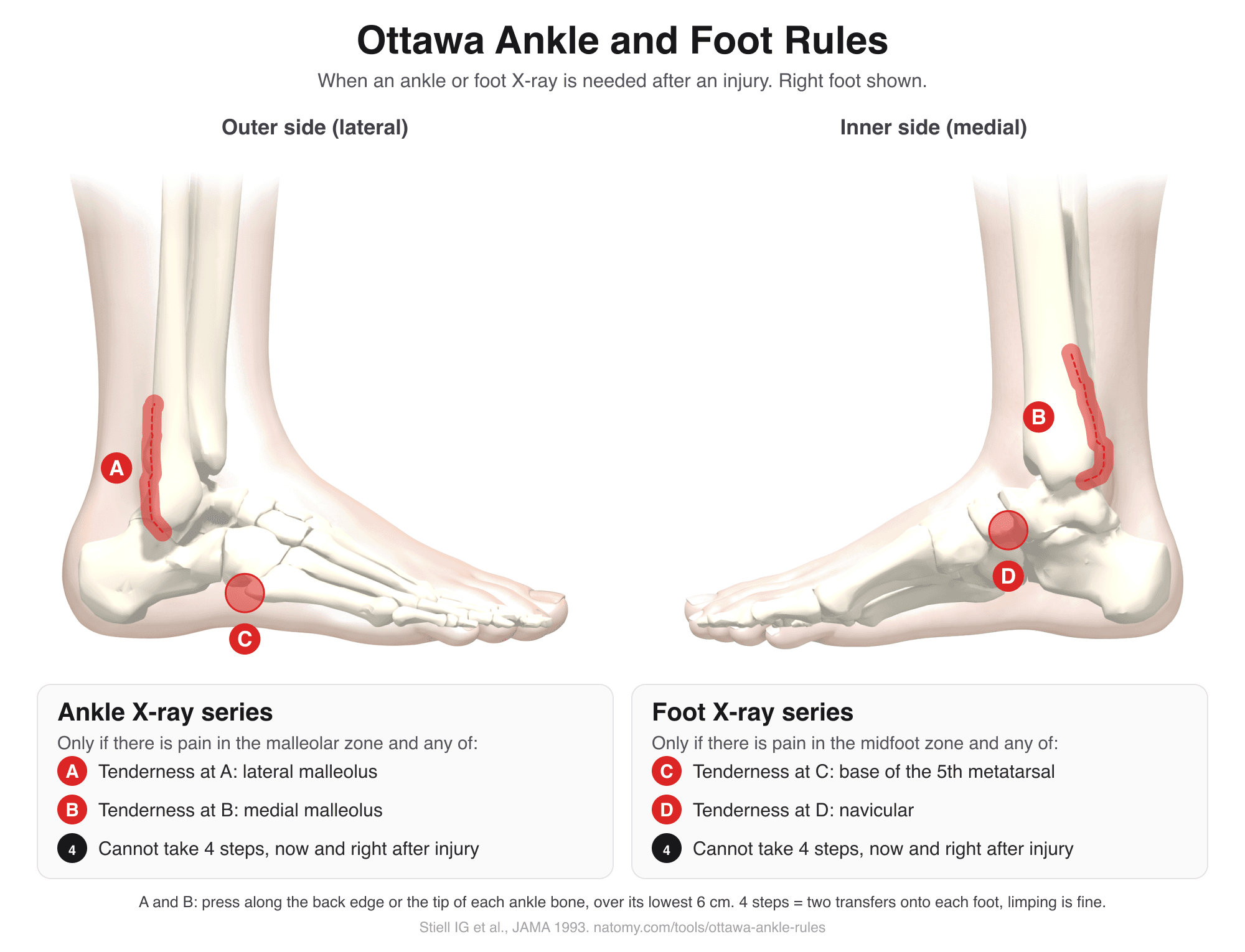
Ottawa Ankle Rules
Tap the tender spots on an illustrated ankle and foot to see if the Ottawa rules call for an X-ray. Includes the Ottawa knee rule.
Try it free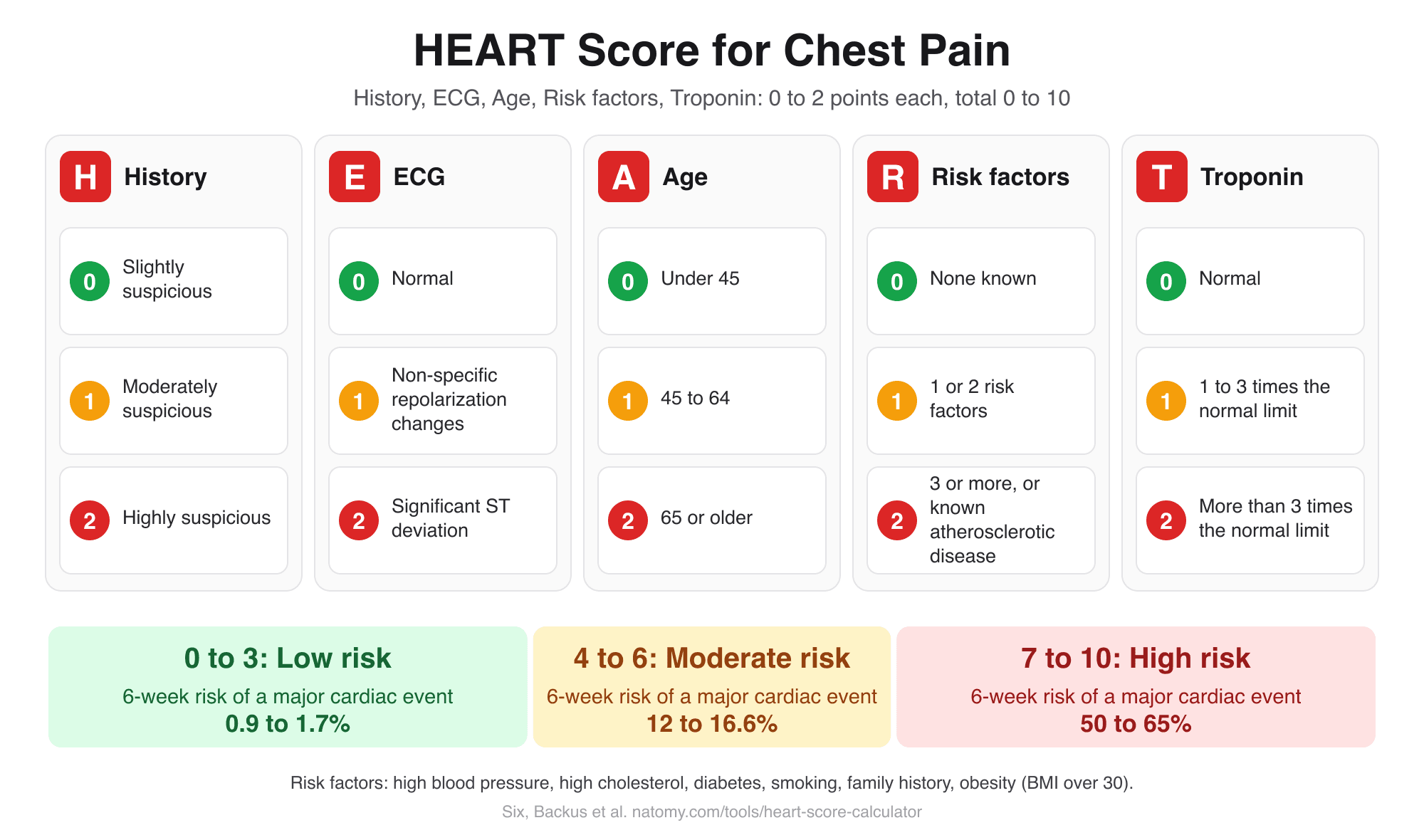
HEART Score Calculator
Score history, ECG, age, risk factors, and troponin for chest pain to get the HEART score, risk group, and 6-week MACE risk.
Try it free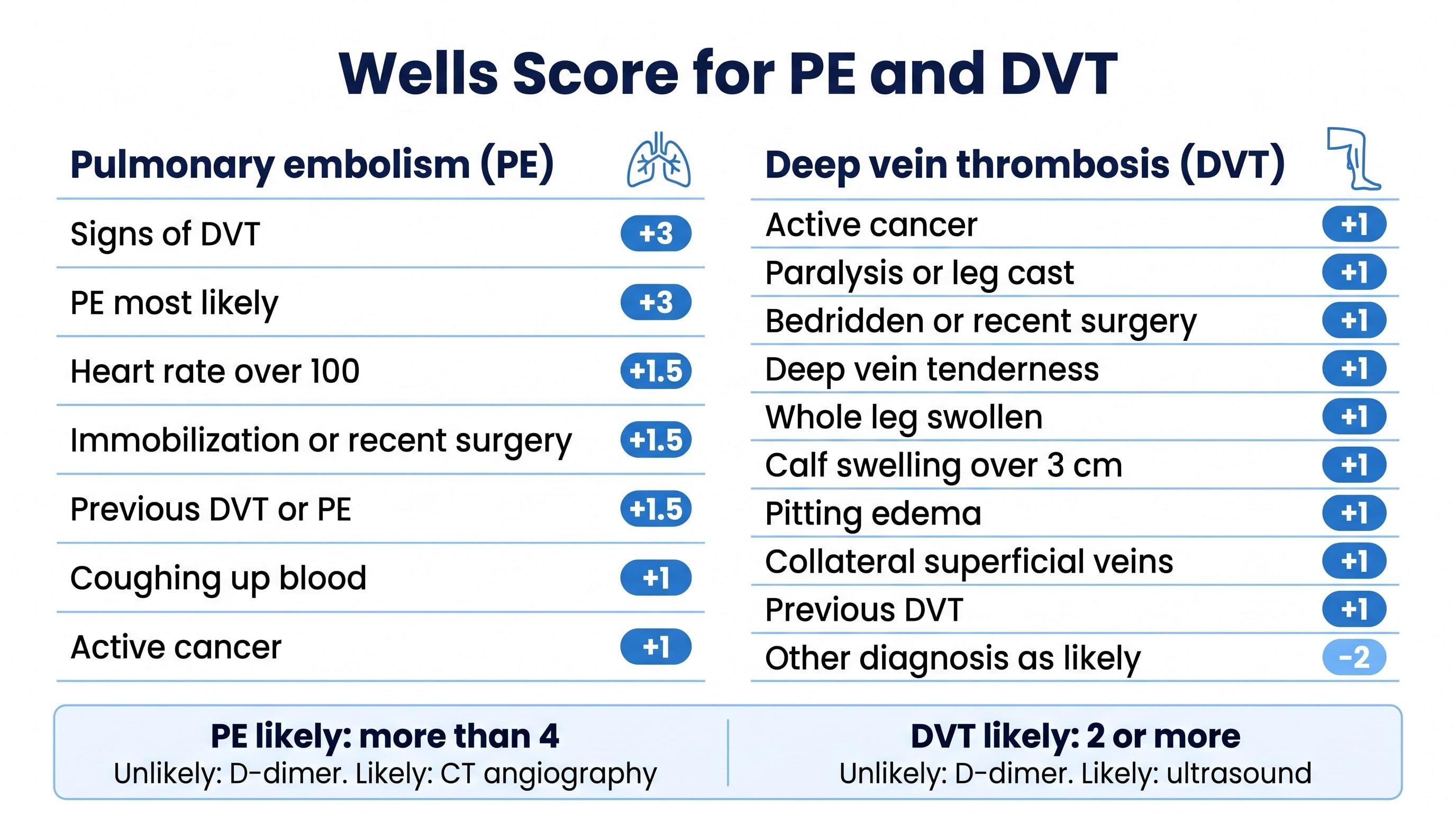
Wells Score Calculator (PE and DVT)
Check the Wells criteria for pulmonary embolism or deep vein thrombosis to get the score, the risk group, and the next test.
Try it free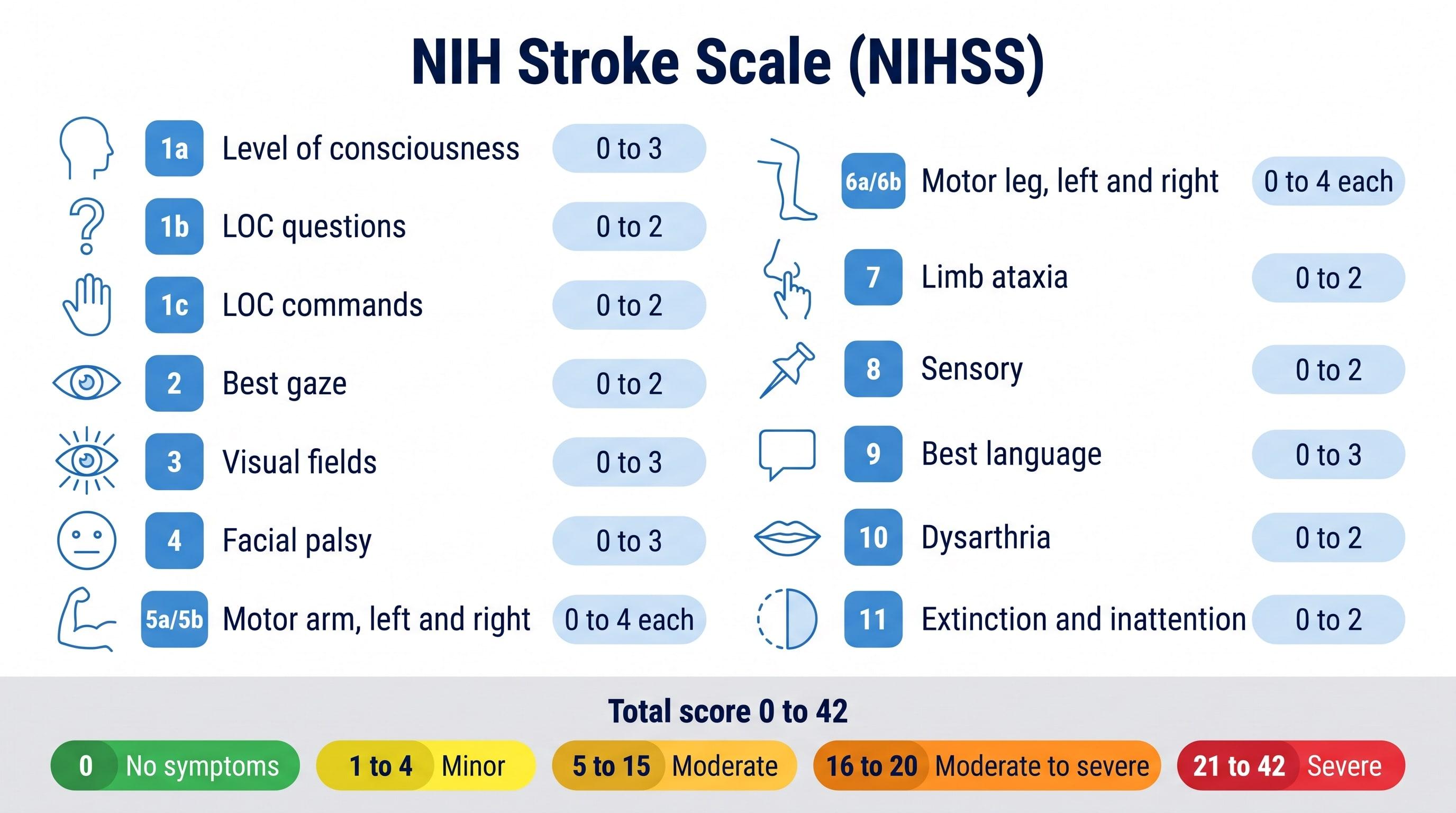
NIHSS Calculator (NIH Stroke Scale)
Score all 15 NIH Stroke Scale items to get the NIHSS total from 0 to 42 and the stroke severity range.
Try it free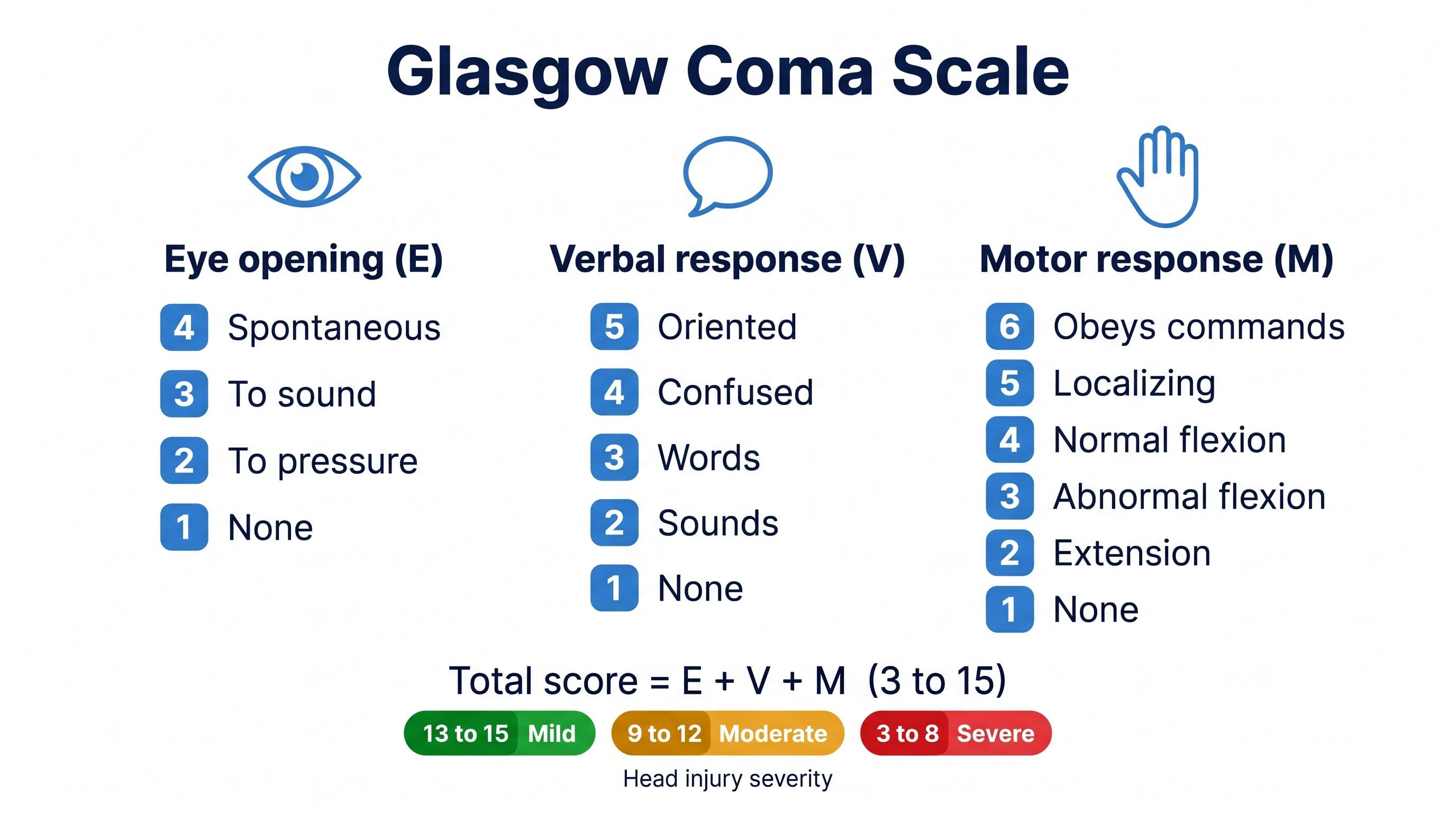
Glasgow Coma Scale Calculator
Score eye, verbal, and motor responses to get the GCS total, E V M code, severity range, and GCS-P.
Try it free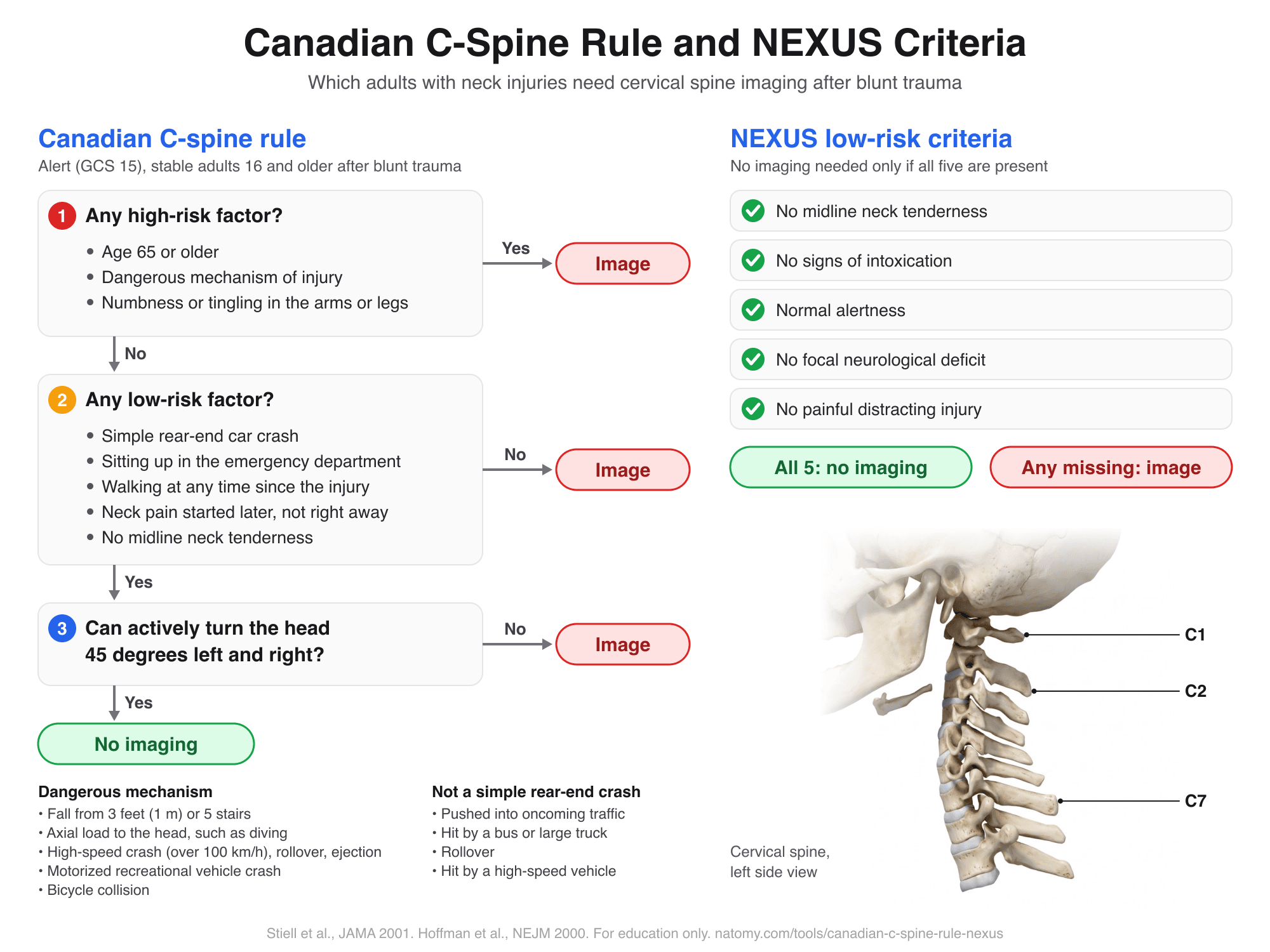
Canadian C-Spine Rule and NEXUS
Run the Canadian C-spine rule or the NEXUS criteria step by step to see which adults need neck imaging after trauma.
Try it free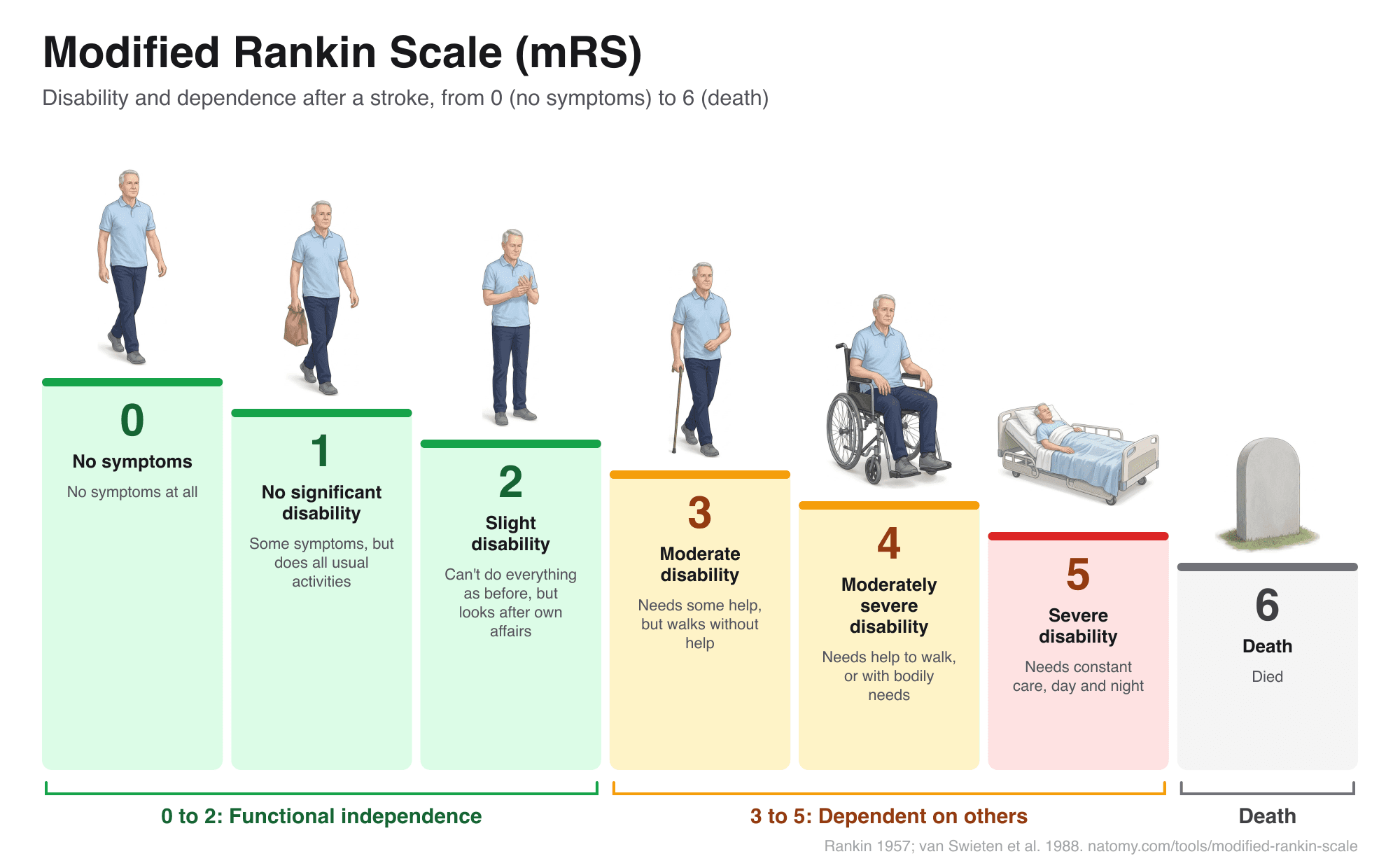
Modified Rankin Scale (mRS)
Illustrated mRS chart from 0 to 6 with a question-based score finder, what each grade means after a stroke, and a copyable note.
Try it free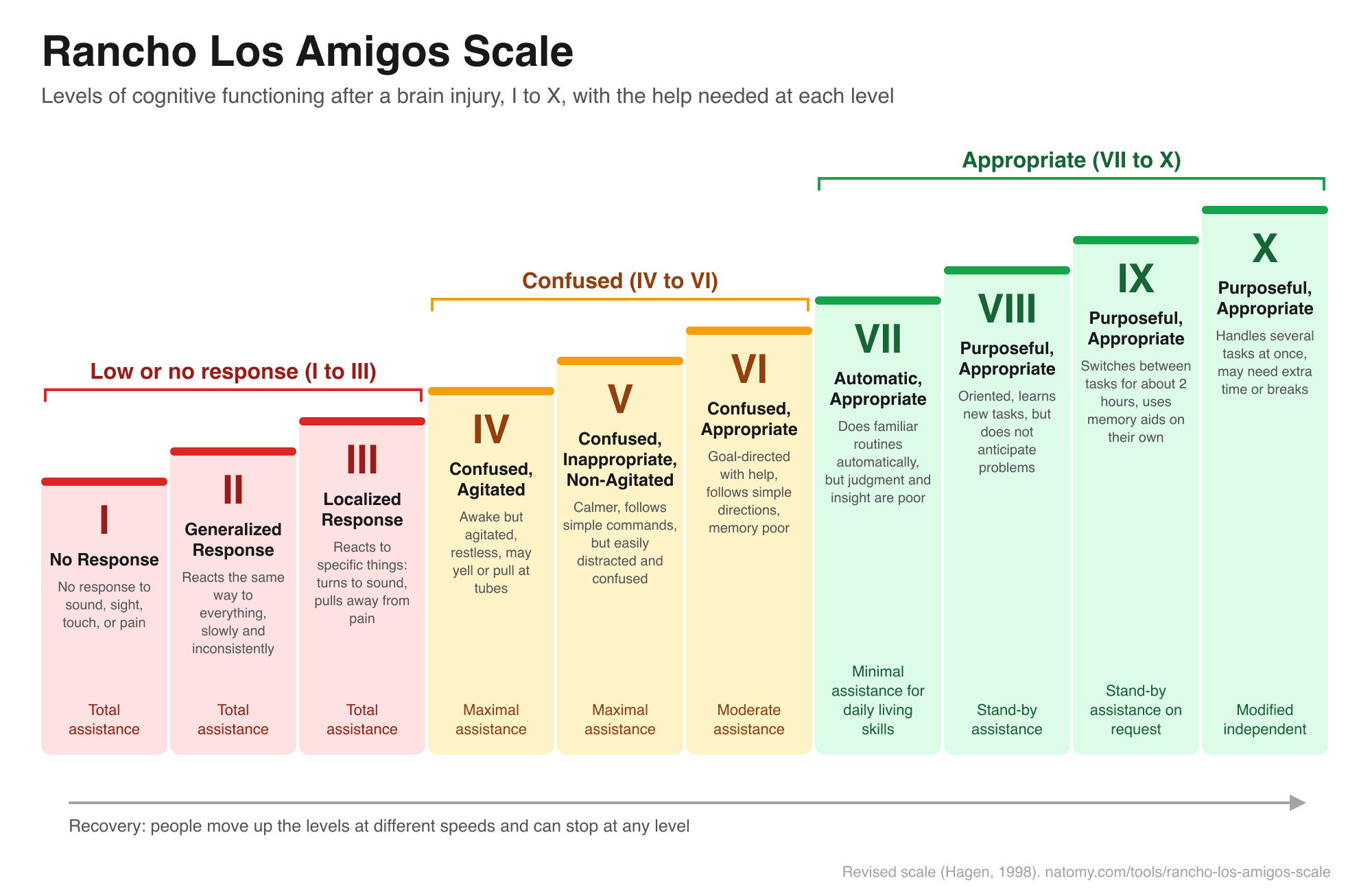
Rancho Los Amigos Scale
The 10 levels of cognitive functioning after a brain injury, with a level finder, what to expect, and how to help.
Try it free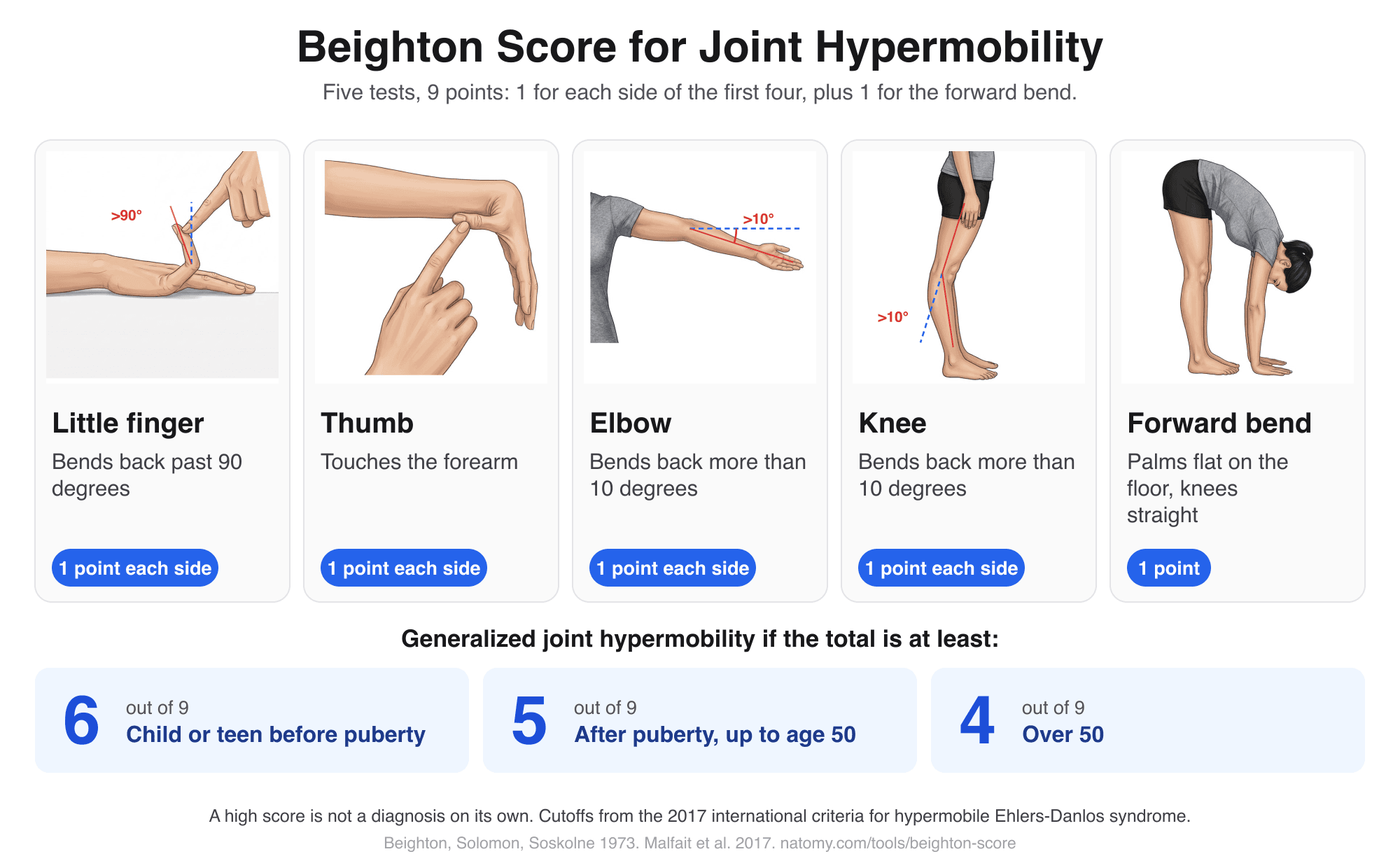
Beighton Score Calculator
Illustrated hypermobility test: score the 5 Beighton movements out of 9, compare with the age cutoff, and copy a note.
Try it free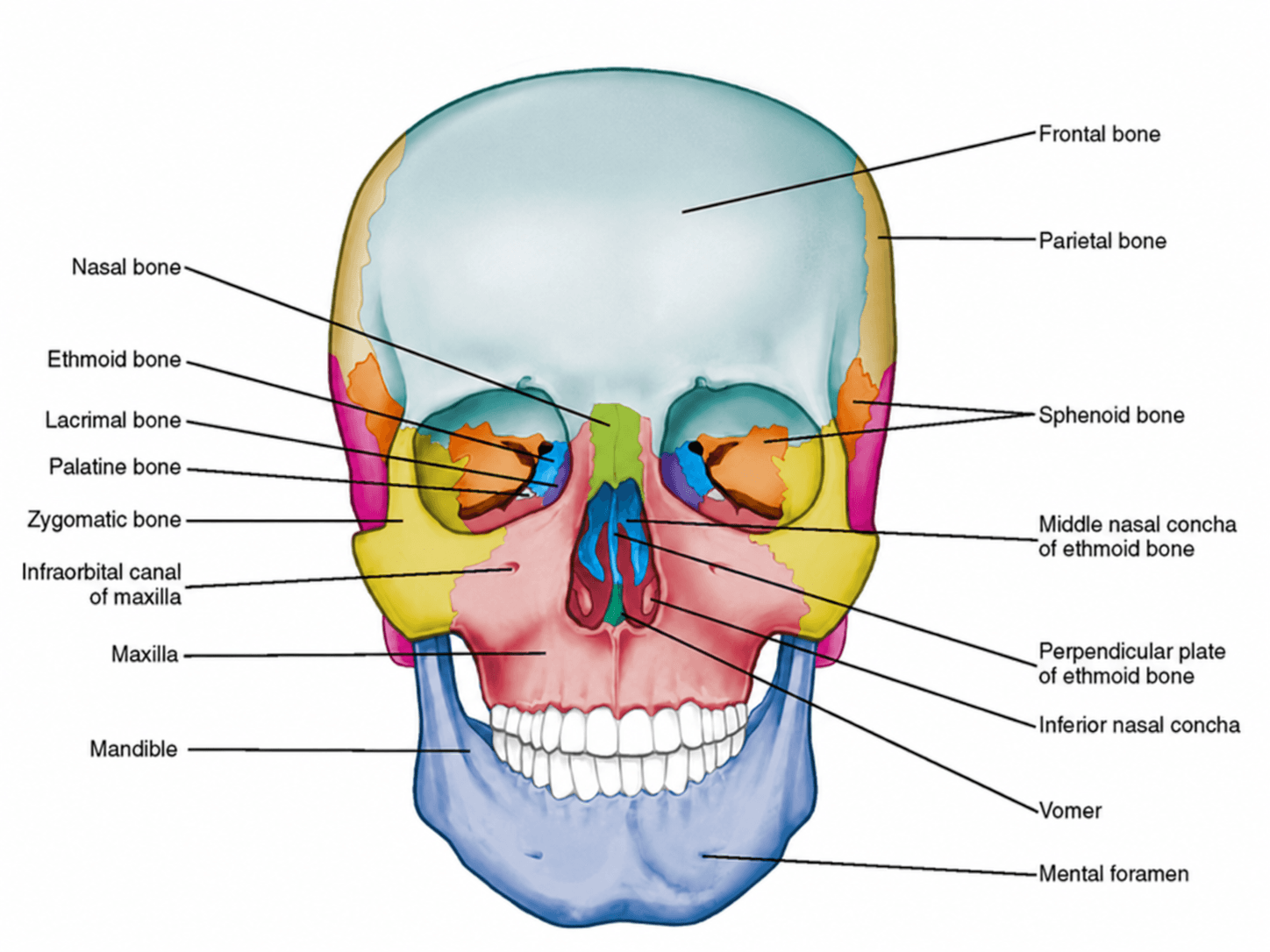
Anterior View of Skull Labeled
Free labeled and unlabeled anterior view of the skull, downloadable as PNG.
Try it free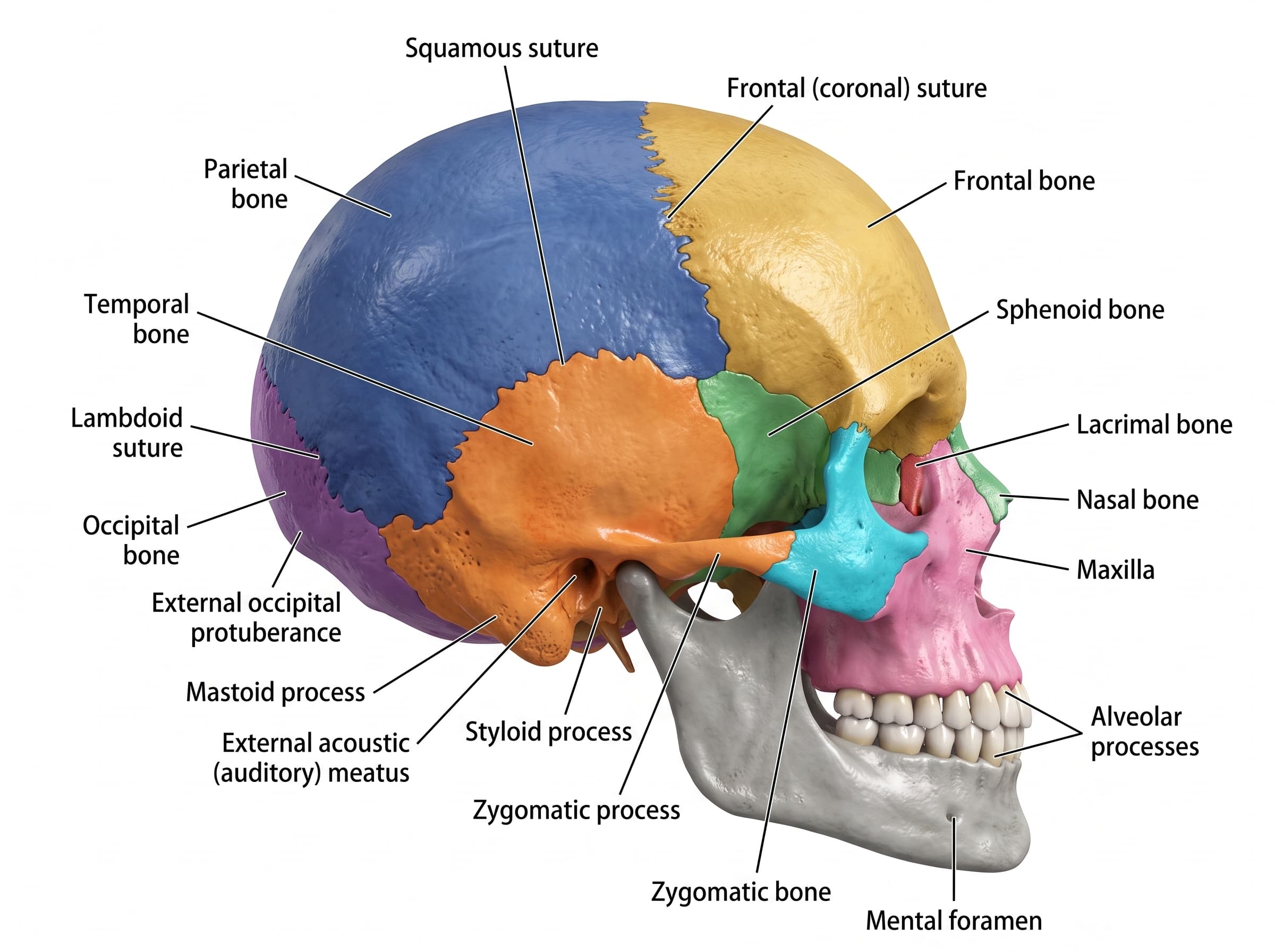
Lateral View of Skull Labeled
Free labeled and unlabeled lateral view of the skull, downloadable as PNG.
Try it free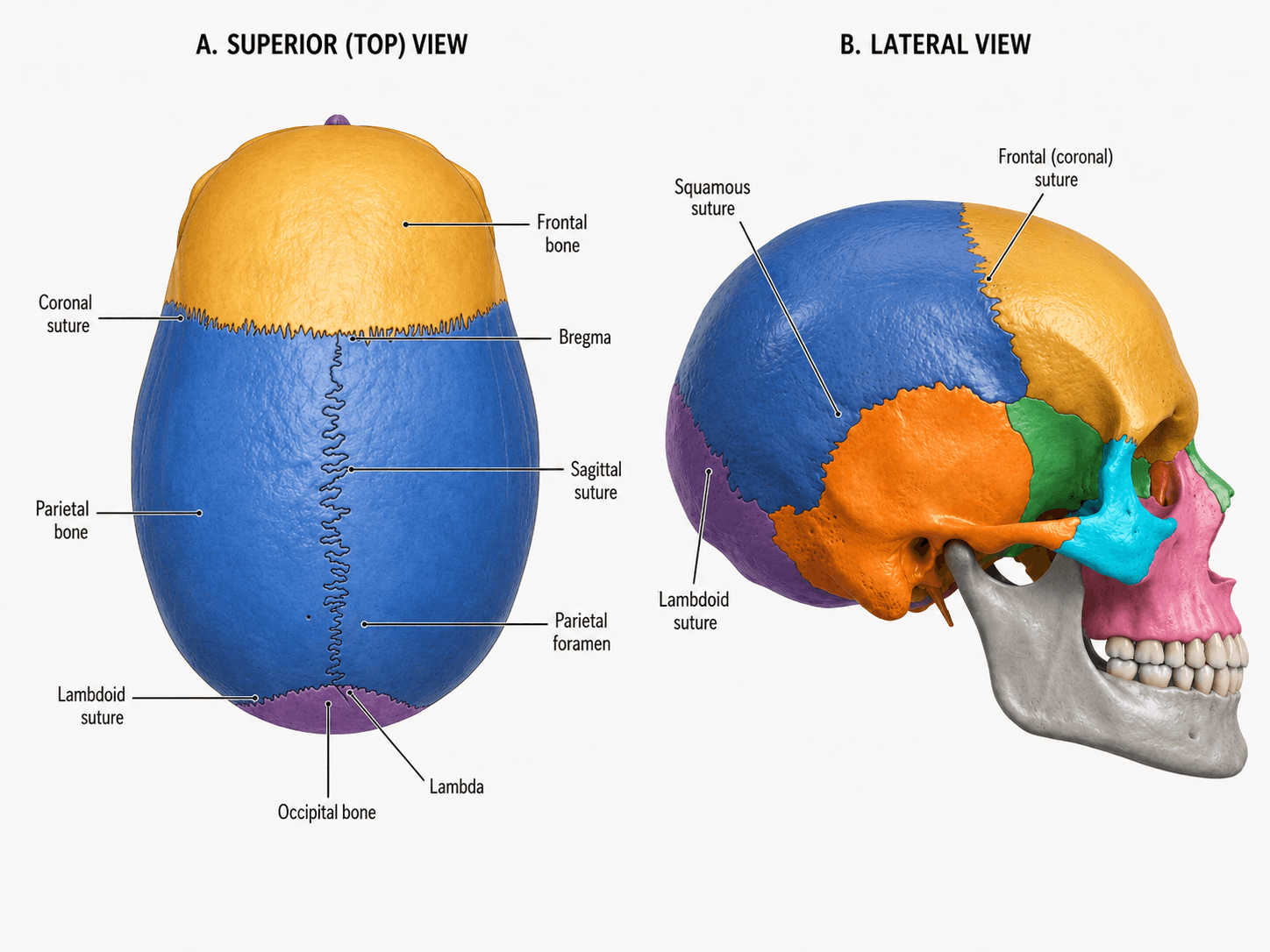
Skull Sutures Labeled
Free labeled and unlabeled skull sutures diagram, superior and lateral views, downloadable as PNG.
Try it free