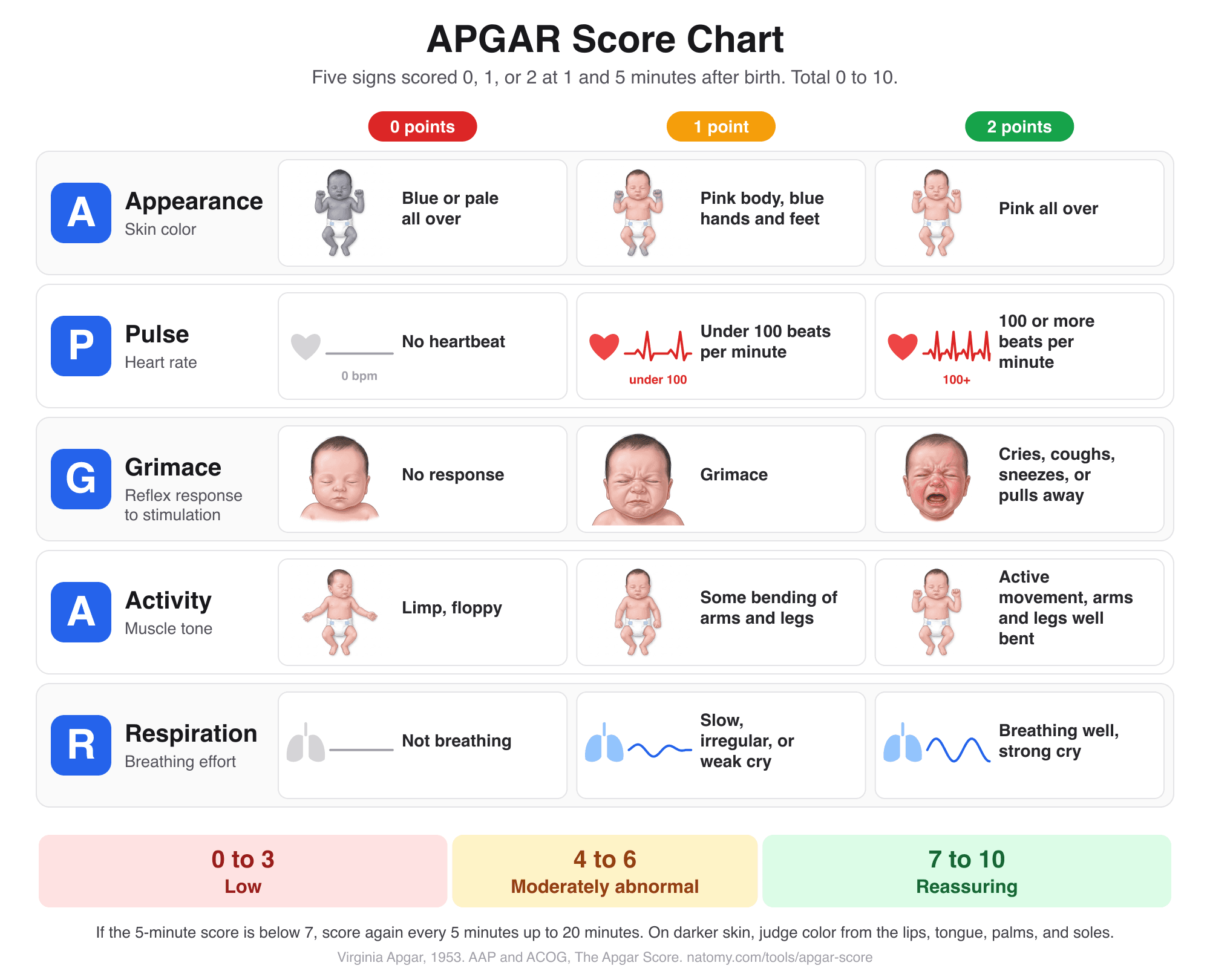
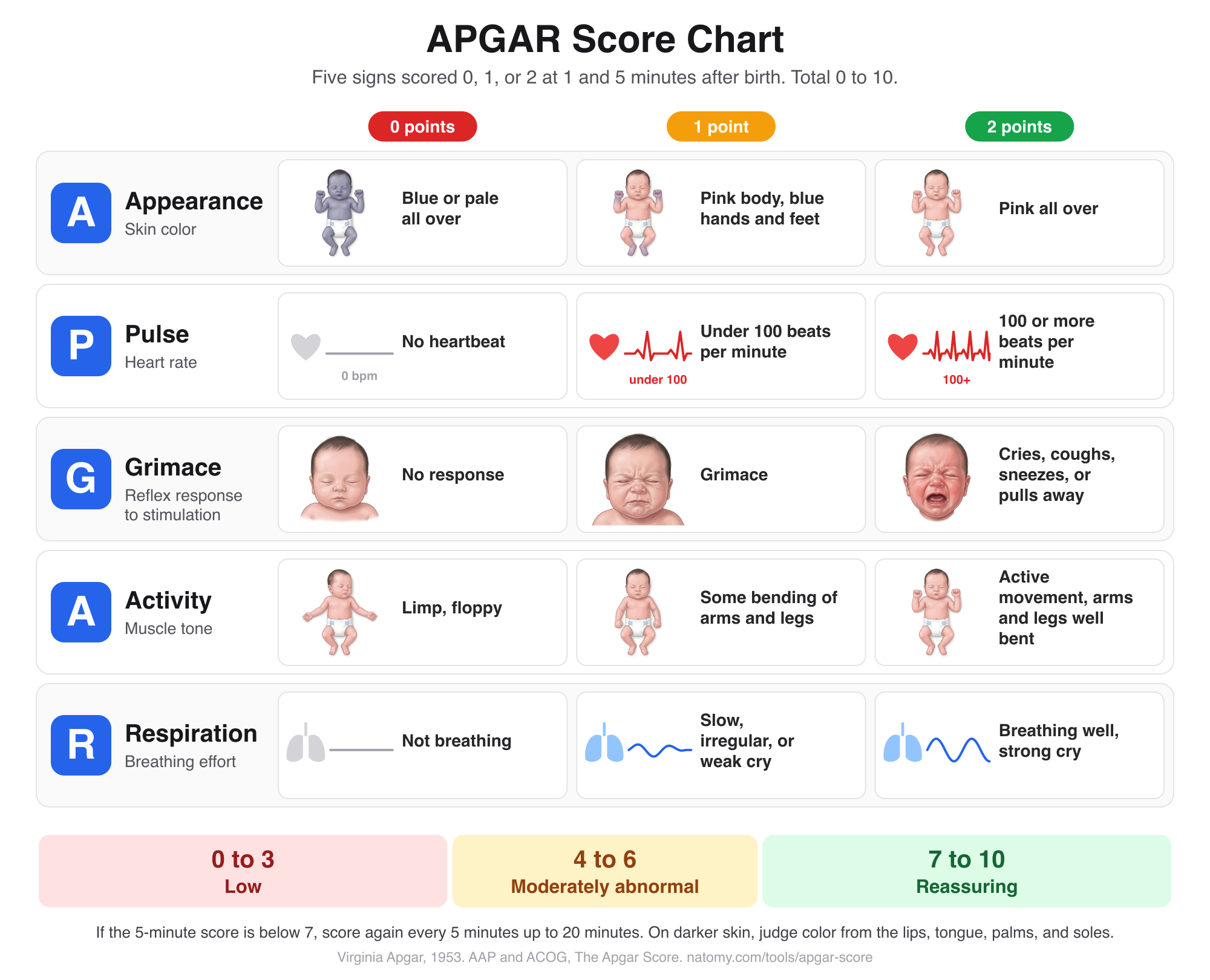
The Apgar score is the first check every newborn gets. At 1 and 5 minutes after birth, five signs, Appearance, Pulse, Grimace, Activity, and Respiration, are each scored 0, 1, or 2 for a total of 0 to 10. A score of 7 or more is reassuring. Use the free calculator below to score each sign and get a note for the record.
Pick a value for each sign at 1 minute, then switch to 5 minutes. If a score is below 7, more times appear.
More times appear if a score is below 7.
Resuscitation at 1 minute (optional)
The expanded Apgar form records any help the baby was getting when it was scored, because support such as ventilation changes the signs.
The five APGAR signs
Each sign is scored 0, 1, or 2. The scorer looks at all five at the same moment, at exactly 1 minute and 5 minutes after the baby is fully born.
AAppearance: skin color
The color of the skin shows how well oxygenated blood is reaching the body. Almost every baby is bluish at birth and turns pink over the first minutes as breathing starts. Blue hands and feet with a pink body (acrocyanosis) are normal for hours after birth, which is why few babies score 2 here at one minute. On darker skin, color is judged from the lips, tongue, gums, palms, and soles rather than the trunk.
PPulse: heart rate
The heart rate is best counted with a stethoscope over the chest. Feeling the pulse at the base of the umbilical cord is quicker but often reads low, so a heart monitor is used if the baby needs resuscitation. It is the most important of the five signs: a heart rate under 100 beats per minute in a newborn usually means the baby is not getting enough oxygen and needs help with breathing.
GGrimace: reflex response to stimulation
Also called reflex irritability. The baby's reaction is checked after a mild stimulus, such as suctioning the nose or mouth or rubbing the back or the soles of the feet. A vigorous baby cries, coughs, sneezes, or pulls away. A grimace alone scores 1.
AActivity: muscle tone
Muscle tone is judged from how the baby lies and moves. A healthy term newborn keeps the arms and legs bent and pulls them back when they are straightened. A limp, floppy baby scores 0. Tone is normally lower in premature babies.
RRespiration: breathing effort
Breathing effort is judged by watching and listening, not by counting a breathing rate. A strong, lusty cry scores 2. Slow, irregular, or shallow breathing or a weak cry scores 1. No breathing scores 0. Gasping is not effective breathing and is treated like no breathing.
When the Apgar score is done
1 minute: how the baby tolerated labor and birth.
5 minutes: how well the baby is adapting, and whether any help is working.
10, 15, and 20 minutes: only if the 5-minute score is below 7. Scoring continues every 5 minutes up to 20 minutes. Many units stop once the score reaches 7.
The score is never a reason to delay care. A baby who is not breathing or has a slow heart rate gets help right away, guided by the newborn resuscitation steps, and the scores are filled in as care goes on.
What the Apgar score means
Score
Meaning
What usually happens
7 to 10
Reassuring
The baby is adapting well to life outside the womb. Routine newborn care continues.
4 to 6
Moderately abnormal
The baby may need some help, such as drying and stimulation, clearing the airway, or breathing support. The score is repeated at the next interval.
0 to 3
Low
The baby needs immediate help, usually with breathing. Resuscitation is started from breathing and heart rate, not by waiting for the score.
These ranges apply to babies born at term or close to term. Premature babies often score lower (see below).
Normal Apgar scores: 7, 8, 9, and 10
Most healthy babies score 7, 8, or 9. A 9 usually means the baby lost one point for blue hands and feet, which is normal. Scores of 7 and 8 are also normal and often follow a long labor, a cesarean birth, or pain medication given to the mother. A 10 is unusual, because almost all newborns lose a point for blue hands and feet, and it is not needed to call a baby healthy.
Low Apgar scores
A low 1-minute score is common and usually rises by 5 minutes with drying, stimulation, and breathing support. Common reasons include:
Premature birth
Opioids, general anesthesia, or magnesium given to the mother
A long or difficult delivery, or an emergency cesarean
Reduced oxygen before or during birth, for example from a cord or placenta problem
Infection, or fluid or meconium in the airway
Birth defects of the heart, lungs, or nervous system
A score that stays low at 5 and 10 minutes is more concerning and is usually followed by newborn intensive care, cord blood gas results, and a neurological exam.
Apgar scores in premature babies
Premature babies naturally have lower muscle tone, weaker reflexes, and less breathing effort, so they often score lower even when they are doing well for their age. Their scores should be read with the gestational age in mind, and the record should note what support the baby was receiving at the time.
The expanded Apgar score
Breathing support changes the signs being scored. A baby on a ventilator may be pink with a good heart rate because of the ventilation, not their own effort. The American Academy of Pediatrics and the American College of Obstetricians and Gynecologists recommend an expanded reporting form that lists, next to each score, the support given at that moment: oxygen, CPAP, positive-pressure ventilation, a breathing tube, chest compressions, or epinephrine. A score given during resuscitation is not the same as a score for a baby breathing on its own. The calculator above records these too.
What the Apgar score does not show
It does not diagnose a lack of oxygen (asphyxia) or brain injury on its own.
It does not predict how an individual child will develop. Most babies with low scores grow up healthy.
It is partly subjective. Two clinicians can score the same baby differently, especially color and tone.
It does not decide when resuscitation starts. Breathing and heart rate do.
Apgar scores in birth injury cases
In birth injury and medical malpractice cases, the Apgar scores are often the first numbers anyone looks at. On their own they prove little, but they are part of a pattern. The American College of Obstetricians and Gynecologists' 2014 report on neonatal encephalopathy lists an Apgar score below 5 at both 5 and 10 minutes as one sign that fits an acute event around the time of birth, together with acidosis on umbilical cord blood gases (pH below 7.0 or base deficit of 12 or more), a matching brain MRI pattern, and injury to other organs.
Attorneys and expert reviewers usually read the scores alongside the fetal heart rate tracing, the times of each score and who gave it, the resuscitation record, cord gases, and the newborn intensive care notes. Gaps matter too: a missing 10-minute score after a 5-minute score below 7, or scores that do not match the resuscitation that was documented. Related injuries include cephalohematoma and brachial plexus injuries after shoulder dystocia. For children with lasting injuries, the records feed into a life care plan.
History of the Apgar score
Dr. Virginia Apgar, an obstetric anesthesiologist at Columbia University in New York, introduced the score in 1952 and published it in 1953. Before it, there was no standard way to describe a newborn's condition, and it gave delivery teams a simple, shared language for deciding which babies needed help. The letters A, P, G, A, R were matched to the five signs in 1962 as a memory aid.
Illustrate a birth injury
Natomy turns records, imaging, and prompts into clear, labeled medical illustrations of birth injuries, such as brachial plexus injuries, skull fractures, and brain bleeds, for patient education and medical-legal exhibits. See examples in the Natomy atlas.
The Apgar score is a quick check of a newborn's condition at 1 and 5 minutes after birth. Five signs, appearance (skin color), pulse (heart rate), grimace (reflex response), activity (muscle tone), and respiration (breathing), are each scored 0, 1, or 2, for a total of 0 to 10. It was created by the anesthesiologist Dr. Virginia Apgar in 1952.
What is a normal Apgar score?+
A score of 7 to 10 is considered reassuring, and most healthy babies score 7, 8, or 9. A score of 4 to 6 is moderately abnormal, and 0 to 3 is low.
Why do so few babies get an Apgar score of 10?+
Almost all newborns still have bluish hands and feet in the first minutes, which scores 1 for appearance instead of 2. So a 9 is the usual top score, and a 9 is a perfectly healthy result.
Is an Apgar score of 7 or 8 bad?+
No. Scores of 7, 8, and 9 are all in the reassuring range. A 1-minute score of 7 or 8 is common, especially after a long labor, a cesarean birth, or medication given to the mother, and it usually rises by 5 minutes.
What happens if the Apgar score is low?+
A low score means the baby needs help adjusting, most often with breathing. The team dries and stimulates the baby, clears the airway, and gives breathing support if needed. Resuscitation is started from breathing and heart rate, before the 1-minute score is even given. If the 5-minute score is below 7, the baby is scored again every 5 minutes up to 20 minutes.
Does a low Apgar score mean brain damage or cerebral palsy?+
Not on its own. Most babies with low 1-minute scores are completely healthy. A 5-minute score of 0 to 3 is linked to a higher risk of problems, including cerebral palsy, but most babies with low scores do not develop it. The score cannot diagnose a lack of oxygen at birth; that takes cord blood gases, a neurological exam, and often a brain MRI.
Is the 1-minute or 5-minute Apgar score more important?+
The 5-minute score. The 1-minute score shows how the baby tolerated birth, and low 1-minute scores are common and usually improve. The 5-minute score shows how well the baby has adapted and whether help worked, and it is the one most linked to later outcomes.
Who gives the Apgar score?+
A nurse, midwife, pediatrician, obstetrician, or anesthesiologist in the delivery room, often the person caring for the baby. It is recorded in the delivery and newborn records with the time of each score.
Is APGAR an acronym?+
The score is named after Dr. Virginia Apgar. The letters were later matched to the five signs, Appearance, Pulse, Grimace, Activity, and Respiration, as a memory aid, first published in 1962.
Sources: Apgar V. A proposal for a new method of evaluation of the newborn infant. Curr Res Anesth Analg. 1953;32(4):260-267. American Academy of Pediatrics and American College of Obstetricians and Gynecologists. The Apgar Score. Committee Opinion No. 644. Obstet Gynecol. 2015;126:e52-5, and Pediatrics. 2015;136(4):819-822 (reaffirmed). American College of Obstetricians and Gynecologists. Neonatal Encephalopathy and Neurologic Outcome, 2nd ed., 2014. Descriptions are written in our own words. For education and documentation only; not a substitute for clinical judgment.