Free Tools
Glasgow Coma Scale Calculator
Pick the best eye, verbal, and motor response to get the GCS total, the E V M code used in charts, and the head injury severity range. Add pupil reactivity for the GCS-P score. Wording follows the 2014 update of the scale.
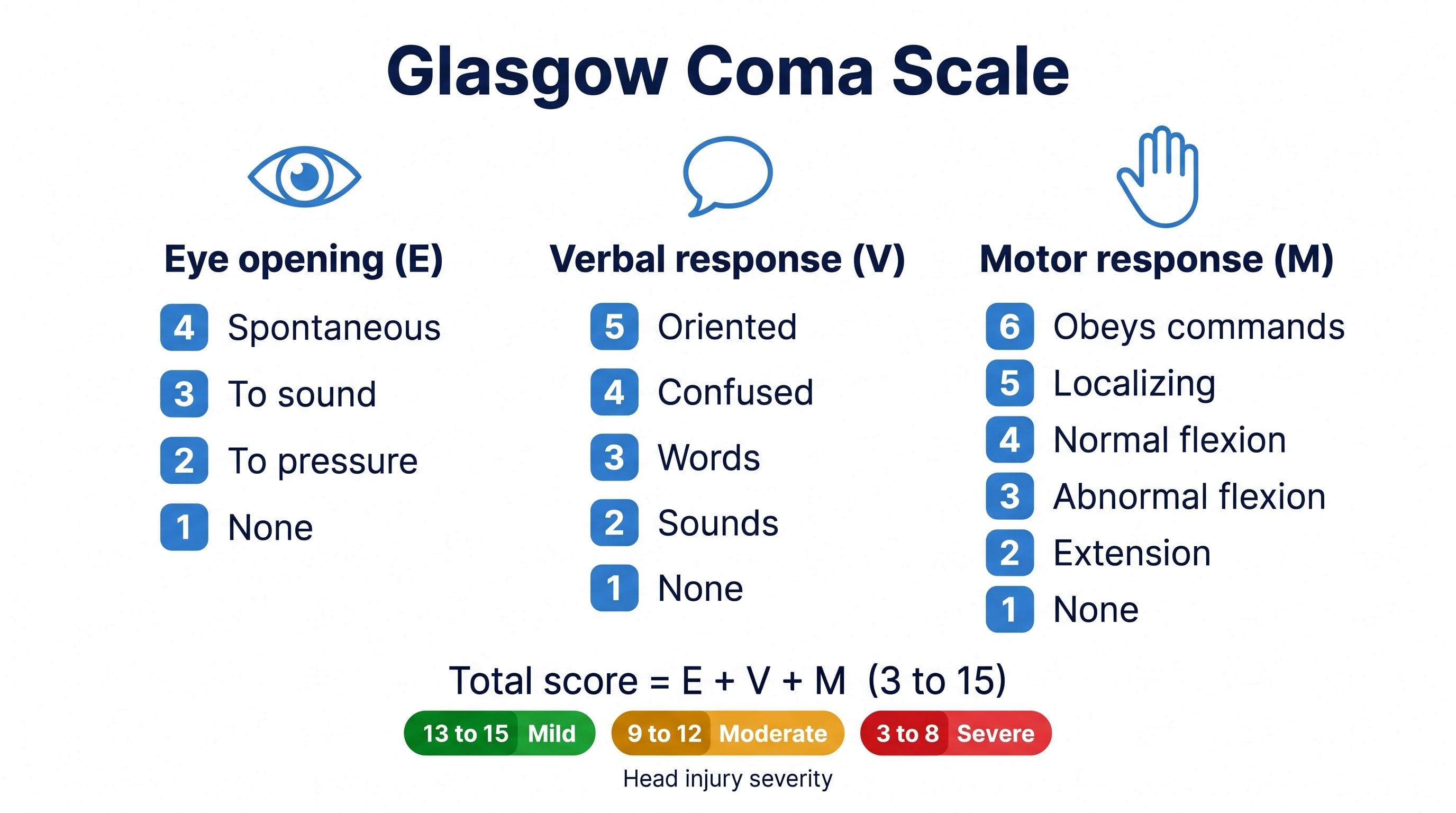
The Glasgow Coma Scale, explained
The Glasgow Coma Scale at a glance
The Glasgow Coma Scale (GCS) was published by Graham Teasdale and Bryan Jennett in 1974 to describe how awake a patient is after a head injury. It is now used by paramedics, emergency teams, intensive care, and neurosurgery to track consciousness over time. Each part is scored on what the patient does, not on the cause.
Eye opening (E), 1 to 4
| 4 | Spontaneous | Eyes already open |
| 3 | To sound | Opens when spoken to or shouted at |
| 2 | To pressure | Opens after fingertip, trapezius, or supraorbital pressure |
| 1 | None | No opening despite pressure |
| NT | Not testable | Eyes closed by swelling or a dressing |
Verbal response (V), 1 to 5
| 5 | Oriented | Gives name, place, and month correctly |
| 4 | Confused | Speaks in sentences but is disoriented |
| 3 | Words | Single intelligible words |
| 2 | Sounds | Moans or groans, no words |
| 1 | None | No sound |
| NT | Not testable | Intubated or another barrier to speech, written as VT |
Motor response (M), 1 to 6
| 6 | Obeys commands | Follows a two-part request |
| 5 | Localizing | Hand reaches above the clavicle toward a head or neck stimulus |
| 4 | Normal flexion | Rapid bending at the elbow, away from the stimulus |
| 3 | Abnormal flexion | Slow, stereotyped bending of the arm (decorticate posture) |
| 2 | Extension | Arm straightens at the elbow (decerebrate posture) |
| 1 | None | No movement |
| NT | Not testable | Paralysis or another limiting factor |
How to assess each response
- Check for anything that stops a response being tested, such as swelling around the eyes, intubation, or sedation.
- Observe first. Note whether the eyes are open and whether the patient is talking or moving without prompting.
- Speak to the patient in a normal voice, then louder. Ask their name, where they are, and the month.
- If there is no response, apply pressure to a fingertip, then the trapezius or the notch above the eye, for up to 10 seconds.
- Record the best response for each part as E, V, and M, plus the total when every part could be tested.
Who uses it
- Physicians, nurses, and paramedics
- Score a patient at the bedside or in the field and copy a clean result, such as "GCS 12 (E3V4M5)", into the record.
- Personal injury and medical malpractice attorneys
- Make sense of the GCS entries in EMS run sheets and emergency records when reviewing a traumatic brain injury case, and see how the score changed over the first hours. For recovery over the following weeks and months, see the Rancho Los Amigos scale.
- Students and educators
- Practice scoring with the current terms and the older names side by side. For stroke, use the NIHSS calculator.
Illustrate a brain injury case
Natomy turns CT and MRI views, reports, and prompts into clear, labeled medical illustrations of brain injuries, such as subdural and epidural hematomas, for patient education and medical-legal exhibits. To look at the scans themselves, open them in the free 3D DICOM viewer.
Try Natomy TodayFAQ
How is the Glasgow Coma Scale calculated?+
Score the best eye response (1 to 4), the best verbal response (1 to 5), and the best motor response (1 to 6), then add them. The total runs from 3, no response at all, to 15, fully alert and oriented. Always record the three parts as well, for example E3V4M5 = 12, because the same total can describe very different patients.
What do mild, moderate, and severe mean on the GCS?+
In head injury, a GCS of 13 to 15 is usually classed as mild, 9 to 12 as moderate, and 3 to 8 as severe. A score of 8 or less is the classic sign of coma and a common trigger to protect the airway. These ranges describe the injury at the time of scoring, not the long-term outcome, and a mild GCS does not rule out a lasting brain injury.
How do you score the GCS when a patient is intubated?+
The verbal response cannot be tested, so it is recorded as T and no total is given, for example E2VTM4. Some records write this as 6T. This calculator shows the code and leaves the total blank whenever a part is marked not testable.
What is the GCS-P score?+
GCS-Pupils subtracts a pupil reactivity score from the GCS total: 0 if both pupils react to light, 1 if one does not, and 2 if neither does. It runs from 1 to 15 and gives more information about outcome after brain injury than the GCS alone.
What is the lowest possible GCS score?+
The lowest score is 3 (E1V1M1), not 0, because each part starts at 1. The highest is 15.
Should I use the best or the worst response?+
Use the best response observed. If the arms respond differently, score the better side for the total and note the difference separately.
Is there a different scale for children?+
Yes. The Pediatric Glasgow Coma Scale adapts the verbal part for children who cannot talk yet, with scores based on cooing, crying, and response to comfort. This calculator uses the adult scale.
Why do lawyers look at GCS scores?+
In personal injury and medical malpractice cases, the GCS recorded by paramedics, in the emergency department, and over the following days is part of documenting a traumatic brain injury. A falling score can point to a delay in recognizing a worsening injury. The scores belong alongside imaging, symptoms, and expert opinion, not in place of them.
Sources: Teasdale G, Jennett B. Assessment of coma and impaired consciousness. Lancet 1974;2:81-4. Teasdale G, et al. The Glasgow Coma Scale at 40 years. Lancet Neurol 2014;13:844-54. Brennan PM, et al. Simplifying the use of prognostic information in traumatic brain injury (GCS-Pupils). J Neurosurg 2018;128:1612-20. For education and documentation only; not a substitute for clinical assessment.
Related free tools
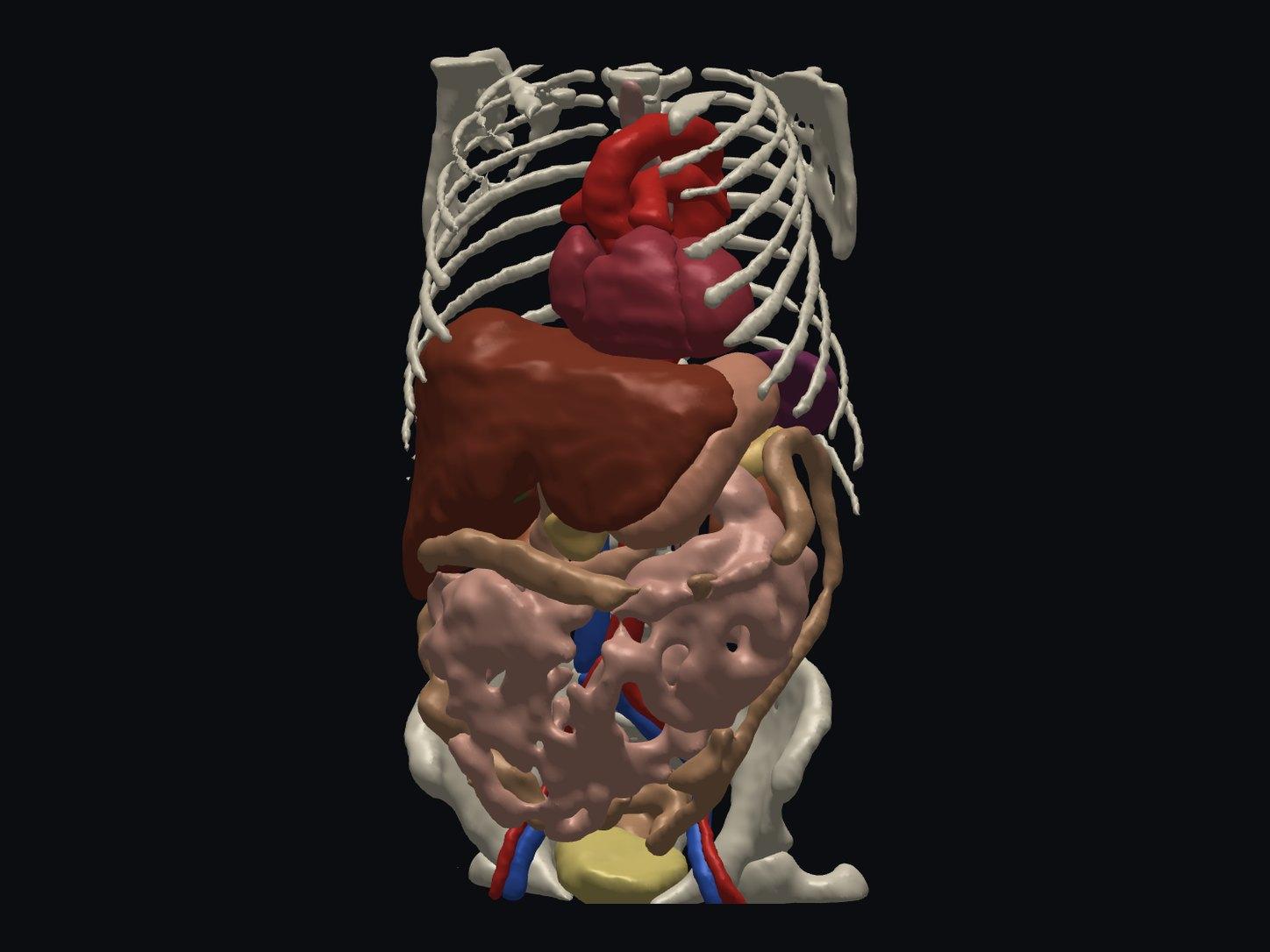
Free Online DICOM Viewer (3D)
Open a CT or MRI DICOM folder in your browser and view it in 3D, with AI anatomy labeling. Nothing is uploaded.
Try it free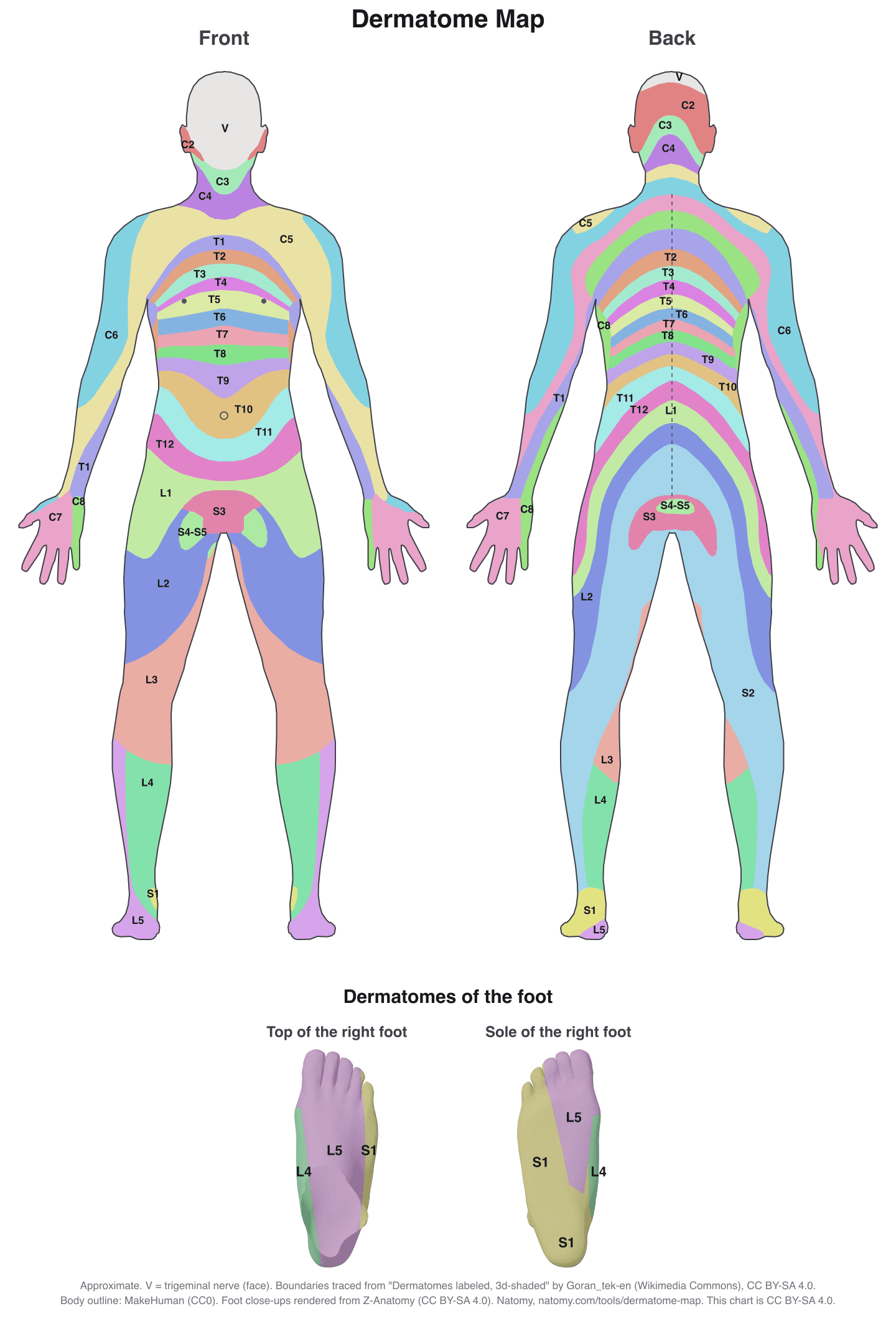
Interactive Dermatome Map
Tap the body to see each nerve root's skin area, test point, myotome, reflex, and disc level. Free printable chart.
Try it free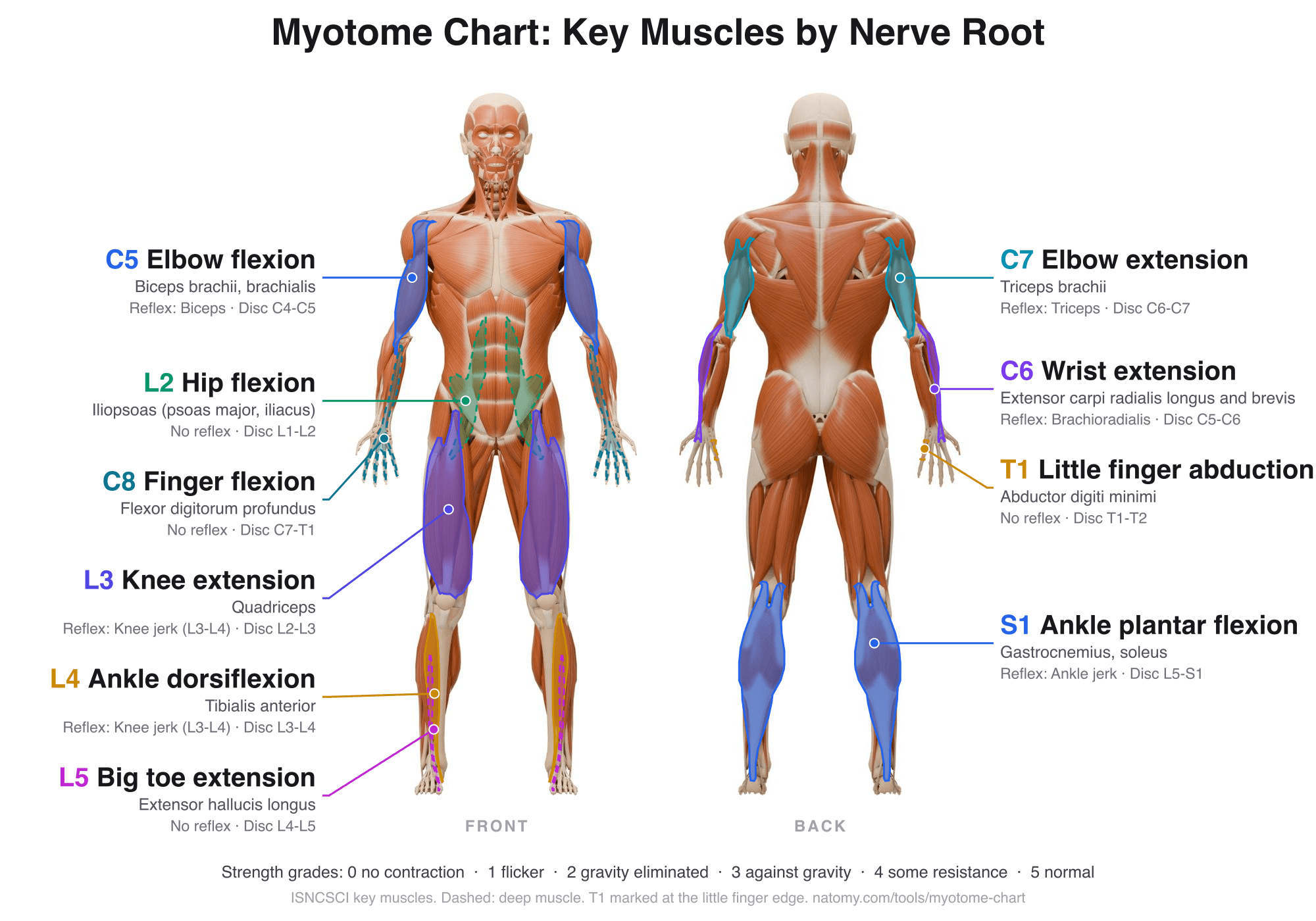
Myotome Chart and Motor Score
Tap a nerve root to see its key muscle, test position, and reflex. Grade strength 0 to 5 for the ISNCSCI motor score.
Try it free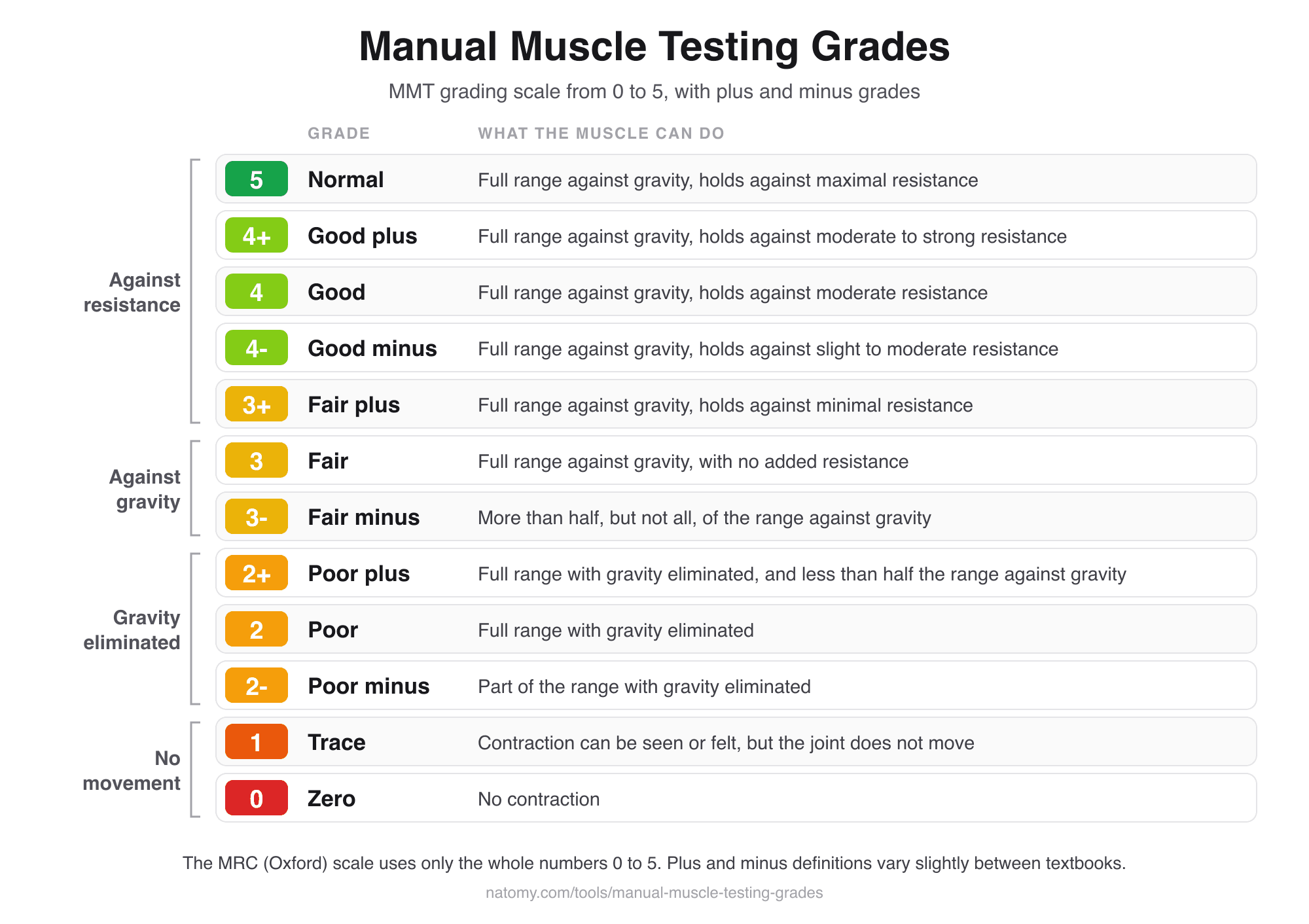
Manual Muscle Testing Grades
MMT grading scale chart from 0 to 5 with plus and minus grades, and a grade finder that writes the note for you.
Try it free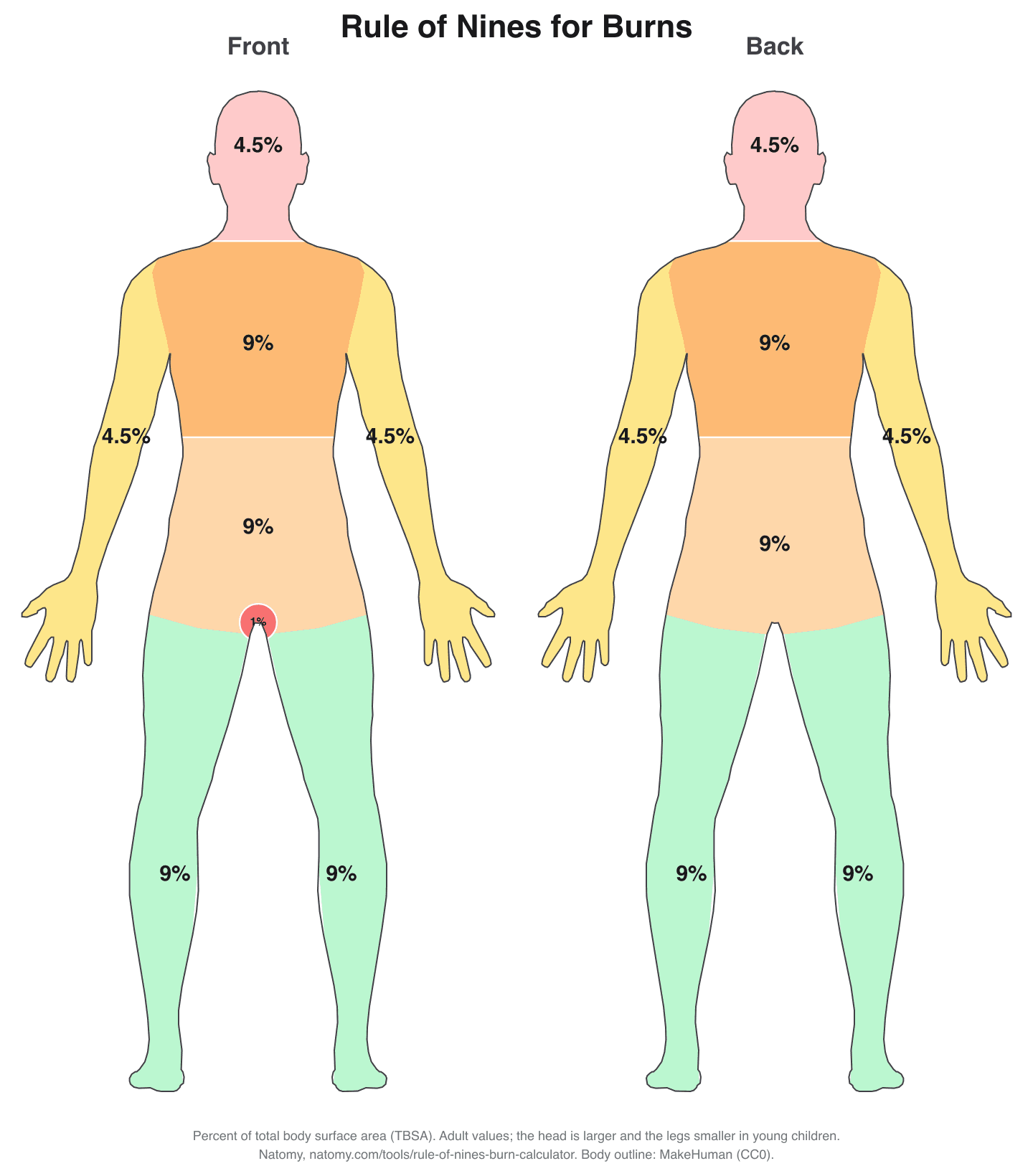
Rule of Nines Burn Calculator
Click the burned areas to get the total body surface area (TBSA), with the Parkland formula and a printable burn chart.
Try it free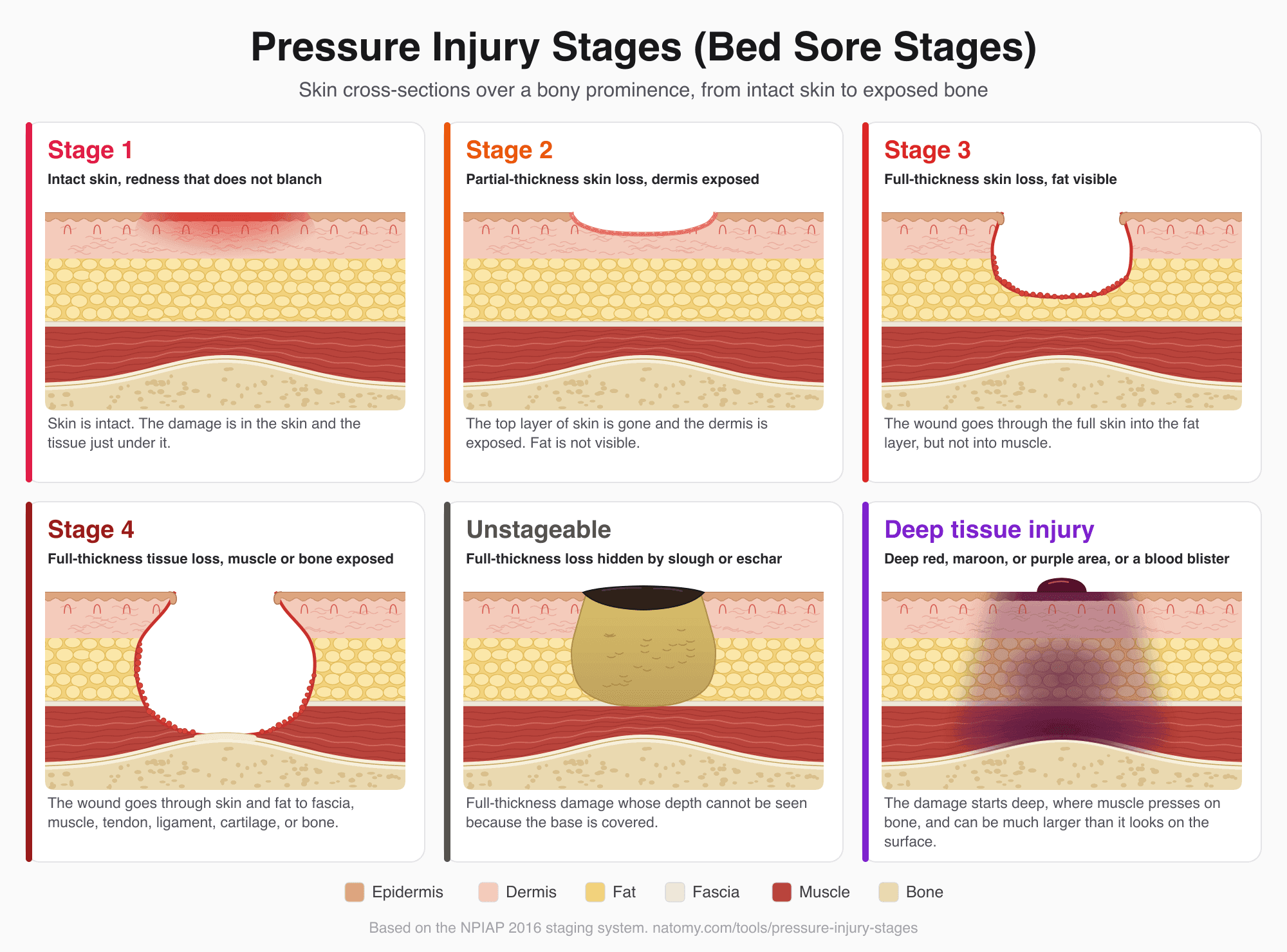
Pressure Injury (Bed Sore) Stages
Illustrated pressure ulcer stages chart, Stage 1 to 4, unstageable, and deep tissue injury, with a stage finder and wound note.
Try it free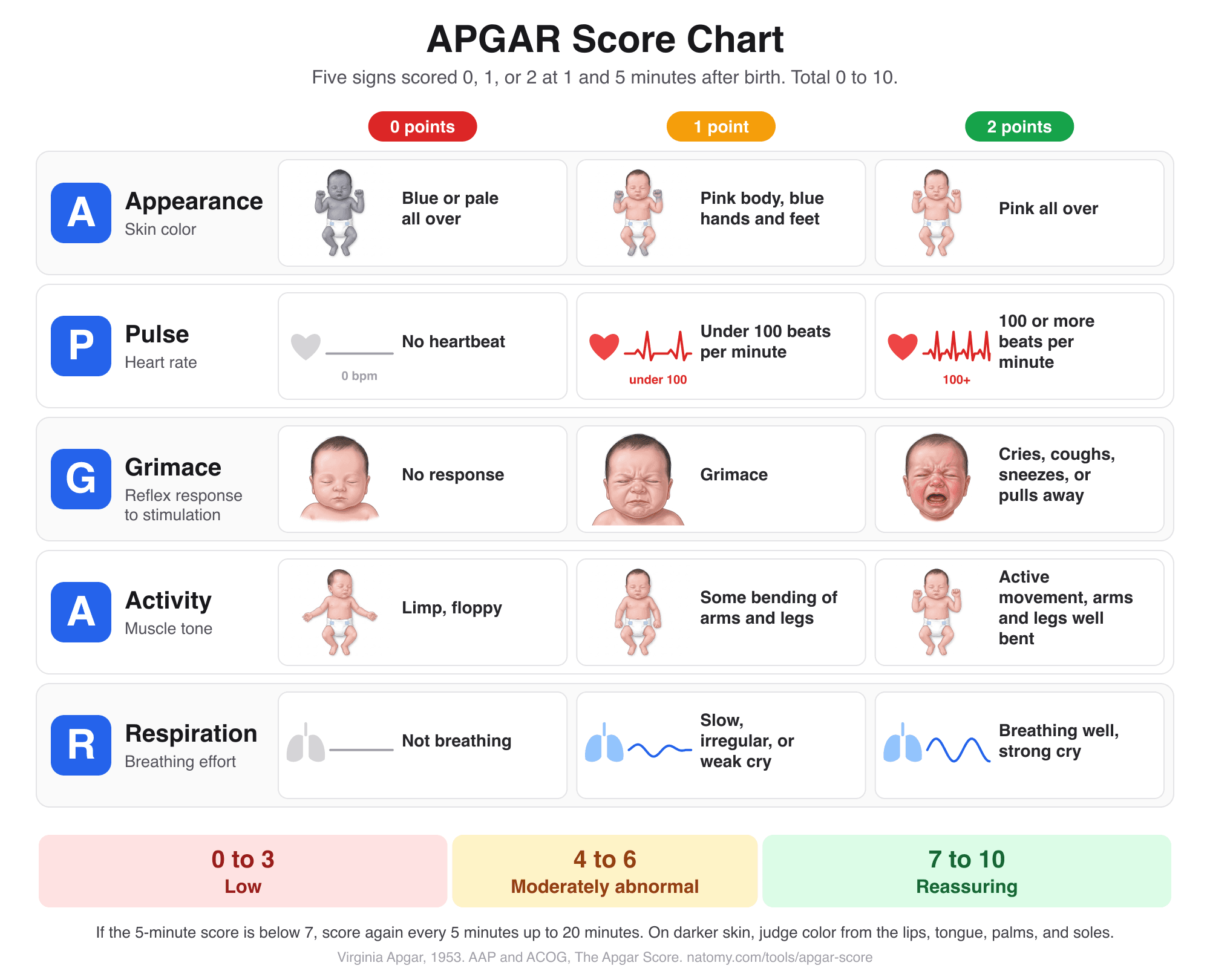
APGAR Score Chart and Calculator
Score the 5 newborn signs at 1, 5, and 10 minutes with an illustrated chart, what normal and low scores mean, and a note for the record.
Try it free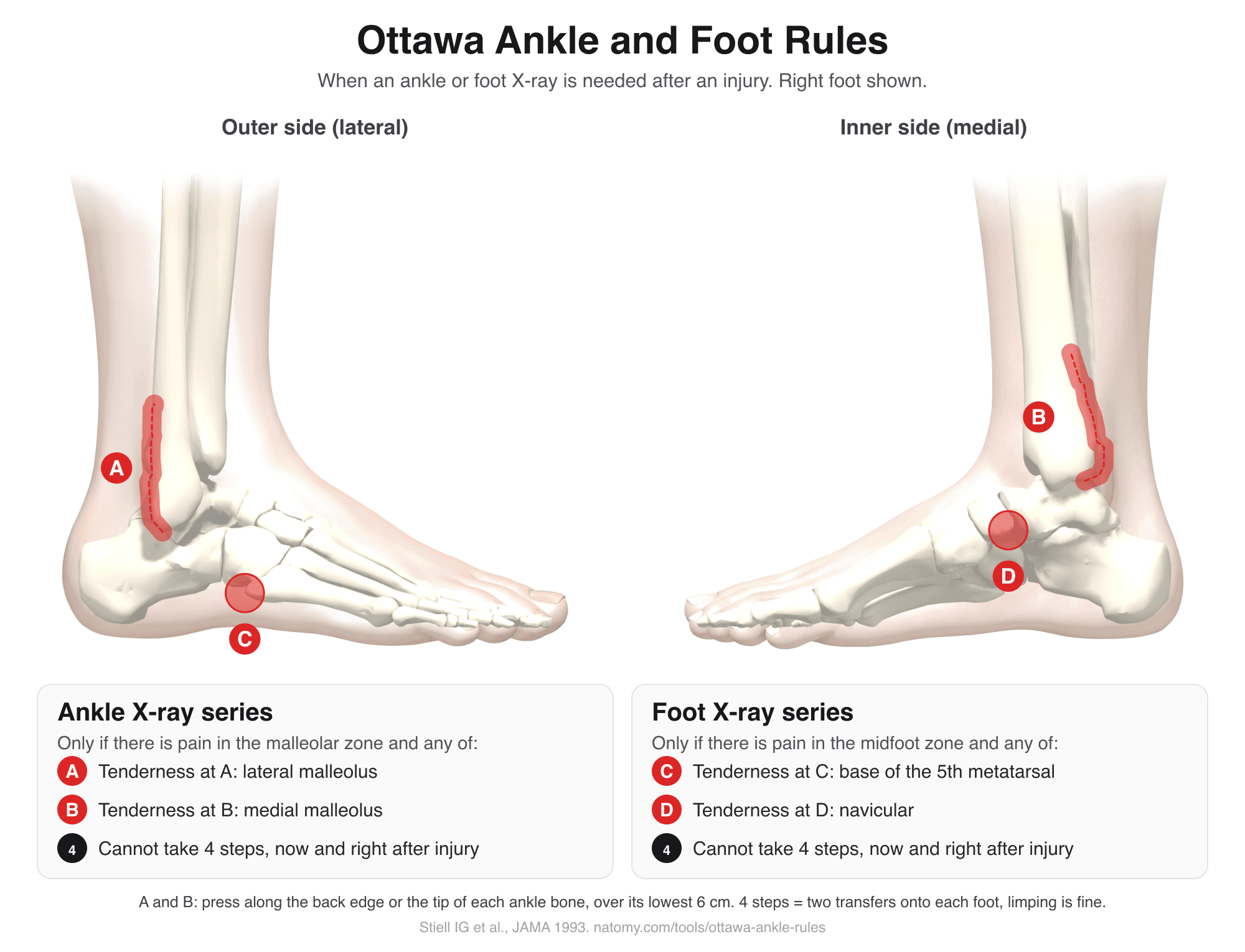
Ottawa Ankle Rules
Tap the tender spots on an illustrated ankle and foot to see if the Ottawa rules call for an X-ray. Includes the Ottawa knee rule.
Try it free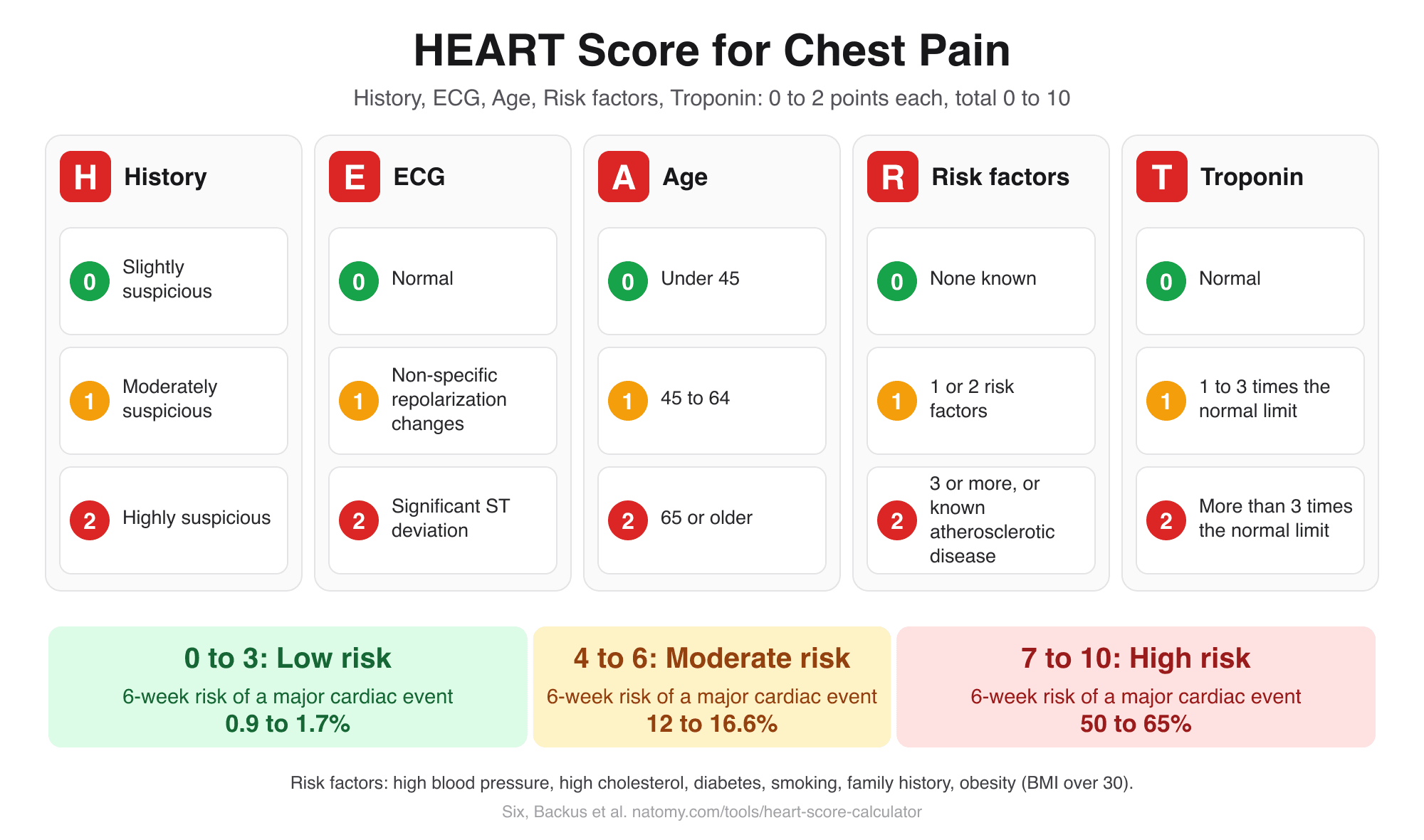
HEART Score Calculator
Score history, ECG, age, risk factors, and troponin for chest pain to get the HEART score, risk group, and 6-week MACE risk.
Try it free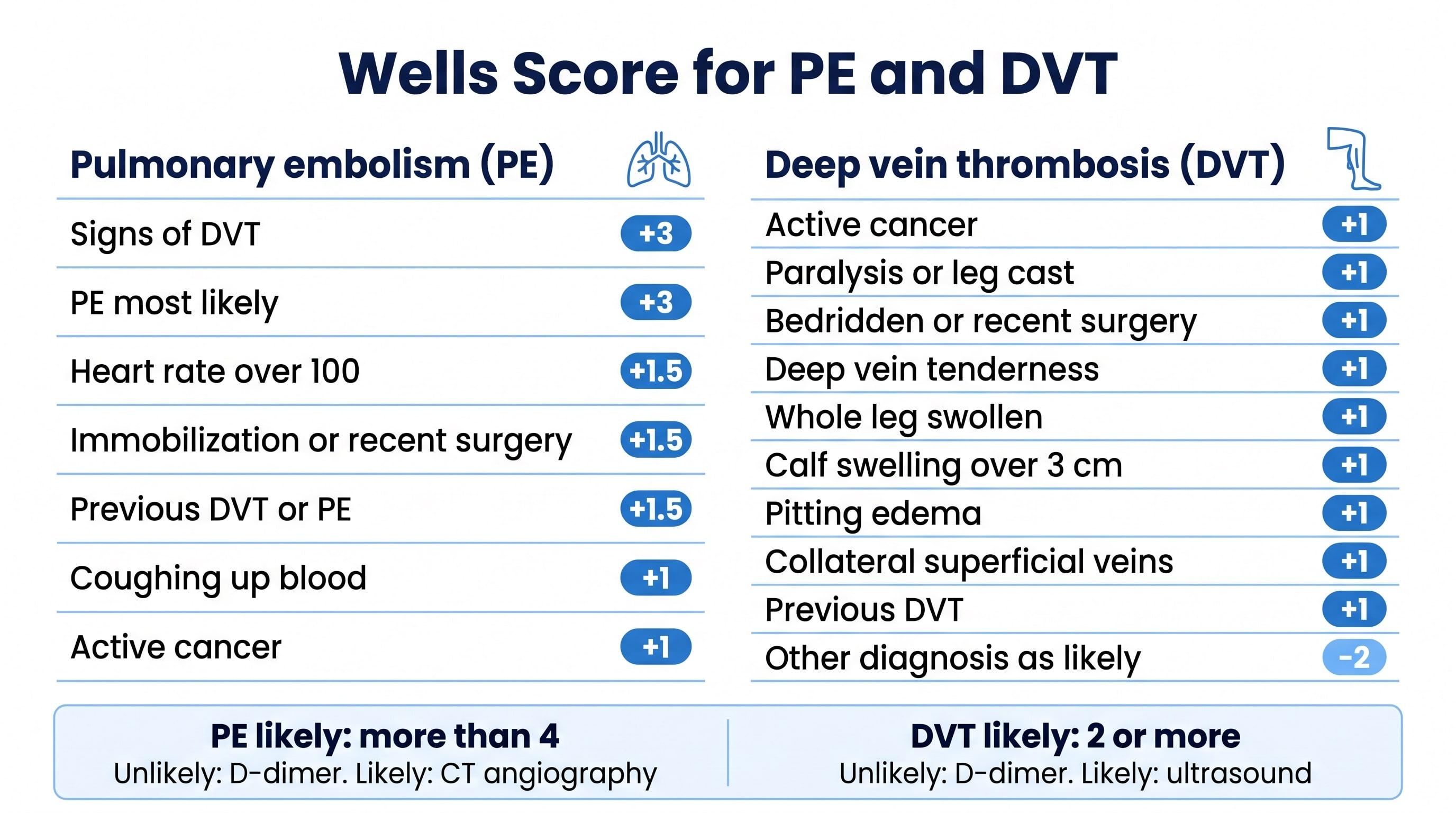
Wells Score Calculator (PE and DVT)
Check the Wells criteria for pulmonary embolism or deep vein thrombosis to get the score, the risk group, and the next test.
Try it free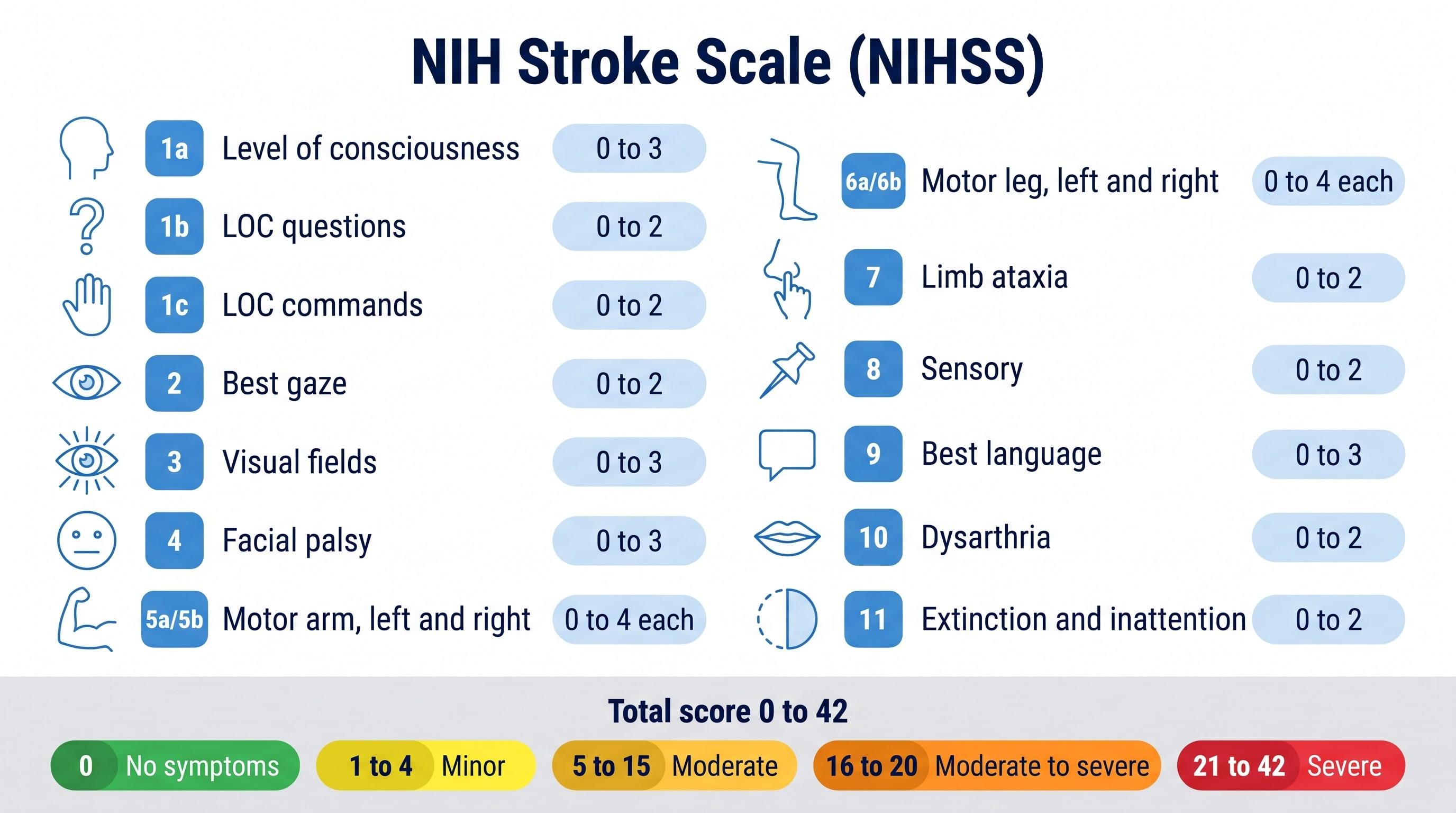
NIHSS Calculator (NIH Stroke Scale)
Score all 15 NIH Stroke Scale items to get the NIHSS total from 0 to 42 and the stroke severity range.
Try it free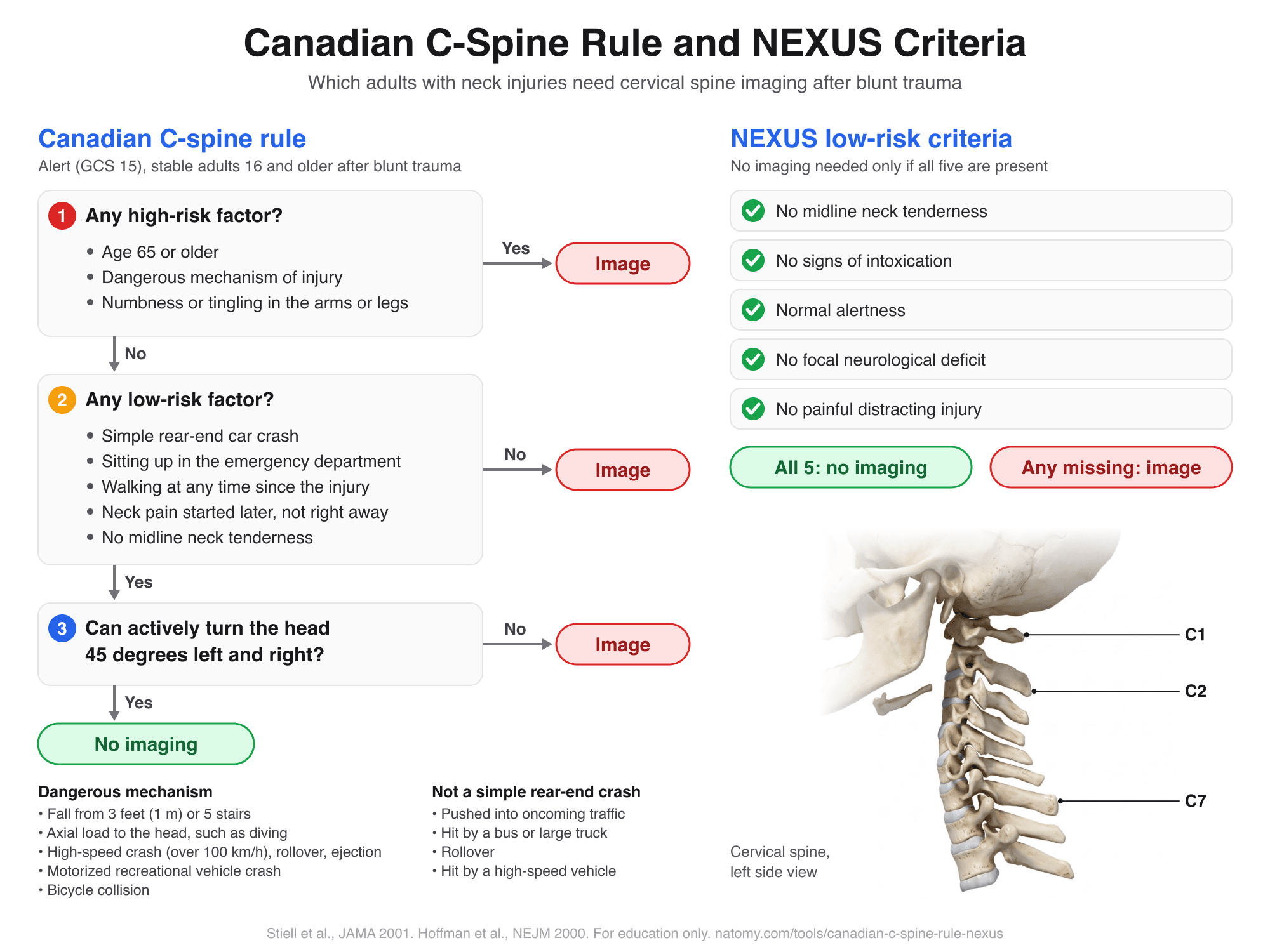
Canadian C-Spine Rule and NEXUS
Run the Canadian C-spine rule or the NEXUS criteria step by step to see which adults need neck imaging after trauma.
Try it free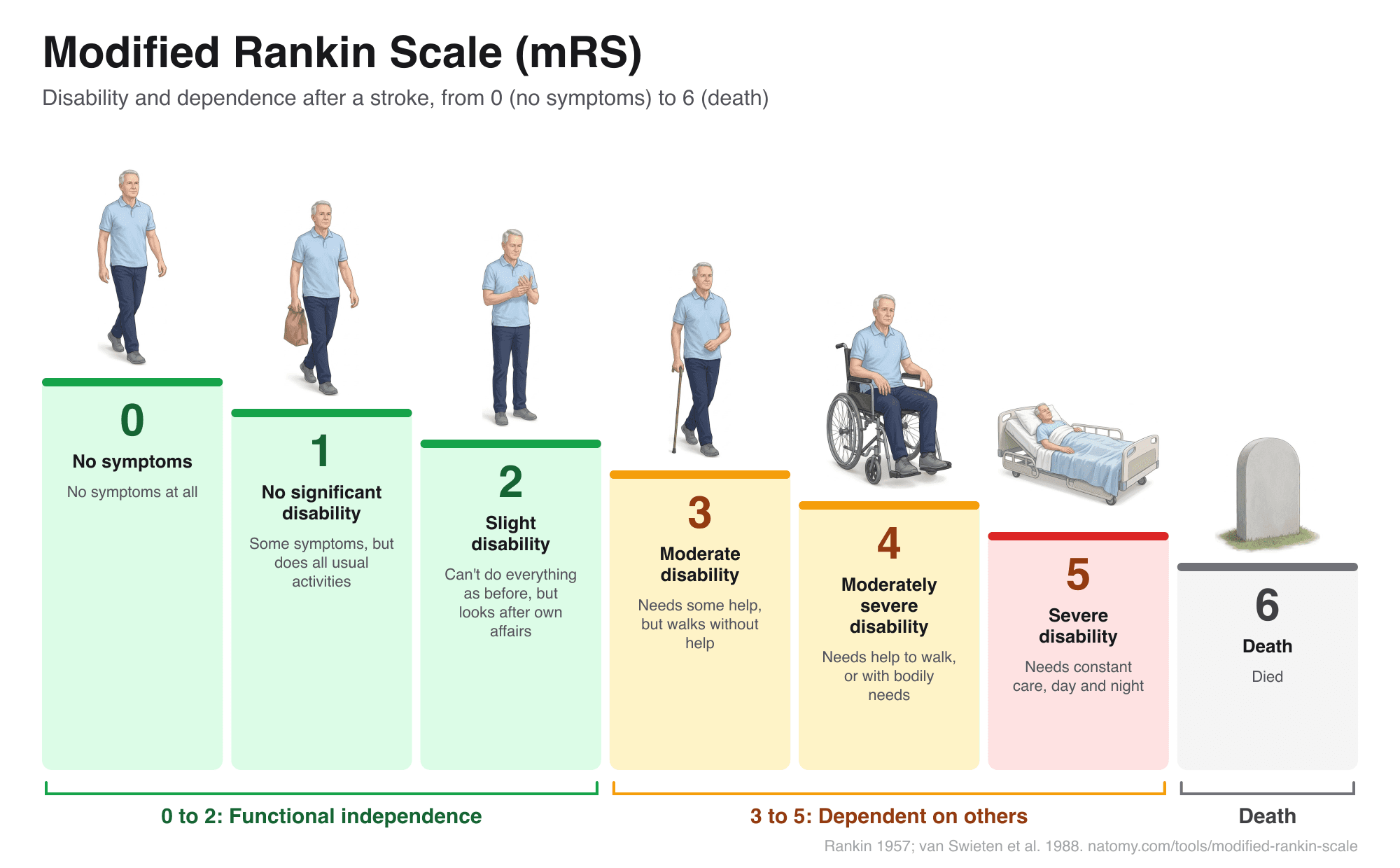
Modified Rankin Scale (mRS)
Illustrated mRS chart from 0 to 6 with a question-based score finder, what each grade means after a stroke, and a copyable note.
Try it free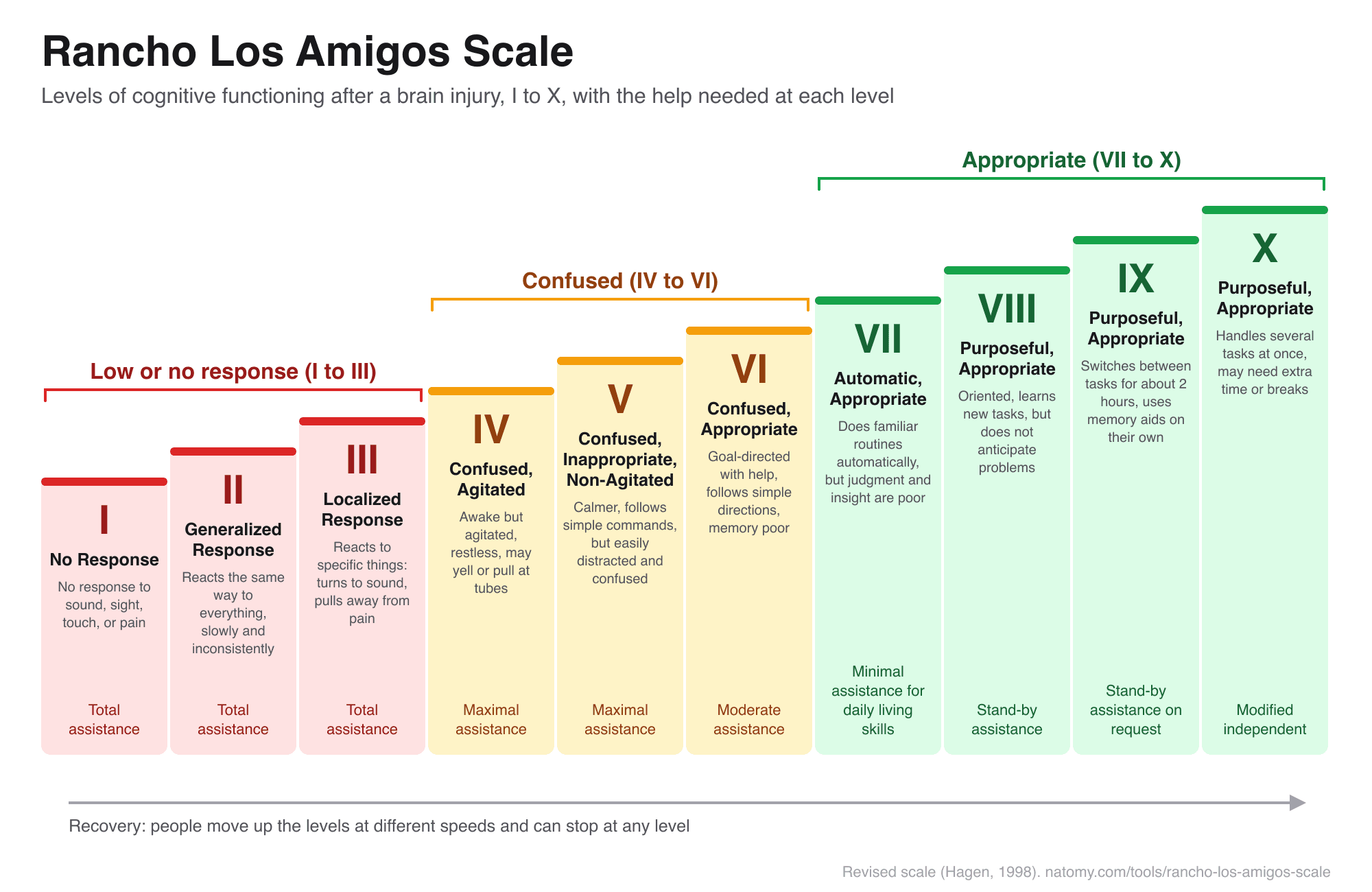
Rancho Los Amigos Scale
The 10 levels of cognitive functioning after a brain injury, with a level finder, what to expect, and how to help.
Try it free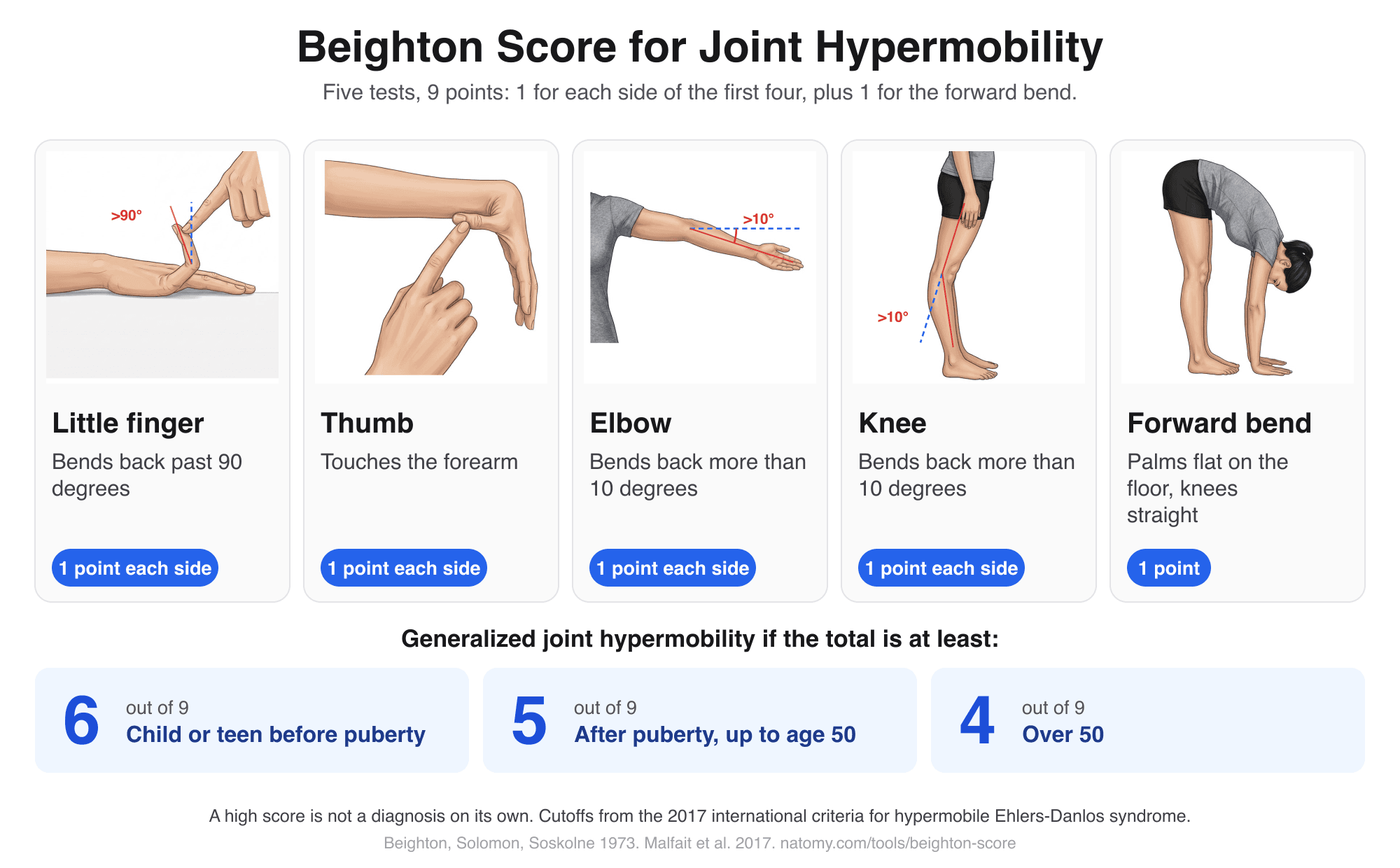
Beighton Score Calculator
Illustrated hypermobility test: score the 5 Beighton movements out of 9, compare with the age cutoff, and copy a note.
Try it free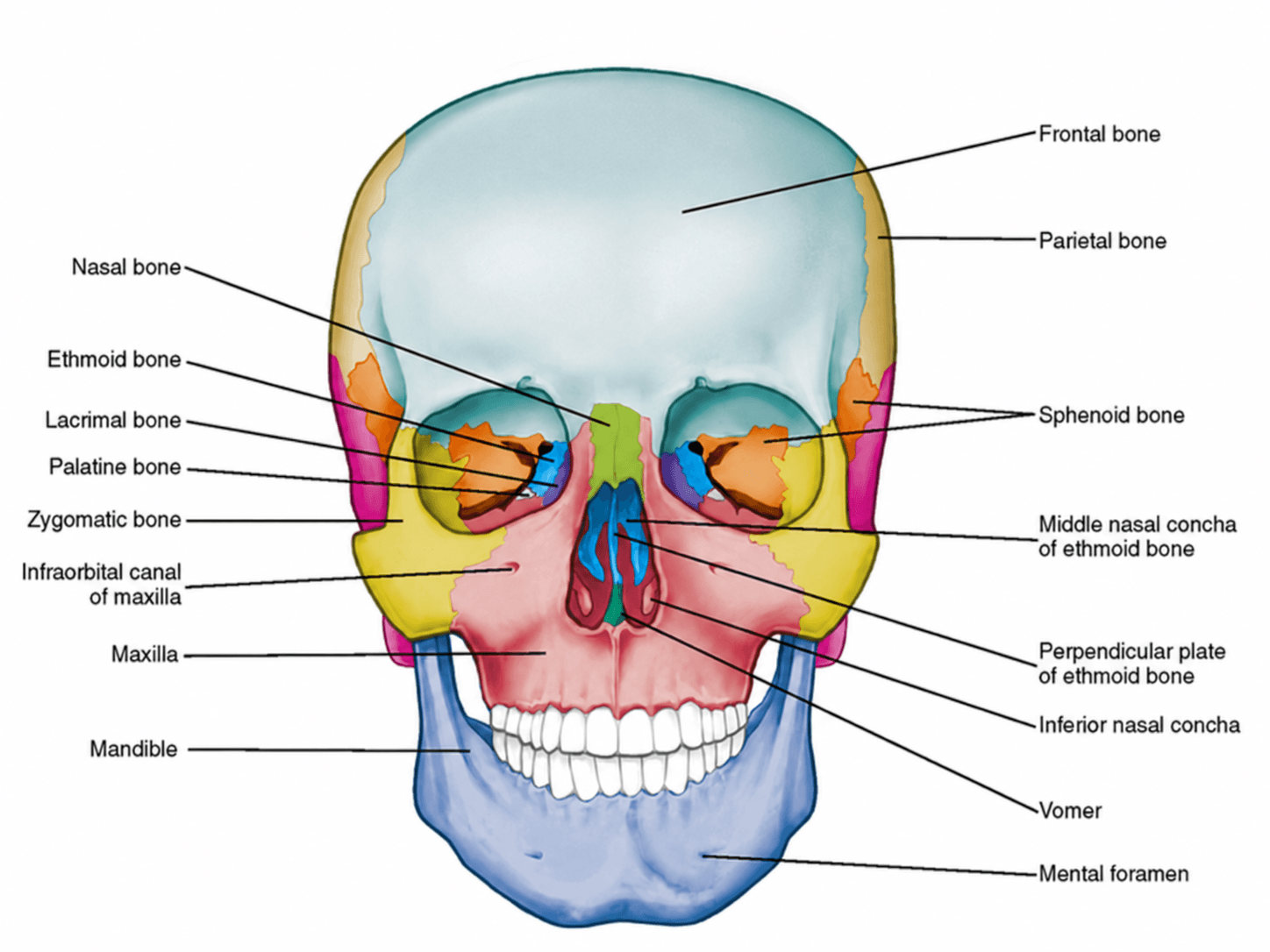
Anterior View of Skull Labeled
Free labeled and unlabeled anterior view of the skull, downloadable as PNG.
Try it free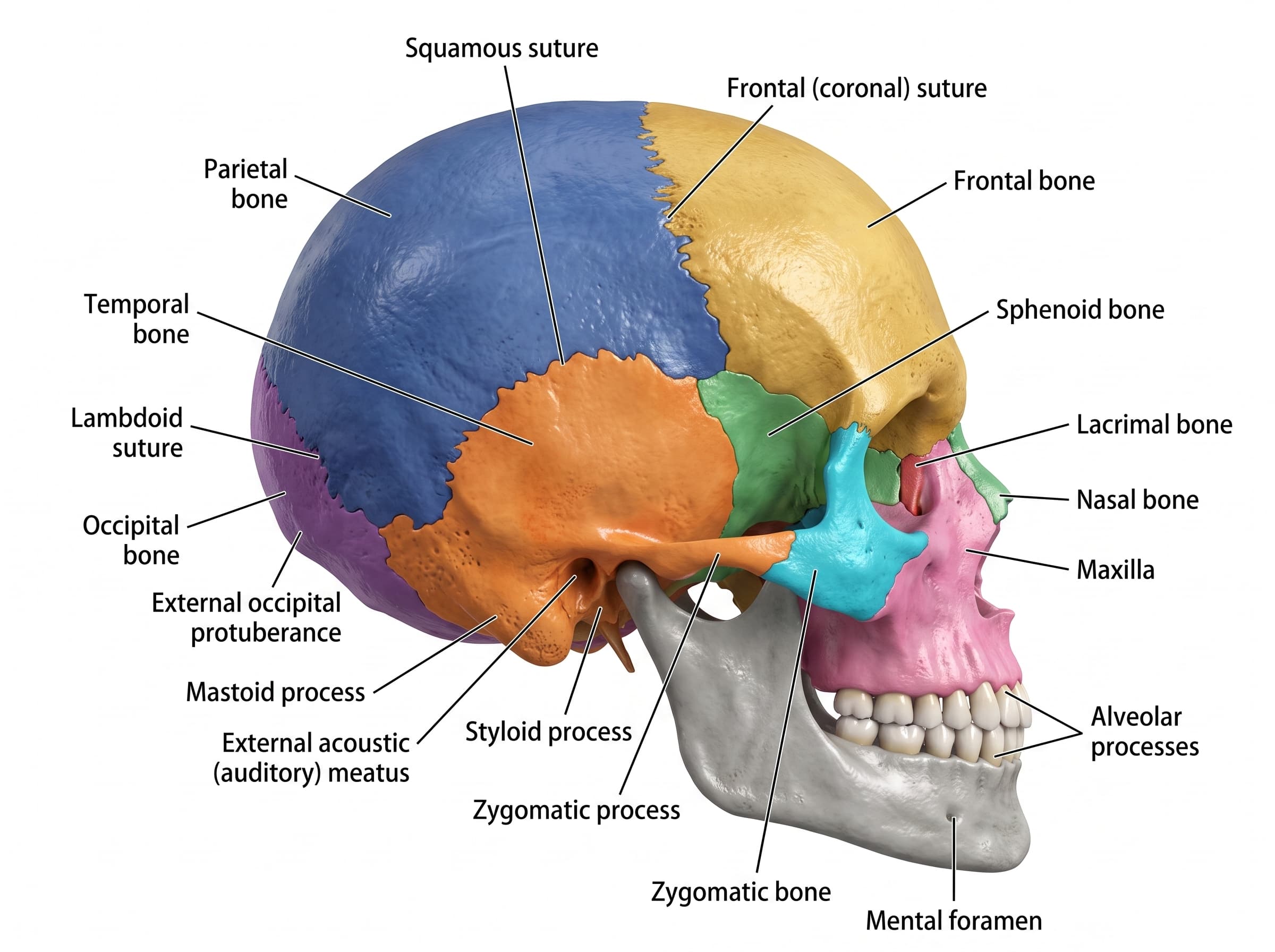
Lateral View of Skull Labeled
Free labeled and unlabeled lateral view of the skull, downloadable as PNG.
Try it free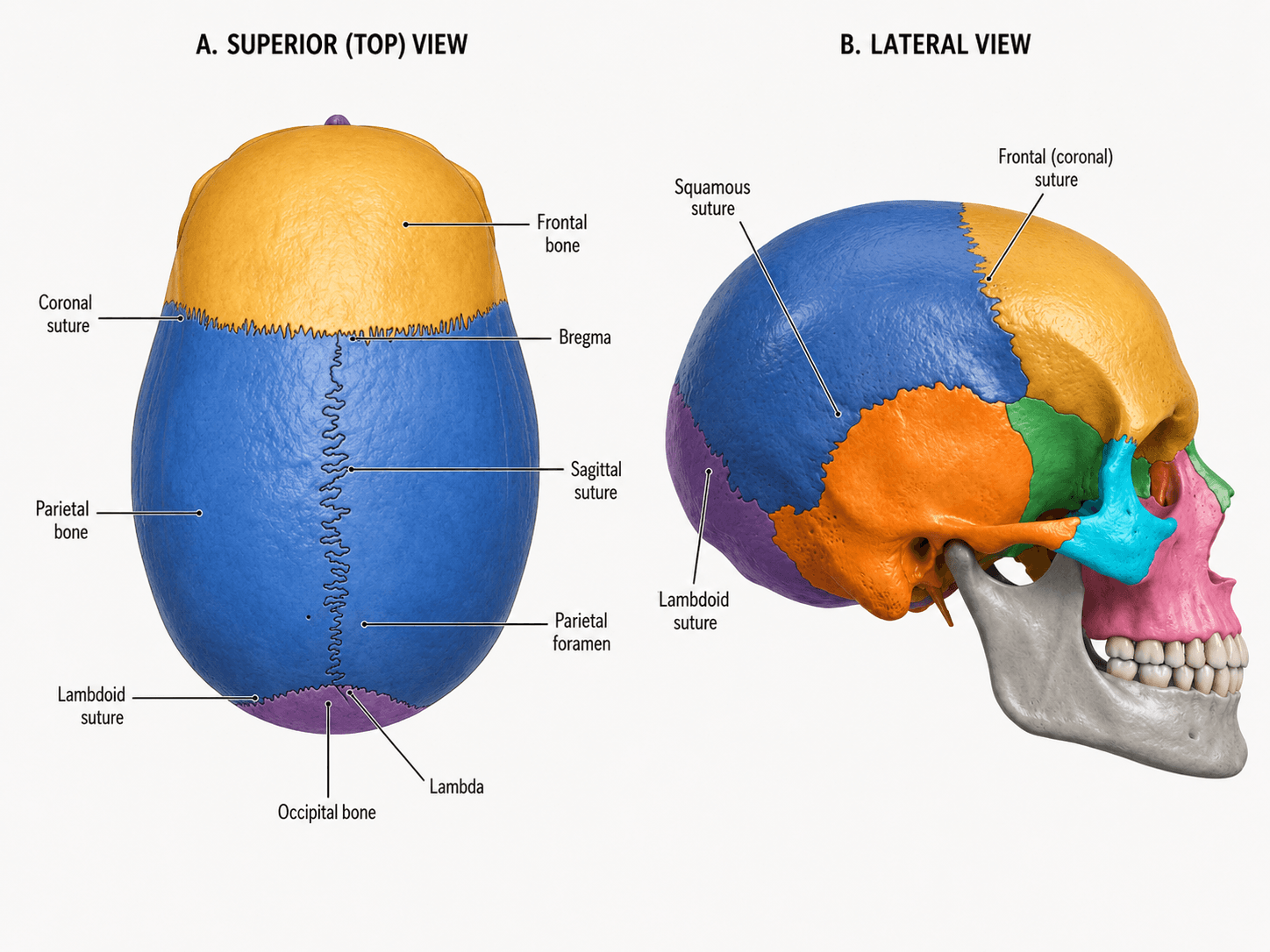
Skull Sutures Labeled
Free labeled and unlabeled skull sutures diagram, superior and lateral views, downloadable as PNG.
Try it free