Free Tools
Pain Scale (0 to 10)
The pain scale puts a number on how much something hurts: 0 is no pain and 10 is the worst pain you can imagine. Scores of 1 to 3 are mild, 4 to 6 moderate, and 7 to 10 severe. Use the chart to find your number, then the free tool below to rate your pain and copy it as a pain journal entry.
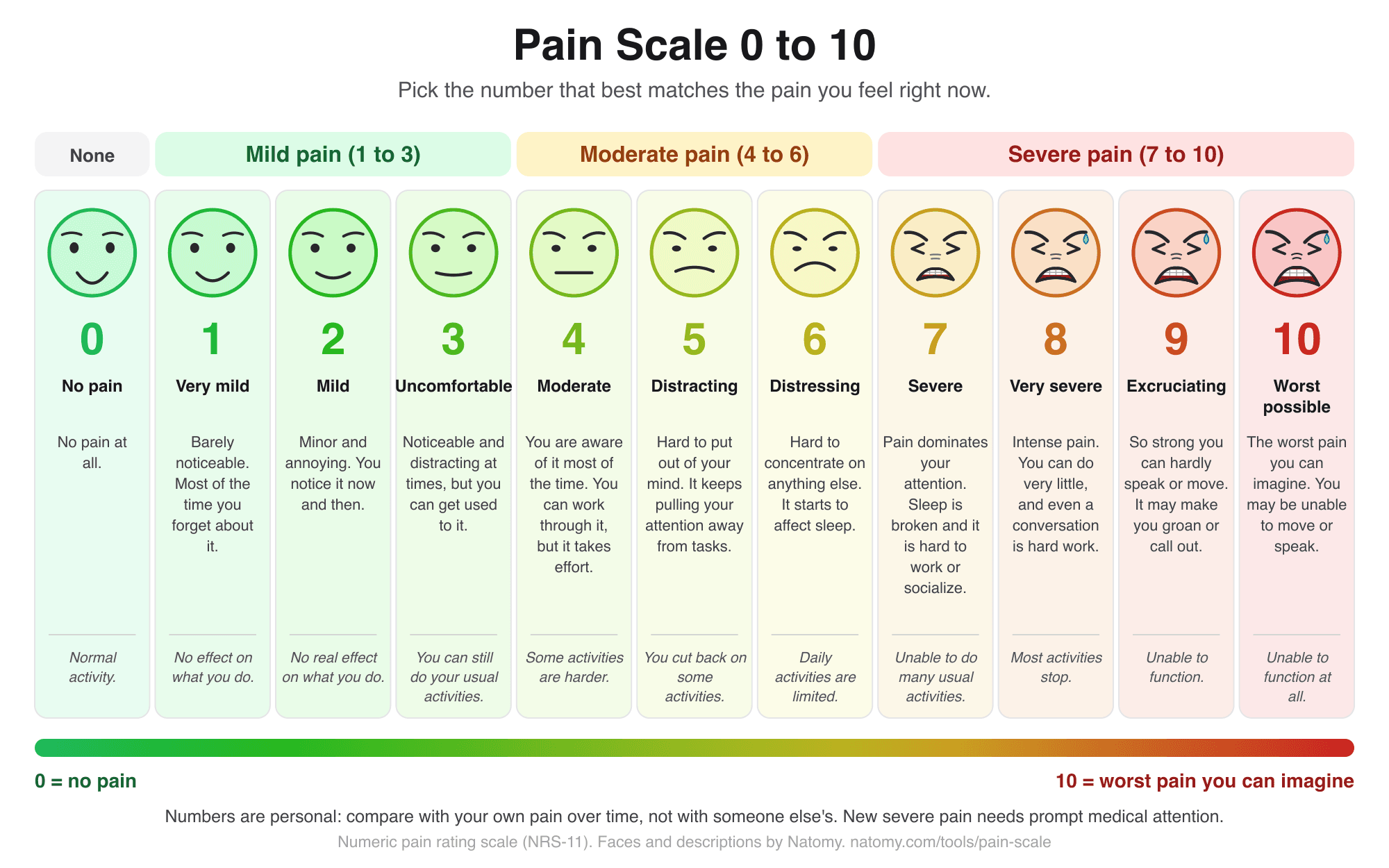
Download the chart (PNG) to print for a clinic, a hospital room, or a pain journal.
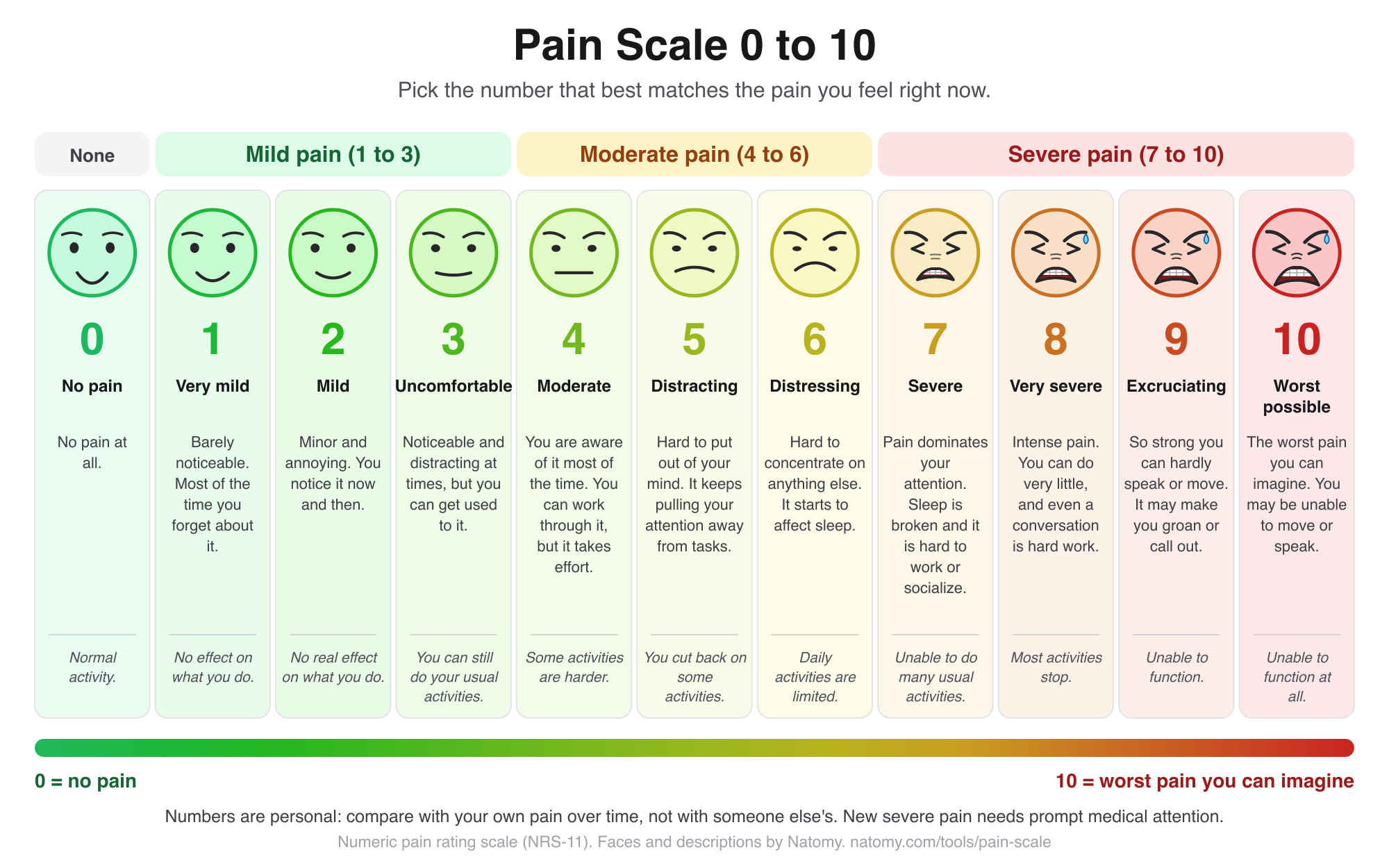
Rate your pain
Tap the face that matches your pain right now. Add your worst and least pain, where it hurts, and how it feels if you want a fuller note.
Add more detail (optional): worst and least pain, where it hurts, how it feels
Worst pain in the last 24 hours
Least pain in the last 24 hours
What does it feel like?
What does it get in the way of?
What each number on the pain scale means
These descriptions are a guide. Pick the number that feels closest, and remember that what matters most is how your own pain changes over time.
| Score | What it feels like | Effect on daily life |
|---|---|---|
| 0 | No pain. No pain at all. | Normal activity. |
| 1 | Very mild. Barely noticeable. Most of the time you forget about it. | No effect on what you do. |
| 2 | Mild. Minor and annoying. You notice it now and then. | No real effect on what you do. |
| 3 | Uncomfortable. Noticeable and distracting at times, but you can get used to it. | You can still do your usual activities. |
| 4 | Moderate. You are aware of it most of the time. You can work through it, but it takes effort. | Some activities are harder. |
| 5 | Distracting. Hard to put out of your mind. It keeps pulling your attention away from tasks. | You cut back on some activities. |
| 6 | Distressing. Hard to concentrate on anything else. It starts to affect sleep. | Daily activities are limited. |
| 7 | Severe. Pain dominates your attention. Sleep is broken and it is hard to work or socialize. | Unable to do many usual activities. |
| 8 | Very severe. Intense pain. You can do very little, and even a conversation is hard work. | Most activities stop. |
| 9 | Excruciating. So strong you can hardly speak or move. It may make you groan or call out. | Unable to function. |
| 10 | Worst possible. The worst pain you can imagine. You may be unable to move or speak. | Unable to function at all. |
Mild, moderate, and severe pain
Mild pain. Noticeable, but you can carry on with your usual activities.
Moderate pain. Gets in the way of concentration, work, and sleep.
Severe pain. Stops most activities. New severe pain needs prompt medical attention.
These are the most common cut-offs, but research does not agree on exact lines. Some studies, especially in cancer pain, call 1 to 4 mild, 5 to 6 moderate, and 7 to 10 severe. Treatment decisions rest on the whole picture, not on the band alone.
How to rate your pain
- Rate it now. Give the number for how it feels at this moment, not how it felt last week.
- Add your worst and least. Pain often comes and goes. Your worst and least pain over the last 24 hours shows the range.
- Use the whole scale. Keep 10 for pain that could not be worse, so there is room to show when things get better or worse.
- Say what it stops you from doing. "A 6 that keeps me from sleeping" tells your care team more than "6" alone.
- Be consistent. Rate at about the same times each day, for example on waking and at bedtime.
Describing how pain feels
The kind of pain helps point to its cause. Words people commonly use:
- Sharp or stabbing: often an injury or inflammation of skin, muscle, bone, or joints.
- Dull or aching: common with muscle strain, arthritis, and long-lasting pain.
- Throbbing: pulses with the heartbeat, as in some headaches, toothaches, and infections.
- Burning, shooting, tingling, or numb: typical of nerve pain, such as sciatica. Where it travels often follows a nerve's skin area, shown on our dermatome map.
- Cramping or pressure: common with pain from the gut, bladder, or uterus. Pressure, squeezing, or tightness in the chest can be a heart attack.
Call emergency services for sudden severe pain, chest pain or pressure, a sudden worst-ever headache, or pain with trouble breathing, weakness, or fainting.
Other pain scales
- Numeric rating scale (NRS): the 0 to 10 scale on this page, spoken or written. The most widely used in adults.
- Visual analog scale (VAS): a 10 cm line from "no pain" to "worst pain". The person marks a point and the distance is measured. Common in research.
- Verbal rating scale: words instead of numbers: none, mild, moderate, or severe.
- Faces scales: a row of faces from happy to distressed, used with young children. The best known are the Wong-Baker FACES scale and the Faces Pain Scale-Revised.
- Behavior scales: for people who cannot report pain. FLACC is used for babies and young children (newborns have their own scales), PAINAD for people with advanced dementia, and CPOT for intensive care patients who cannot report pain, such as those on a breathing machine.
- Multi-question tools: questionnaires such as the Brief Pain Inventory and the McGill Pain Questionnaire add how pain affects daily life and what it feels like.
Pain scales for children
Children can usually use a 0 to 10 number scale from about age 8. From about 3 or 4, most can point to a face that shows how they feel. For babies and children who cannot talk, clinicians score what they see: facial expression, leg movement, crying, how the child moves, and how easily the child is comforted.
Limits of the pain scale
- It is subjective. The same injury can be a 4 for one person and a 7 for another, and both are honest answers.
- Mood, sleep, fear, and past experience of pain all change the number.
- A single number does not show what the pain stops a person from doing, which is often what matters most.
- Long-lasting pain can be serious even when the number looks moderate, because it wears down sleep, work, and mood over time.
In the mid to late 1990s, pain was promoted in the United States as "the fifth vital sign", and a 0 to 10 score became a routine part of hospital checks. That focus on a single number was later criticized, including for its role in opioid overprescribing, and many clinicians now pair the score with questions about function: can you sleep, walk, work, and do what you need to?
Pain scores in personal injury cases
Pain cannot be seen on an X-ray, so in personal injury and medical malpractice cases the pain scores written in the records are an important part of the evidence of how much an injury hurt and for how long. They appear in emergency department triage notes, doctor visits, physical therapy notes, and nursing charts. Together they help support the non-economic damages often called pain and suffering.
Reviewers look for a consistent story. Scores that match the injury and the treatment, that change in a believable way as treatment goes on, and that come with notes on what the pain stopped the person from doing carry more weight. Gaps in care and scores that do not fit the rest of the record are what the other side looks for. A daily pain journal, like the entry the tool above creates, helps fill in the days between visits. Keep entries factual: in a legal case, a journal may be shared with the other side.
Show the injury behind the pain
A number says how much it hurts. A medical illustration shows why. Natomy turns records, imaging, and prompts into clear, labeled medical illustrations of injuries, such as herniated discs, fractures, and nerve damage, for patient education and medical-legal exhibits. See examples in the Natomy atlas.
Try Natomy TodayFAQ
What is the pain scale from 1 to 10?+
It is a way to put a number on how much something hurts. Most versions run from 0 to 10: 0 is no pain and 10 is the worst pain you can imagine. Scores of 1 to 3 are usually called mild, 4 to 6 moderate, and 7 to 10 severe. Clinicians call it the numeric rating scale, or NRS.
What does a 7 on the pain scale mean?+
A 7 is severe pain. It takes over your attention, breaks up your sleep, and makes it hard to work or be around other people. Pain that is new and this strong should be checked by a clinician promptly.
What number is considered severe pain?+
Most clinicians treat 7 to 10 as severe. Studies place the cut-offs slightly differently: some call 5 to 6 moderate and 7 to 10 severe, and at least one study of chronic muscle and joint pain put severe at 8 and above.
What is a 10 on the pain scale?+
A 10 is the worst pain you can imagine, pain so strong that you cannot move, talk, or think of anything else. Because it is the top of the scale, it is most useful kept for pain that could not be worse.
How do I describe my pain to a doctor?+
Give the number for how it feels now, plus your worst and least pain over the last day. Then say where it is, whether it spreads, what it feels like (sharp, burning, aching, throbbing, shooting), when it started, what makes it better or worse, and what it stops you from doing. The tool on this page puts all of that into one note you can copy.
Is the pain scale accurate?+
It is a self-report, so it measures how you experience pain, not a value that can be checked with a test. One person's 5 is not the same as another's. It is most useful for tracking your own pain over time, for example whether a treatment brought it from 7 to 4.
What pain scale is used for children?+
Many children can use a 0 to 10 number scale from about age 8. Younger children often point to a face on a faces scale, such as the Wong-Baker FACES scale or the Faces Pain Scale-Revised. For babies and children who cannot talk, clinicians use behavior scales such as FLACC, which scores the face, legs, activity, cry, and how easily the child is comforted.
How much does a pain score need to change to matter?+
In studies of chronic pain, a drop of about 2 points, or about 30 percent, matched what patients rated as a meaningful ("much improved") change. Smaller changes can still matter to the person in pain.
How are pain scores used in personal injury cases?+
Pain scores in medical, therapy, and emergency records help show how much an injury hurt and how long it lasted, which bears on pain and suffering damages. Consistent scores across visits, backed by notes on what the pain stopped the person from doing, are more persuasive than a single number.
Sources: Hawker GA, Mian S, Kendzerska T, French M. Measures of adult pain. Arthritis Care Res. 2011;63(S11):S240-S252. Farrar JT, Young JP, LaMoreaux L, Werth JL, Poole RM. Clinical importance of changes in chronic pain intensity measured on an 11-point numerical pain rating scale. Pain. 2001;94(2):149-158. Serlin RC, Mendoza TR, Nakamura Y, Edwards KR, Cleeland CS. When is cancer pain mild, moderate or severe? Pain. 1995;61(2):277-284. Merkel SI et al. The FLACC: a behavioral scale for scoring postoperative pain in young children. Pediatr Nurs. 1997;23(3):293-297. Faces and descriptions are drawn and written by Natomy. For education and tracking only; not a substitute for medical advice.
Related free tools
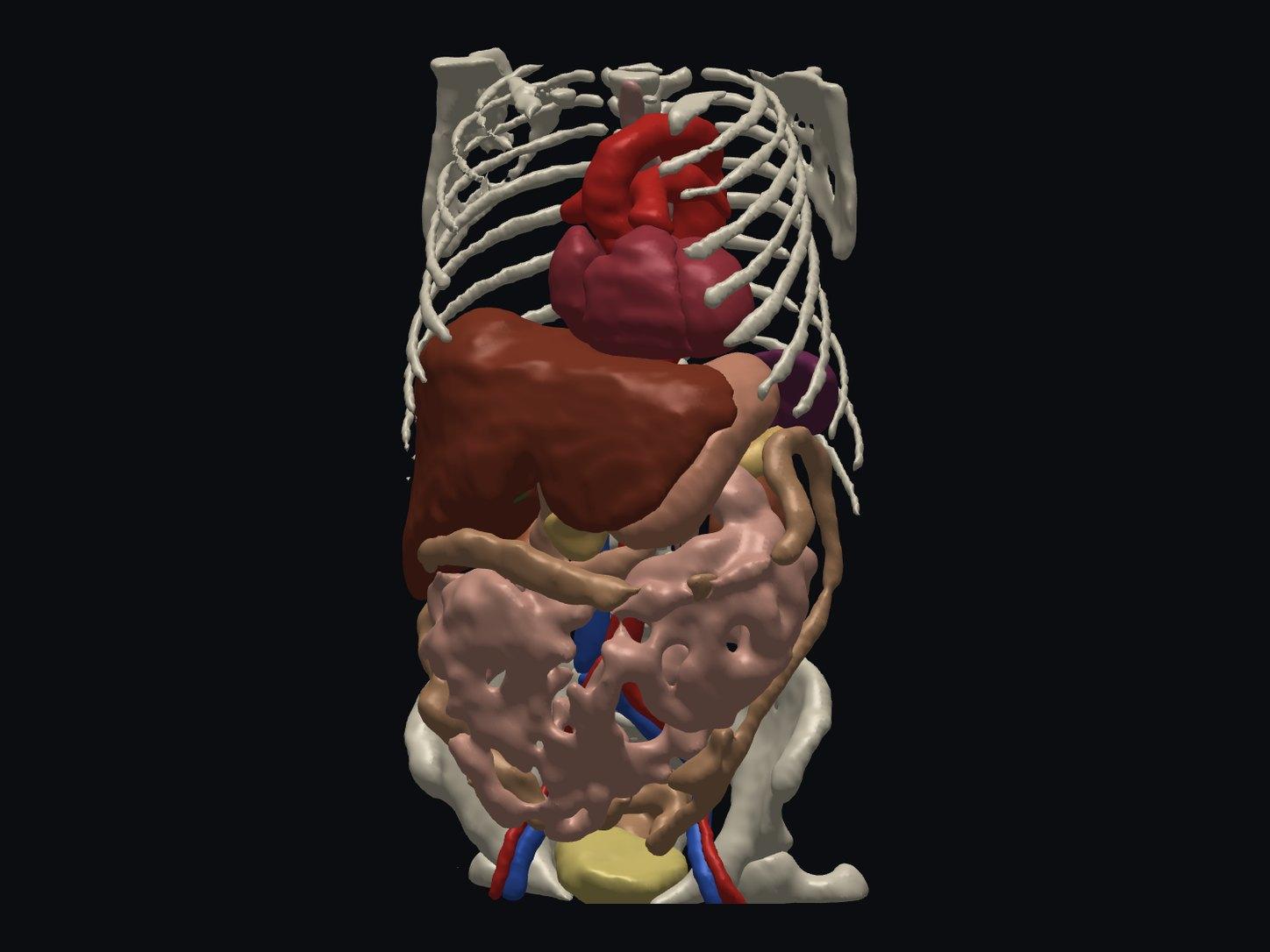
Free Online DICOM Viewer (3D)
Open a CT or MRI DICOM folder in your browser and view it in 3D, with AI anatomy labeling. Nothing is uploaded.
Try it free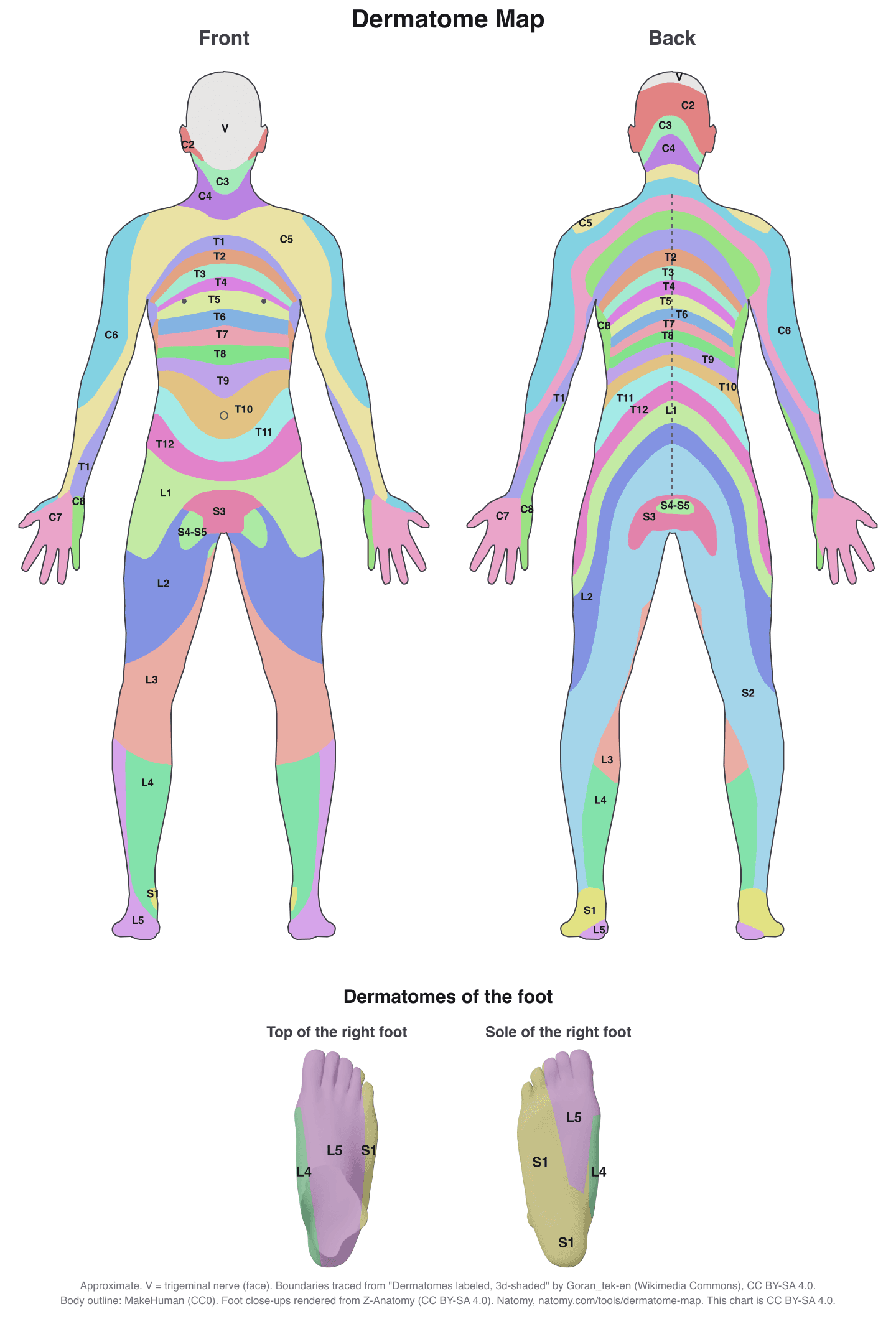
Interactive Dermatome Map
Tap the body to see each nerve root's skin area, test point, myotome, reflex, and disc level. Free printable chart.
Try it free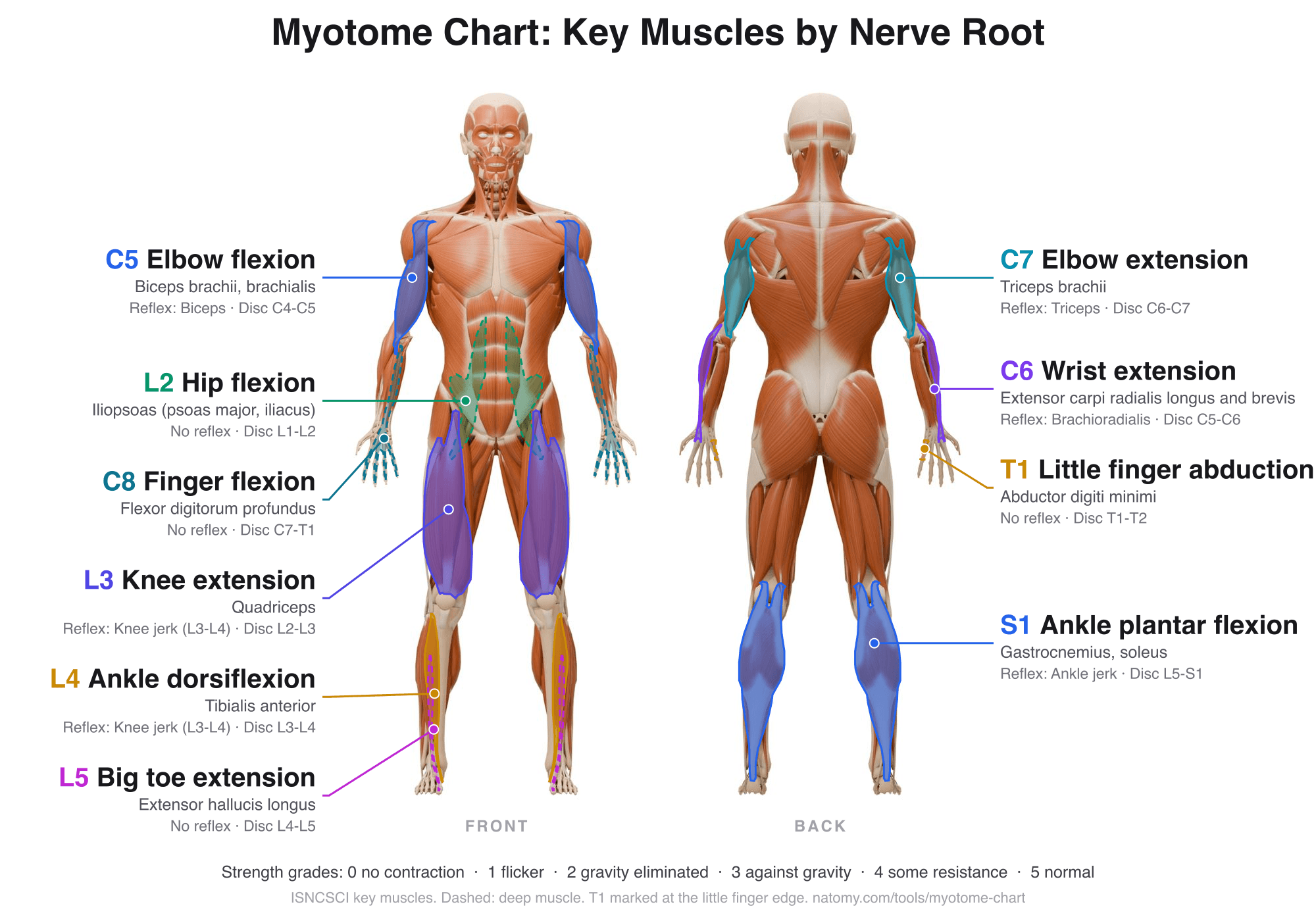
Myotome Chart and Motor Score
Tap a nerve root to see its key muscle, test position, and reflex. Grade strength 0 to 5 for the ISNCSCI motor score.
Try it free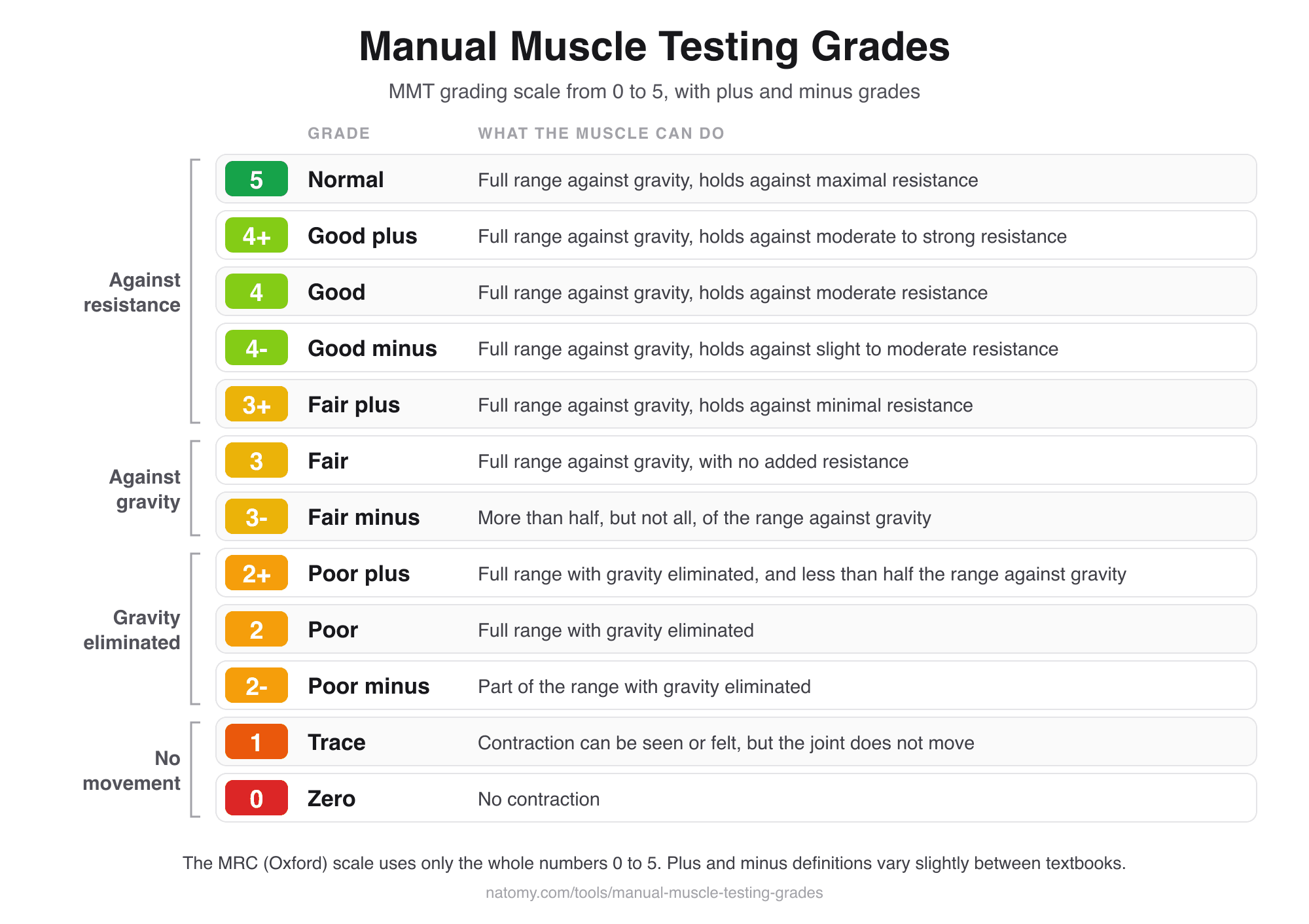
Manual Muscle Testing Grades
MMT grading scale chart from 0 to 5 with plus and minus grades, and a grade finder that writes the note for you.
Try it free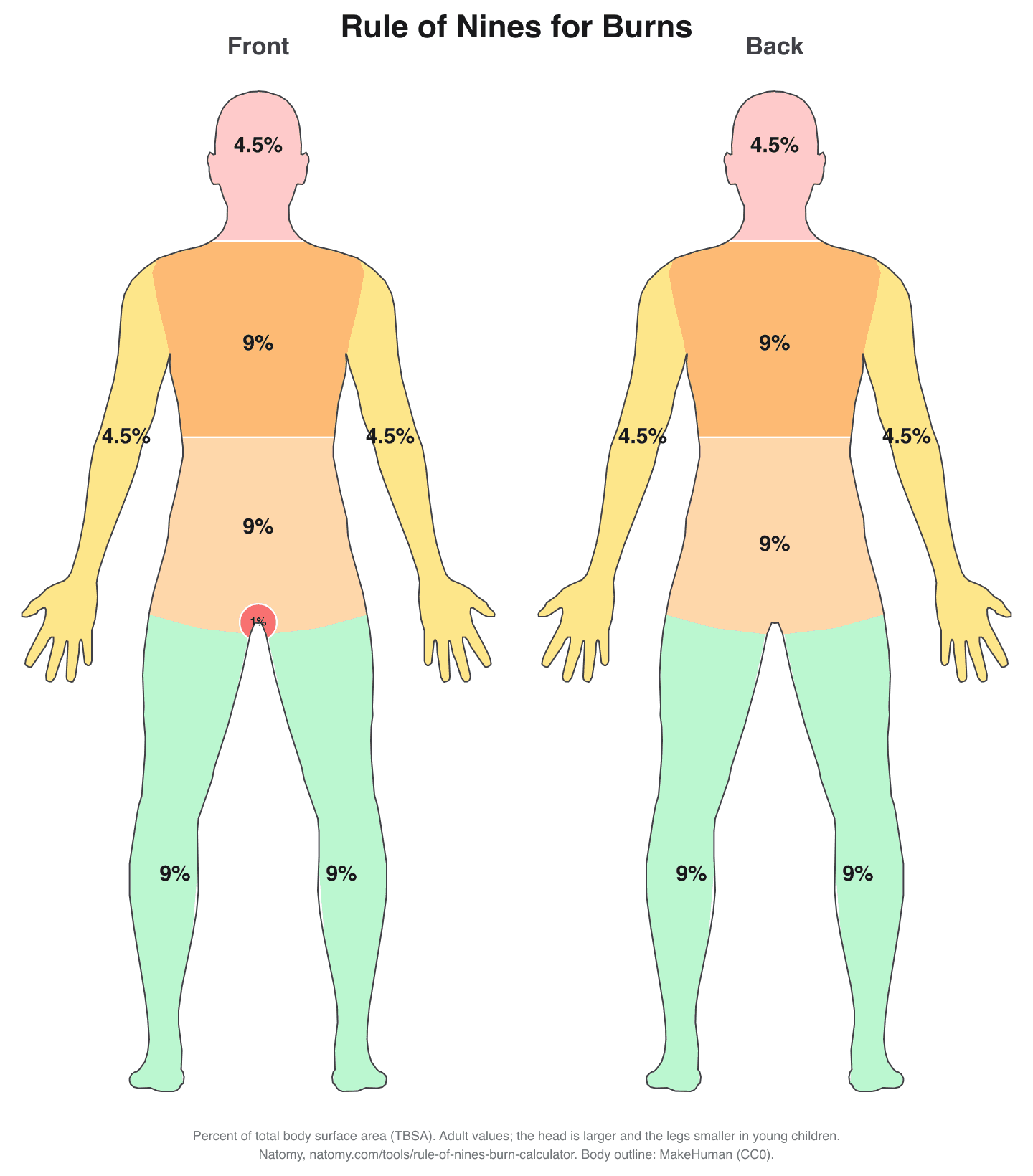
Rule of Nines Burn Calculator
Click the burned areas to get the total body surface area (TBSA), with the Parkland formula and a printable burn chart.
Try it free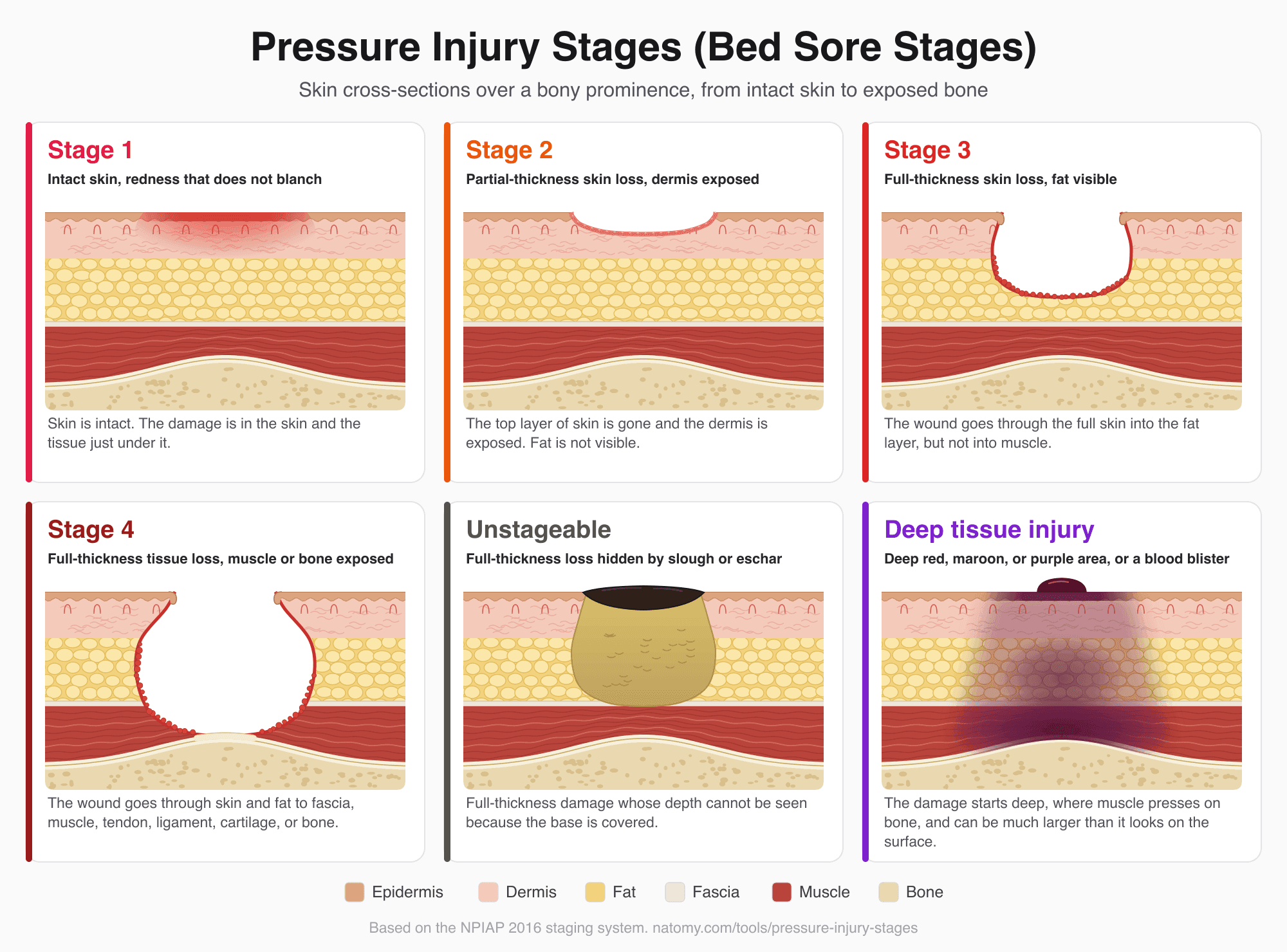
Pressure Injury (Bed Sore) Stages
Illustrated pressure ulcer stages chart, Stage 1 to 4, unstageable, and deep tissue injury, with a stage finder and wound note.
Try it free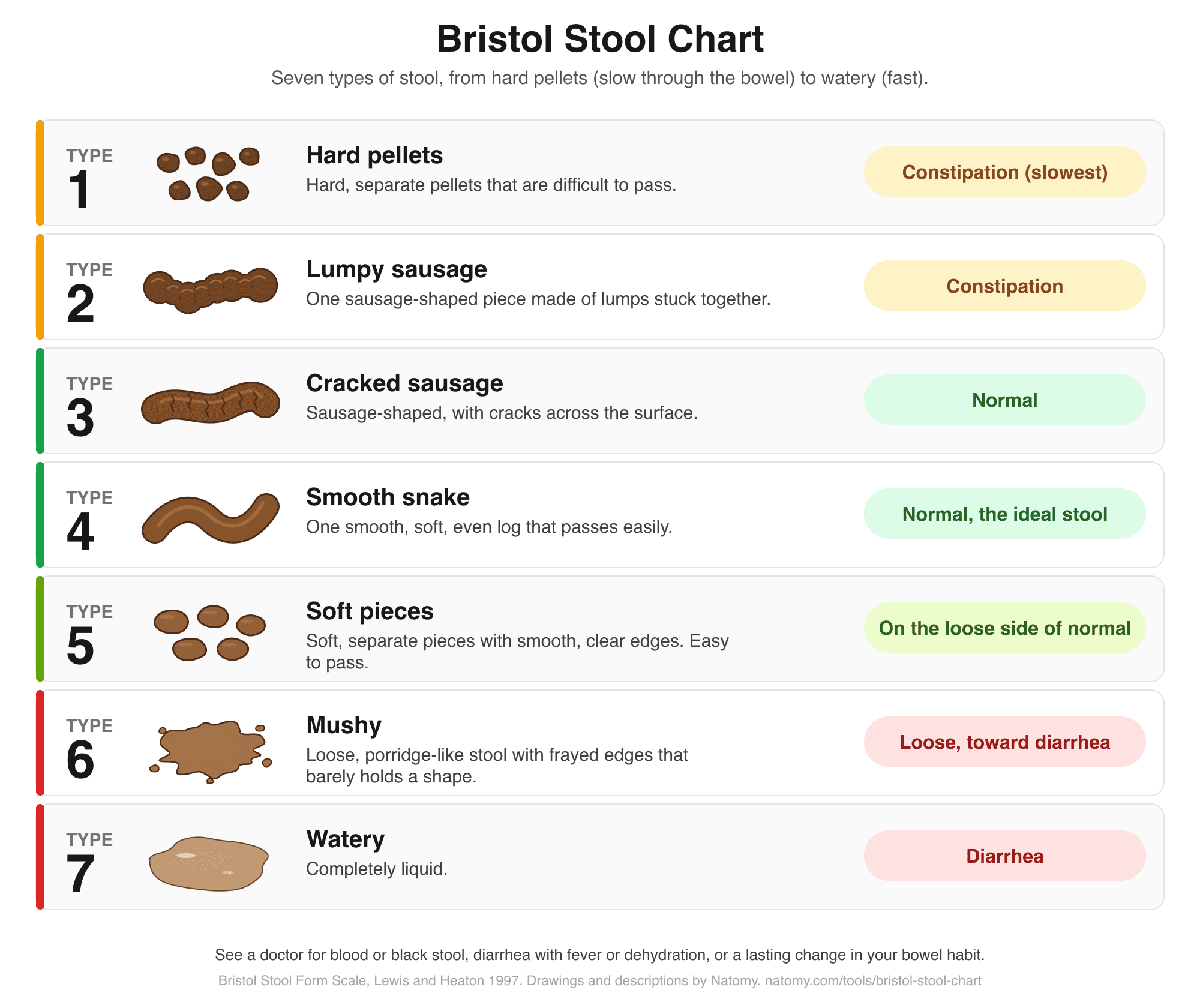
Bristol Stool Chart
Find your stool type from 1 to 7 on an illustrated chart, see what it means, and keep a simple bowel diary for your doctor.
Try it free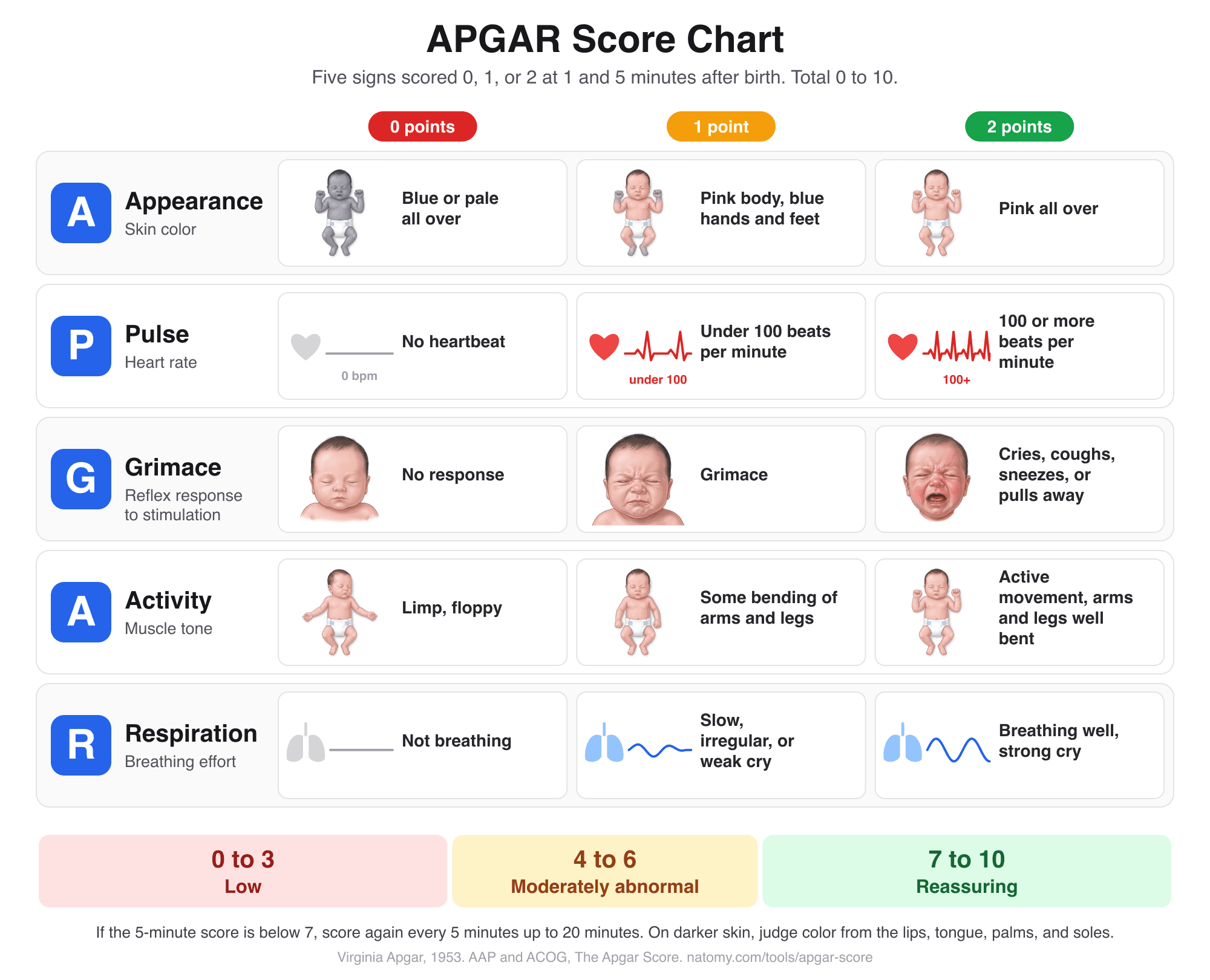
APGAR Score Chart and Calculator
Score the 5 newborn signs at 1, 5, and 10 minutes with an illustrated chart, what normal and low scores mean, and a note for the record.
Try it free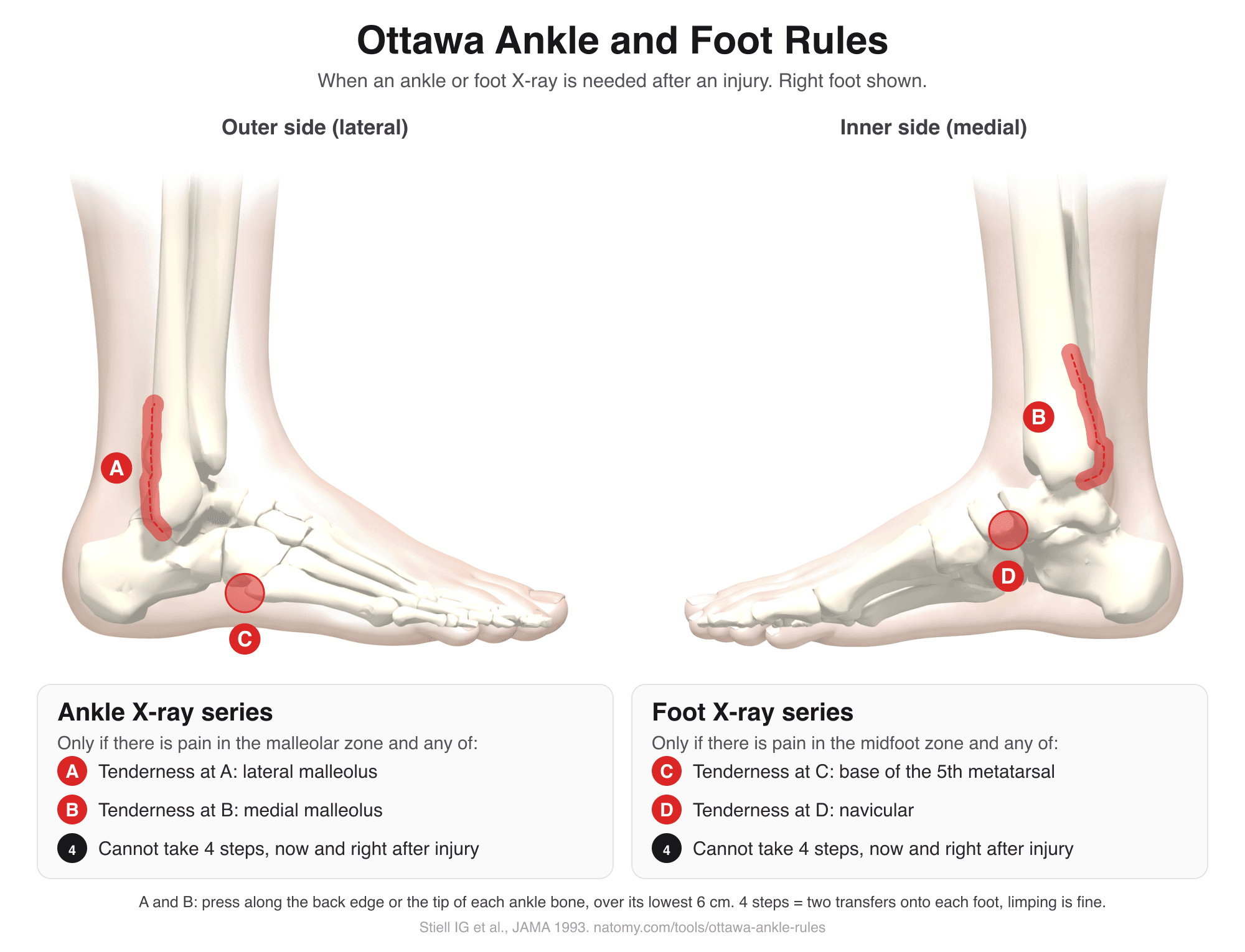
Ottawa Ankle Rules
Tap the tender spots on an illustrated ankle and foot to see if the Ottawa rules call for an X-ray. Includes the Ottawa knee rule.
Try it free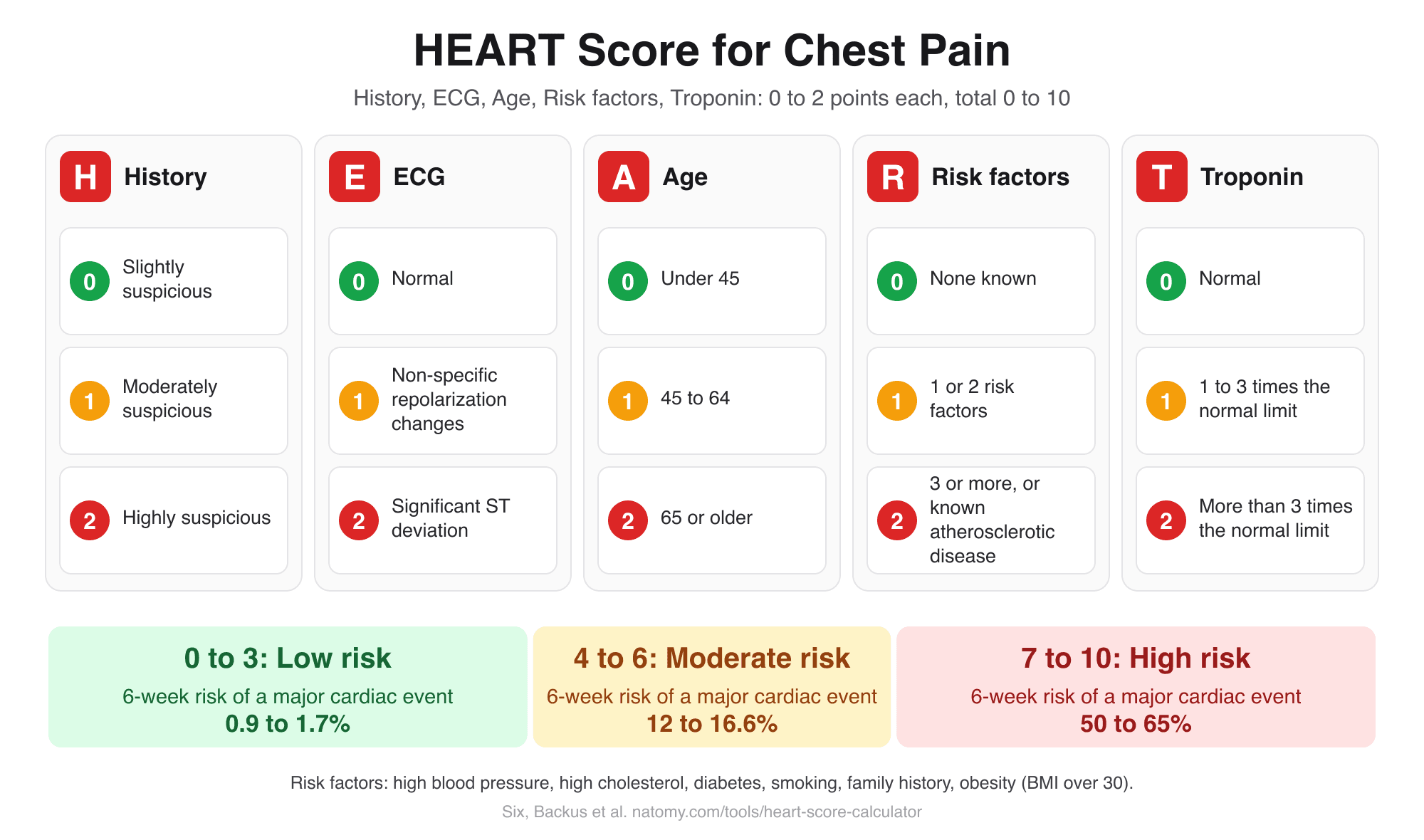
HEART Score Calculator
Score history, ECG, age, risk factors, and troponin for chest pain to get the HEART score, risk group, and 6-week MACE risk.
Try it free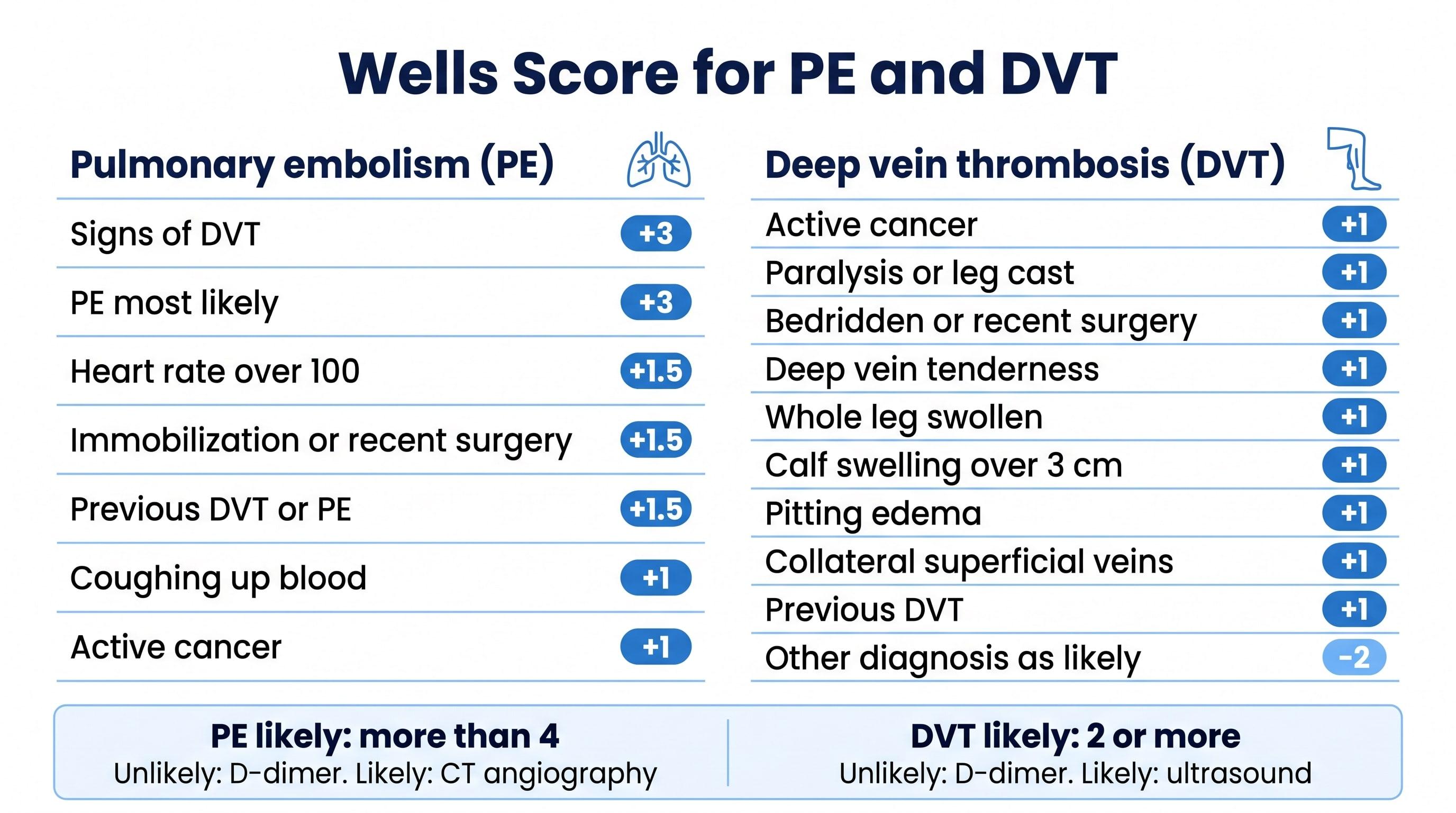
Wells Score Calculator (PE and DVT)
Check the Wells criteria for pulmonary embolism or deep vein thrombosis to get the score, the risk group, and the next test.
Try it free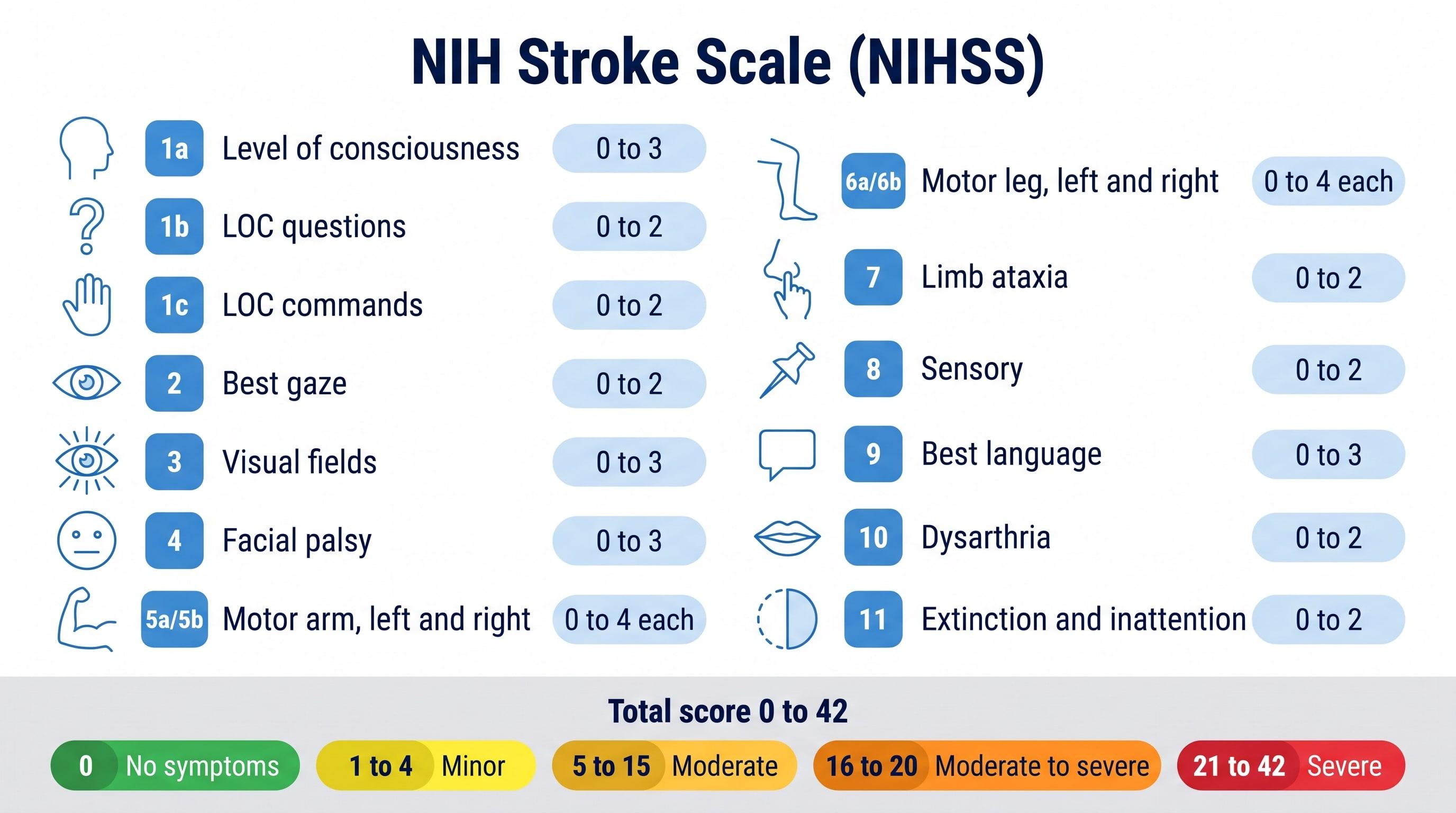
NIHSS Calculator (NIH Stroke Scale)
Score all 15 NIH Stroke Scale items to get the NIHSS total from 0 to 42 and the stroke severity range.
Try it free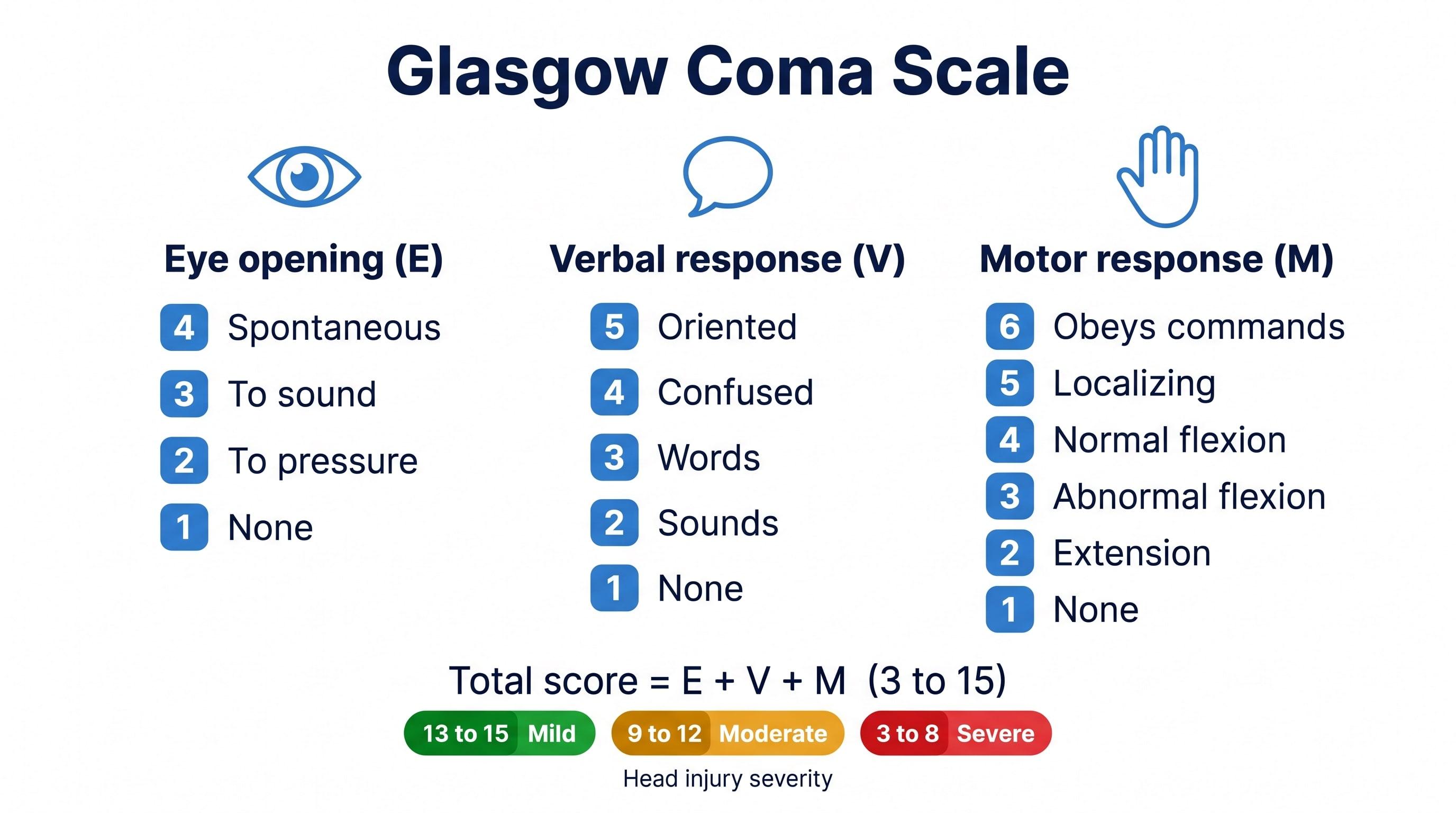
Glasgow Coma Scale Calculator
Score eye, verbal, and motor responses to get the GCS total, E V M code, severity range, and GCS-P.
Try it free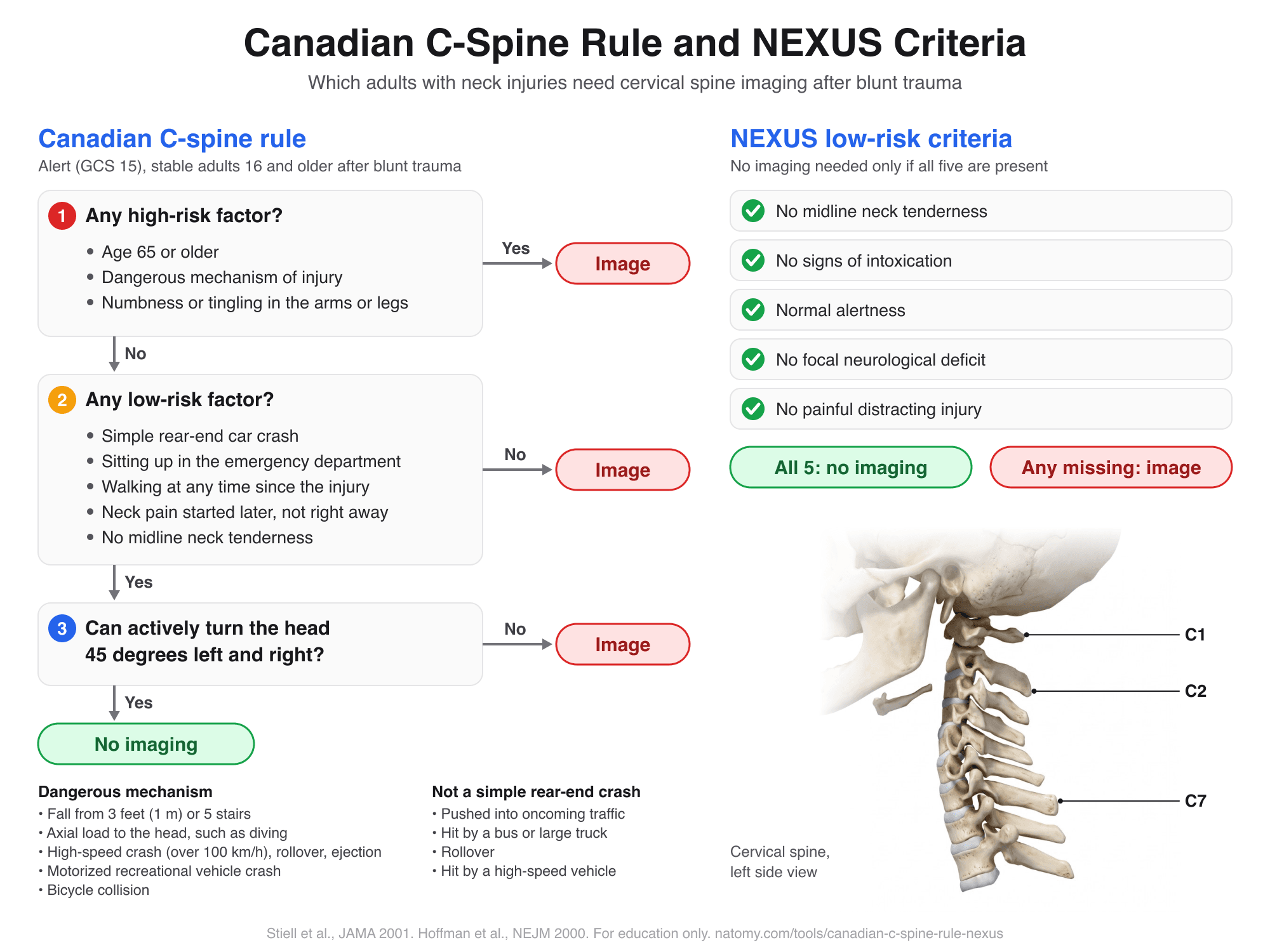
Canadian C-Spine Rule and NEXUS
Run the Canadian C-spine rule or the NEXUS criteria step by step to see which adults need neck imaging after trauma.
Try it free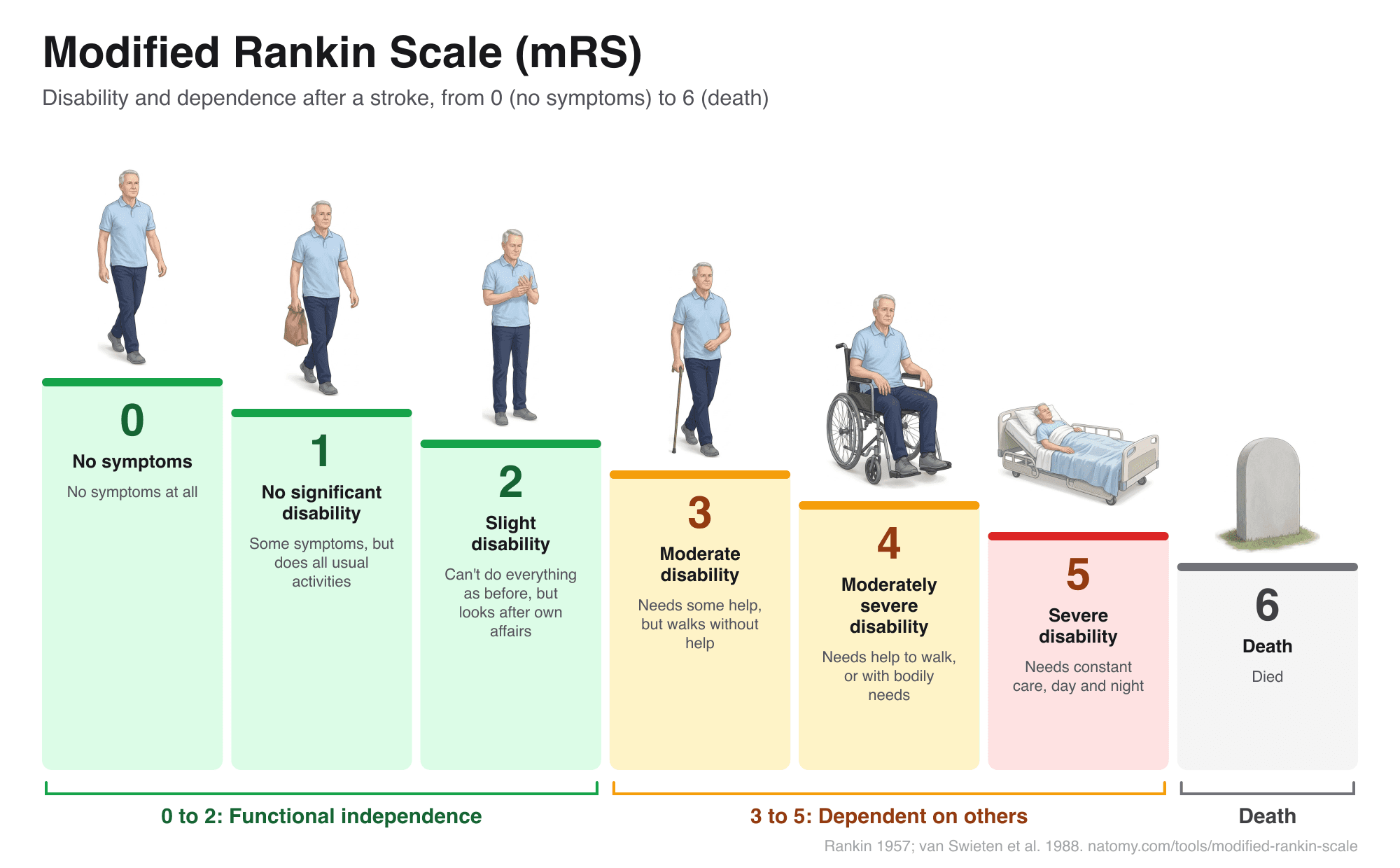
Modified Rankin Scale (mRS)
Illustrated mRS chart from 0 to 6 with a question-based score finder, what each grade means after a stroke, and a copyable note.
Try it free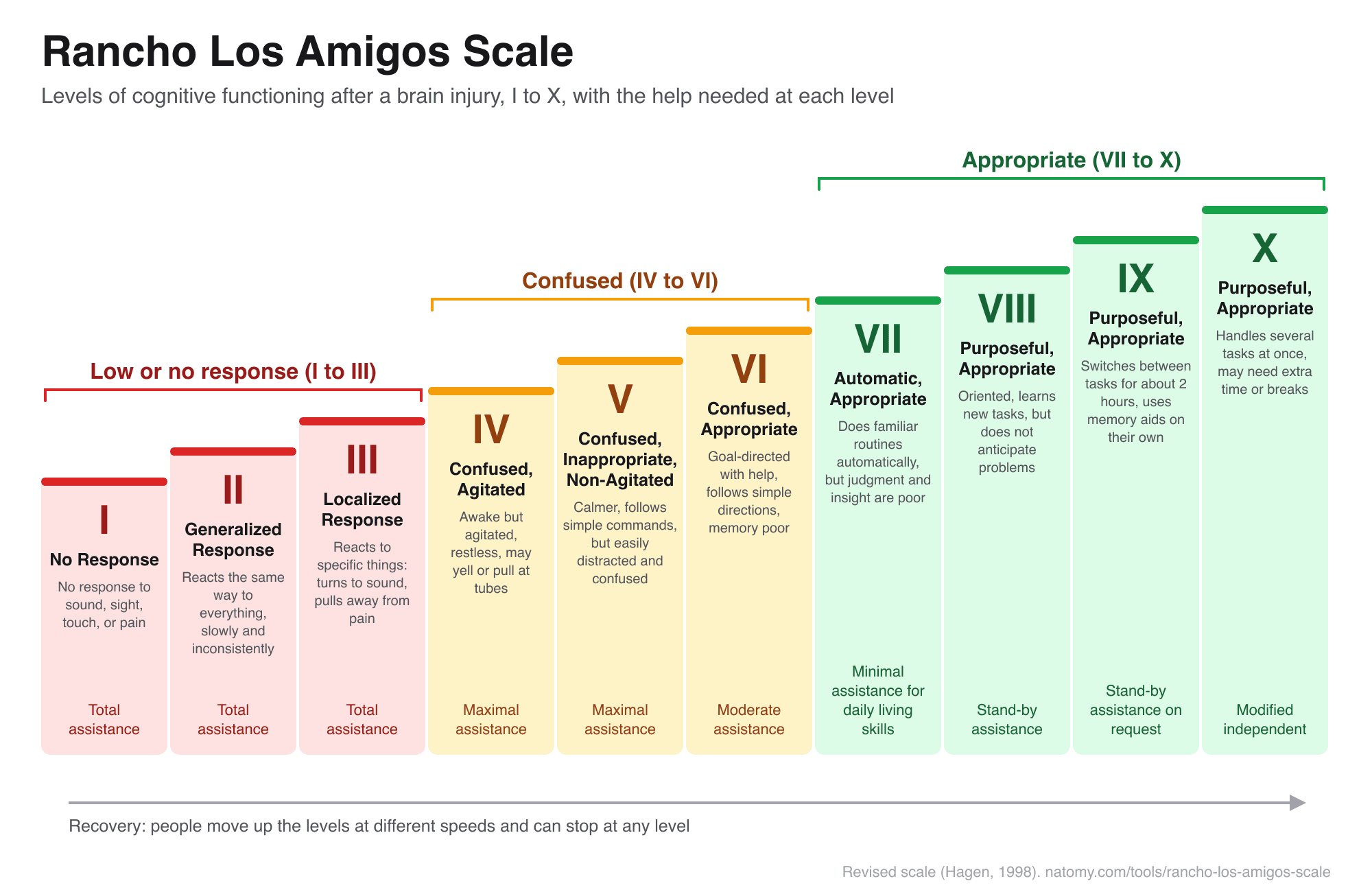
Rancho Los Amigos Scale
The 10 levels of cognitive functioning after a brain injury, with a level finder, what to expect, and how to help.
Try it free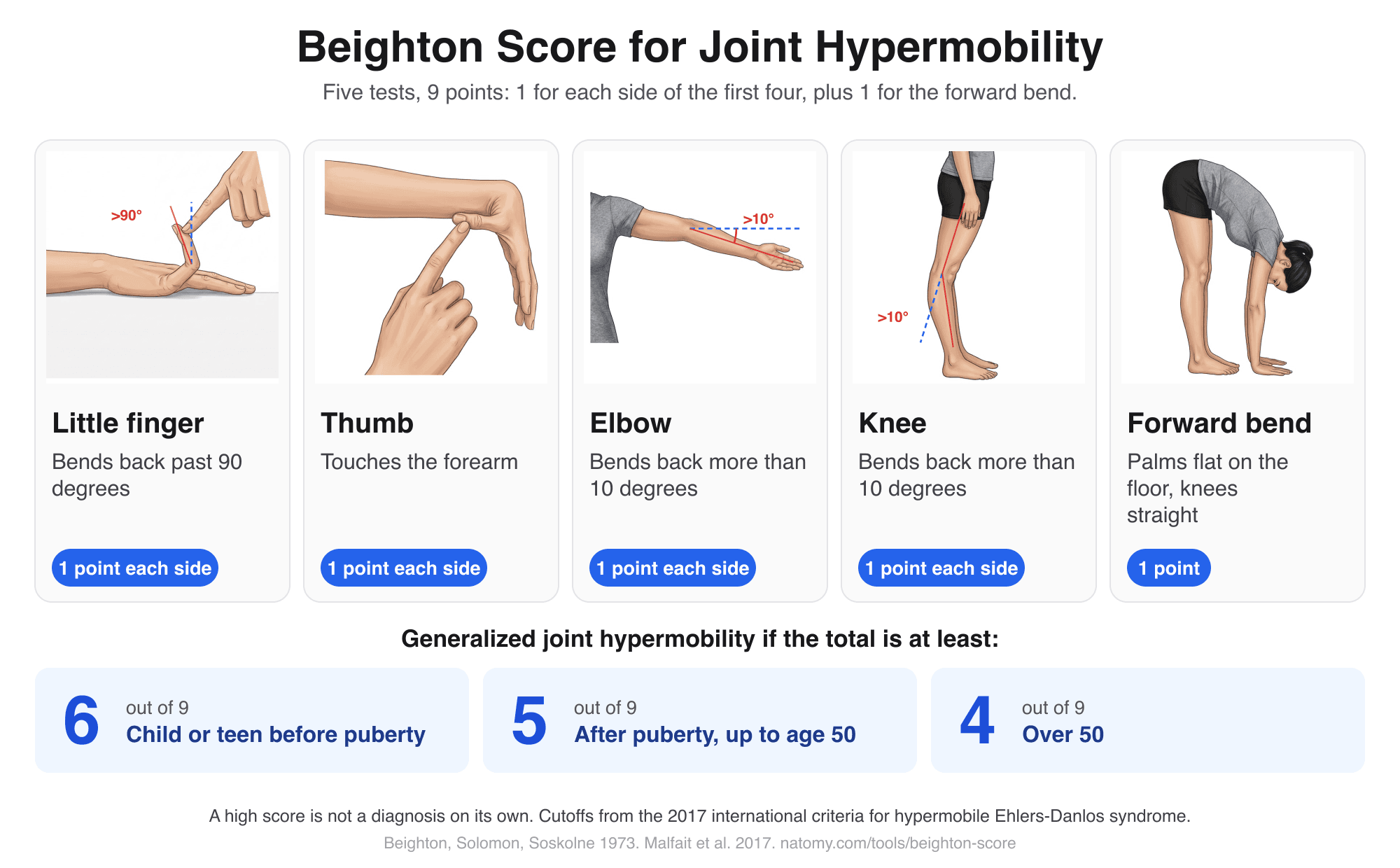
Beighton Score Calculator
Illustrated hypermobility test: score the 5 Beighton movements out of 9, compare with the age cutoff, and copy a note.
Try it free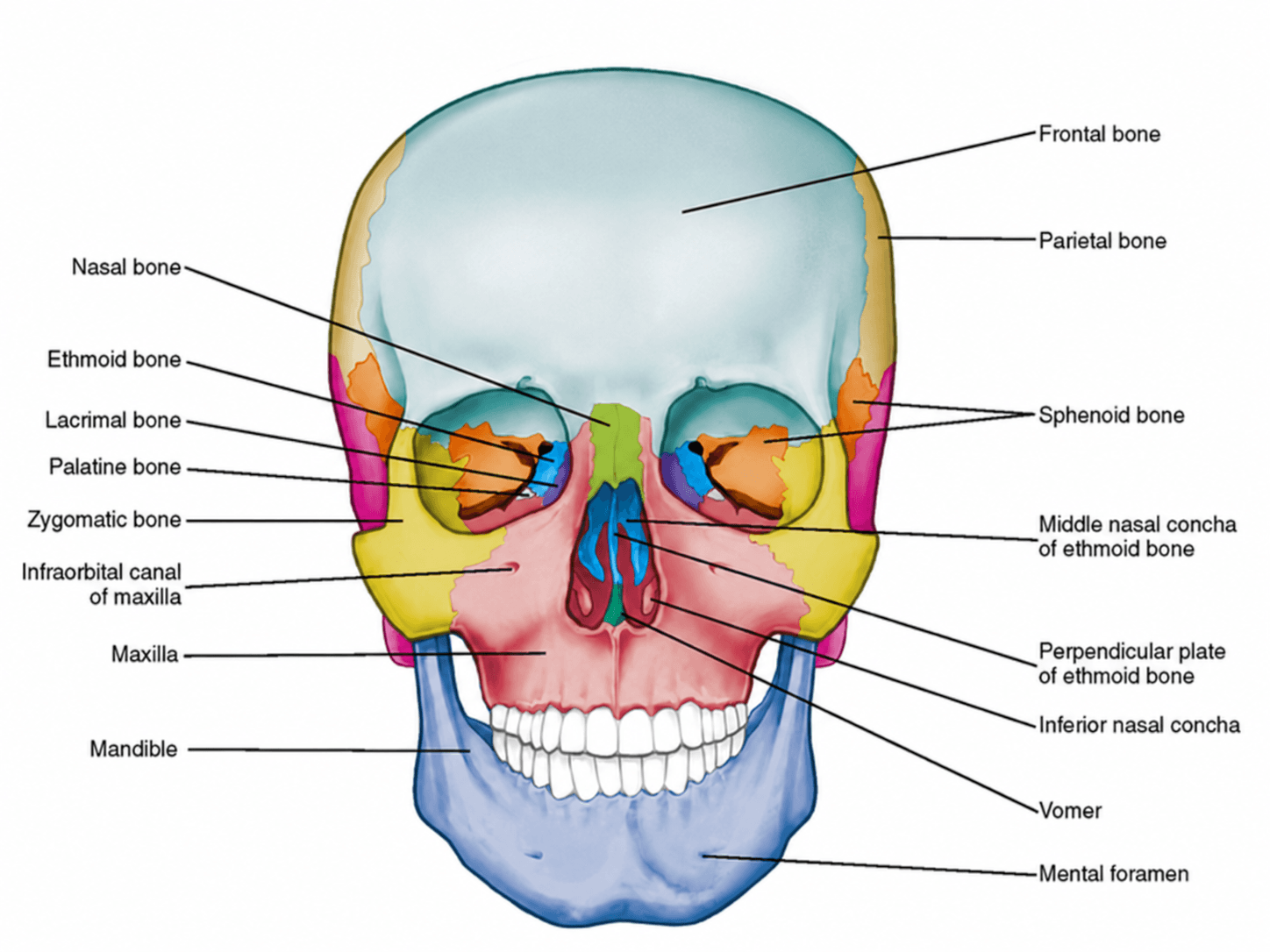
Anterior View of Skull Labeled
Free labeled and unlabeled anterior view of the skull, downloadable as PNG.
Try it free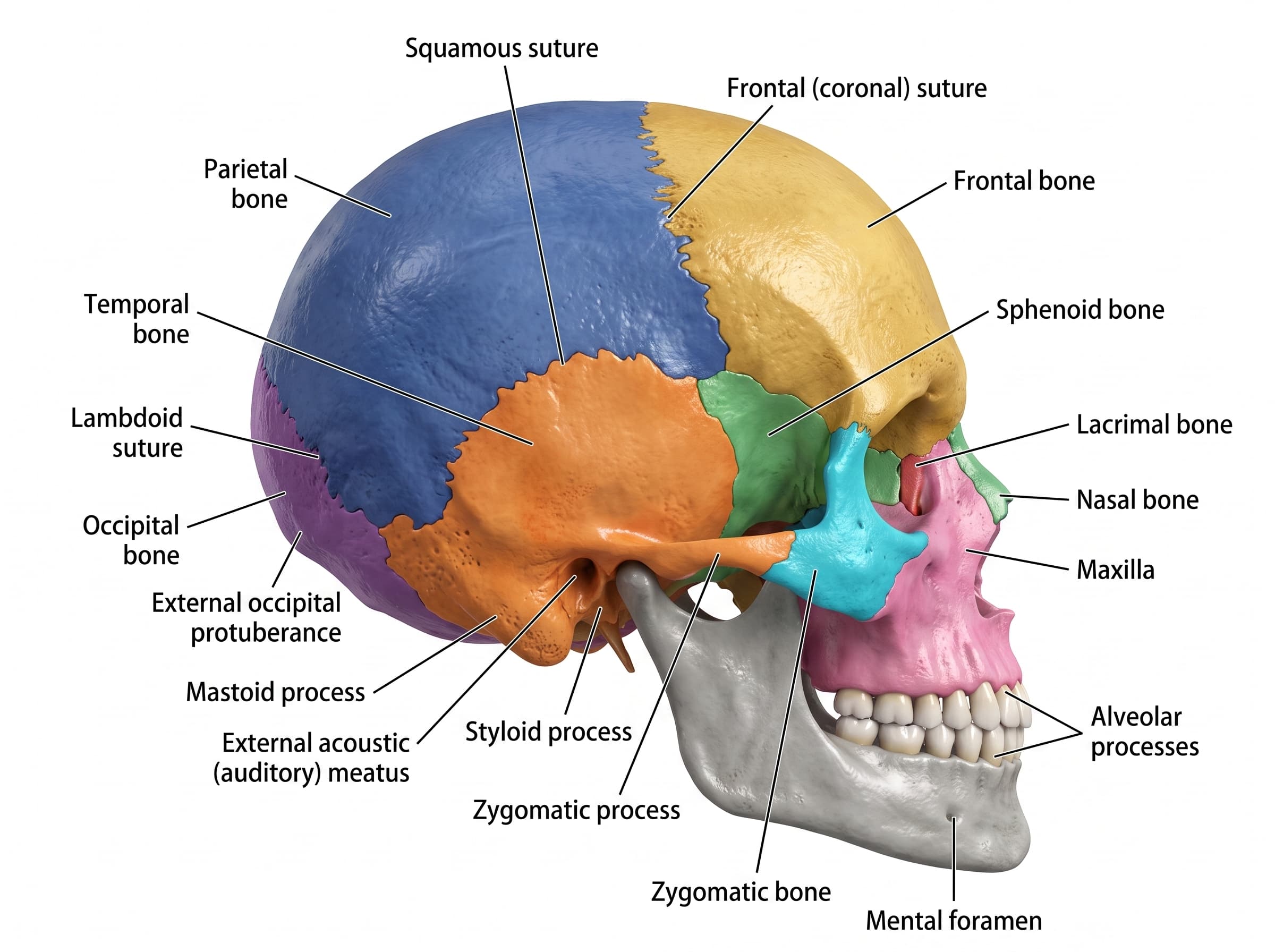
Lateral View of Skull Labeled
Free labeled and unlabeled lateral view of the skull, downloadable as PNG.
Try it free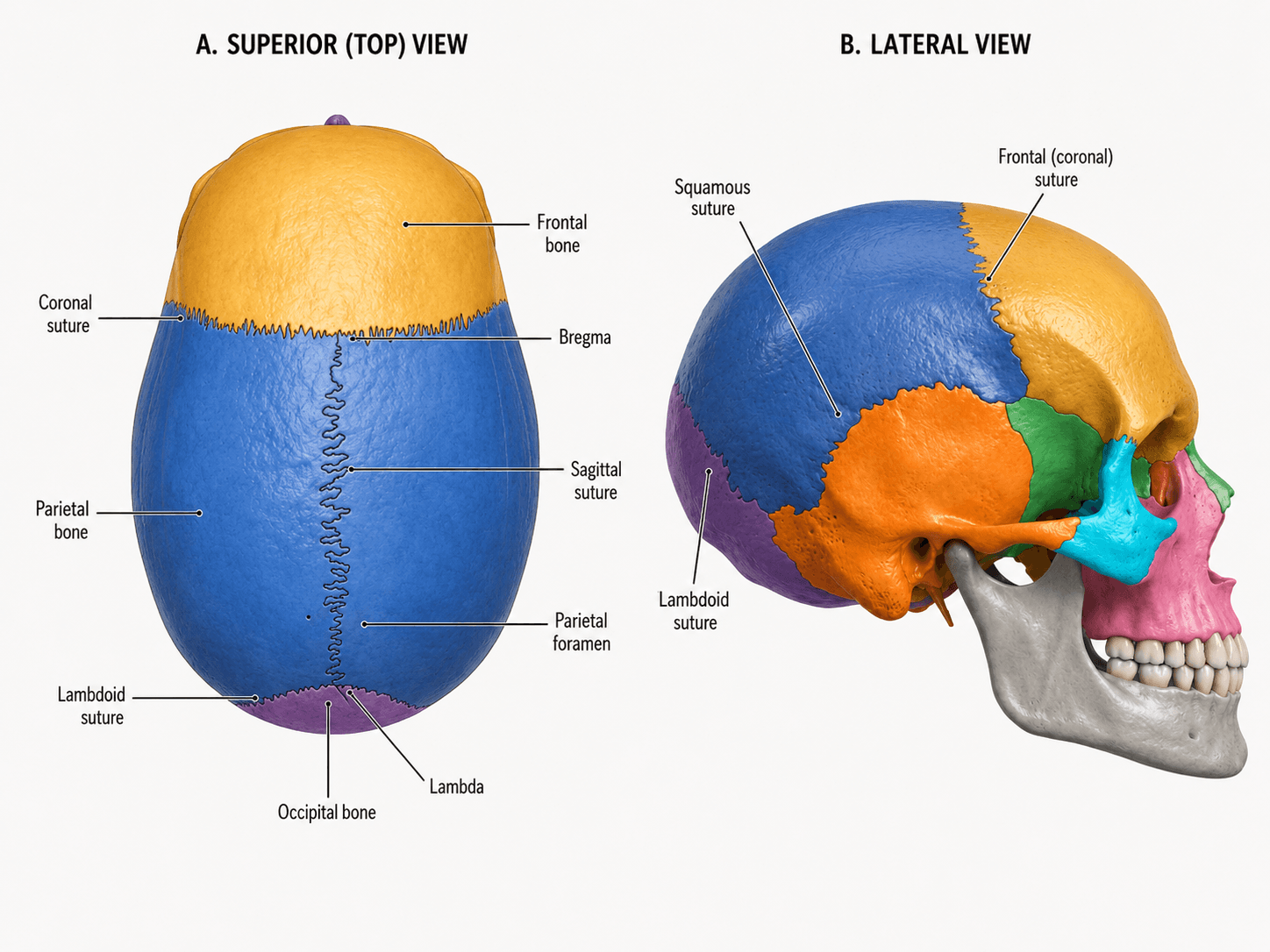
Skull Sutures Labeled
Free labeled and unlabeled skull sutures diagram, superior and lateral views, downloadable as PNG.
Try it free