Free Tools
Canadian C-Spine Rule and NEXUS Criteria
The Canadian C-spine rule and the NEXUS criteria are the two decision rules emergency clinicians use to decide which adults need imaging of the neck (cervical spine) after blunt trauma, such as a car crash or a fall. Use the free calculator to run either rule step by step and copy the result for the record.
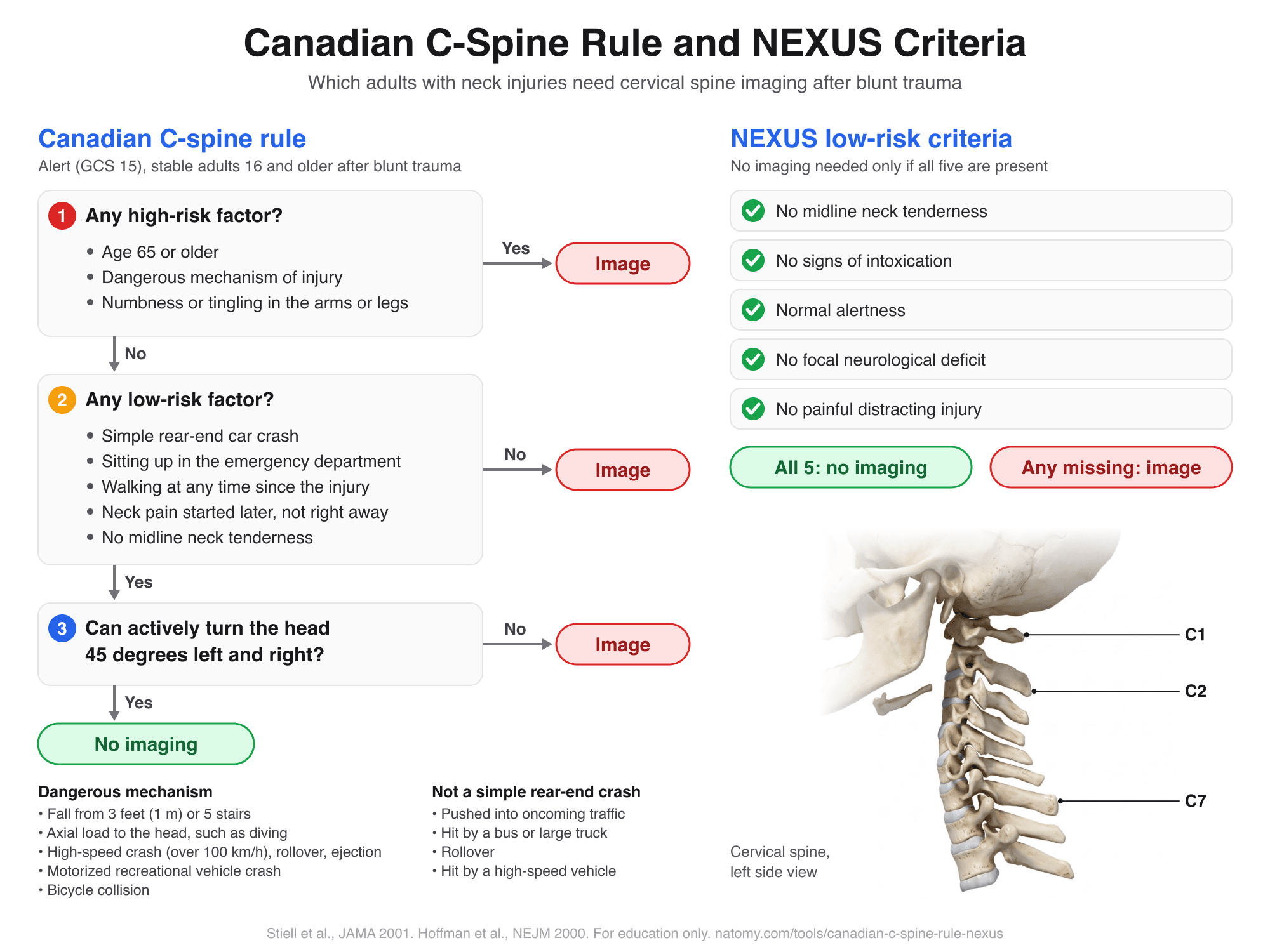
Download the chart (PNG) for teaching, the emergency department, or case files.
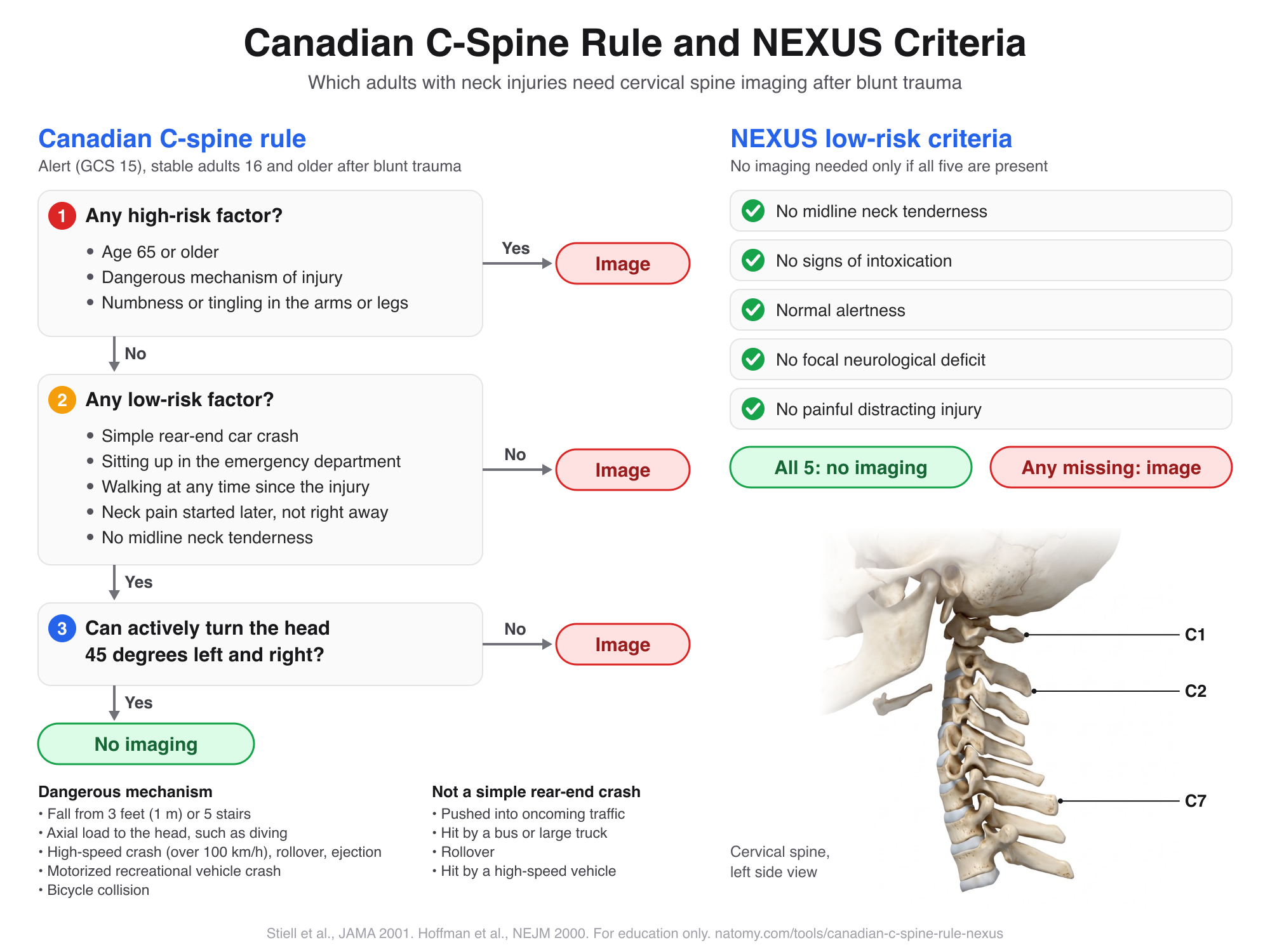
C-spine rule calculator
Who the Canadian rule applies to
- Alert: Glasgow Coma Scale of 15
- Stable: systolic blood pressure 90 or higher and breathing rate 10 to 24
- Blunt trauma to the head or neck within the last 48 hours
- Neck pain, or no neck pain but a visible injury above the collarbones, unable to walk, and a dangerous mechanism
It does not apply to:
- Under 16 years old
- Penetrating trauma
- Acute paralysis
- Known spine disease, such as ankylosing spondylitis, rheumatoid arthritis, spinal stenosis, or previous neck surgery
- Pregnancy
- Returning for reassessment of the same injury
The Canadian C-spine rule
The Canadian C-spine rule was derived by Dr. Ian Stiell and colleagues from 8,924 patients in 10 Canadian emergency departments and published in 2001. In that study it identified every clinically important cervical spine injury (sensitivity 100%), while allowing many patients to skip imaging (specificity 42.5%).
Who it applies to
- Alert: Glasgow Coma Scale of 15
- Stable: systolic blood pressure 90 or higher and breathing rate 10 to 24
- Blunt trauma to the head or neck within the last 48 hours
- Neck pain, or no neck pain but a visible injury above the collarbones, unable to walk, and a dangerous mechanism
It does not apply to patients with any of these:
- Under 16 years old
- Penetrating trauma
- Acute paralysis
- Known spine disease, such as ankylosing spondylitis, rheumatoid arthritis, spinal stenosis, or previous neck surgery
- Pregnancy
- Returning for reassessment of the same injury
Step 1: any high-risk factor means imaging
- Age 65 or older
- Dangerous mechanism of injury
- Numbness or tingling (paresthesias) in the arms or legs
A dangerous mechanism is any of:
- Fall from 3 feet (about 1 meter) or 5 stairs or higher
- Axial load to the head, such as diving
- Car crash at high speed (over 100 km/h, about 60 mph), rollover, or ejection
- Crash of a motorized recreational vehicle, such as an ATV or snowmobile
- Bicycle collision
Step 2: a low-risk factor allows a range-of-motion check
If there is no high-risk factor, look for at least one low-risk factor. Without one, the neck cannot safely be moved for the test in step 3, so the patient is imaged.
- Simple rear-end car crash
- Sitting up in the emergency department
- Walking (ambulatory) at any time since the injury
- Neck pain started later, not right away
- No tenderness over the midline of the back of the neck
A rear-end crash is not simple if the car was pushed into oncoming traffic, hit by a bus or large truck, rollover, or hit by a high-speed vehicle.
Step 3: can the patient turn the head?
The patient is asked to actively turn the head 45 degrees to the left and to the right, without help. If they can, imaging is not needed under the rule. If they cannot, the patient is imaged.
The NEXUS criteria
NEXUS, the National Emergency X-Radiography Utilization Study, enrolled 34,069 patients in 21 US emergency departments. A patient with blunt trauma does not need cervical spine imaging if all five low-risk criteria are present. In the study, the criteria found 99.6% of clinically significant injuries.
No tenderness over the midline of the back of the neck
From the base of the skull to the top of the back (T1), pain when the spine itself is pressed.
No signs of intoxication
No history or signs of alcohol or drug intoxication.
Normal alertness
Glasgow Coma Scale 15, oriented, answers promptly, and remembers 3 objects after 5 minutes.
No focal neurological deficit
No focal neurological complaint by history and no focal finding on the motor or sensory exam.
No painful distracting injury
No other injury painful enough to distract from neck pain, such as a long-bone fracture, an internal injury needing a surgeon, a large cut, degloving, crush injury or burn, or any injury that causes acute loss of function.
A focal deficit or numbness that follows a nerve root pattern can be mapped with the dermatome map, and alertness is usually documented with the Glasgow Coma Scale.
Canadian C-spine rule vs NEXUS
| Canadian C-spine rule | NEXUS | |
|---|---|---|
| Published | 2001, JAMA | 2000, NEJM |
| Patients | Alert (GCS 15), stable, 16 and older | Blunt trauma, no age limit |
| Steps | 3 questions, including a neck rotation test | 5 criteria, no movement test |
| Age 65 or older | Always imaged | No separate age rule |
| Sensitivity in the 2003 comparison | 99.4% | 90.7% |
| Specificity in the 2003 comparison | 45.1% | 36.8% |
The 2003 comparison (Stiell et al., NEJM) applied both rules to 7,438 alert, stable adults. The Canadian rule would have missed 1 patient with a clinically important injury and NEXUS would have missed 16. Because that study only included GCS 15 patients, it favored the setting the Canadian rule was built for. NEXUS remains widely used because it is quick and needs no movement test.
The cervical spine
The neck has seven cervical vertebrae, C1 to C7. C1 (the atlas) carries the skull and C2 (the axis) has the dens, the peg the atlas rotates around. C7 has the long spinous process you can feel at the base of the neck. In the NEXUS cohort, about a third of injuries were at C2 and about half were at C6 or C7. See the cervical spine anatomy guide for labeled illustrations, and cervical disc herniation for a common cause of arm numbness after neck injuries.
Limits of the rules
- Both rules are for blunt trauma only, not penetrating injuries.
- Neither replaces clinical judgment. A clinician can image a patient the rule calls low risk.
- The Canadian rule needs a cooperative patient for the rotation test and does not apply to people with known spine disease.
- Age 65 or older was a high-risk predictor in the Canadian rule's own derivation study. Some later studies found NEXUS less sensitive in older adults (reported sensitivity ranges from about 66% to 100%), so many clinicians use a low threshold to image them.
- Neither rule was designed for young children.
C-spine rules in neck injury cases
A missed cervical spine fracture is one of the classic emergency medicine malpractice claims, because a fracture sent home without imaging can later cause spinal cord injury. Attorneys and expert reviewers look at whether a rule was applied and documented, whether a high-risk factor such as age or a dangerous mechanism was recorded, and whether the patient had midline tenderness or abnormal neurological findings that should have led to imaging.
In car crash and whiplash claims, the same emergency records show how the neck was assessed on the day of the injury: the mechanism, the symptoms, the exam, and why imaging was or was not done. Clear demand package visuals then help explain the injury to adjusters and juries.
Illustrate a neck injury
Natomy turns CT and MRI scans, records, and prompts into clear, labeled medical illustrations of cervical fractures, disc injuries, and spinal cord injuries for patient education and medical-legal exhibits. See examples in the Natomy atlas.
Try Natomy TodayFAQ
What is the Canadian C-spine rule?+
The Canadian C-spine rule is a three-step decision rule for alert, stable adults with a neck injury after blunt trauma. Any high-risk factor (age 65 or older, a dangerous mechanism, or numbness or tingling in the limbs) means imaging. Otherwise, if a low-risk factor allows it, the patient is asked to turn the head 45 degrees each way; if they can, imaging is not needed. It was published by Stiell and colleagues in JAMA in 2001.
What are the NEXUS criteria?+
NEXUS (the National Emergency X-Radiography Utilization Study) gives five low-risk criteria: no midline neck tenderness, no signs of intoxication, normal alertness, no focal neurological deficit, and no painful distracting injury. If all five are present after blunt trauma, cervical spine imaging is not needed. It was published by Hoffman and colleagues in the New England Journal of Medicine in 2000.
Which is better, the Canadian C-spine rule or NEXUS?+
In a head-to-head study of 7,438 alert, stable adults (Stiell 2003, NEJM), the Canadian rule was more sensitive (99.4% vs 90.7%) and more specific (45.1% vs 36.8%) for clinically important injuries. NEXUS is simpler and does not need a range-of-motion test, and it was not limited to GCS 15 patients. Many emergency departments use either, and some use both.
What counts as a dangerous mechanism?+
Fall from 3 feet (about 1 meter) or 5 stairs or higher. Axial load to the head, such as diving. Car crash at high speed (over 100 km/h, about 60 mph), rollover, or ejection. Crash of a motorized recreational vehicle, such as an ATV or snowmobile. Bicycle collision.
What is a simple rear-end collision?+
A rear-end car crash at ordinary speed. It is not simple if the car was pushed into oncoming traffic, hit by a bus or large truck, rollover, or hit by a high-speed vehicle.
Do these rules apply to older adults and children?+
The Canadian rule treats age 65 or older as high risk, so older adults are always imaged under it, and it was not studied in patients under 16. NEXUS had no age limit, but few young children were enrolled. Some later studies found NEXUS less sensitive in older adults (reported sensitivity ranges from about 66% to 100%), so many clinicians use a low threshold to image them. Children are usually assessed with pediatric-specific approaches.
Is a CT scan or an X-ray used?+
The original studies used plain X-rays, but CT is now the recommended first imaging test for adults who need cervical spine imaging after trauma (ACR, NICE), because it finds fractures more reliably. MRI is added when there are neurological symptoms or a suspected ligament or spinal cord injury.
Why do lawyers care about the Canadian C-spine rule and NEXUS?+
A missed neck fracture is a well-known emergency medicine malpractice claim. When a patient with a high-risk factor or a failed NEXUS criterion was sent home without imaging, the record of whether the rule was applied, and how, is often central to the case. In car crash and whiplash claims, the same records show how the injury was assessed on day one.
Sources: Stiell IG, Wells GA, Vandemheen KL, et al. The Canadian C-spine rule for radiography in alert and stable trauma patients. JAMA. 2001;286(15):1841-1848. Hoffman JR, Mower WR, Wolfson AB, et al. Validity of a set of clinical criteria to rule out injury to the cervical spine in patients with blunt trauma. N Engl J Med. 2000;343(2):94-99. Stiell IG, Clement CM, McKnight RD, et al. The Canadian C-spine rule versus the NEXUS low-risk criteria in patients with trauma. N Engl J Med. 2003;349(26):2510-2518. Goldberg W, Mueller C, Panacek E, et al. Distribution and patterns of blunt traumatic cervical spine injury. Ann Emerg Med. 2001;38(1):17-21. Paykin G, O'Reilly G, Ackland HM, Mitra B. Review article: NEXUS criteria to rule out cervical spine injury among older patients: a systematic review. Injury. 2017. American College of Radiology. ACR Appropriateness Criteria: Suspected Spine Trauma. National Institute for Health and Care Excellence. Spinal injury: assessment and initial management (NG232). Descriptions are written in our own words. For education and documentation only; not a substitute for clinical judgment.
Related free tools
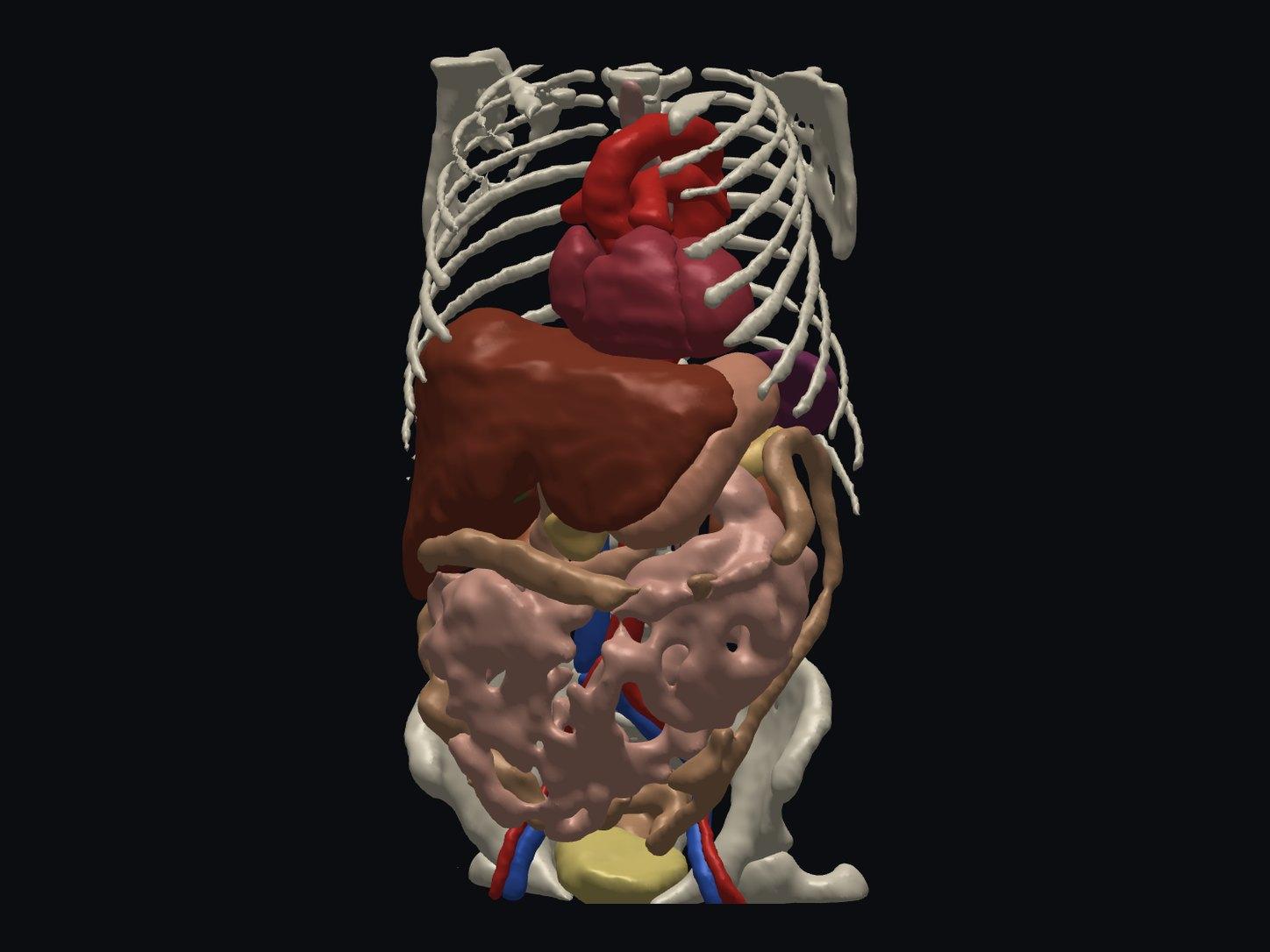
Free Online DICOM Viewer (3D)
Open a CT or MRI DICOM folder in your browser and view it in 3D, with AI anatomy labeling. Nothing is uploaded.
Try it free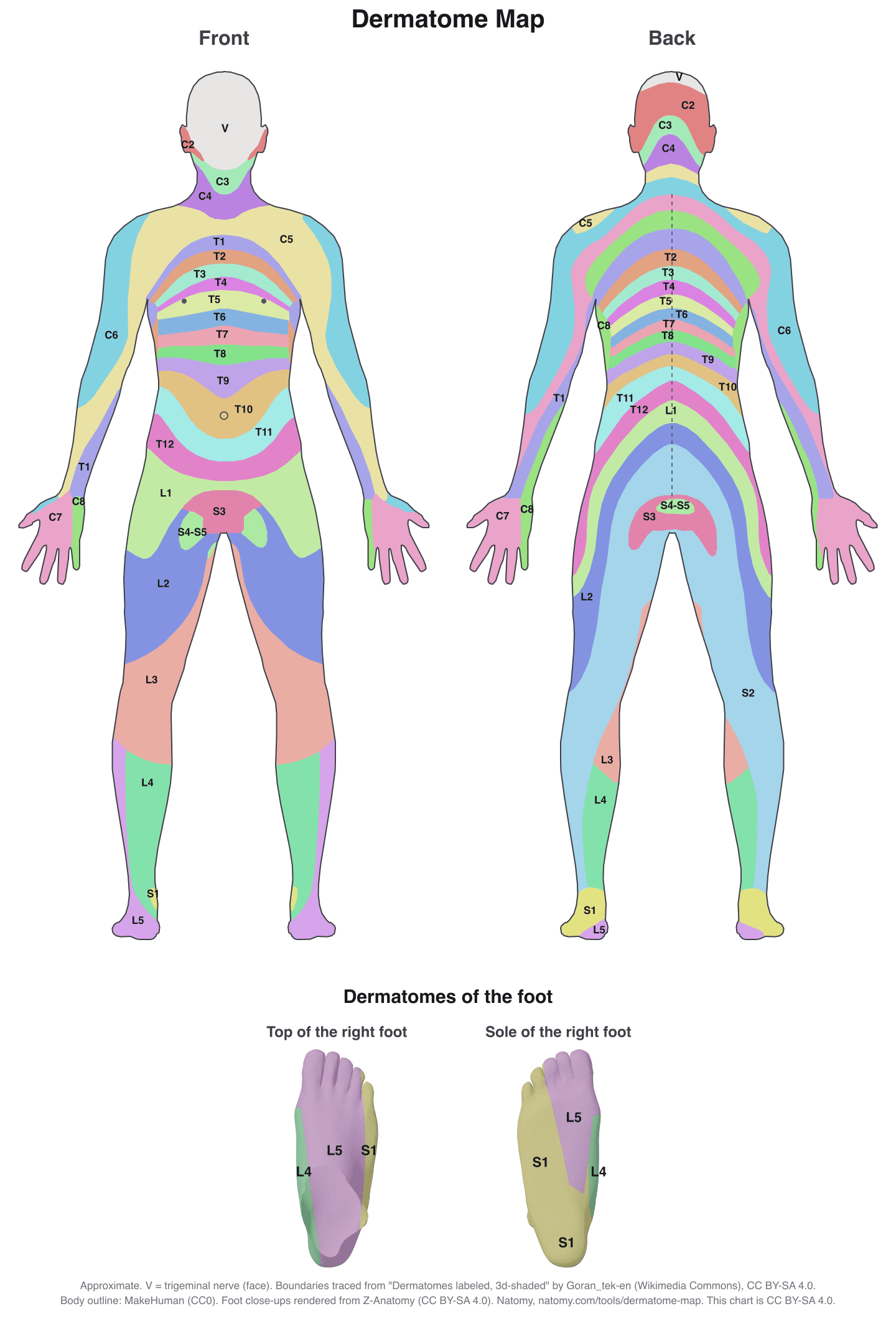
Interactive Dermatome Map
Tap the body to see each nerve root's skin area, test point, myotome, reflex, and disc level. Free printable chart.
Try it free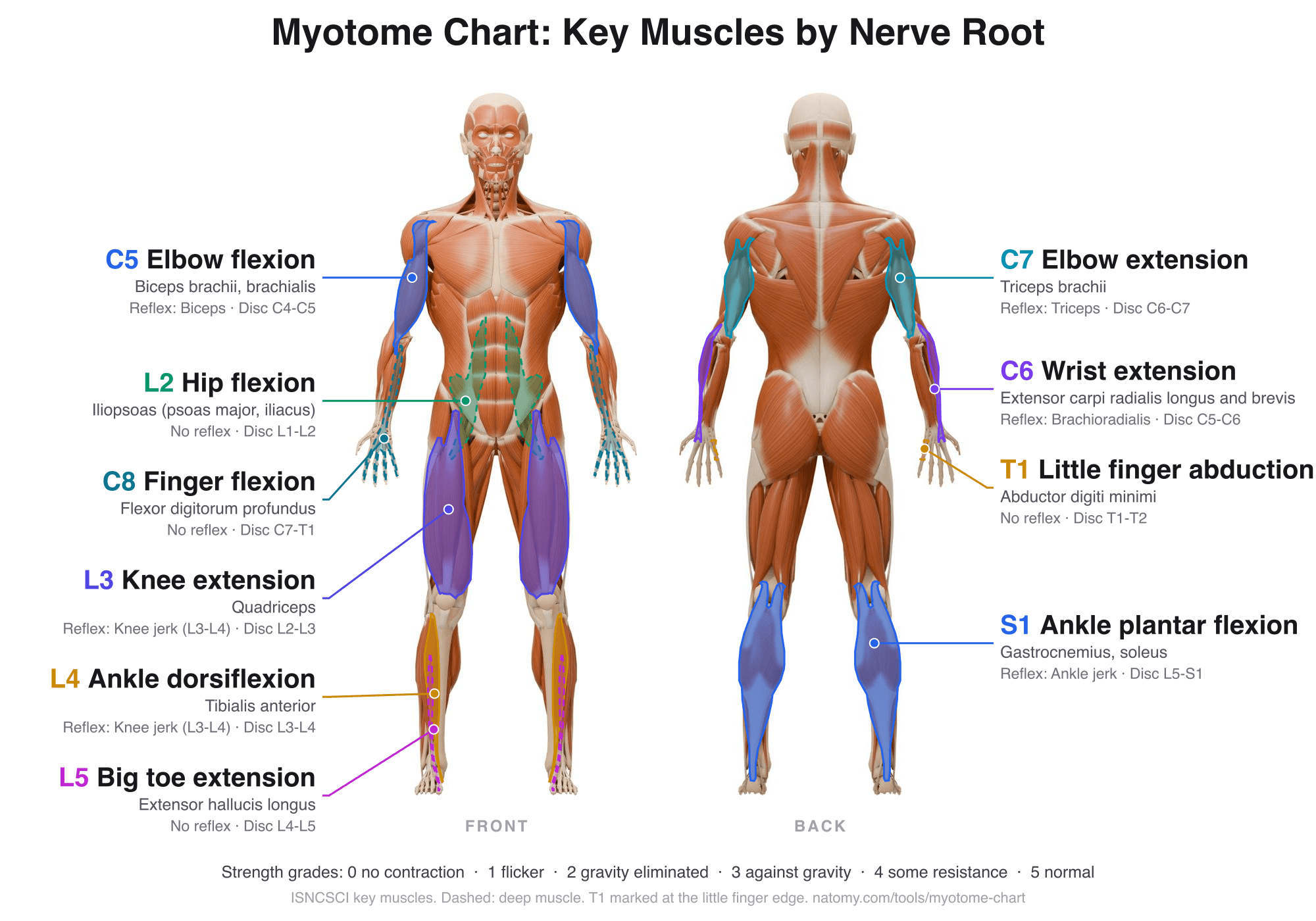
Myotome Chart and Motor Score
Tap a nerve root to see its key muscle, test position, and reflex. Grade strength 0 to 5 for the ISNCSCI motor score.
Try it free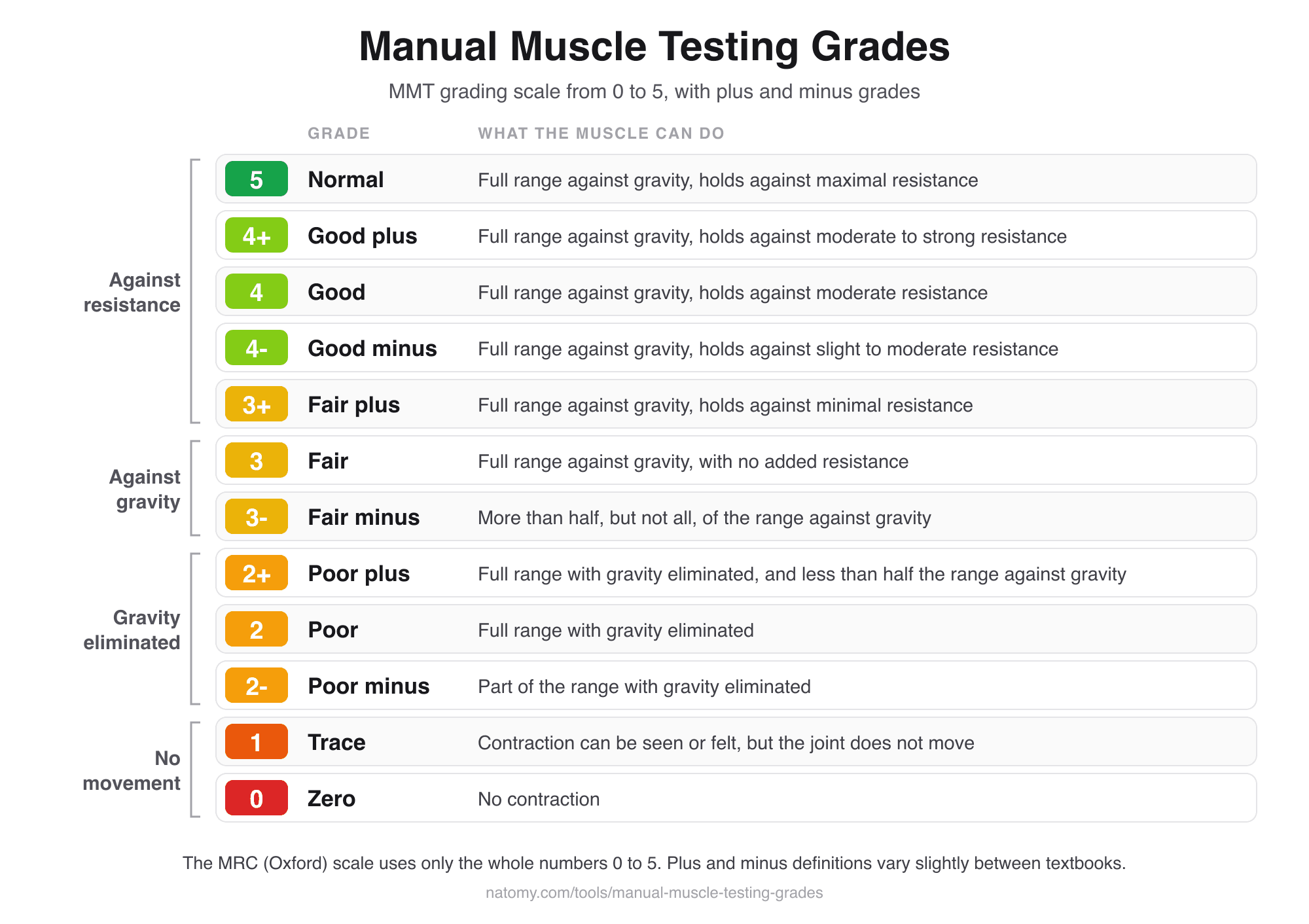
Manual Muscle Testing Grades
MMT grading scale chart from 0 to 5 with plus and minus grades, and a grade finder that writes the note for you.
Try it free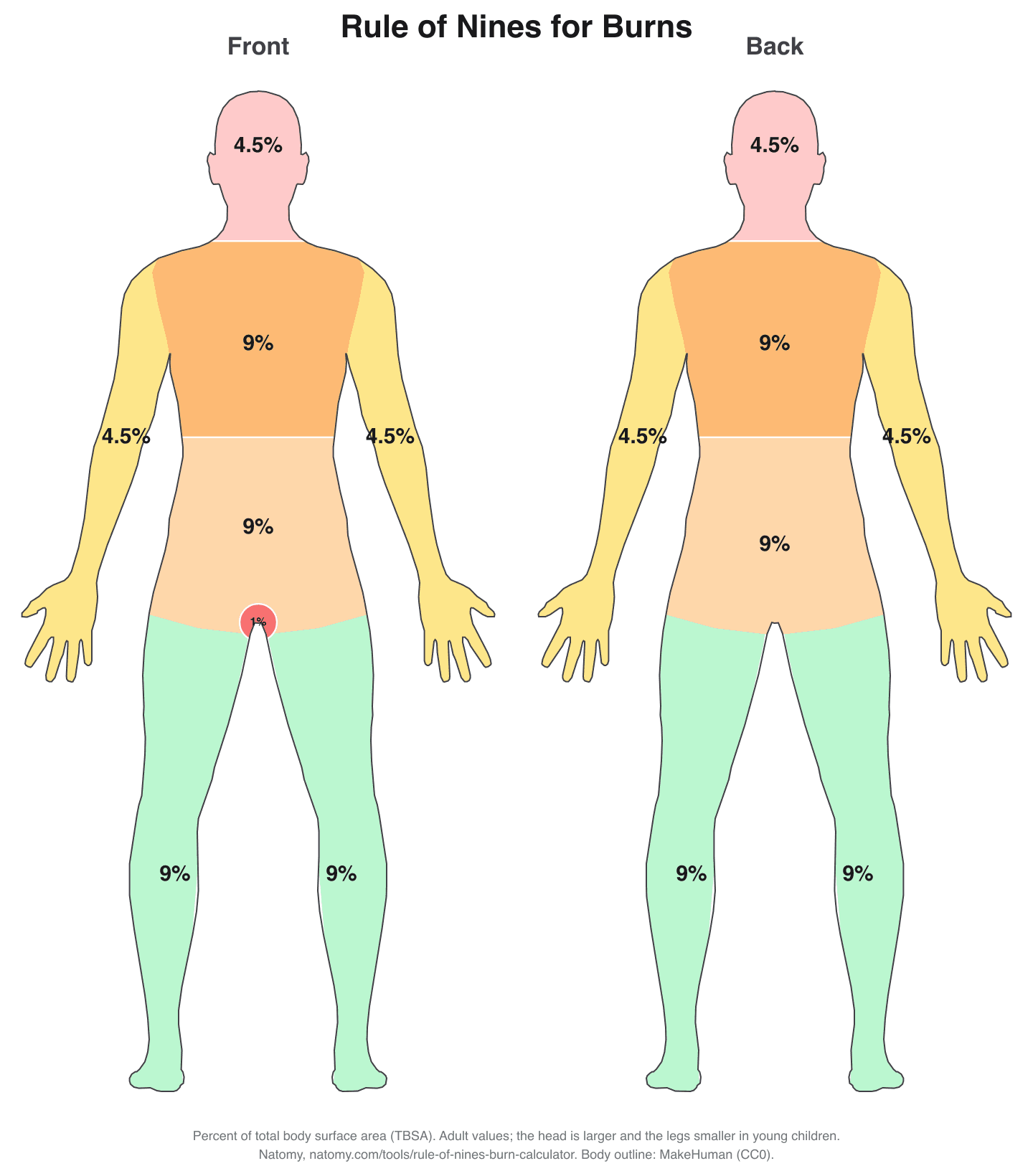
Rule of Nines Burn Calculator
Click the burned areas to get the total body surface area (TBSA), with the Parkland formula and a printable burn chart.
Try it free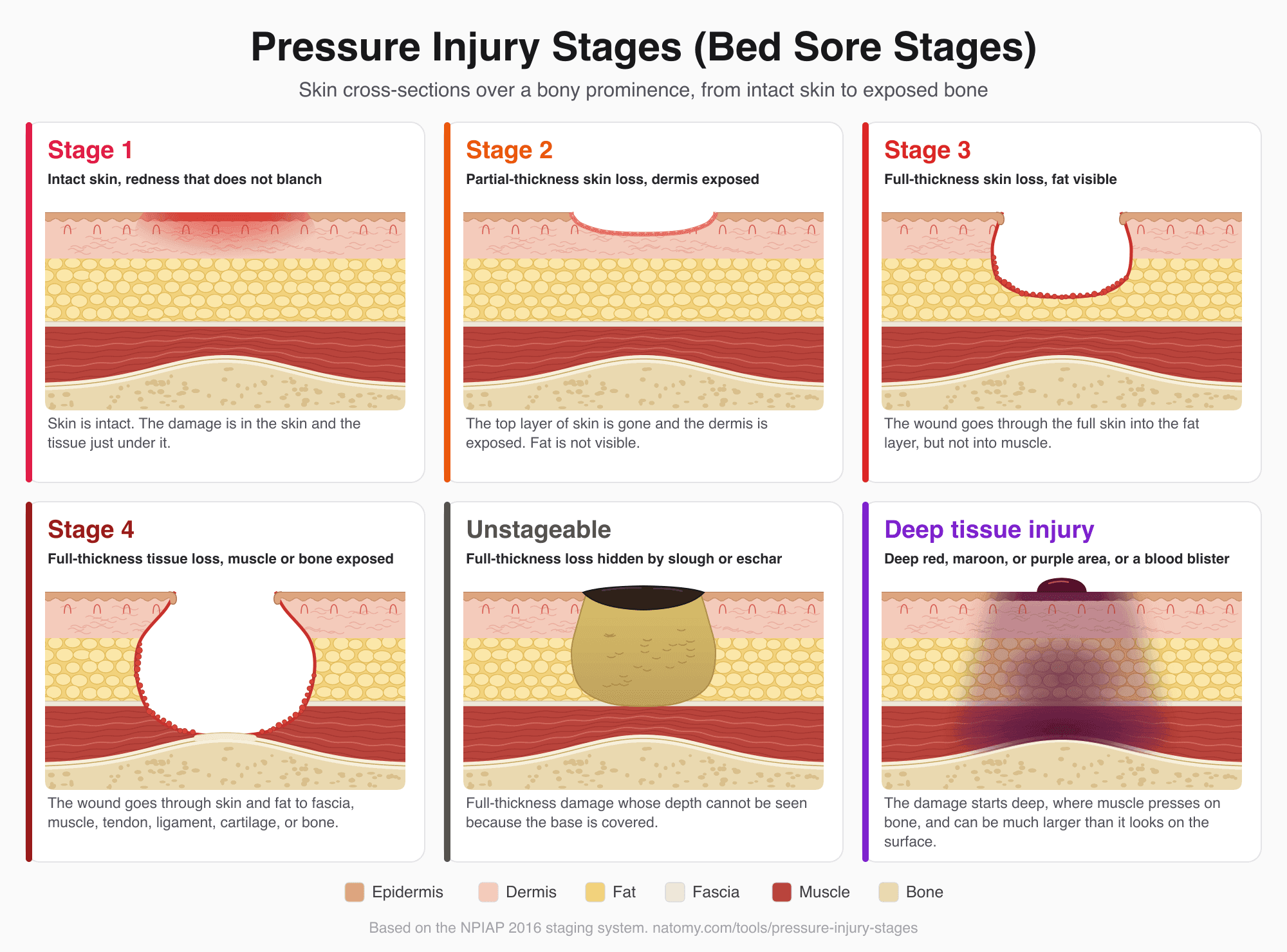
Pressure Injury (Bed Sore) Stages
Illustrated pressure ulcer stages chart, Stage 1 to 4, unstageable, and deep tissue injury, with a stage finder and wound note.
Try it free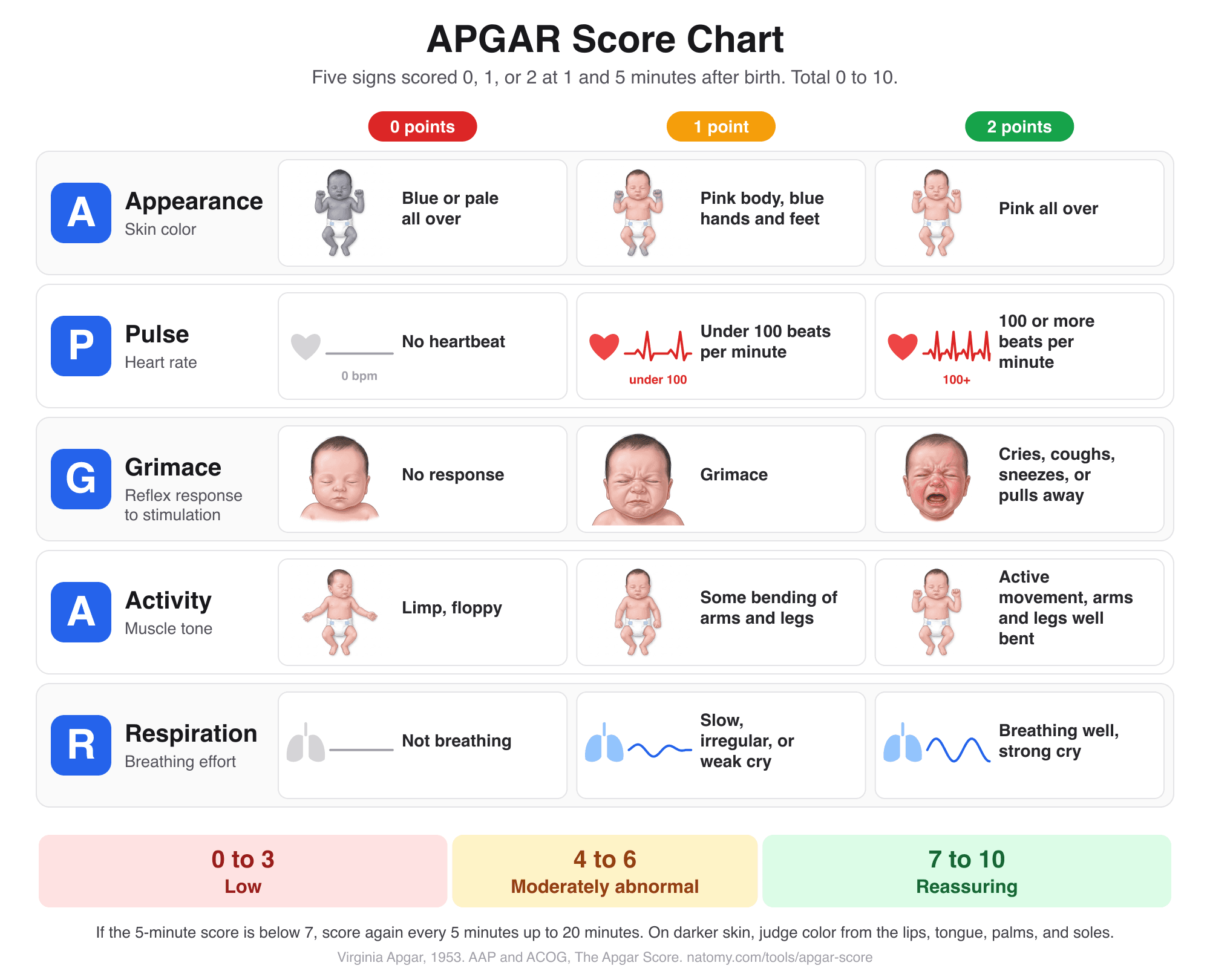
APGAR Score Chart and Calculator
Score the 5 newborn signs at 1, 5, and 10 minutes with an illustrated chart, what normal and low scores mean, and a note for the record.
Try it free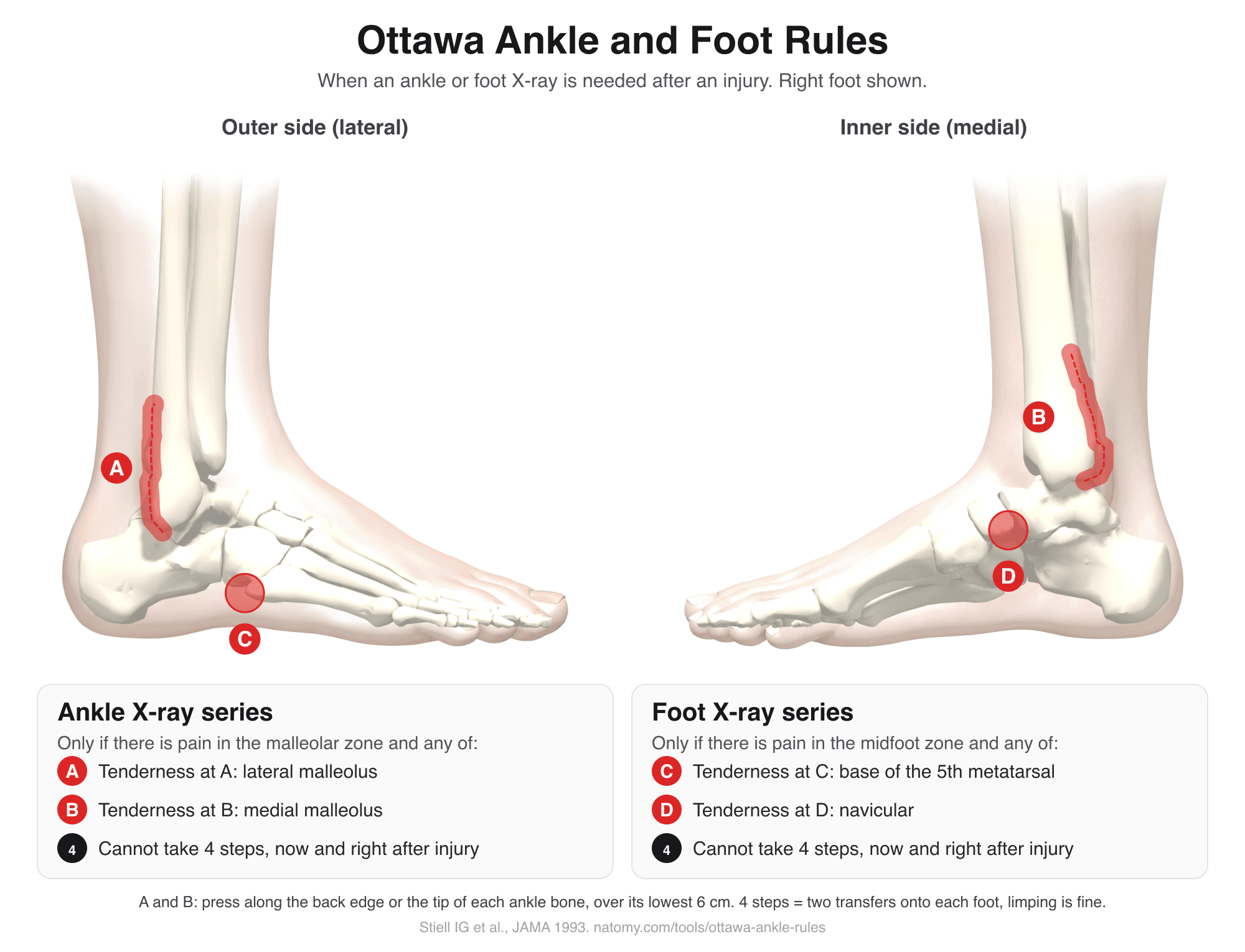
Ottawa Ankle Rules
Tap the tender spots on an illustrated ankle and foot to see if the Ottawa rules call for an X-ray. Includes the Ottawa knee rule.
Try it free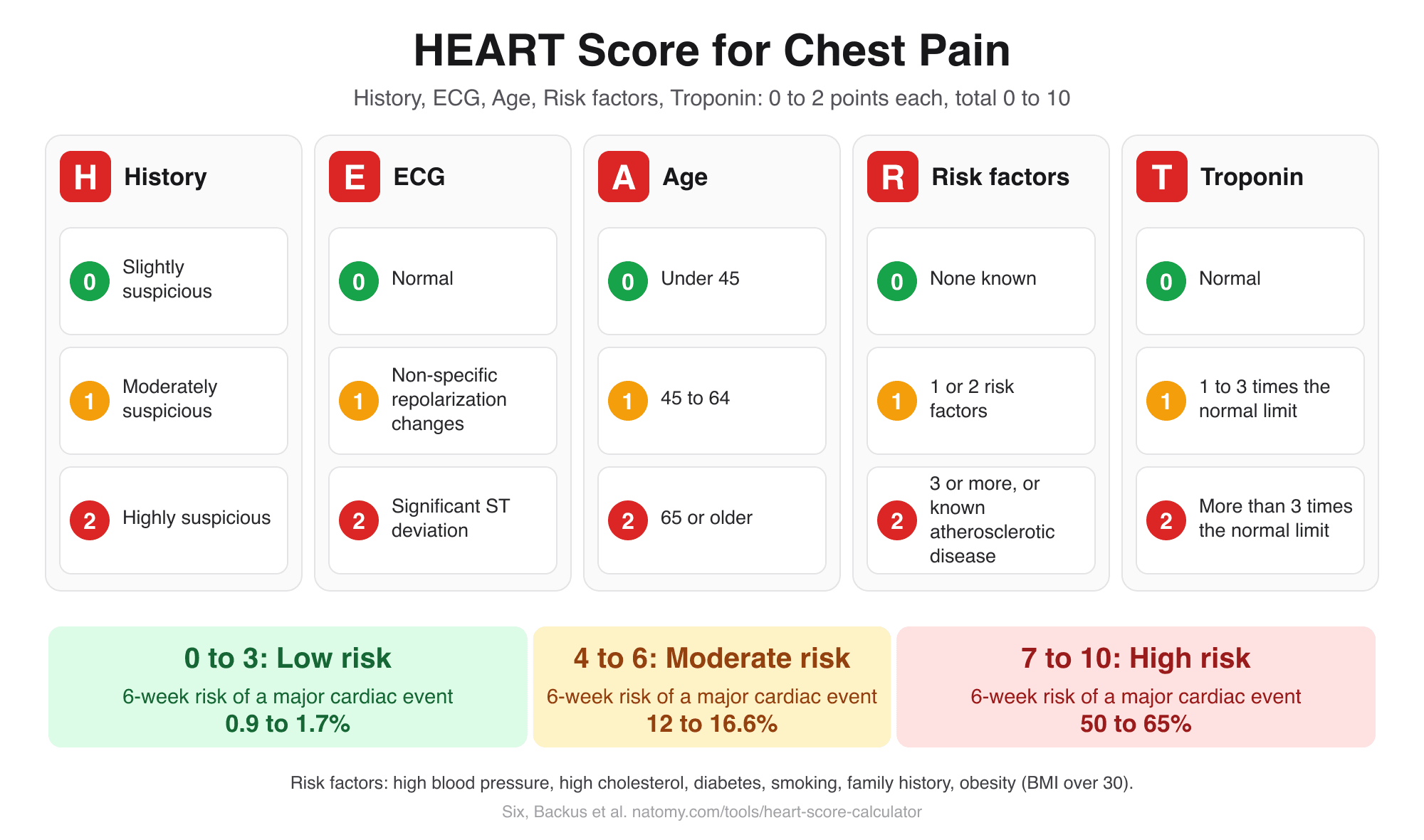
HEART Score Calculator
Score history, ECG, age, risk factors, and troponin for chest pain to get the HEART score, risk group, and 6-week MACE risk.
Try it free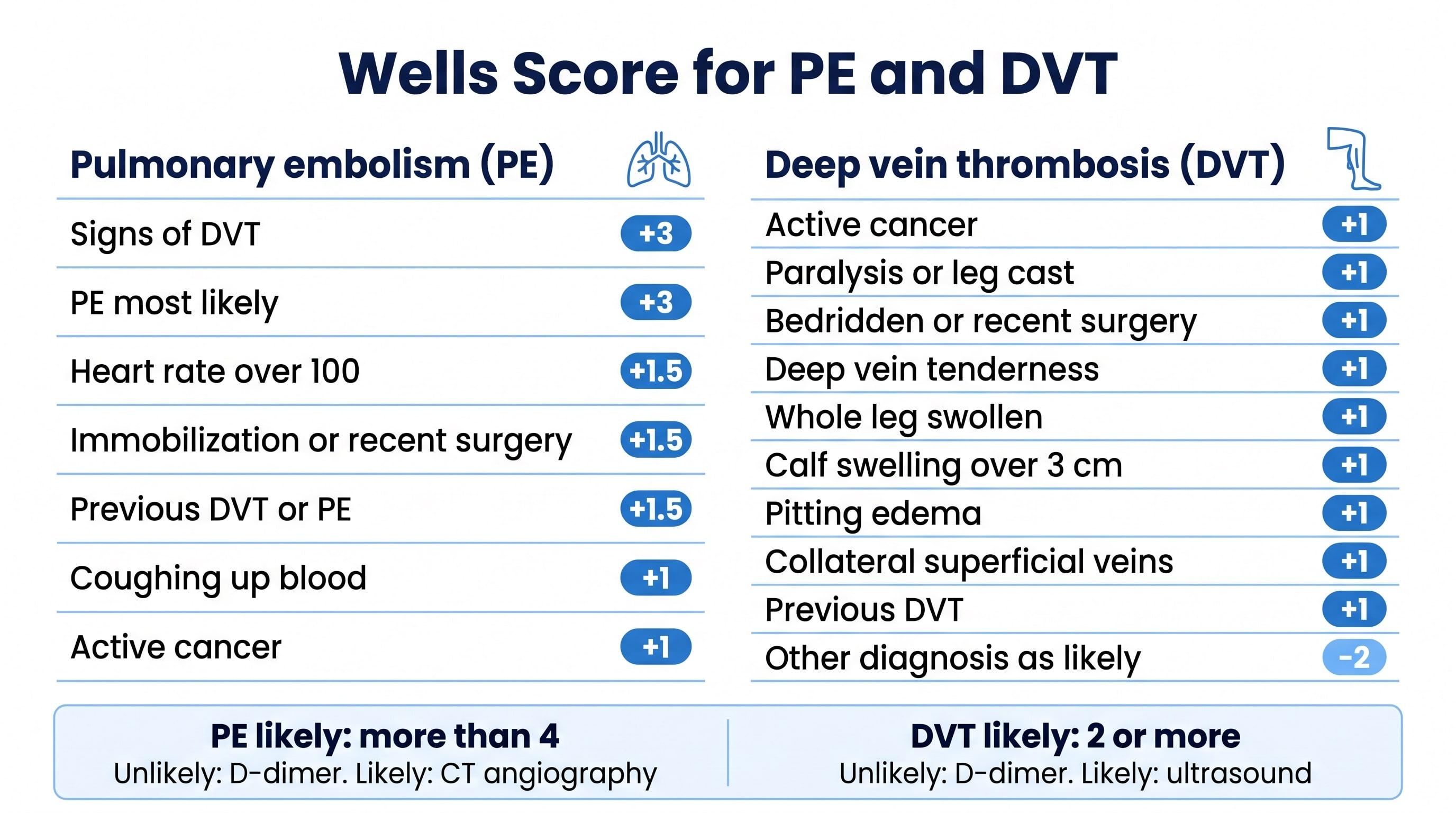
Wells Score Calculator (PE and DVT)
Check the Wells criteria for pulmonary embolism or deep vein thrombosis to get the score, the risk group, and the next test.
Try it free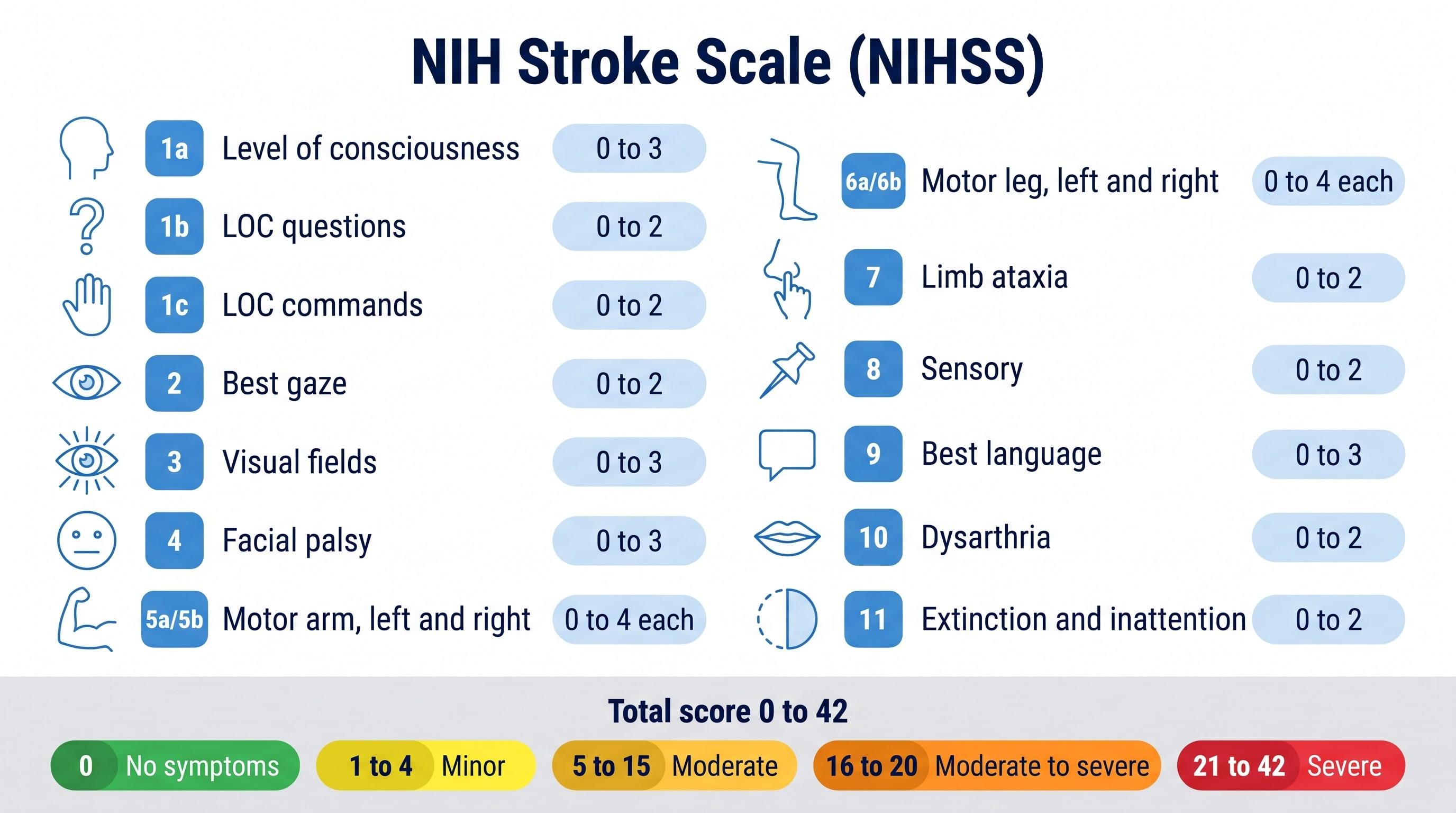
NIHSS Calculator (NIH Stroke Scale)
Score all 15 NIH Stroke Scale items to get the NIHSS total from 0 to 42 and the stroke severity range.
Try it free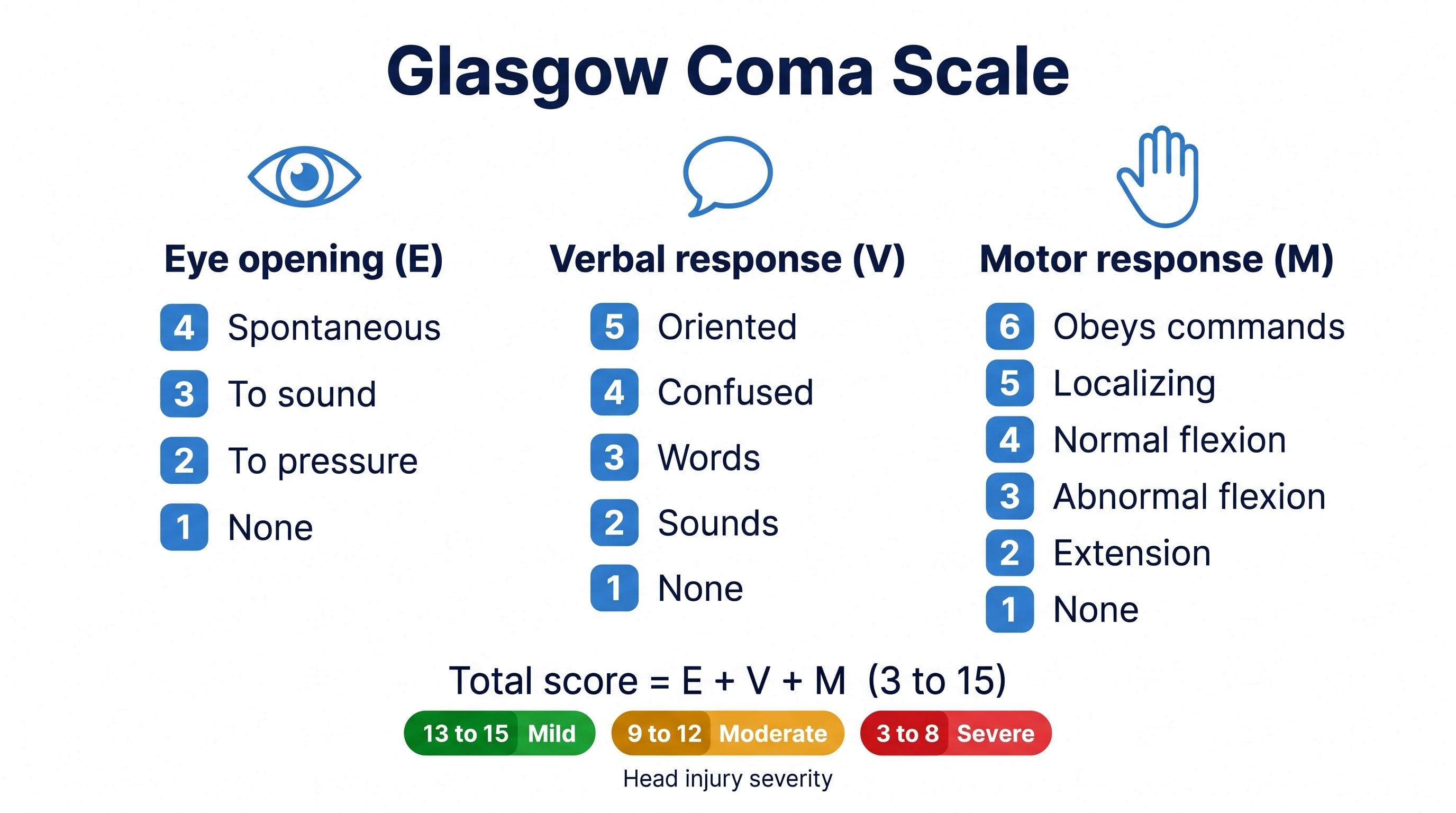
Glasgow Coma Scale Calculator
Score eye, verbal, and motor responses to get the GCS total, E V M code, severity range, and GCS-P.
Try it free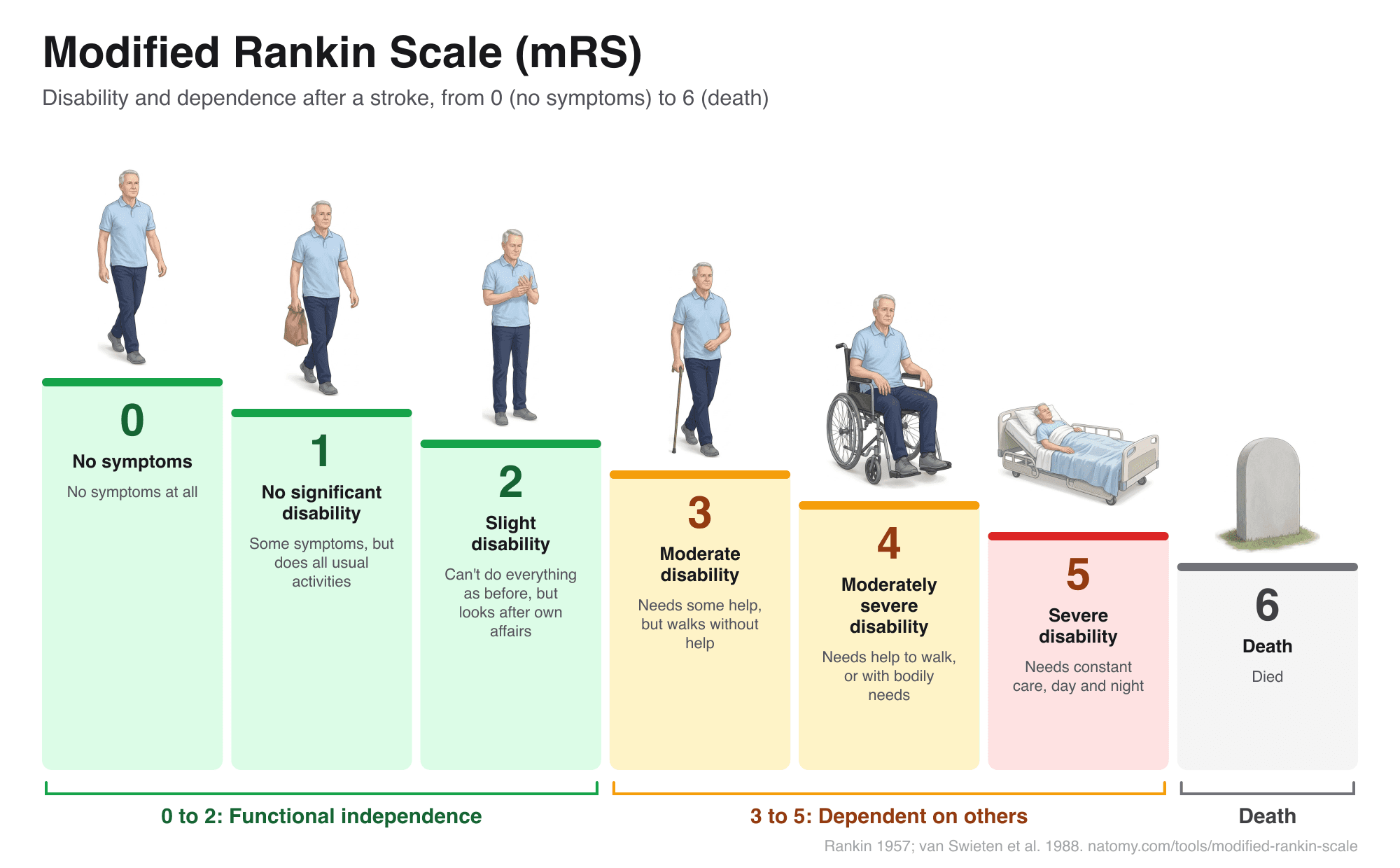
Modified Rankin Scale (mRS)
Illustrated mRS chart from 0 to 6 with a question-based score finder, what each grade means after a stroke, and a copyable note.
Try it free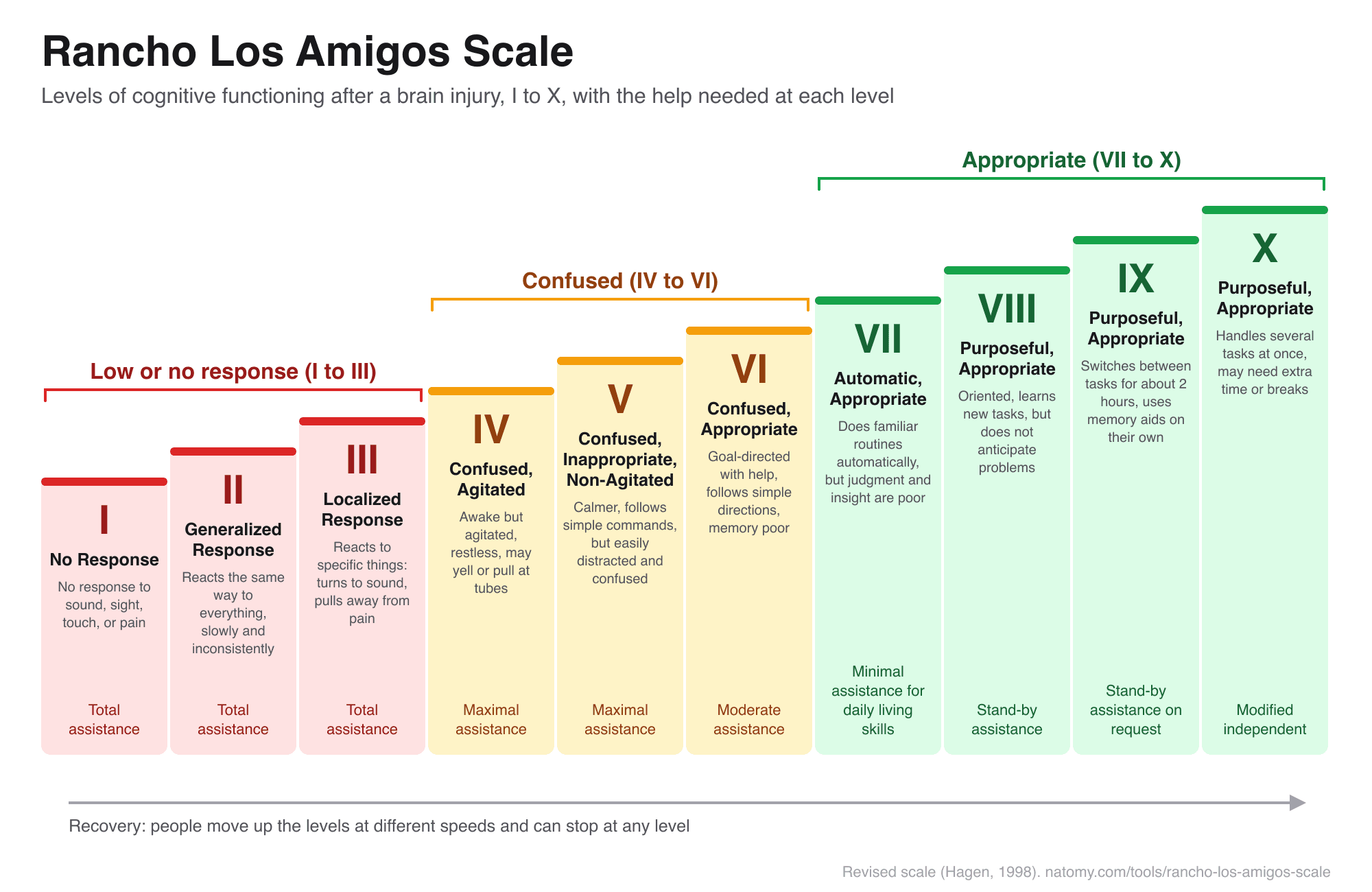
Rancho Los Amigos Scale
The 10 levels of cognitive functioning after a brain injury, with a level finder, what to expect, and how to help.
Try it free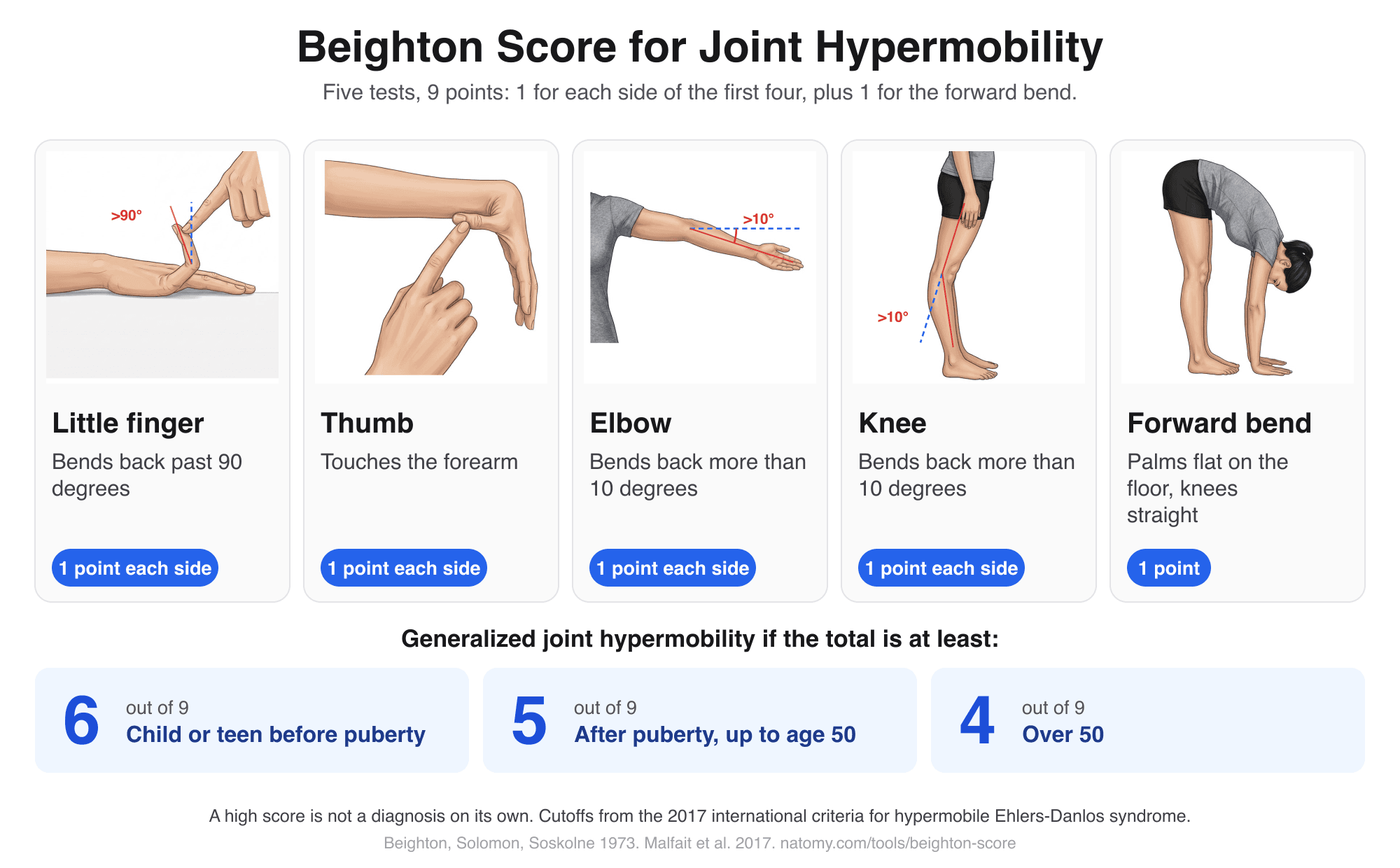
Beighton Score Calculator
Illustrated hypermobility test: score the 5 Beighton movements out of 9, compare with the age cutoff, and copy a note.
Try it free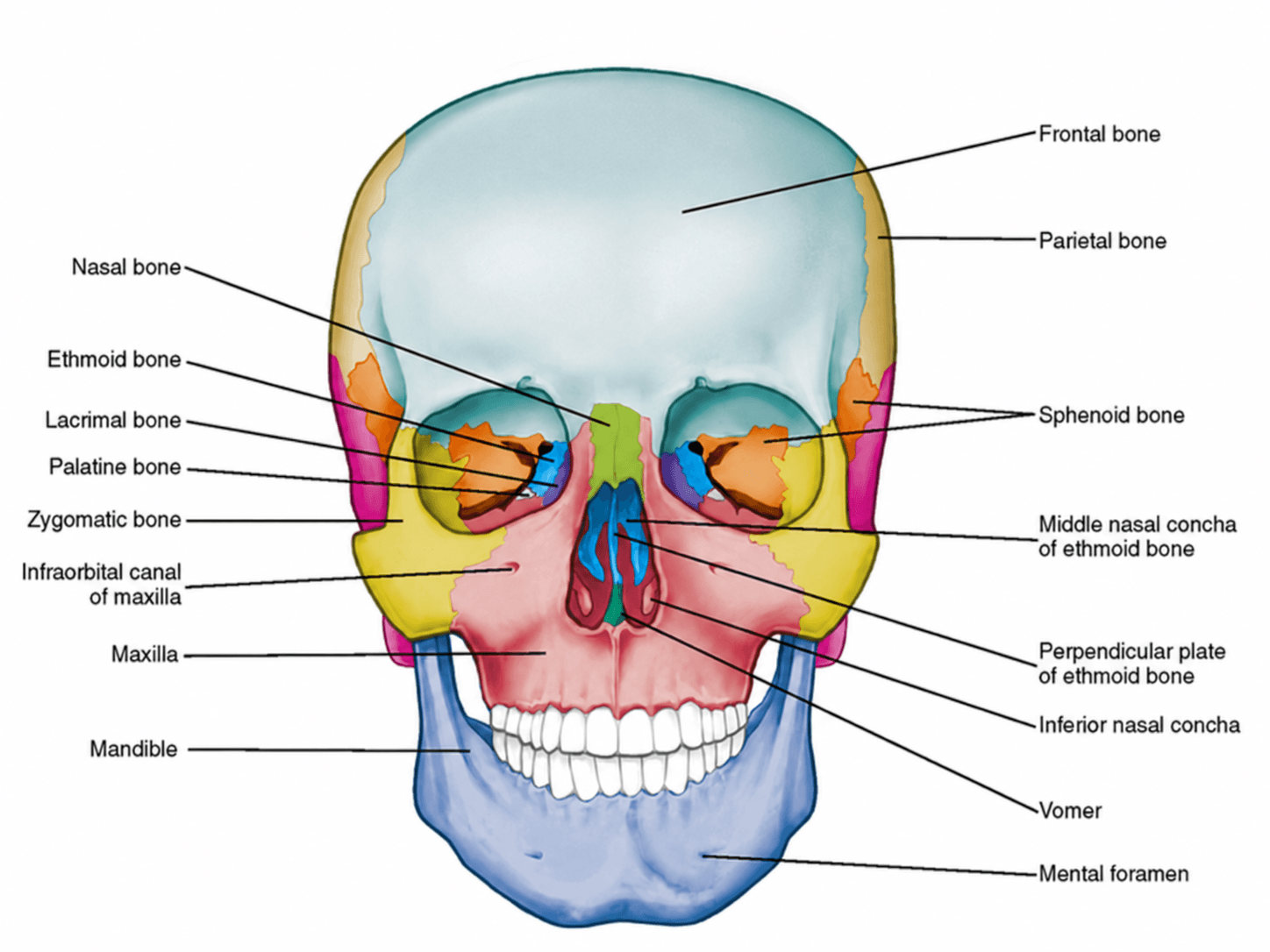
Anterior View of Skull Labeled
Free labeled and unlabeled anterior view of the skull, downloadable as PNG.
Try it free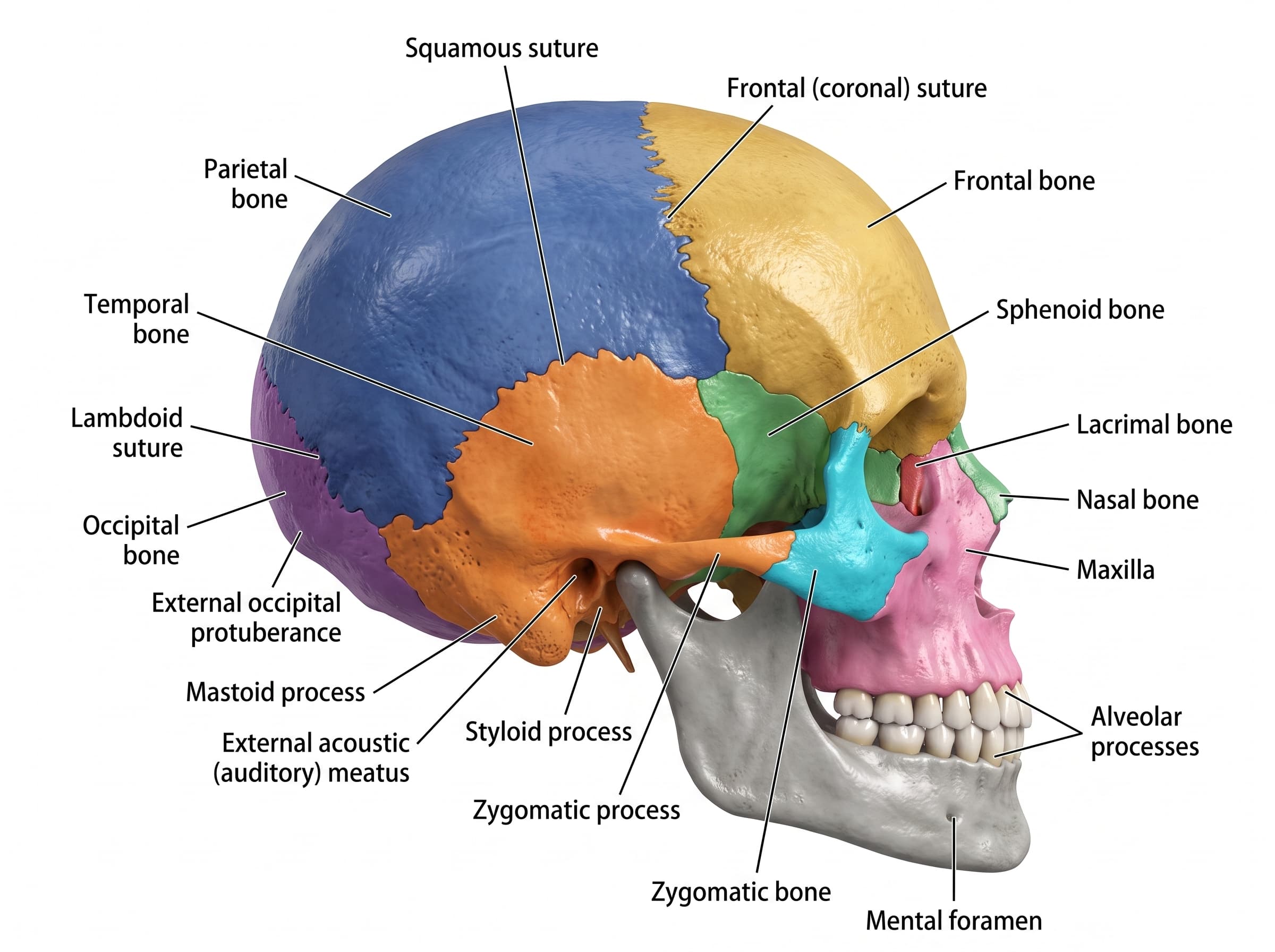
Lateral View of Skull Labeled
Free labeled and unlabeled lateral view of the skull, downloadable as PNG.
Try it free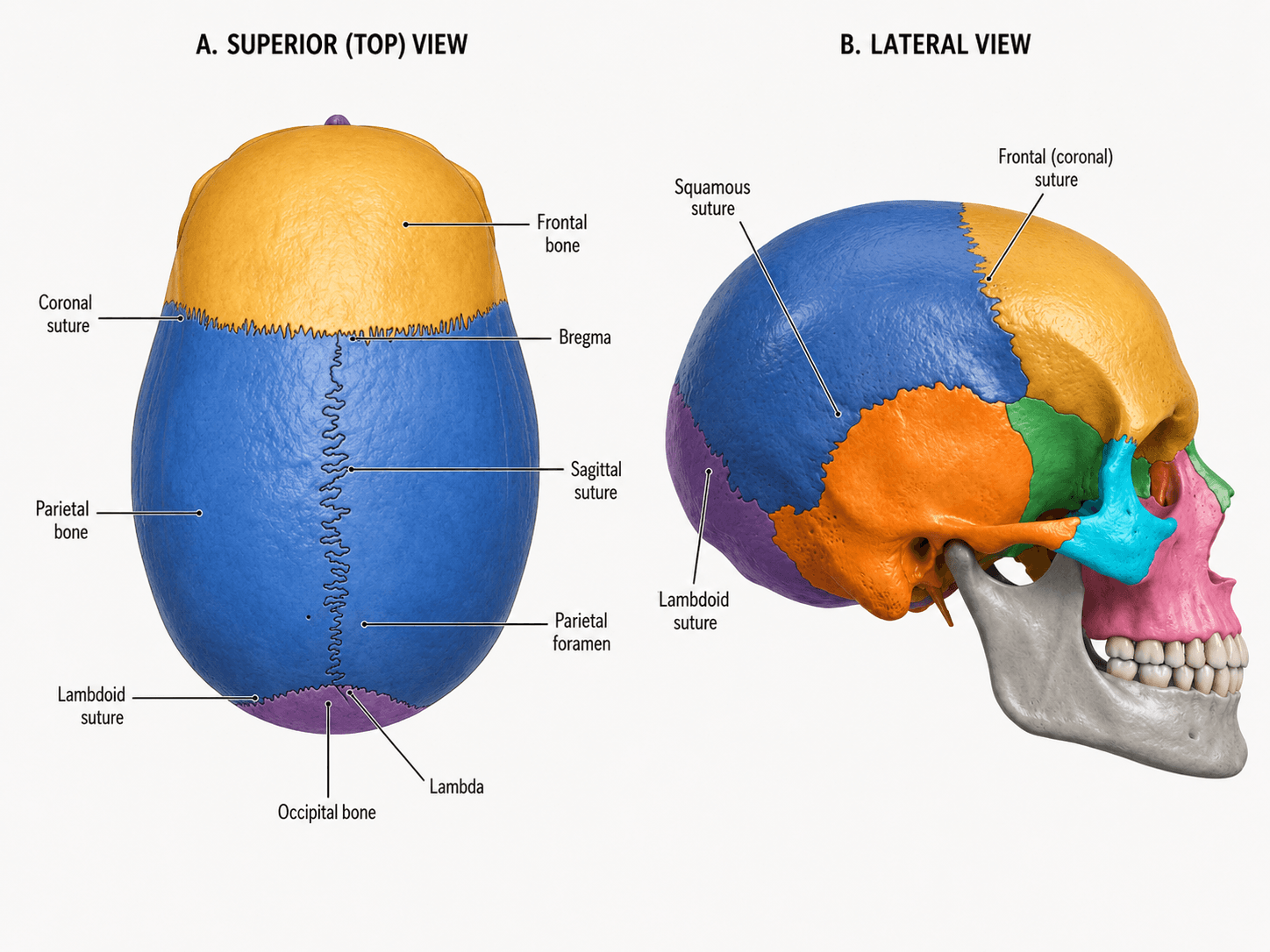
Skull Sutures Labeled
Free labeled and unlabeled skull sutures diagram, superior and lateral views, downloadable as PNG.
Try it free