Free Tools
Manual Muscle Testing Grades: MMT Grading Scale Chart
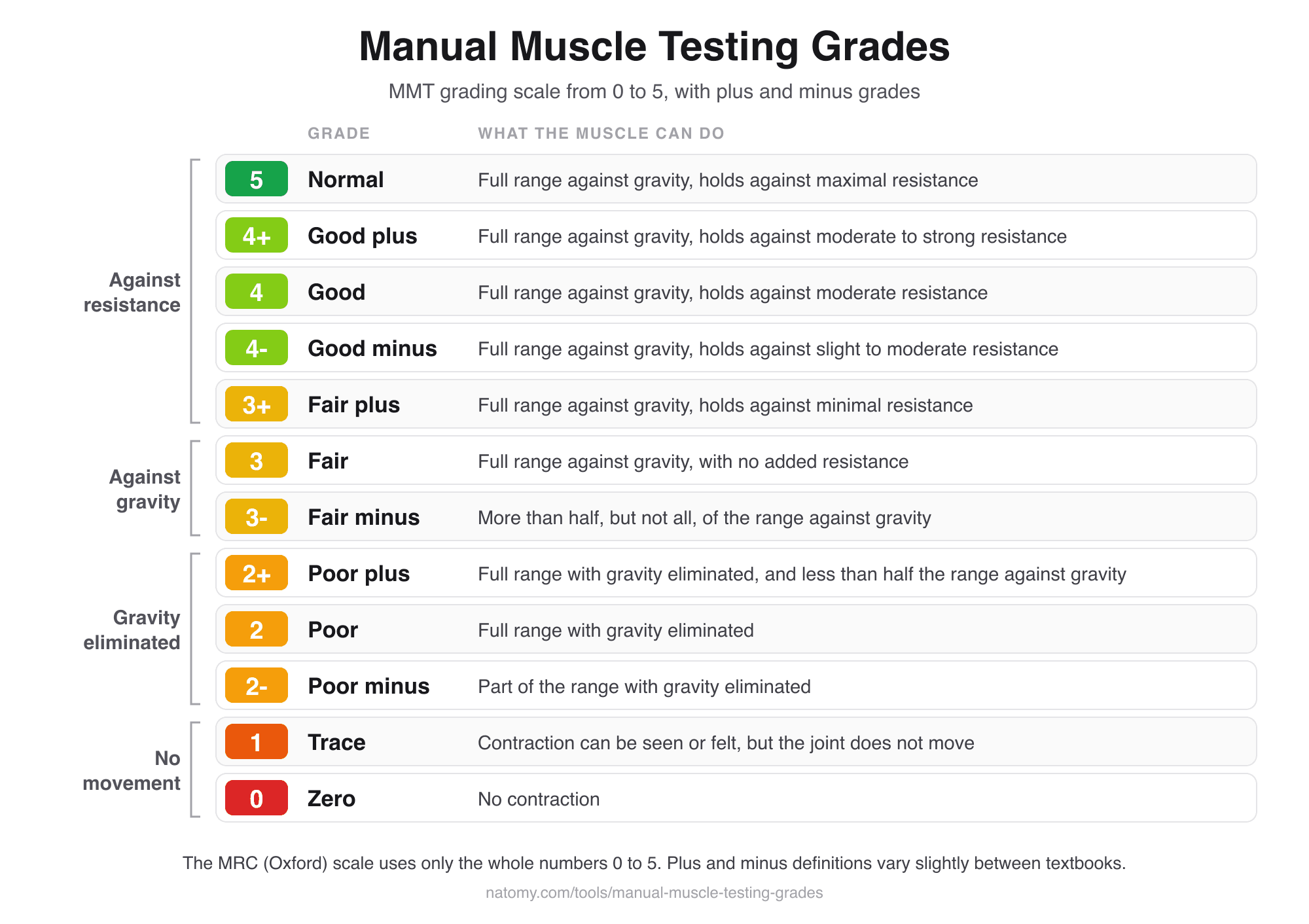
The full manual muscle testing scale from 0 to 5, with plus and minus grades. Use the grade finder below to turn what you see on exam into a grade, then copy it into your notes.
MMT grade finder
Answer two or three questions about the movement to get the grade. Add a movement and side to build a note, such as "R ankle dorsiflexion 4-/5".
Can the patient move the joint through its full range against gravity?
Limb positioned so the movement lifts it upward.
MMT grades in 60 seconds
The muscle strength grading scale
Gravity and resistance set the thresholds. A muscle that cannot lift the limb against gravity is graded with gravity eliminated, by moving the limb sideways along a supported surface. One that can is then tested against the examiner's resistance at the end of its range.
| Grade | Name | Definition |
|---|---|---|
| 5 | Normal | Full range against gravity, holds against maximal resistance |
| 4+ | Good plus | Full range against gravity, holds against moderate to strong resistance |
| 4 | Good | Full range against gravity, holds against moderate resistance |
| 4- | Good minus | Full range against gravity, holds against slight to moderate resistance |
| 3+ | Fair plus | Full range against gravity, holds against minimal resistance |
| 3 | Fair | Full range against gravity, with no added resistance |
| 3- | Fair minus | More than half, but not all, of the range against gravity |
| 2+ | Poor plus | Full range with gravity eliminated, and less than half the range against gravity |
| 2 | Poor | Full range with gravity eliminated |
| 2- | Poor minus | Part of the range with gravity eliminated |
| 1 | Trace | Contraction can be seen or felt, but the joint does not move |
| 0 | Zero | No contraction |
MRC scale vs. plus and minus grades
The Medical Research Council (MRC) scale, also called the Oxford scale, uses only the whole numbers 0 to 5. It is the version used in neurology and in the spinal cord injury exam, where the 10 key muscles of the myotome chart are graded 0 to 5 to give a motor score out of 100. Physical therapists often add plus and minus grades to track smaller changes during rehabilitation. The exact plus and minus definitions vary a little between textbooks, so note which convention you use.
Common test positions
Each movement is tested in a position where the muscle lifts against gravity, and in a second position where gravity is eliminated for grades below 3. These are common positions; textbooks differ in the details. The calf is too strong to grade by hand, so plantar flexion is graded with repeated single-leg heel raises.
| Movement | Against gravity (3 and above) | Gravity eliminated (below 3) |
|---|---|---|
| Shoulder flexion | Sitting, raise the arm forward | Side-lying, slide the arm forward on a supported surface |
| Shoulder abduction | Sitting, raise the arm out to the side | Lying on the back, slide the arm out along the table |
| Elbow flexion | Sitting, bend the elbow with the palm up | Arm supported at shoulder height, bend the elbow along the table |
| Elbow extension | Lying face down, arm over the table edge, straighten the elbow | Arm supported at shoulder height, straighten the elbow along the table |
| Wrist extension | Forearm on the table palm down, lift the hand | Forearm thumb up, move the hand sideways |
| Hip flexion | Sitting, lift the thigh off the table | Side-lying, slide the leg forward |
| Hip abduction | Side-lying, lift the top leg | Lying on the back, slide the leg out to the side |
| Knee extension | Sitting, straighten the knee | Side-lying, straighten the knee with the leg supported |
| Ankle dorsiflexion | Sitting, pull the foot up | Side-lying, pull the foot up with the leg supported |
| Ankle plantar flexion | Standing on one leg, rise onto the toes repeatedly | Side-lying, point the foot with the leg supported |
How to perform a manual muscle test
- Explain the test and show the movement on the other side first.
- Position the patient so the movement lifts the limb against gravity, and stabilize the body part above the joint.
- Ask the patient to move through the full range. If they cannot, retest with gravity eliminated.
- If they can, have them hold the end position while you push gradually against the limb, just above the next joint.
- Compare with the other side, then record the grade, side, and movement, for example "L elbow flexion 4/5".
Strength grades in the medical record
For surgeons and physicians, serial grades show recovery after nerve or spine surgery and flag new weakness early. For personal injury and medical malpractice attorneys, the grades in the records show whether weakness was documented, how severe it was, and whether it matches the injured nerve root or nerve. Lining up weak movements with their roots on the myotome chart and numb areas on the dermatome map connects the exam to the MRI.
Illustrate a nerve or muscle injury
Natomy turns MRI views, reports, and prompts into clear, labeled medical illustrations of nerve injuries, disc herniations, and the muscles they weaken, for patient education and medical-legal exhibits. See examples in the Natomy atlas.
Try Natomy TodayFAQ
What are manual muscle testing grades?+
Manual muscle testing (MMT) grades describe muscle strength on a scale from 0 to 5. Grade 0 is no contraction, 1 is a flicker with no movement, 2 is full movement with gravity eliminated, 3 is full movement against gravity, 4 holds against moderate resistance, and 5 holds against maximal resistance. Plus and minus grades, such as 4+ or 3-, mark the steps in between.
What does 4/5 muscle strength mean?+
4/5, or Good, means the muscle moves the joint through its full range against gravity and holds against moderate resistance, but gives way to strong resistance. It is mild weakness. 4- holds against slight to moderate resistance, and 4+ against moderate to strong resistance.
What does 5/5 strength mean?+
5/5, or Normal, means the muscle holds its test position against maximal resistance, as expected for that person's age, size, and sex. "Strength 5/5 throughout" in a medical record means no weakness was found in the muscles tested.
What is the difference between 3 and 3+?+
Grade 3 (Fair) moves the joint through its full range against gravity but cannot hold any added resistance. Grade 3+ (Fair plus) also holds against minimal resistance at the end of the range. 3- moves more than half, but not all, of the range against gravity.
What is the difference between the MRC scale and MMT grades?+
The Medical Research Council (MRC) scale, also called the Oxford scale, uses only the whole numbers 0 to 5 and is the version in the spinal cord injury exam (ISNCSCI). MMT in physical therapy uses the same numbers with names (Zero, Trace, Poor, Fair, Good, Normal) and adds plus and minus grades for finer steps.
What is a break test?+
In a break test the patient holds the limb at the end of its range while the examiner gradually pushes against it, and the grade reflects how much force the muscle holds before it gives way. In a make test the patient pushes against the examiner's fixed hand. Most manual muscle testing grades come from break tests.
How reliable is manual muscle testing?+
MMT is quick and needs no equipment, and grades 0 to 3 are fairly consistent between examiners because they depend on visible movement. Grades 4 and 5 depend on the examiner's strength and judgment, so small changes are hard to detect. A handheld dynamometer gives a number in pounds or kilograms when finer measurement is needed.
Why do lawyers look at muscle strength grades?+
In personal injury and malpractice cases, documented strength grades show whether weakness was present, how severe it was, and whether it changed over time. A drop from 5/5 to 4-/5 in ankle dorsiflexion after an accident, for example, supports a nerve root or peripheral nerve injury, and matching the weak muscles to their nerve roots links the exam to imaging.
Sources: Hislop, Avers, and Brown, Daniels and Worthingham's Muscle Testing; Kendall et al., Muscles: Testing and Function; Medical Research Council, Aids to the Examination of the Peripheral Nervous System. Plus and minus definitions and test positions vary between these sources; this page uses a common convention. For education and documentation only; not a substitute for clinical assessment.
Related free tools
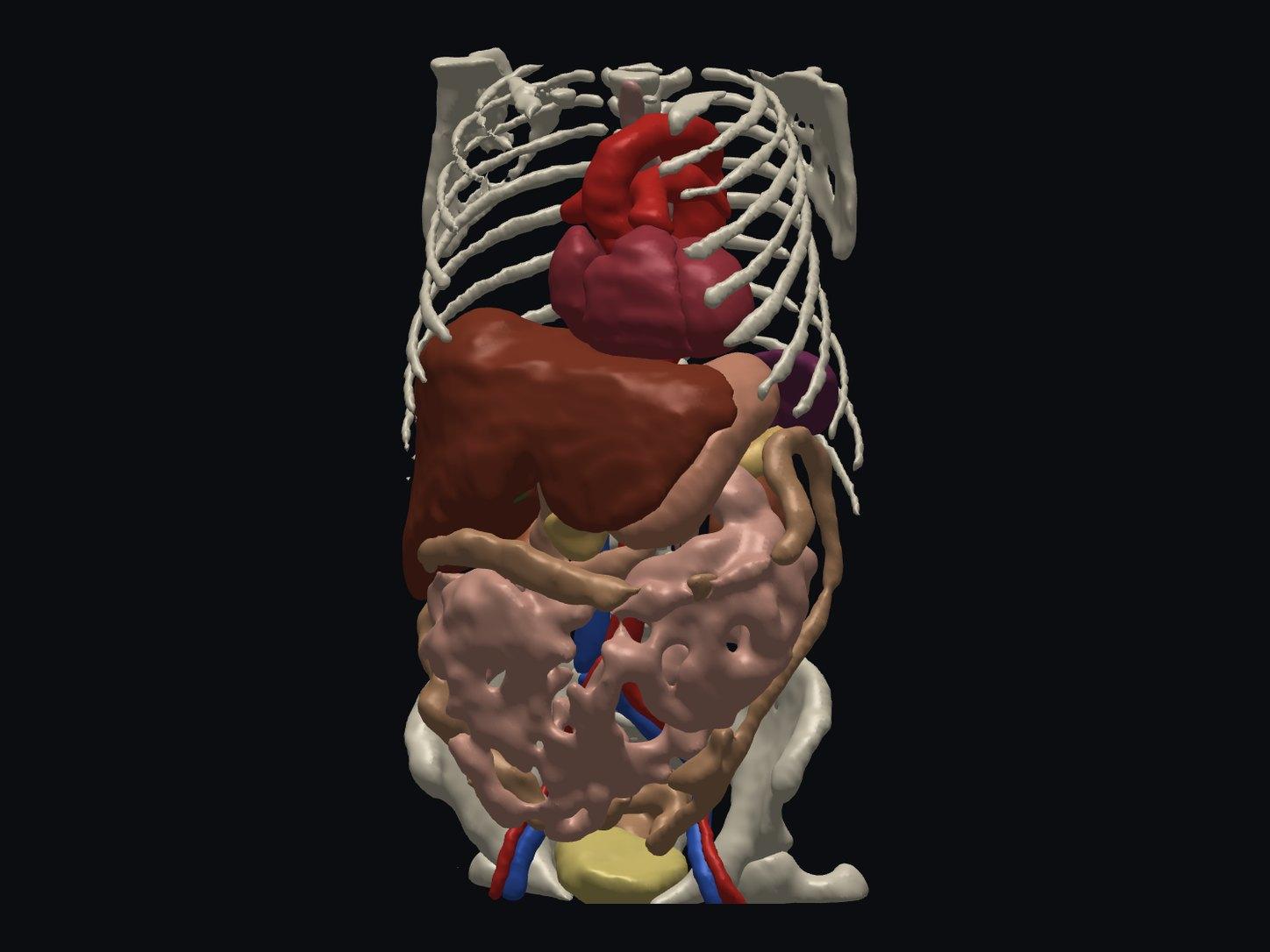
Free Online DICOM Viewer (3D)
Open a CT or MRI DICOM folder in your browser and view it in 3D, with AI anatomy labeling. Nothing is uploaded.
Try it free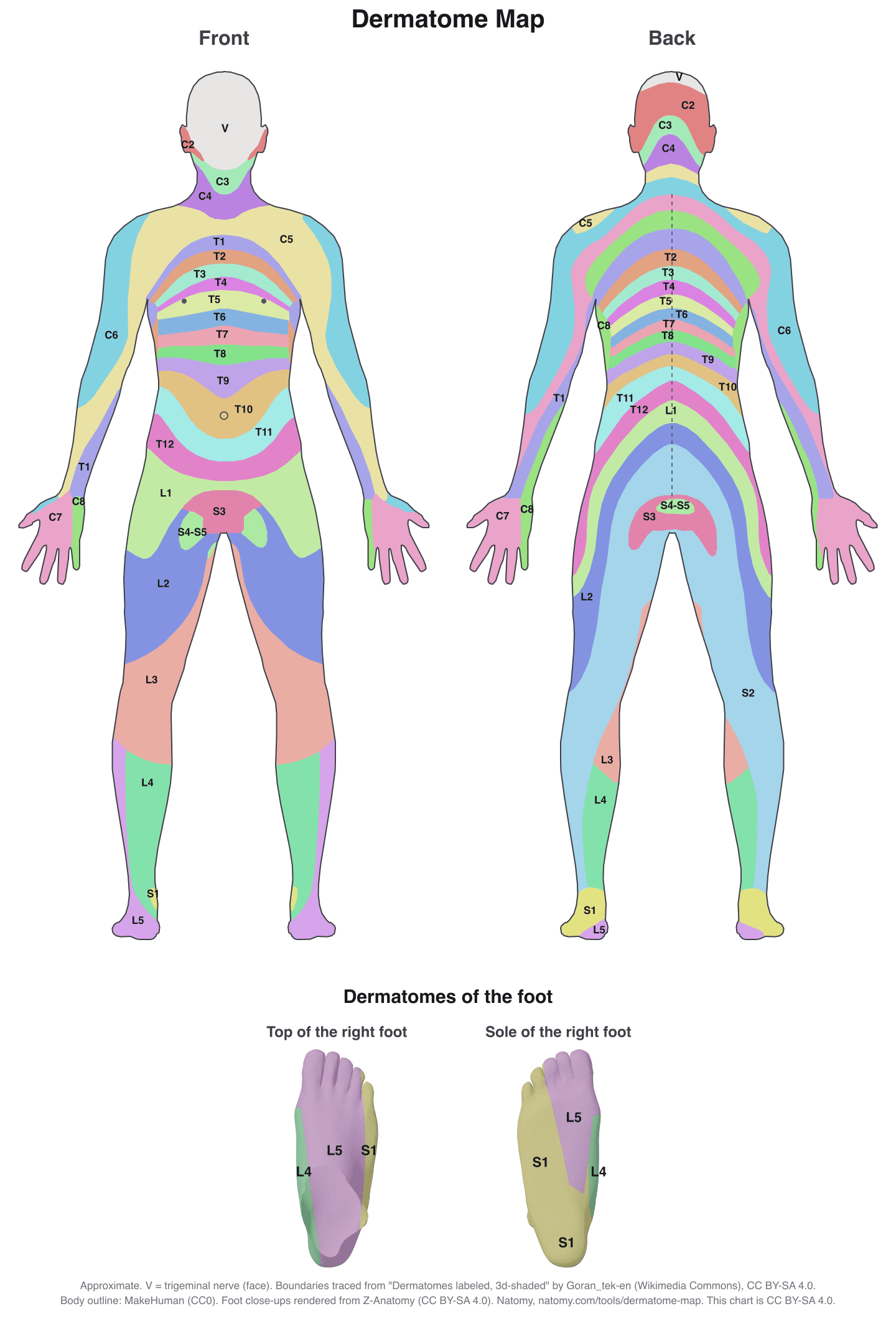
Interactive Dermatome Map
Tap the body to see each nerve root's skin area, test point, myotome, reflex, and disc level. Free printable chart.
Try it free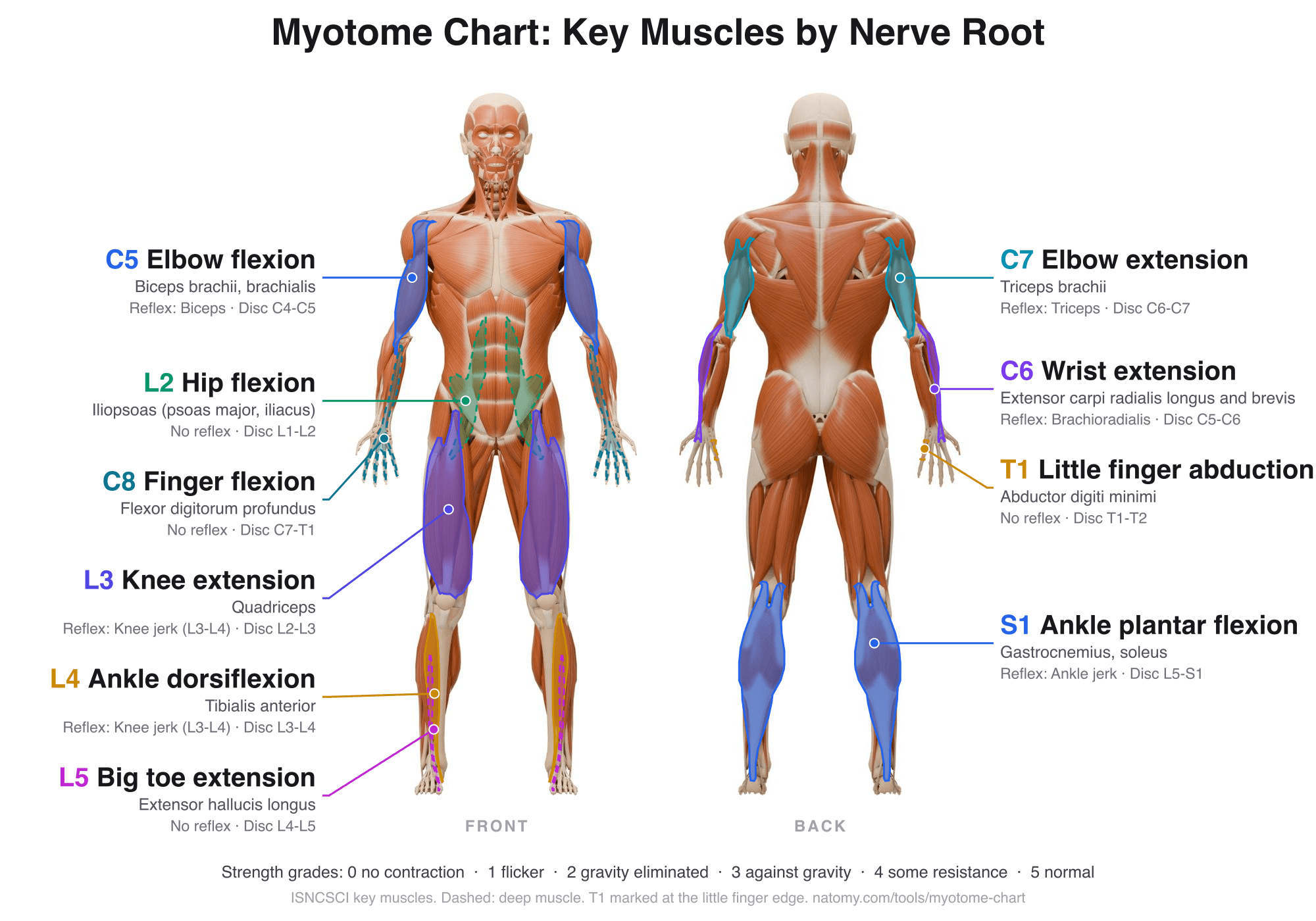
Myotome Chart and Motor Score
Tap a nerve root to see its key muscle, test position, and reflex. Grade strength 0 to 5 for the ISNCSCI motor score.
Try it free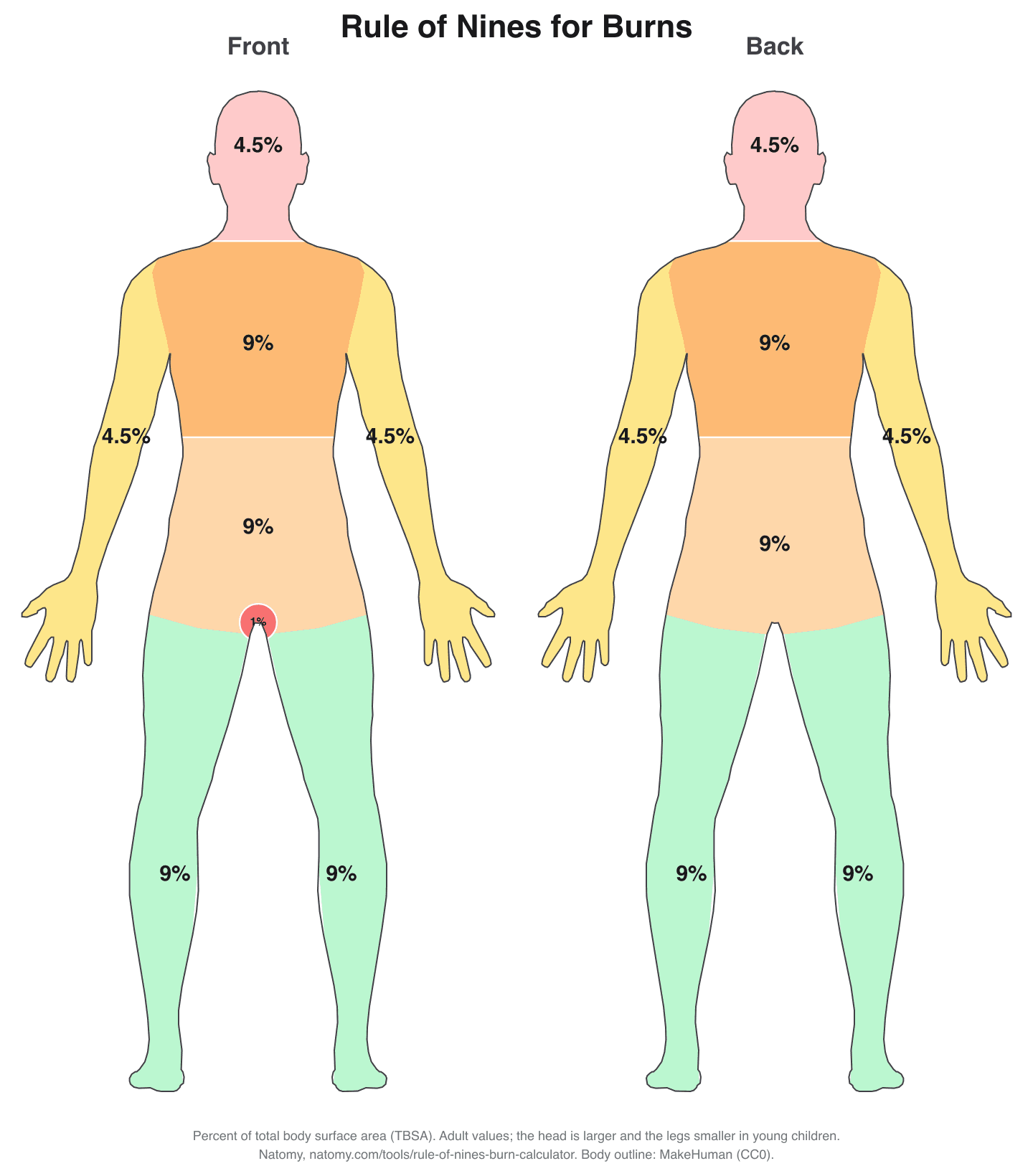
Rule of Nines Burn Calculator
Click the burned areas to get the total body surface area (TBSA), with the Parkland formula and a printable burn chart.
Try it free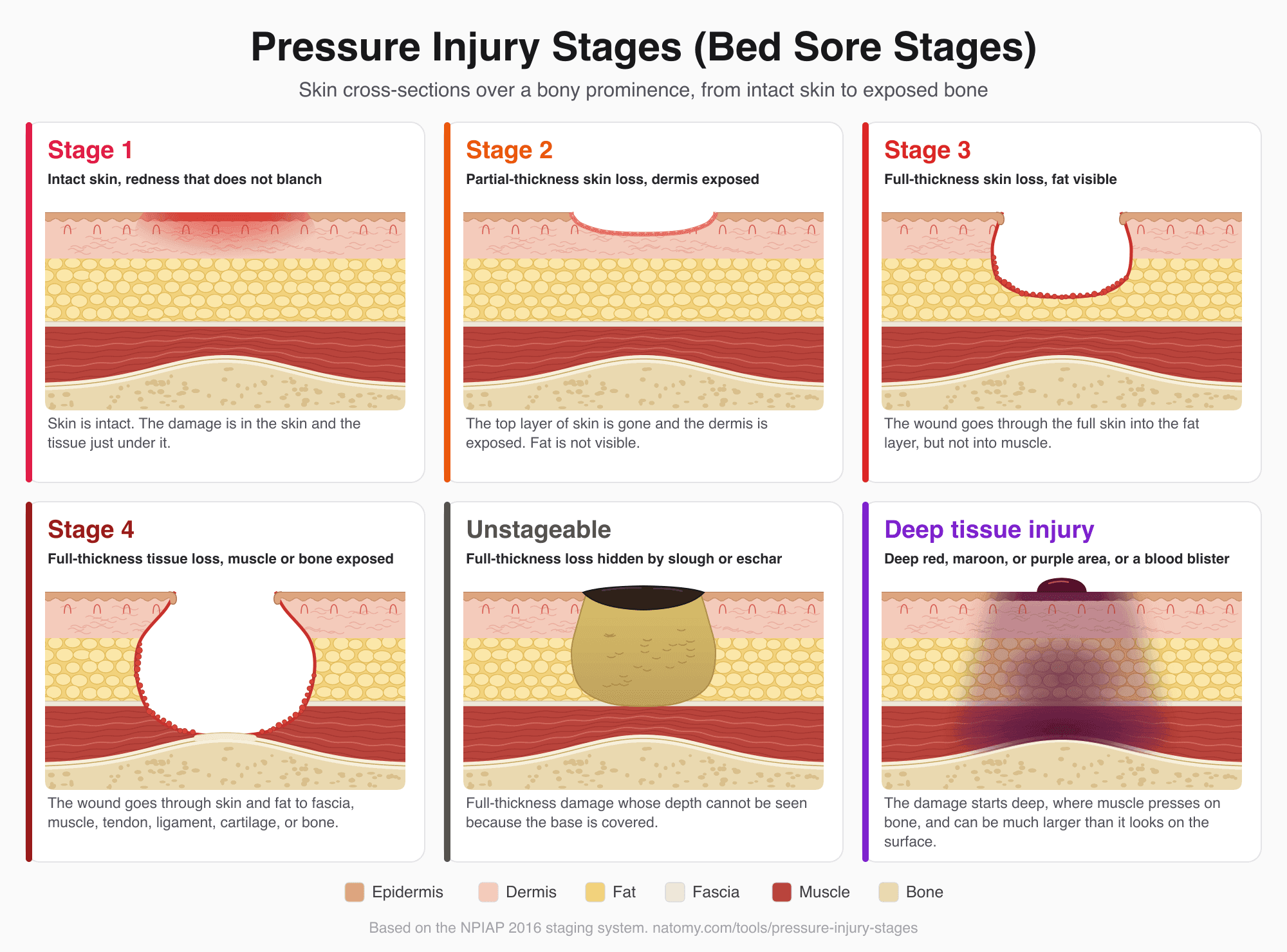
Pressure Injury (Bed Sore) Stages
Illustrated pressure ulcer stages chart, Stage 1 to 4, unstageable, and deep tissue injury, with a stage finder and wound note.
Try it free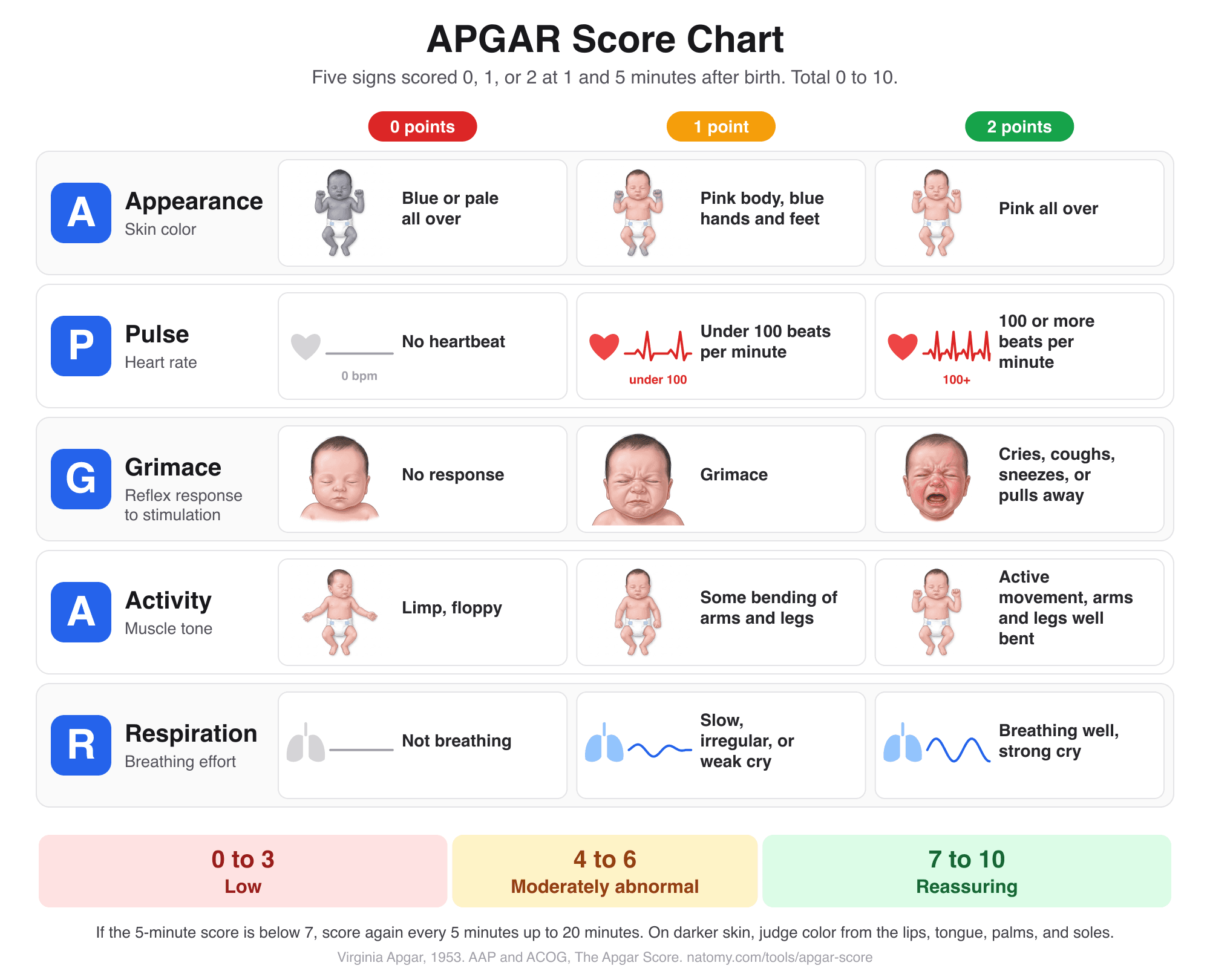
APGAR Score Chart and Calculator
Score the 5 newborn signs at 1, 5, and 10 minutes with an illustrated chart, what normal and low scores mean, and a note for the record.
Try it free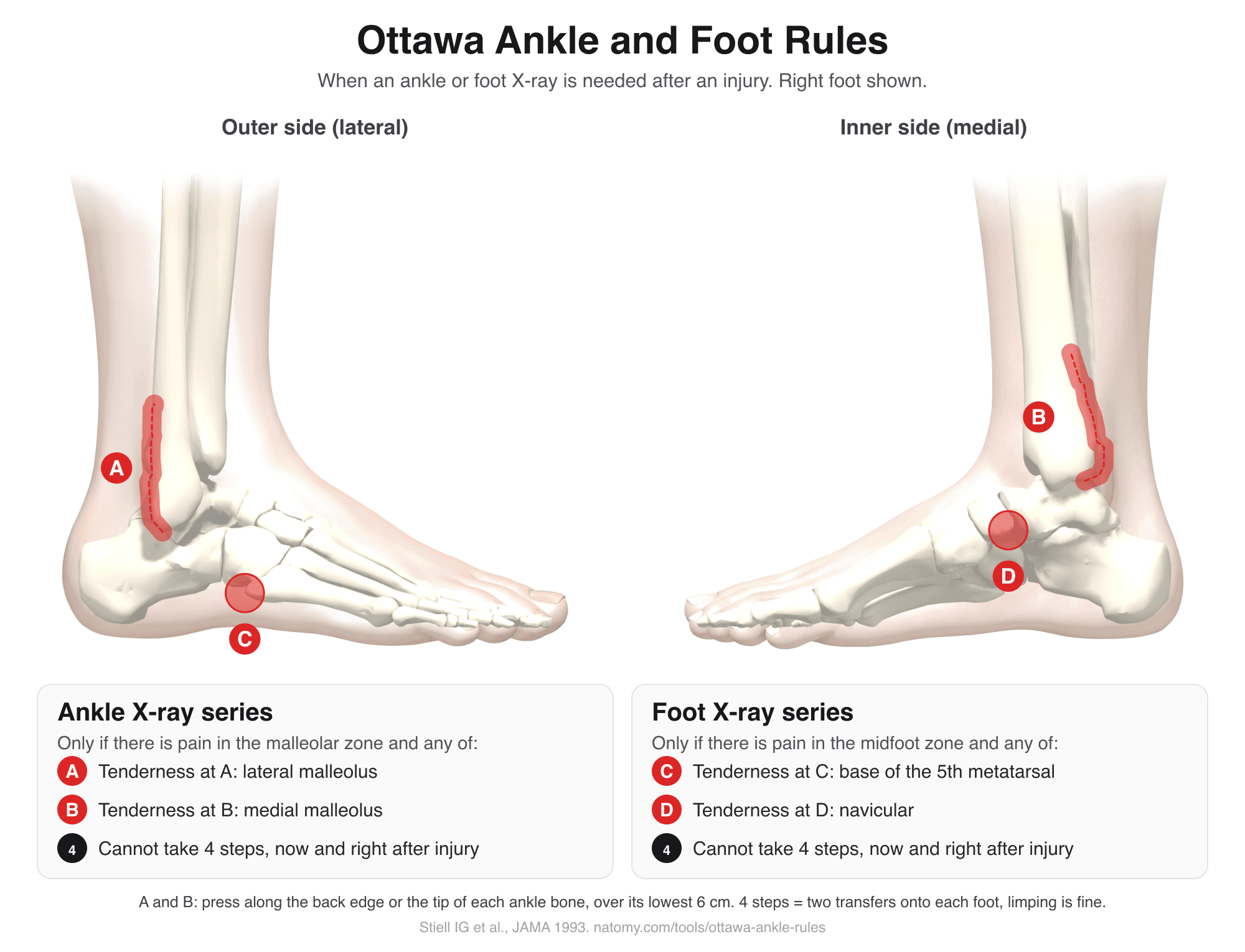
Ottawa Ankle Rules
Tap the tender spots on an illustrated ankle and foot to see if the Ottawa rules call for an X-ray. Includes the Ottawa knee rule.
Try it free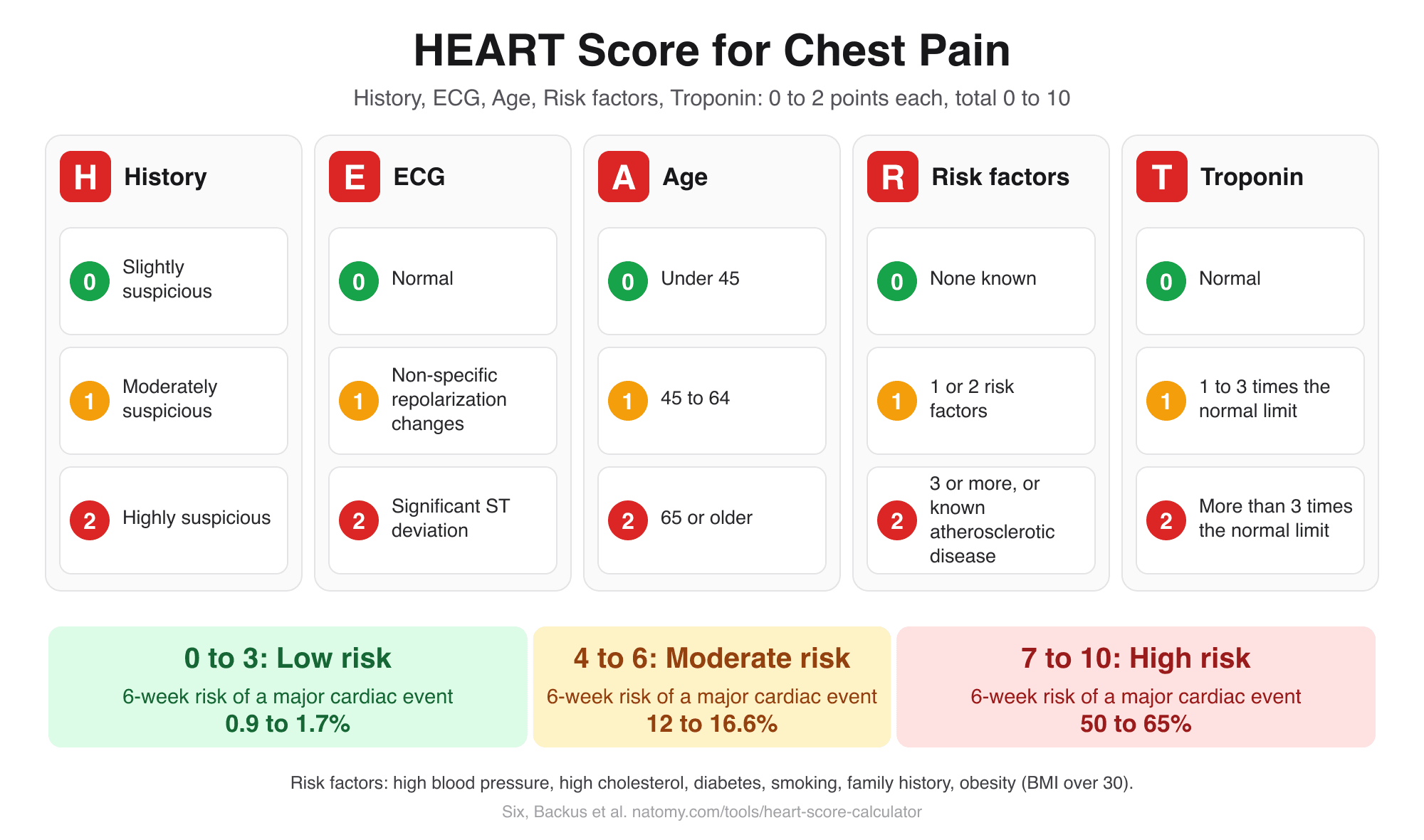
HEART Score Calculator
Score history, ECG, age, risk factors, and troponin for chest pain to get the HEART score, risk group, and 6-week MACE risk.
Try it free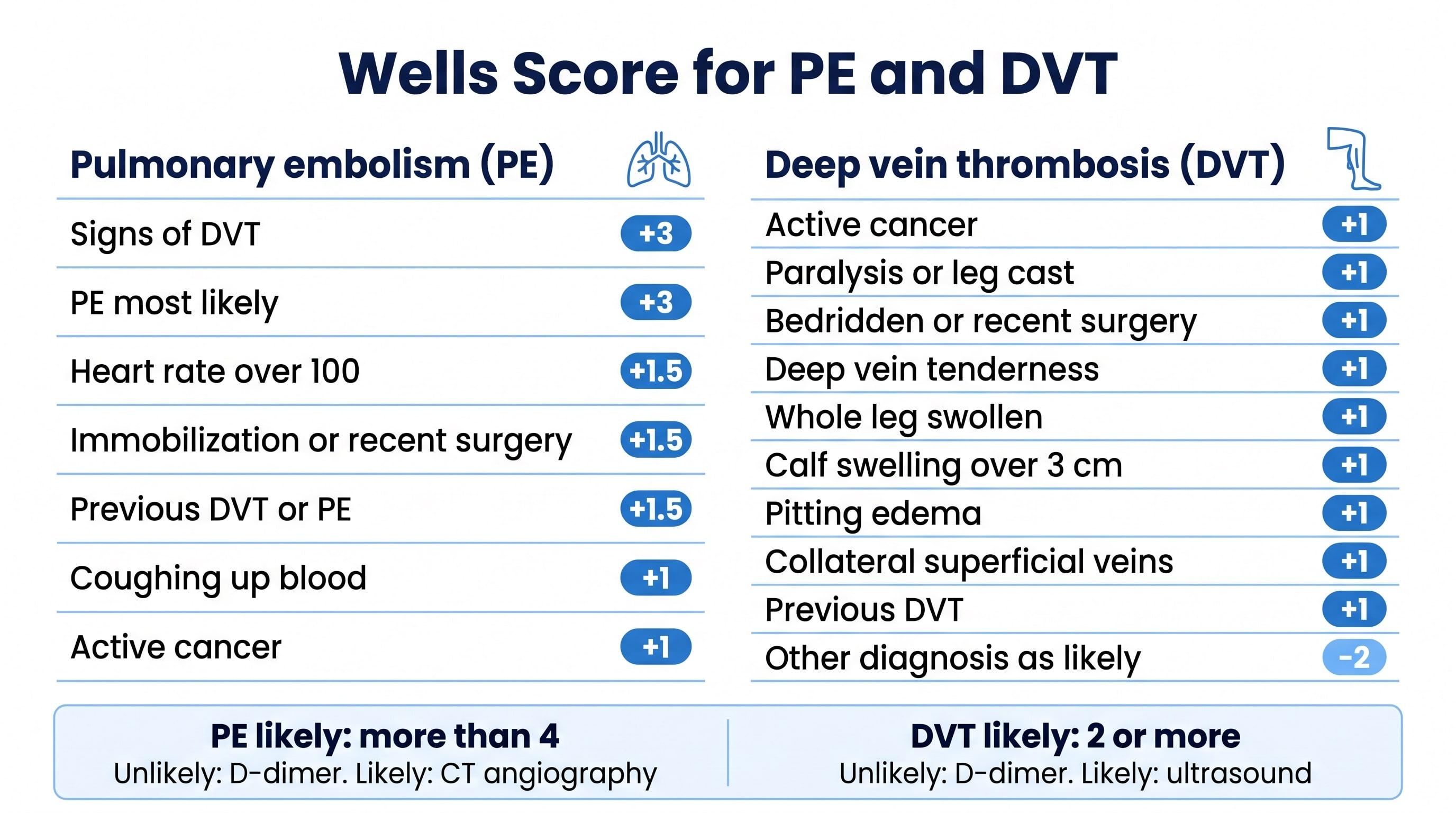
Wells Score Calculator (PE and DVT)
Check the Wells criteria for pulmonary embolism or deep vein thrombosis to get the score, the risk group, and the next test.
Try it free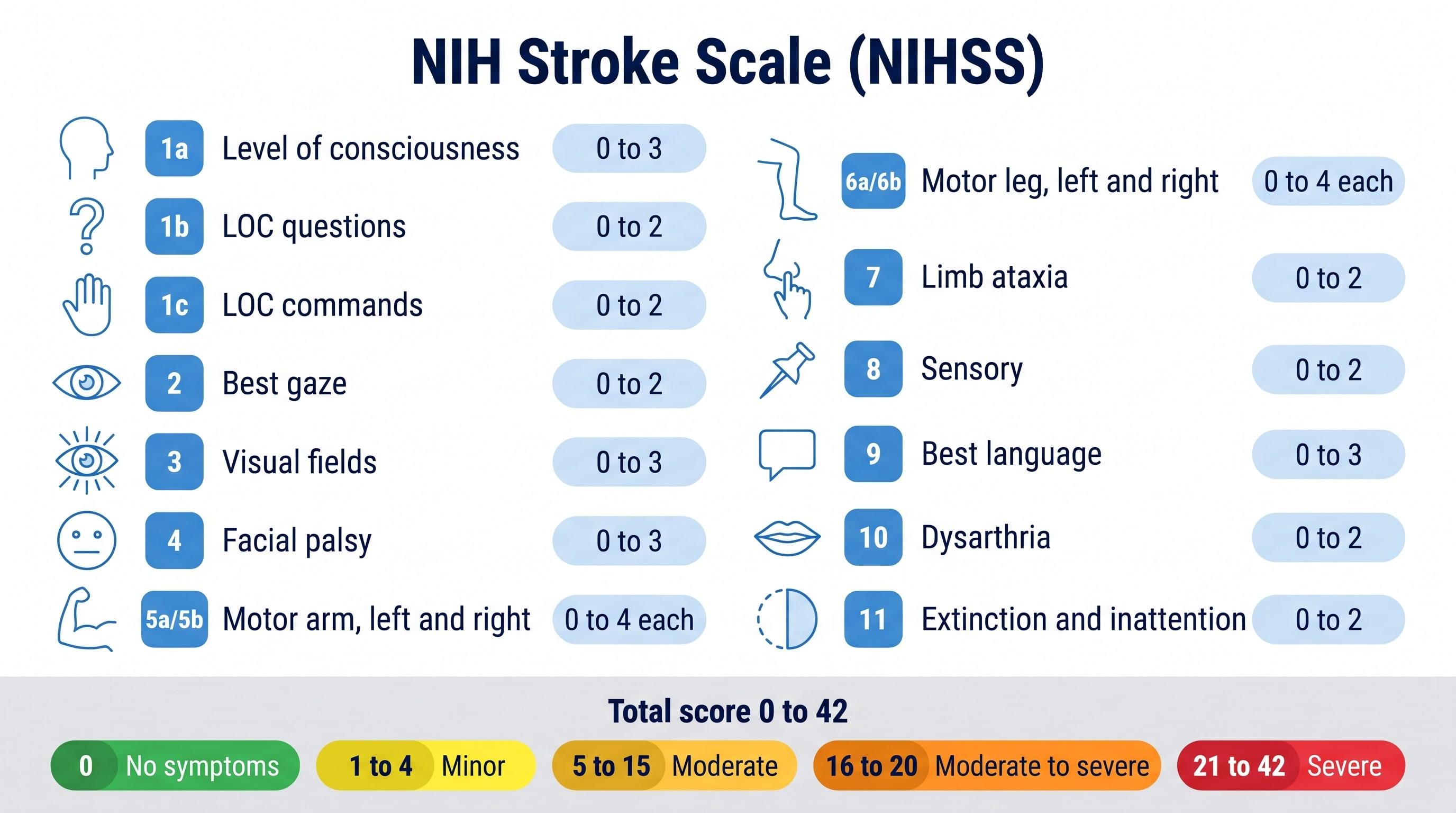
NIHSS Calculator (NIH Stroke Scale)
Score all 15 NIH Stroke Scale items to get the NIHSS total from 0 to 42 and the stroke severity range.
Try it free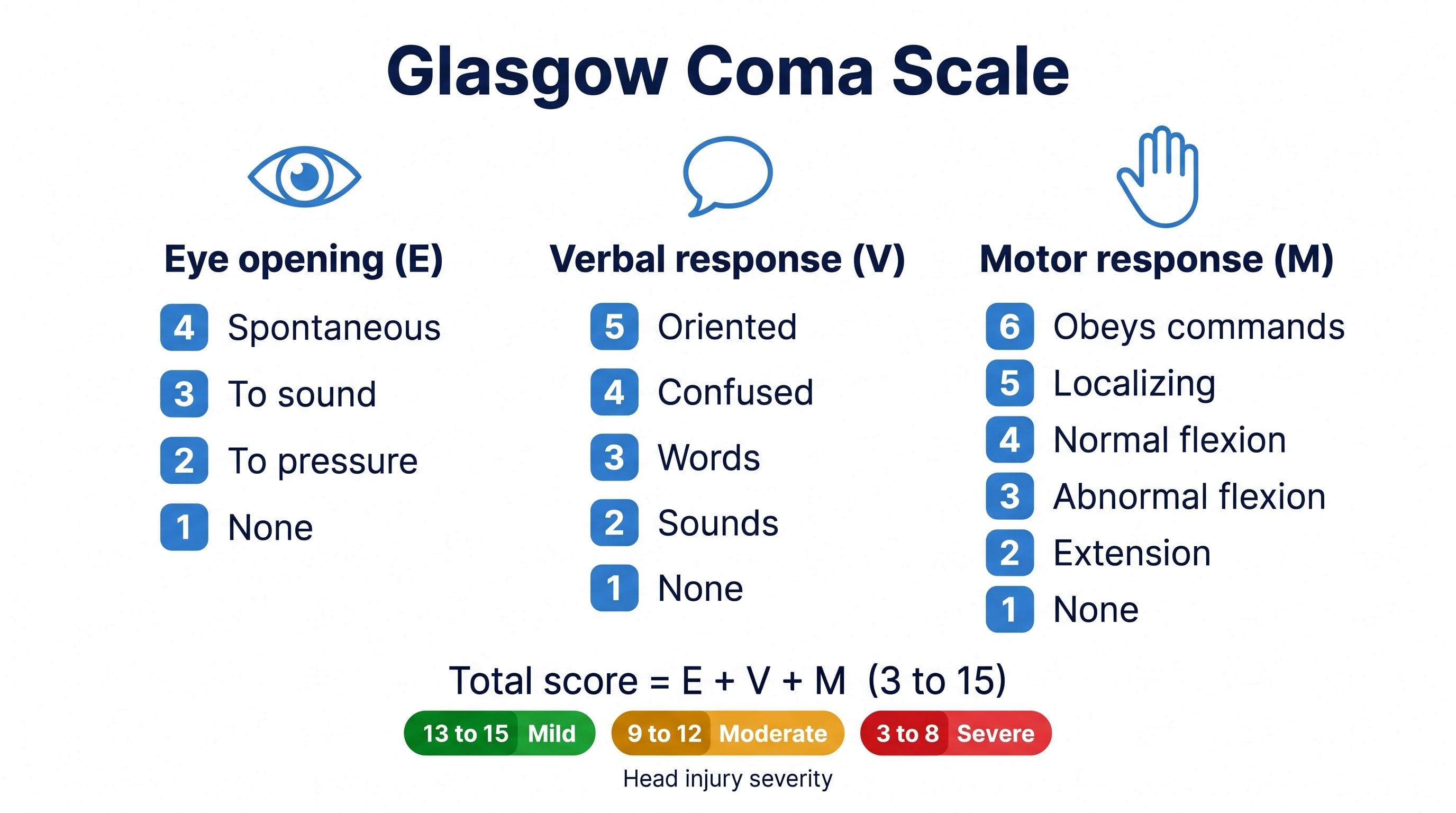
Glasgow Coma Scale Calculator
Score eye, verbal, and motor responses to get the GCS total, E V M code, severity range, and GCS-P.
Try it free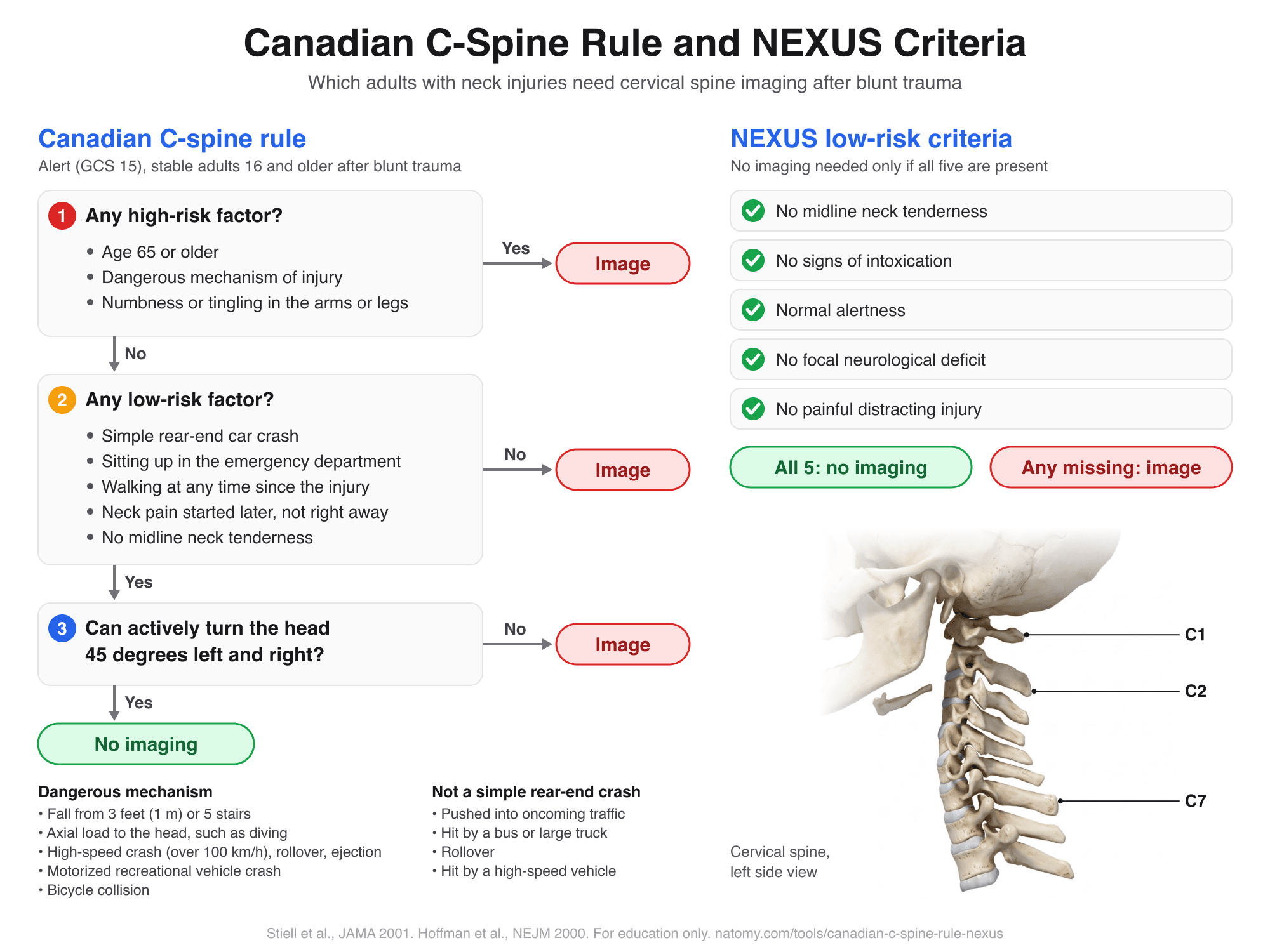
Canadian C-Spine Rule and NEXUS
Run the Canadian C-spine rule or the NEXUS criteria step by step to see which adults need neck imaging after trauma.
Try it free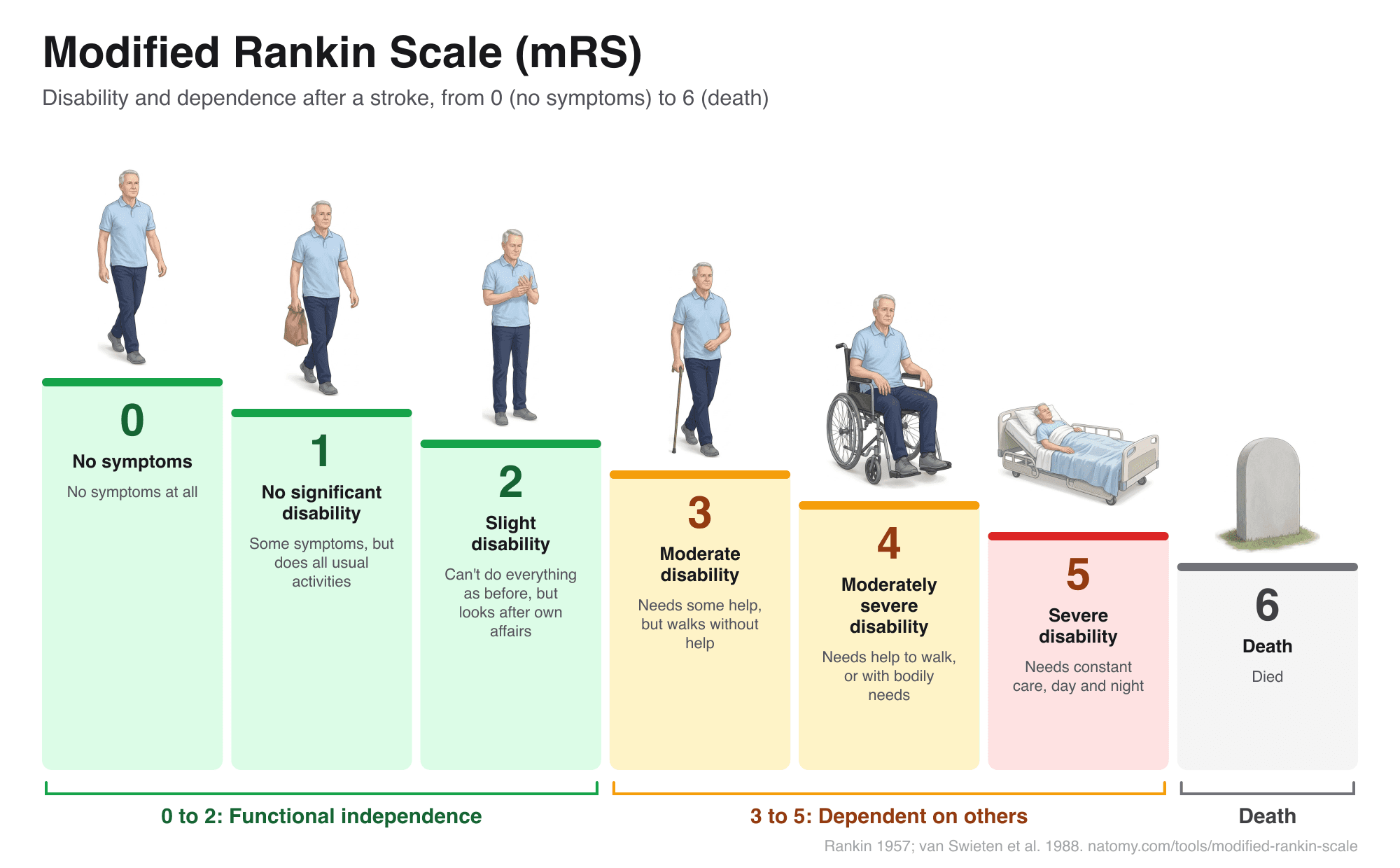
Modified Rankin Scale (mRS)
Illustrated mRS chart from 0 to 6 with a question-based score finder, what each grade means after a stroke, and a copyable note.
Try it free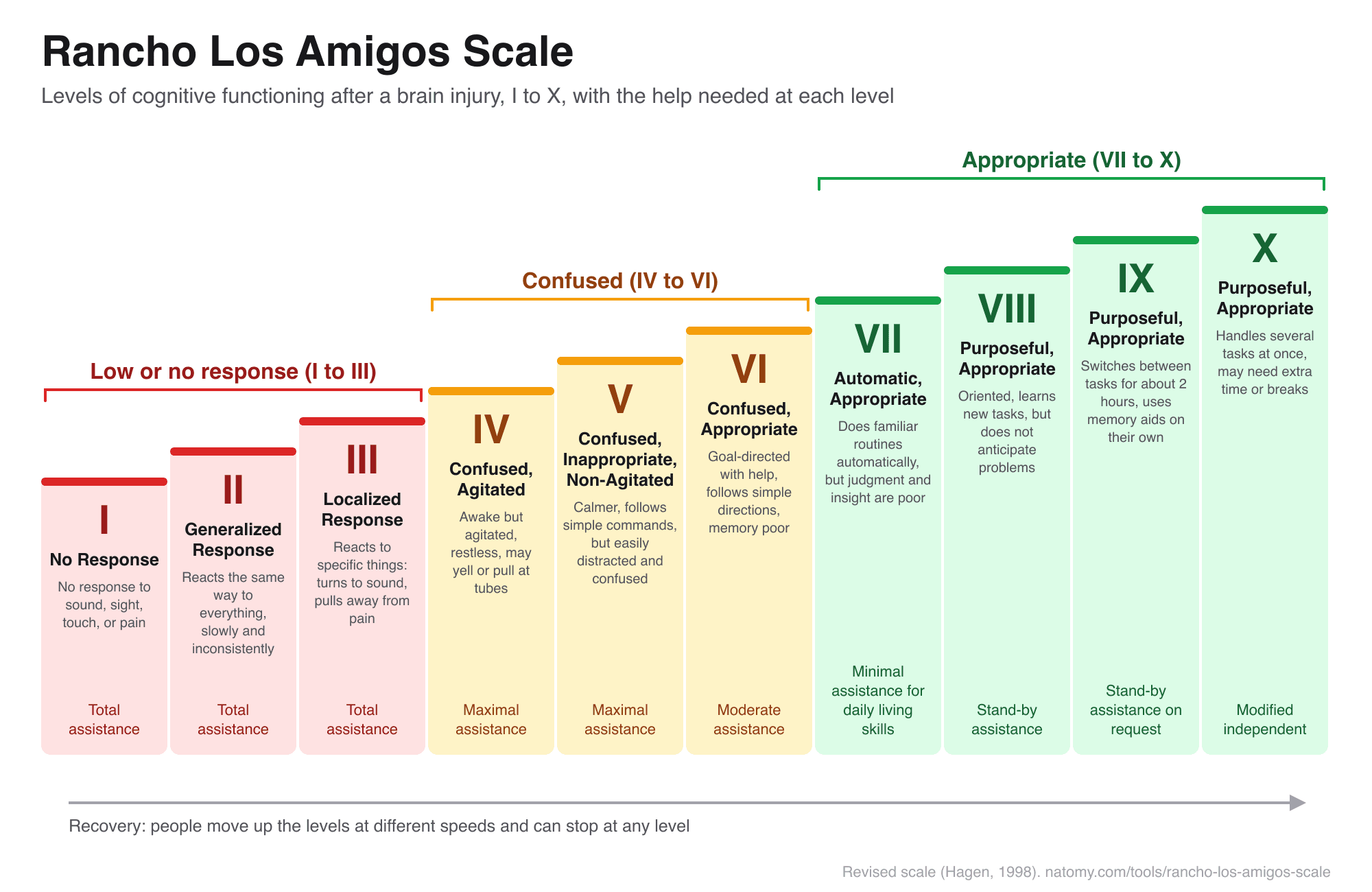
Rancho Los Amigos Scale
The 10 levels of cognitive functioning after a brain injury, with a level finder, what to expect, and how to help.
Try it free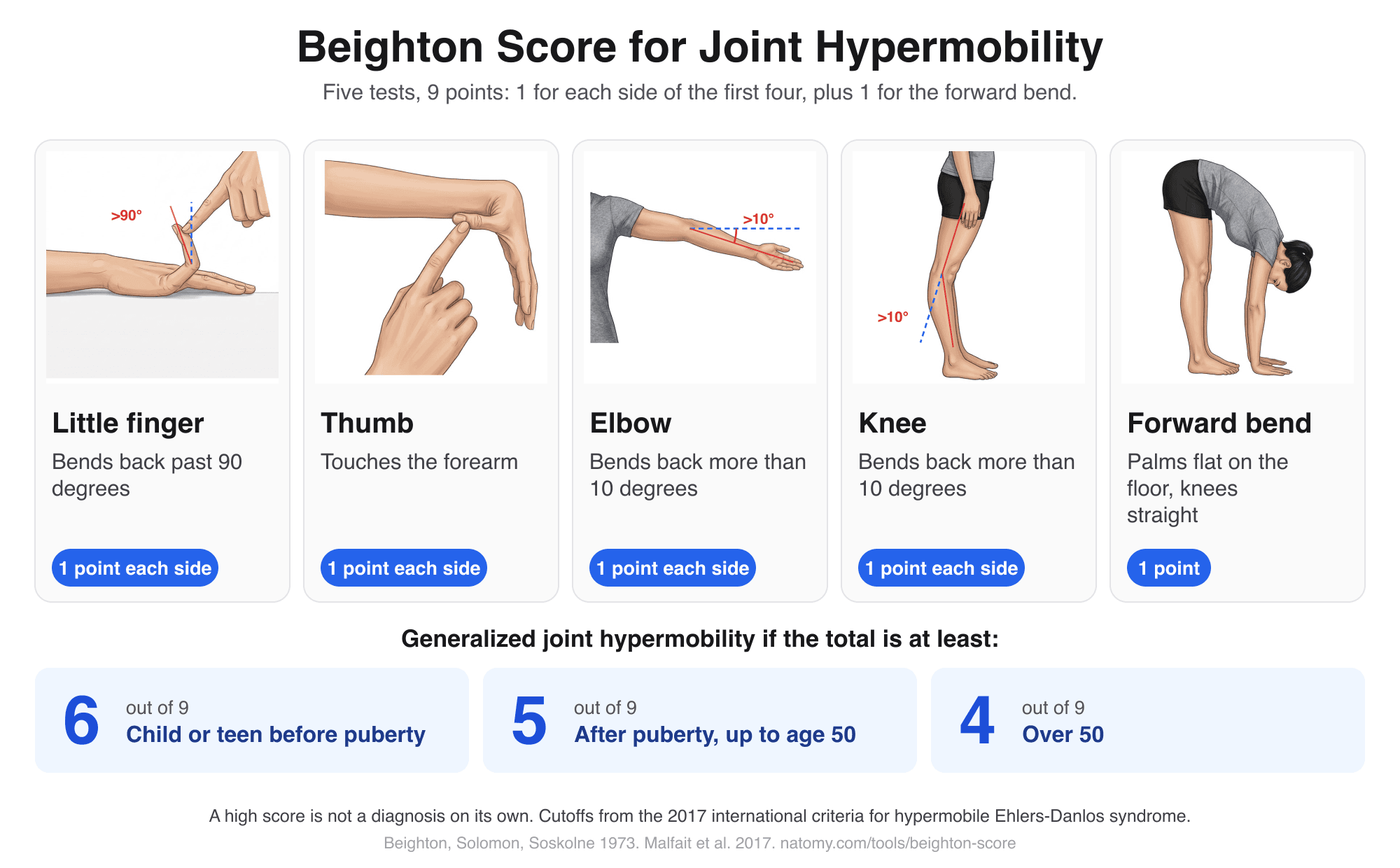
Beighton Score Calculator
Illustrated hypermobility test: score the 5 Beighton movements out of 9, compare with the age cutoff, and copy a note.
Try it free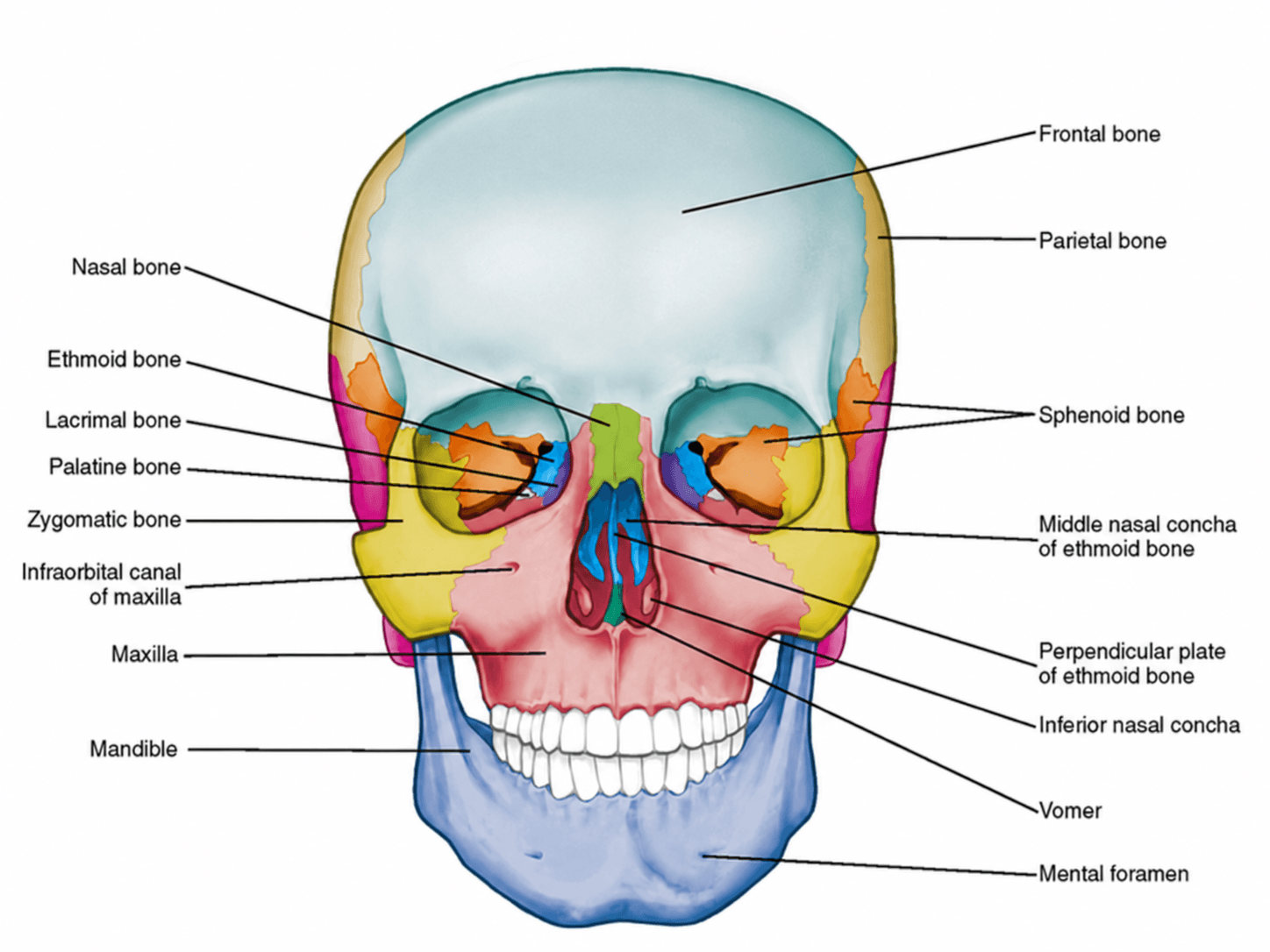
Anterior View of Skull Labeled
Free labeled and unlabeled anterior view of the skull, downloadable as PNG.
Try it free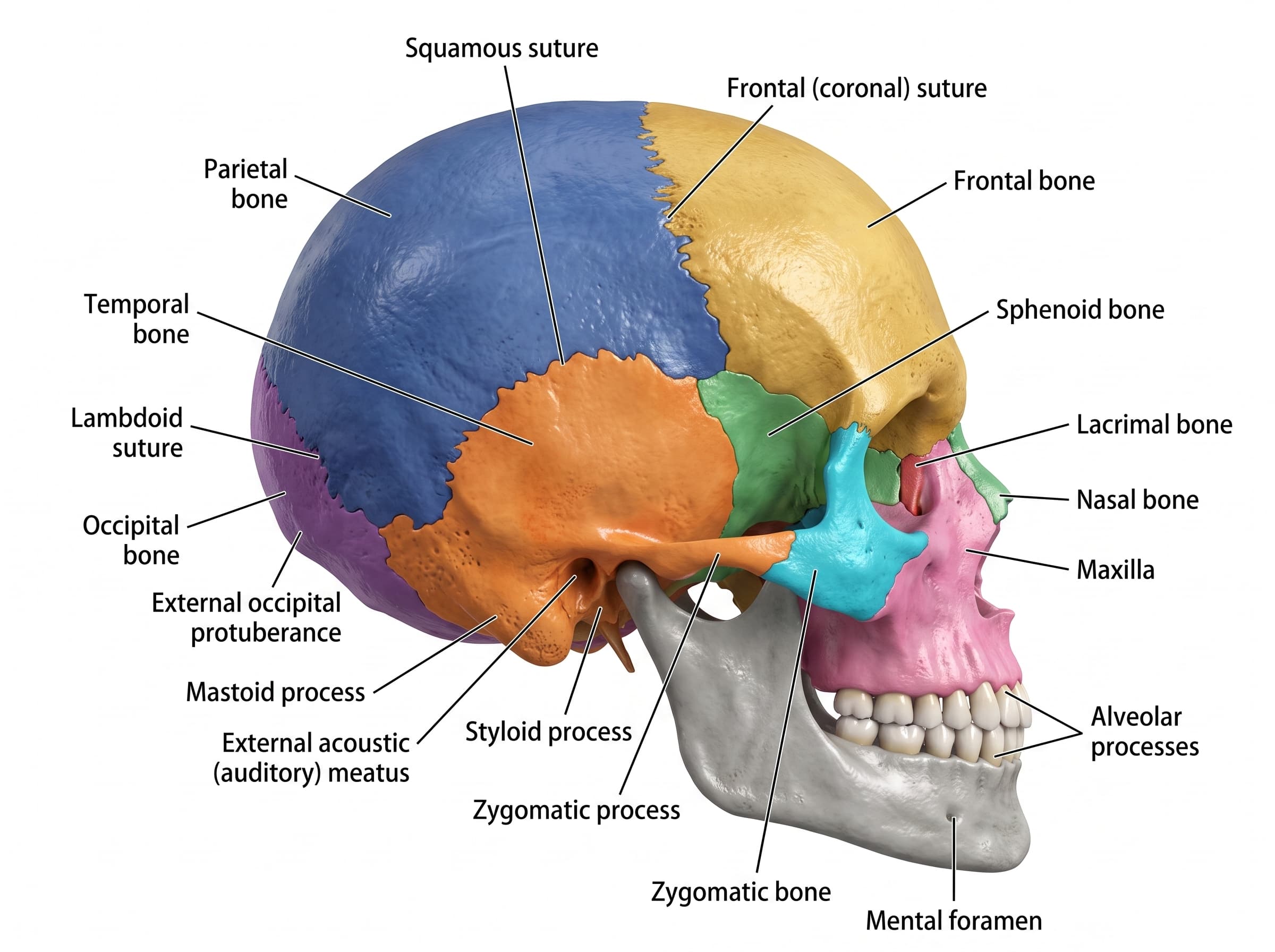
Lateral View of Skull Labeled
Free labeled and unlabeled lateral view of the skull, downloadable as PNG.
Try it free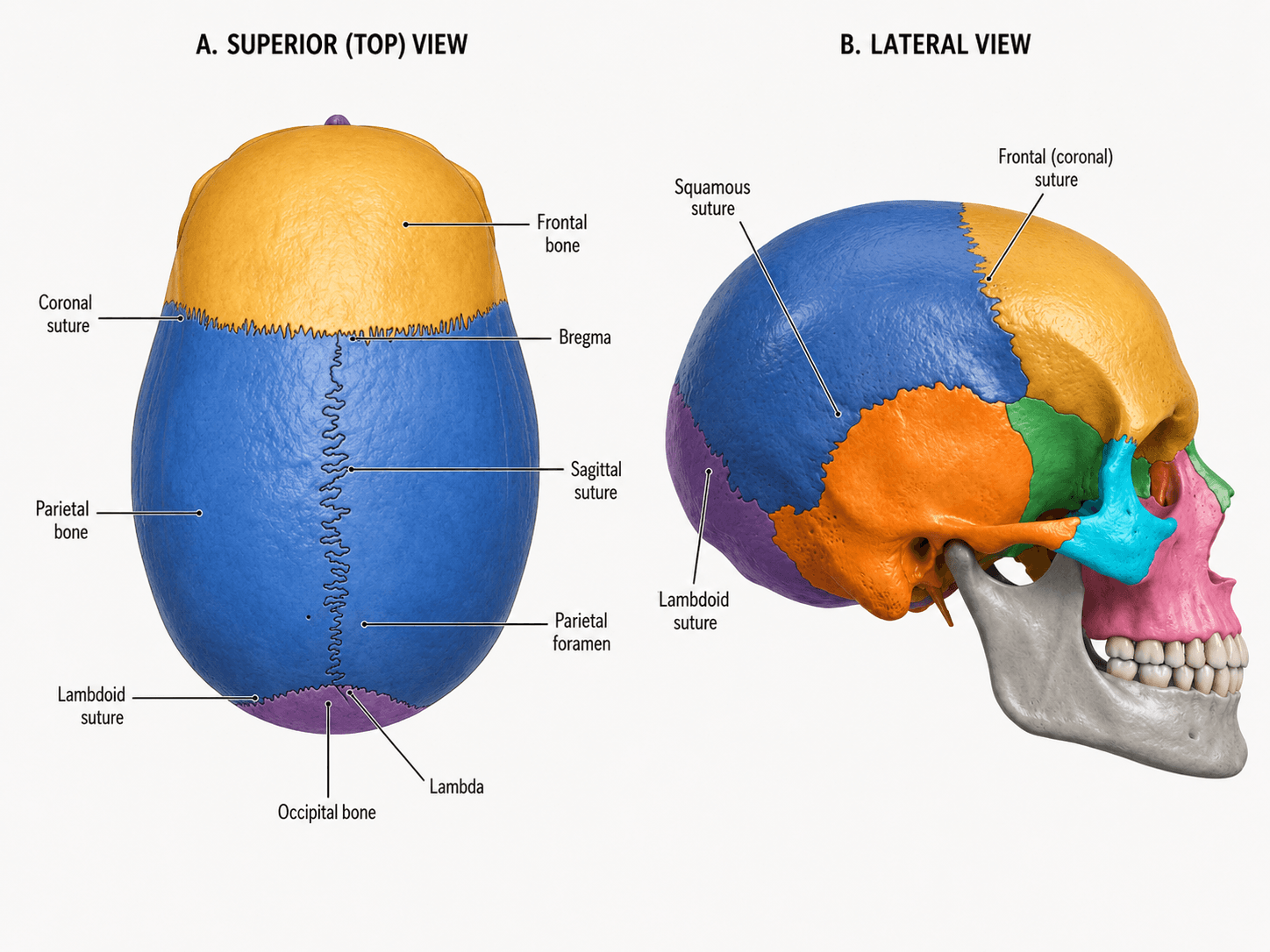
Skull Sutures Labeled
Free labeled and unlabeled skull sutures diagram, superior and lateral views, downloadable as PNG.
Try it free