Herniated Disc in Neck: C5-C6 Symptoms & Treatment
A herniated disc in the neck pushes disc material onto a nerve root or the spinal cord. Learn C5-C6 symptoms and treatment, illustrated beside a normal disc.
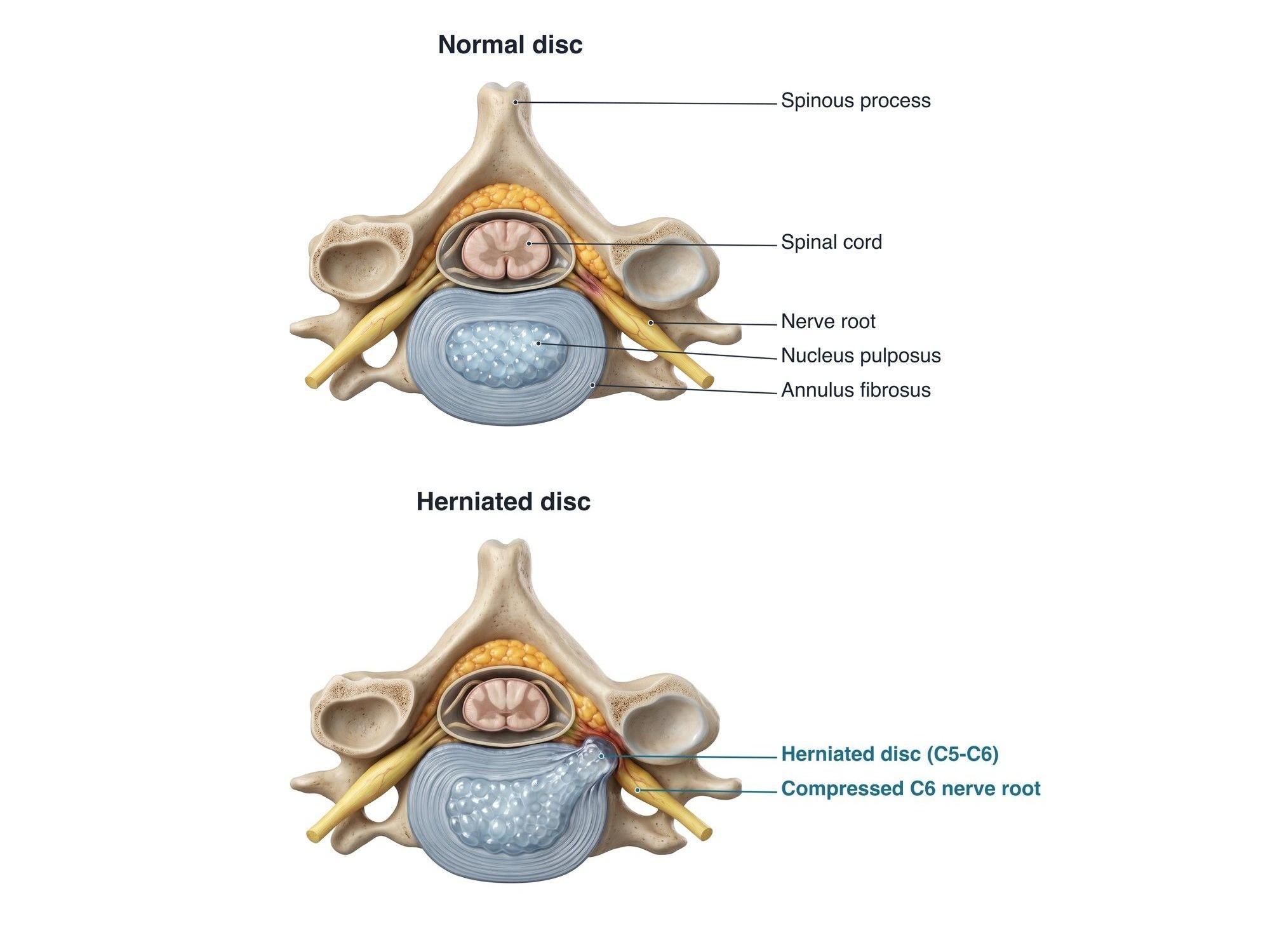
A herniated disc in the neck (cervical disc herniation) happens when the soft center of a disc between two neck vertebrae pushes out through a tear in its tough outer ring. The escaped material can press on a nerve root, causing pain, numbness or weakness down the arm, or on the spinal cord itself. It is most common at C5-C6 and C6-C7, the most mobile levels of the neck. The illustration above shows a normal disc beside a C5-C6 herniation pinching the C6 nerve root.
The anatomy
Each intervertebral disc sits between two vertebral bodies and acts as a shock absorber. It has two parts:
- The annulus fibrosus, a tough outer ring made of layers of fibers
- The nucleus pulposus, a soft, gel-like center
Behind the disc is the spinal canal, which holds the spinal cord. On each side, a nerve root leaves the canal through an opening called the foramen. In the neck, a nerve root exits above the vertebra of the same number, so a C5-C6 herniation usually affects the C6 root. For the normal anatomy, see cervical spine anatomy.
Types
| Type | What happens |
|---|---|
| Bulge | The disc extends evenly past the vertebral edge; the annulus is intact |
| Protrusion | Nucleus pushes into a weak spot, but the outer ring still holds it |
| Extrusion | Nucleus breaks through the annulus |
| Sequestration | A free fragment breaks off and moves in the canal |
By location, a herniation can be central (toward the spinal cord), paracentral, or foraminal / posterolateral (toward the nerve root, as shown above).
Causes
- Disc aging (degeneration). Discs lose water and their outer ring weakens with age, so small tears form.
- Trauma. Car crashes, especially rear-end collisions with whiplash, falls, and sports injuries.
- Repetitive strain. Heavy lifting, overhead work and long hours of neck bending.
- Smoking and genetics, which speed up disc wear.
Symptoms
Symptoms depend on which structure is compressed.
Nerve root compression (radiculopathy):
- Neck pain that spreads to the shoulder blade and down one arm
- Numbness or tingling in a pattern set by the nerve root
- Weakness of the muscles that nerve controls
- Pain that worsens with turning or tilting the head toward the painful side
| Disc level | Nerve root | Where symptoms go | Weakness |
|---|---|---|---|
| C4-C5 | C5 | Shoulder and upper arm | Shoulder (deltoid) |
| C5-C6 | C6 | Thumb and index finger | Biceps, wrist extensors |
| C6-C7 | C7 | Middle finger | Triceps |
| C7-T1 | C8 | Ring and little finger | Hand grip |
Spinal cord compression (myelopathy): clumsy hands, trouble with buttons or handwriting, unsteady walking, and sometimes bladder changes. Myelopathy needs prompt specialist care.
Diagnosis
A doctor examines strength, sensation and reflexes in the arms, and tests that reproduce arm pain (the Spurling test). MRI is the best test. It shows the herniated material, which nerve root or how much of the cord it compresses, and any swelling in the cord. CT is used when MRI is not possible. Nerve studies (EMG) can confirm which nerve root is damaged.
Treatment
Most people get better without surgery.
- Activity changes. Avoid heavy lifting and positions that worsen arm pain. Bed rest is not recommended.
- Medicines. Anti-inflammatory medicines, a short course of oral steroids, and nerve pain medicines.
- Physical therapy. Posture work, gentle traction and strengthening.
- Epidural steroid injection. Steroid placed near the inflamed nerve root to calm the inflammation.
- Surgery. For lasting arm pain, progressive weakness or myelopathy. The most common operation is ACDF surgery, which removes the disc from the front of the neck and fuses the level. A posterior foraminotomy frees a single nerve root from behind. Artificial disc replacement is another option for some patients.
Recovery
Arm pain from a herniated disc usually improves over 6 to 12 weeks. Numbness and weakness can take months to recover. After ACDF, most people return to desk work in a few weeks, and the bones fuse over 3 to 6 months.
Complications
- Chronic neck and arm pain
- Permanent numbness or weakness from long-standing nerve compression
- Myelopathy, spinal cord damage from a central herniation
- Recurrence at the same or another level
- Adjacent segment disease after a fusion
How a herniated disc in the neck is shown in a personal injury case
Cervical disc herniations are among the most common injuries claimed after car crashes and falls. The defense often argues that the MRI shows only age-related degeneration that was there before. The plaintiff's experts may point to a new onset of arm symptoms after the crash, or to features that suggest an acute herniation. An illustration based on the plaintiff's own MRI, beside a normal disc, shows the jury exactly where the disc pressed on the nerve and why the arm hurts. A follow-up illustration can show the surgery, such as an ACDF. For how these images are used at trial, see demonstrative evidence and medical legal illustration. For a herniation in the lower back, see lumbar disc herniation.
Related pages
FAQ
How long does it take to recover from a herniated disc in the neck?+
Most people improve a lot within 6 to 12 weeks without surgery. The body often shrinks and reabsorbs the herniated material over time. Numbness and weakness can take longer to recover than pain. Symptoms that last past about 3 months, or weakness that gets worse, may need surgery.
What is the difference between a bulging and a herniated disc?+
A bulging disc extends evenly beyond the edge of the vertebra, like a hamburger too big for its bun, while the outer ring stays intact. In a herniated disc, the soft inner nucleus pushes through a tear in the outer ring. A herniation is more likely to press on a nerve and cause arm symptoms.
What are the symptoms of a C5-C6 herniated disc?+
A C5-C6 herniation usually pinches the C6 nerve root. It causes neck pain and pain, numbness or tingling down the arm into the thumb and index finger. It can weaken the biceps and wrist extensors and reduce the biceps reflex.
Can a herniated disc in the neck cause swelling or inflammation?+
Yes. The nucleus contains chemicals that inflame the nerve root, so the nerve swells and becomes very sensitive. This inflammation is a large part of the pain, which is why anti-inflammatory medicines and steroid injections often help. Visible swelling of the neck itself is not typical.
Does a herniated disc in the neck need surgery?+
Most do not. Rest from aggravating activities, anti-inflammatory medicine, physical therapy and epidural steroid injections help most people. Surgery, such as ACDF or a posterior foraminotomy, is considered for severe or lasting arm pain, progressive weakness, or spinal cord compression.
Which exercises should be avoided with a C5-C6 herniated disc?+
Avoid heavy overhead lifting, exercises that load the neck such as headstands or shoulder presses with heavy weight, and repeated deep neck bending, until a doctor or physical therapist says otherwise. Gentle chin tucks, posture work and shoulder blade exercises are usually encouraged.
What happens to a herniated disc 10 years later?+
Many herniations shrink and stop causing symptoms within months. Years later, the disc often looks degenerated on MRI, and some people have recurring neck pain. A new herniation at the same or another level can occur.
When is a herniated disc in the neck an emergency?+
Seek urgent care for clumsy hands, trouble walking or balance problems, weakness in both arms or legs, or loss of bladder or bowel control. These can mean the spinal cord is compressed (myelopathy).
Need this illustration for a patient or a case?
Describe the injury or upload a scan and get a clear, labeled medical illustration for a consult, a chart or a case exhibit.
Try Natomy →