Cephalohematoma: Causes, Symptoms & Treatment in Newborns
A cephalohematoma is blood under the periosteum of a newborn's skull that stops at the sutures.
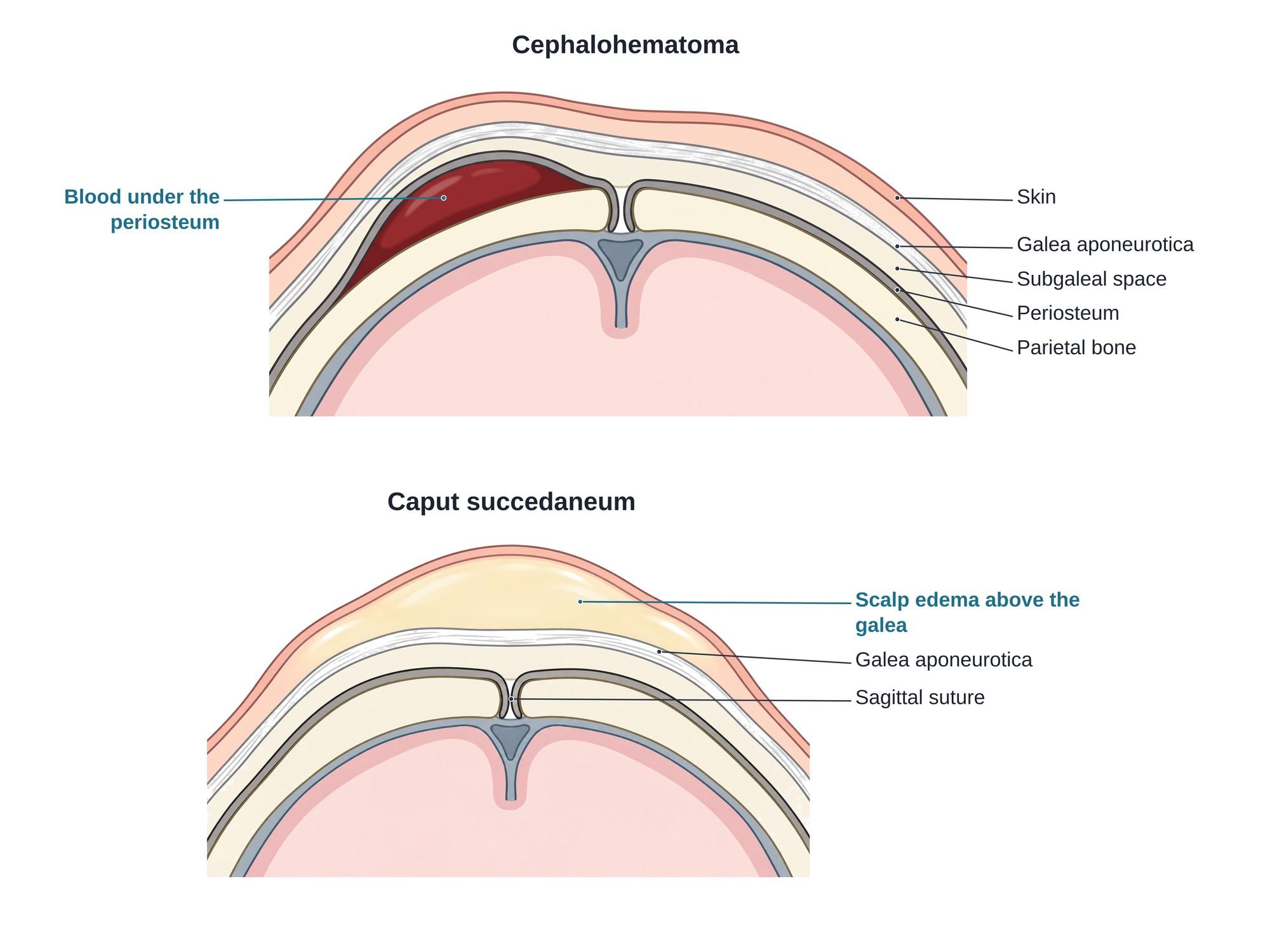
A cephalohematoma is a collection of blood between a newborn's skull bone and its outer lining, the periosteum. It most often lies over one parietal bone, at the top and side of the head. Because the periosteum is attached at the skull's sutures (the seams between bones), the blood stops at the suture line and does not cross it. It shows up as a firm lump hours to days after birth. Most go away on their own within weeks to a few months. The illustration above shows a cephalohematoma beside caput succedaneum, the more common birth swelling it is often confused with.
The anatomy
A newborn's scalp has several layers over the skull. From outside in, they are the skin, a layer of connective tissue, the galea aponeurotica (a tough sheet of tendon), the subgaleal space (a loose layer of tissue), and the periosteum. The periosteum is a thin membrane stuck tightly to the outer surface of each skull bone. The bones of a newborn's skull are thin and not yet joined. They meet at sutures, which are bands of fibrous tissue. The periosteum anchors to the bone edges at each suture. That is why a cephalohematoma is held to one bone. For the full anatomy, see skull anatomy and brain anatomy.
Cephalohematoma vs caput succedaneum vs subgaleal hemorrhage
Three kinds of scalp swelling happen at birth. Each one sits in a different layer.
| Caput succedaneum | Subgaleal hemorrhage | Cephalohematoma | |
|---|---|---|---|
| What it is | Fluid (edema) in the scalp | Blood under the galea | Blood under the periosteum |
| Layer | Above the galea | Between the galea and the periosteum | Between the periosteum and the bone |
| Crosses sutures | Yes | Yes, can spread over the whole scalp | No, stops at the suture |
| When it appears | At birth | At birth or in the first hours to days | Hours to days after birth, may grow |
| Feel | Soft, pits when pressed | Soft, shifts with position | Firm, with a clear edge |
| How long it lasts | A few days | Weeks | Weeks to months |
| Main risk | Rarely serious | Large blood loss and shock | Jaundice, rarely infection or calcification |
Causes
A cephalohematoma happens when force during birth tears small blood vessels under the periosteum. The head is squeezed and rubbed against the mother's pelvis. The periosteum shears away from the bone, and blood fills the gap. Risk factors include:
- A long or hard labor
- A first baby
- A large baby, or a baby in an unusual position
- Vacuum extraction, the strongest risk factor, and forceps delivery
- A difficult delivery of the shoulders, such as shoulder dystocia
It can also happen after an easy delivery, and rarely after a cesarean section.
Symptoms
- A firm, raised lump on the head, usually over one side of the top of the head
- The lump stops at a clear edge and does not cross the midline
- It appears hours to days after birth and may grow for a few days
- The skin over it usually looks normal, without bruising
- Over weeks, the edges may feel hard while the center stays soft
Diagnosis
Doctors usually diagnose a cephalohematoma with a physical exam. They feel for a firm swelling that stays within the edges of one skull bone. They also check the baby's color, feeding and alertness. If a skull fracture or bleeding inside the skull is a concern, imaging is done. An ultrasound or CT scan shows a smooth, curved collection on the outer surface of the bone, bounded by the sutures. Blood tests check the bilirubin level and the blood count when the swelling is large.
Treatment
Most cephalohematomas need no treatment. The body slowly absorbs the blood.
- Watchful waiting: the doctor checks the size of the lump at each visit.
- Jaundice checks: bilirubin levels are measured, and phototherapy is used if they rise too high.
- No draining in most cases: putting a needle in the swelling can let in germs.
- Treating infection: a rare infected cephalohematoma needs antibiotics and drainage.
- Surgery for calcification: rarely, a hardened lump that leaves a clear skull deformity is removed.
Recovery
Most cephalohematomas go away in 2 weeks to 3 months. Large ones may take longer. Some leave a firm ridge while they heal, which usually smooths out as the skull grows. Most babies have no long-term problems.
Complications
- Jaundice from the breakdown of the trapped blood
- Anemia (a low red blood cell count) when the collection is large
- Calcification, where the blood turns to bone and leaves a lasting bump
- Infection, rare, sometimes after a needle was placed in it
- Skull fracture underneath, found in a small share of cases
- Rarely, bleeding inside the skull from the same delivery
How cephalohematoma is shown in a personal injury case
A cephalohematoma is a common finding in birth injury and medical malpractice cases. The questions are often how much force was used, how many vacuum pulls or forceps attempts were made, and whether jaundice or bleeding was found and treated in time. Lawyers also need to explain why a cephalohematoma is usually less dangerous than a subgaleal hemorrhage, which can cause severe blood loss. It is often one of several injuries from the same delivery, along with a brachial plexus injury such as Erb's palsy. A cross-section like the one above shows a jury which layer the blood sits in and why it stops at the suture. For how these images are used at trial, see demonstrative evidence and medical legal illustration.
Related pages
FAQ
What is the difference between caput succedaneum and cephalohematoma?+
Caput succedaneum is swelling of the scalp skin from fluid, above the galea. It is soft, crosses the sutures, and is present at birth. A cephalohematoma is blood under the periosteum of one skull bone. It is firmer, does not cross a suture, and often grows over the first hours to days. Caput usually fades in a few days. A cephalohematoma can take weeks to months.
Can a cephalohematoma cause brain damage?+
A cephalohematoma sits outside the skull, so by itself it does not press on the brain. Most babies have no lasting effects. Doctors look for problems that can come with it, such as a skull fracture or bleeding inside the skull, especially after a hard delivery or a vacuum or forceps birth.
How can a cephalohematoma cause jaundice?+
As the trapped blood breaks down, the body turns its red cells into bilirubin. A large cephalohematoma adds extra bilirubin for the newborn liver to clear. This can raise the jaundice level, and some babies need phototherapy (light treatment).
What is a calcified hematoma on a baby's head?+
Sometimes a cephalohematoma does not fully absorb. The edges harden into bone over weeks, leaving a firm bump. Most calcified cephalohematomas flatten as the skull grows. A few that leave a clear deformity are treated with surgery.
How long does a cephalohematoma take to go away?+
Most go away on their own over about 2 weeks to 3 months. Larger ones take longer. The lump may feel soft at first, then firm at the edges as it heals.
Should a cephalohematoma be drained?+
Usually not. Draining it with a needle raises the risk of infection and is rarely needed. Drainage is considered only if the area looks infected or another problem is suspected.
Is a cephalohematoma the same as a subgaleal hemorrhage?+
No. A subgaleal hemorrhage is bleeding into the loose space under the galea, above the periosteum. That space covers the whole scalp, so the blood can spread widely and a baby can lose a dangerous amount of blood. A cephalohematoma is held in by the periosteum and the sutures, so it stays small and limited to one bone.
Is a cephalohematoma a birth injury?+
Yes. It is caused by pressure and shearing forces on the head during labor and delivery. It is more common after a long labor, a large baby, or a vacuum or forceps delivery. It can also happen after a normal birth.
Need this illustration for a patient or a case?
Describe the injury or upload a scan and get a clear, labeled medical illustration for a consult, a chart or a case exhibit.
Try Natomy →