Shoulder Dystocia Maneuvers: McRoberts, HELPERR & More
Shoulder dystocia maneuvers, led by the McRoberts maneuver and suprapubic pressure, free a baby's shoulder stuck behind the pubic bone.
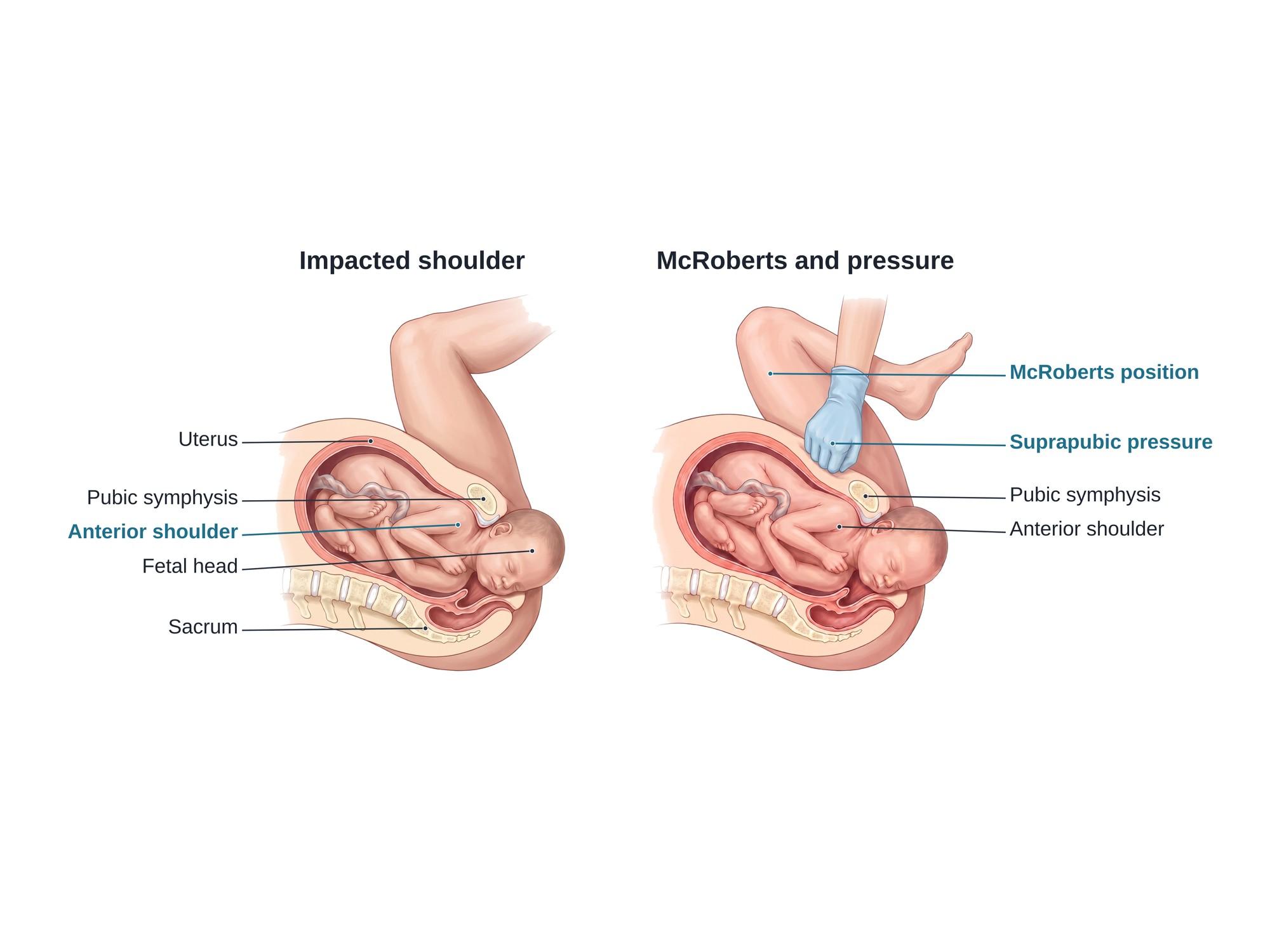
Shoulder dystocia maneuvers are the hand movements and position changes used when a baby's shoulder gets stuck during a vaginal birth. In shoulder dystocia, the baby's head delivers, but the front (anterior) shoulder catches behind the mother's pubic bone, the pubic symphysis. The body cannot follow. It is an emergency, because the baby's oxygen supply can drop while it is stuck. The first steps are almost always the McRoberts maneuver and suprapubic pressure. The illustration above shows the impacted shoulder, and the same view during these two maneuvers.
Why it is done
The goal is to free the shoulder quickly and gently. Pulling hard on the head does not work and can tear the nerves of the neck and arm. Instead, the team changes the shape and angle of the mother's pelvis, or turns the baby's shoulders, so the shoulders can pass.
Signs that the maneuvers are needed:
- The head delivers, then pulls back tight against the perineum (the turtle sign)
- The head does not turn to the side on its own (no restitution)
- The shoulders do not deliver with normal gentle downward guidance
The anatomy
The pelvis is a ring of bone. In front, the two pubic bones meet at the pubic symphysis. In back is the sacrum, the triangular bone at the base of the spine. During birth, the baby's shoulders must pass through this ring. Normally they turn to fit its widest angle. In shoulder dystocia, the shoulders stay front to back. The anterior shoulder then hits the pubic symphysis. Less often, the posterior shoulder catches on the sacrum. See the female abdomen and pelvis for the bones and organs involved.
How the maneuvers are done
Many teams use the memory aid HELPERR to keep the steps in order. The order can change with the situation.
- H: Help. Call for help: more nurses, a senior obstetrician, anesthesia and the newborn team. Note the time the head delivered. The mother is asked to stop pushing.
- E: Evaluate for episiotomy. A cut in the perineum does not free the shoulder by itself. It can give more room for the hand during the internal maneuvers.
- L: Legs (McRoberts). Two helpers pull the mother's thighs back toward her abdomen.
- P: Pressure (suprapubic). A helper presses just above the pubic bone to push the shoulder down and under it.
- E: Enter (internal rotation). The clinician places a hand inside to turn the baby's shoulders into a wider angle of the pelvis.
- R: Remove the posterior arm. The clinician sweeps the back arm across the baby's chest and delivers it, which narrows the shoulders.
- R: Roll. The mother rolls onto her hands and knees (the Gaskin maneuver) and the team tries again.
Throughout, the clinician uses only gentle guidance on the head. No one pushes on the top of the uterus.
McRoberts maneuver
The McRoberts maneuver is the first maneuver in most cases. The mother lies flat on her back. Two helpers each hold one leg. They pull her thighs back sharply against her abdomen, so her knees move toward her shoulders.
This does two things. It flattens the curve of the lower back. It also rotates the pelvis so the pubic symphysis tilts up toward her head. The pubic bone then slides over the stuck shoulder. McRoberts alone frees the shoulder in a large share of cases. It is quick, needs no hand inside the body and rarely causes harm.
Suprapubic pressure
Suprapubic pressure means pressing on the lower abdomen just above the pubic bone. A helper stands on the side of the baby's back. With the heel of the hand or a fist, as in CPR, the helper pushes down and toward the baby's face. The pressure can be steady or rocking. When done with the push in this direction, it is sometimes called the Rubin I maneuver.
The push moves the anterior shoulder toward the baby's chest. This makes the shoulders narrower and turns them to an angle where they fit. McRoberts and suprapubic pressure together resolve most cases. This pressure is very different from fundal pressure, a push on the top of the uterus. Fundal pressure drives the shoulder harder into the bone and should not be used.
Internal maneuvers: Rubin, Woods screw and posterior arm
If the first steps fail, the clinician reaches into the vagina along the back of the pelvis, where there is the most room.
- Rubin II maneuver: pressure on the back of the anterior shoulder, pushing it toward the baby's chest
- Woods screw maneuver: pressure on the front of the posterior shoulder, turning the baby like a screw
- Reverse Woods maneuver: the same turn in the other direction
- Delivery of the posterior arm: the back arm is flexed at the elbow and swept across the chest and out. This can fracture the upper arm bone (the humerus), which usually heals well.
Gaskin maneuver
In the Gaskin maneuver, the mother turns onto her hands and knees. Gravity and the change in angle can free the shoulder. The posterior shoulder often delivers first in this position. It works best when the mother can move easily, for example without a dense epidural block.
Zavanelli maneuver and other last steps
When nothing else works, rare last options exist. In the Zavanelli maneuver, the head is turned back and pushed back into the birth canal, then the baby is delivered by emergency cesarean. Other rare steps include breaking the baby's collarbone on purpose to narrow the shoulders, or symphysiotomy, cutting the cartilage of the pubic symphysis. These carry real risk and are used only in extreme cases.
Risk factors for shoulder dystocia
- A large baby (fetal macrosomia), especially over about 4,500 grams
- Diabetes in the mother, including gestational diabetes
- Obesity or high weight gain in pregnancy
- Shoulder dystocia in an earlier birth
- A long second stage of labor
- Delivery with forceps or vacuum
- Pregnancy past the due date
Even so, shoulder dystocia is hard to predict. Many cases happen in babies of normal weight with no risk factors. ACOG suggests offering a planned cesarean when the estimated weight is over 5,000 grams, or over 4,500 grams if the mother has diabetes.
Recovery
For the baby, most recover fully. The newborn team checks the arms, collarbones and breathing right after birth. If one arm does not move well, this may be a brachial plexus injury such as Erb's palsy, a stretch of the nerves from the neck to the arm (the C5 and C6 nerve roots of the cervical spine). Many of these improve over weeks to months, with physical therapy. A fractured collarbone or humerus usually heals in a few weeks. Other birth injuries can occur with a hard delivery, such as a cephalohematoma, a collection of blood under the scalp.
For the mother, recovery depends on any tears or bleeding. Deep perineal tears are repaired after birth and usually heal over several weeks. In a later pregnancy, the risk of shoulder dystocia is higher, so the delivery plan is discussed early.
Risks
Baby:
- Brachial plexus injury (Erb's palsy, or less often Klumpke palsy), usually temporary but sometimes permanent
- Fractured collarbone (clavicle) or upper arm bone (humerus)
- Low oxygen during the delay (hypoxia), which in rare, prolonged cases can cause brain injury
- Rarely, death
Mother:
- Heavy bleeding after birth (postpartum hemorrhage)
- Third or fourth degree perineal tears, involving the anal muscle
- Injury to the bladder or the pubic symphysis (rare)
- Uterine rupture (rare, linked to fundal pressure)
How shoulder dystocia maneuvers are shown in a personal injury case
Shoulder dystocia is one of the most common causes of birth injury lawsuits. Most claims involve a child with a permanent brachial plexus injury. Common claims are that the provider pulled too hard on the head, skipped or delayed standard maneuvers, used fundal pressure, or failed to offer a cesarean for a very large baby. The defense often argues that the normal forces of labor can stretch the nerves, even with correct care.
The medical record is central. Experts look for the time the head delivered, each maneuver in order, who did it, which shoulder was anterior, and the time to deliver the body. An illustration like the one above shows a jury where the shoulder was stuck and how the McRoberts maneuver and suprapubic pressure are meant to free it. For how these images are used at trial, see demonstrative evidence and medical legal illustration.
Related pages
FAQ
How do you know it is shoulder dystocia?+
The baby's head delivers, then pulls back tight against the mother's perineum. This is called the turtle sign. The head does not turn to the side as it normally would. The shoulders then do not deliver with gentle downward guidance. At that point the team calls it shoulder dystocia and starts the maneuvers.
What percentage of babies have shoulder dystocia?+
It happens in a small share of vaginal births, often quoted as roughly 0.2 to 3 percent depending on how it is defined. It is more common with large babies and maternal diabetes. But many cases happen in babies of normal weight with no risk factors.
Is there a way to prevent shoulder dystocia?+
It cannot be reliably predicted or prevented. A planned cesarean may be offered when the baby is estimated to be very large, especially if the mother has diabetes. Controlling blood sugar in pregnancy also lowers the risk. Teams prepare with drills so they can respond quickly.
How do they deliver a baby with shoulder dystocia?+
The team calls for help and avoids pulling hard on the head. The first steps are the McRoberts maneuver and suprapubic pressure. If those fail, the clinician reaches inside to rotate the shoulders or deliver the posterior arm. The mother may also be rolled onto her hands and knees.
What is the McRoberts maneuver?+
Two helpers pull the mother's thighs back toward her abdomen. This flattens the low back and tilts the pubic bone upward. That often frees the stuck shoulder. It is fast, safe and usually the first maneuver used.
How long do doctors have to deliver the baby?+
There is no exact cutoff, but time matters. Oxygen to the baby can drop while the body is stuck. Teams aim to resolve it within a few minutes. A clear record of the time from head to body delivery is part of good care.
Can shoulder dystocia cause permanent injury?+
Most babies recover fully. The most common injury is a stretch of the brachial plexus, the nerves to the arm, called Erb's palsy. Most of these heal in the first year, but some are permanent. A fractured collarbone or upper arm bone usually heals well.
Why is fundal pressure not used?+
Pushing on the top of the uterus drives the stuck shoulder harder into the pubic bone. It can make the impaction worse and raise the risk of nerve injury and uterine rupture. Suprapubic pressure, just above the pubic bone, is used instead.
Need a surgical illustration for consent or a case?
Describe the operation and get a clear, labeled medical illustration for patient consent, teaching or a case exhibit.
Try Natomy →