Nociceptive vs Neuropathic Pain: Key Differences
Nociceptive pain comes from injured tissue. Neuropathic pain comes from a damaged nerve. Learn the signs, examples and treatment.
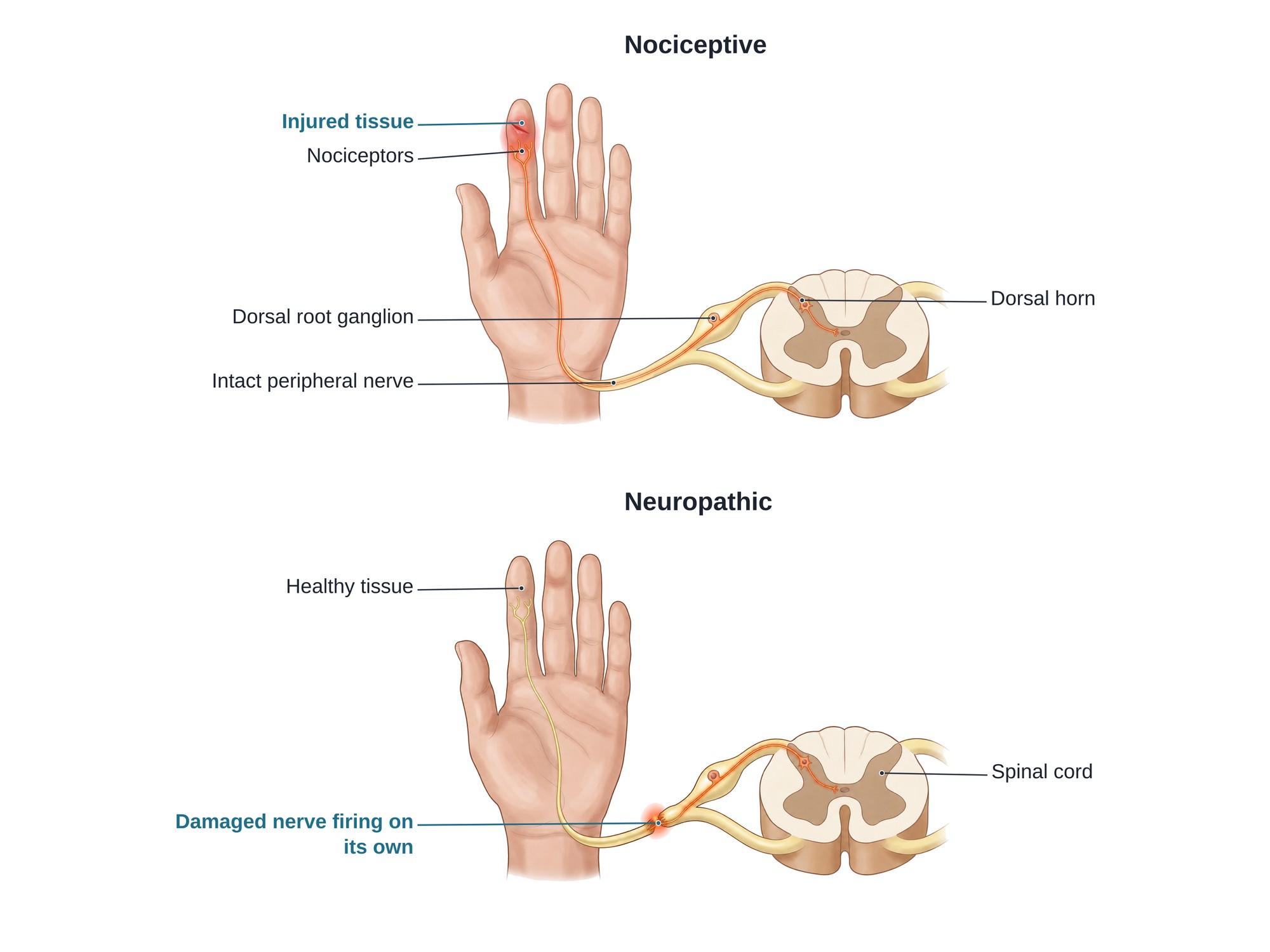
Nociceptive pain is pain from injured tissue. Special nerve endings called nociceptors sense the damage and send a warning to the spinal cord and brain. A cut, a sprain or a broken bone hurts this way. Neuropathic pain is pain from a damaged nerve. Experts define it as "pain arising as a direct consequence of a lesion or disease affecting the somatosensory system" (Treede et al., 2008). The nerve itself fires, even when the tissue it serves is healthy. Pain with neuropathic features affects an estimated 6.9% to 10% of the general population (van Hecke et al., 2014). The figure above shows both side by side.
The anatomy
Pain travels along a chain of nerve cells, called the pain pathway.
- Nociceptors. These are free nerve endings in skin, muscle, bone, joints and organs. They respond to heat, pressure, cuts and chemicals released by inflamed tissue.
- Peripheral nerve. The signal runs up a thin fiber inside a peripheral nerve. Fast A-delta fibers carry sharp, first pain. Slow C fibers carry dull, aching pain.
- Dorsal root ganglion. The cell body of each sensory fiber sits in this small swelling on the nerve root, just outside the spinal cord.
- Dorsal horn. The fiber enters the back of the spinal cord. It passes the signal to a second neuron in the dorsal horn, the rear part of the gray matter.
- Spinal cord and brain. The second neuron crosses the cord and carries the signal up to the thalamus. The brain then feels it as pain.
In nociceptive pain, this chain works normally. In neuropathic pain, a link in the chain is damaged. The damage can be anywhere from the nerve endings to the brain. A damaged fiber can fire on its own, fire too easily, or lose its normal brakes. For the spinal levels and nerve roots, see the spine anatomy and lower limb nerves pages.
Types
| Feature | Nociceptive pain | Neuropathic pain |
|---|---|---|
| Source | Injured or inflamed tissue | Injured or diseased nerve |
| Nerves | Healthy, doing their job | Damaged, firing abnormally |
| Feels like | Aching, throbbing, sharp, sore | Burning, shooting, electric, pins and needles |
| Location | At the injury, often well defined | Along the nerve's territory, such as a strip down the leg |
| Numbness | Not usual | Common, often with weakness |
| Pain from light touch | Rare | Common (allodynia) |
| Usual course | Fades as the tissue heals | Can last long after the injury heals |
| Drugs that help | Acetaminophen, NSAIDs, opioids short term | Certain antidepressants, gabapentin, pregabalin |
Nociceptive pain has two subtypes. Somatic pain comes from skin, muscle, bone and joints. It is usually easy to point to, like a sprained ankle. Visceral pain comes from internal organs. It is deep, vague, and often felt somewhere else, like heart pain felt in the left arm.
Neuropathic pain is peripheral when it starts in a nerve, root or ganglion. It is central when it starts in the spinal cord or brain, as after a spinal cord injury or stroke.
A third type, nociplastic pain, comes from a nervous system that amplifies pain without clear tissue or nerve damage. Fibromyalgia is the usual example. Many patients have mixed pain, with more than one type at once.
Causes
Nociceptive pain examples:
- Cuts, lacerations, abrasions and burns
- Bruises and contusions
- Sprains and strains, and broken bones
- Arthritis and facet joint arthropathy
- Pain after surgery
- Visceral pain, such as appendicitis or a kidney stone
Neuropathic pain examples:
- A pinched spinal nerve root from a lumbar disc herniation, a cervical disc herniation or foraminal stenosis (radiculopathy, or sciatica in the leg)
- Nerve injury from trauma, such as a crushed, stretched or cut nerve
- Brachial plexus stretch injuries, such as Erb's palsy
- Carpal tunnel syndrome and other entrapments
- Diabetic peripheral neuropathy
- Shingles pain that persists (postherpetic neuralgia)
- Phantom limb pain after amputation
- Spinal cord injury, stroke and multiple sclerosis (central pain)
Symptoms
Nociceptive pain is usually:
- Aching, throbbing or sharp
- Worse with movement or pressure on the injured part
- Tender to the touch right at the injury
- Proportional to the injury, and better as it heals
Neuropathic pain often brings:
- Burning, shooting, stabbing or electric shock pain
- Pins and needles (paresthesia) or numbness
- Allodynia, which means pain from something that should not hurt, like a bedsheet
- Hyperalgesia, which means too much pain from a mildly painful stimulus
- Pain in a nerve's pattern, such as a band around the chest or a line down the leg
- Weakness or lost reflexes when the nerve also carries motor fibers
- Pain that is worse at night
Diagnosis
There is no single test that proves a pain is neuropathic. Doctors put together the history and the exam. They ask what the pain feels like and draw where it spreads. A nerve pain pattern that matches one nerve or root is a strong clue. On exam, they test light touch, pinprick, temperature, strength and reflexes. Lost or changed sensation in the painful area points to a nerve problem.
Short questionnaires such as the DN4 or the LANSS screen for nerve pain features. Tests then look for the lesion. Nerve conduction studies and electromyography (EMG) measure how well nerves carry signals. An MRI can show a herniated disc pressing on a nerve root, or narrowing of the foramen where the root exits. A skin biopsy can count the small nerve fibers in neuropathy. For nociceptive pain, imaging looks for the tissue injury instead, such as a fracture or torn ligament.
Treatment
Nociceptive pain is treated at its source. Rest, ice, splints and physical therapy let tissue heal. Acetaminophen and NSAIDs (anti-inflammatory drugs such as ibuprofen and naproxen) ease inflammation. Short courses of stronger drugs may help after surgery or a fracture. Injections, joint surgery or fracture fixation treat the damaged structure itself.
Neuropathic pain responds poorly to NSAIDs. A large review gave a strong first-line recommendation to tricyclic antidepressants, SNRIs (such as duloxetine), pregabalin and gabapentin (Finnerup et al., 2015). Benefits are modest. About 6 to 8 people must take an SNRI, pregabalin or gabapentin for one to get half their pain relieved (number needed to treat 6.4, 7.7 and 7.2) (Finnerup et al., 2015). Lidocaine and capsaicin patches can help pain in one area.
When a structure is pressing on the nerve, removing the pressure is the most direct fix. Options include a microdiscectomy for a herniated disc, a foraminotomy to widen a tight foramen, ACDF surgery in the neck, or a carpal tunnel release at the wrist.
For nerve pain that lasts despite these steps, a spinal cord stimulator can help. It sends mild electrical pulses to the spinal cord to calm the pain signal. In a trial of patients with nerve root leg pain after back surgery, 48% with a stimulator got at least half their leg pain relieved at 6 months, compared with 9% on medical treatment alone (Kumar et al., 2007).
Recovery
Nociceptive pain usually fades as the tissue heals. A sprain may take weeks. A fracture takes about 6 to 12 weeks to knit. Pain that lasts past normal healing needs a new look for a missed injury or a nerve problem.
Neuropathic pain follows the nerve. A nerve that is only compressed often recovers within weeks to months once the pressure is gone. A crushed or torn nerve has to regrow its fibers, which is slow, about 1 millimeter a day at best. Some nerve pain becomes chronic. Chronic pain of any kind is common: about 20.9% of U.S. adults had pain lasting 3 months or more in 2021 (Rikard et al., 2023).
Complications
- Chronic pain, pain that lasts more than 3 months
- Central sensitization, where the spinal cord and brain turn up the volume on pain
- Sleep loss, depression and anxiety, which make pain worse
- Weakness and muscle wasting when a motor nerve is also damaged
- Disability and time off work
- Medication side effects, such as drowsiness and dizziness from nerve pain drugs
- Device complications after a stimulator: in the same trial, 32% of stimulator patients had a device-related problem by 12 months (Kumar et al., 2007)
References
- Treede RD, Jensen TS, Campbell JN, et al. Neuropathic pain: redefinition and a grading system for clinical and research purposes. Neurology. 2008.
- van Hecke O, Austin SK, Khan RA, Smith BH, Torrance N. Neuropathic pain in the general population: a systematic review of epidemiological studies. Pain. 2014.
- Finnerup NB, Attal N, Haroutounian S, et al. Pharmacotherapy for neuropathic pain in adults: a systematic review and meta-analysis. Lancet Neurology. 2015.
- Kumar K, Taylor RS, Jacques L, et al. Spinal cord stimulation versus conventional medical management for neuropathic pain: a multicentre randomised controlled trial in patients with failed back surgery syndrome. Pain. 2007.
- Rikard SM, Strahan AE, Schmit KM, Guy GP Jr. Chronic Pain Among Adults, United States, 2019-2021. MMWR Morbidity and Mortality Weekly Report (CDC). 2023.
FAQ
What is the main difference between nociceptive and neuropathic pain?+
Nociceptive pain comes from damaged tissue, such as a cut, a sprain or a broken bone. The nerves are healthy and are doing their job. Neuropathic pain comes from damage to the nerve itself. The nerve sends pain signals even when the tissue around it is fine.
What are examples of nociceptive pain?+
A cut, a burn, a sprained ankle, a broken bone, a bruise, arthritis, and pain after surgery are all nociceptive. Visceral examples include appendicitis and kidney stones. The pain usually matches the injury and fades as the tissue heals.
What are examples of neuropathic pain?+
Sciatica from a herniated disc, diabetic neuropathy, shingles pain (postherpetic neuralgia), carpal tunnel syndrome, trigeminal neuralgia, phantom limb pain and pain after a spinal cord injury. Each one starts with an injury or disease of the nerves.
What does nerve pain feel like?+
People often describe it as burning, shooting, stabbing or electric. It may come with pins and needles, numbness, or pain from a light touch that should not hurt. It usually follows the area a nerve supplies, such as a strip down the leg.
Can you have both nociceptive and neuropathic pain at once?+
Yes. This is called mixed pain. Low back pain with sciatica is a common example. The disc and joints cause nociceptive back pain, and the pinched nerve root causes neuropathic leg pain.
Can Aleve or ibuprofen treat nerve pain?+
Anti-inflammatory drugs like naproxen (Aleve) and ibuprofen work well for nociceptive pain from inflamed tissue. They help little with true neuropathic pain. First-line drugs for nerve pain are certain antidepressants and the drugs gabapentin and pregabalin. Ask a doctor before starting any of them.
Does neuropathic pain go away?+
Sometimes. If the pressure on the nerve is removed early, such as a disc that shrinks or a nerve that is freed in surgery, the pain often improves. Nerves heal slowly, about an inch a month at best. Pain from long-standing or severe nerve damage can be permanent.
What is nociplastic pain?+
Nociplastic pain is a third type. There is no clear tissue damage and no nerve lesion, but the nervous system has become more sensitive and amplifies pain. Fibromyalgia is the usual example. It can overlap with the other two types.
Need this illustration for a patient or a case?
Describe the injury or upload a scan and get a clear, labeled medical illustration for a consult, a chart or a case exhibit.
Try Natomy →