Contusion (Bruise): Types, Healing Time & Bone Bruise
A contusion is a bruise: blood leaks from torn small vessels under intact skin, or inside a bone. See both illustrated beside the tissue layers.
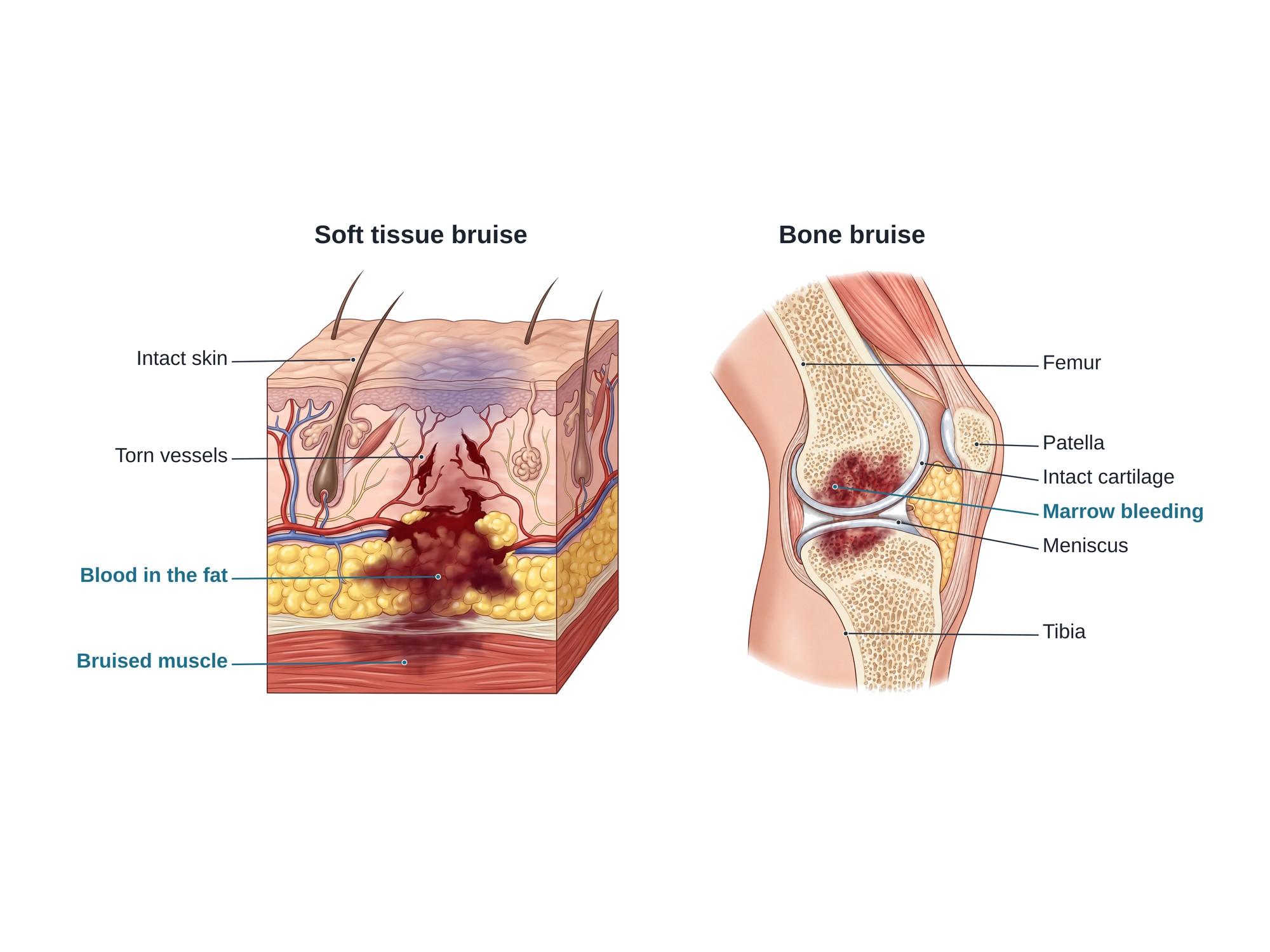
A contusion is a bruise. A blunt blow crushes small blood vessels under the skin without breaking the skin surface. Blood leaks out of the torn vessels into the surrounding fat and muscle, which causes the color, swelling and pain. When the blow is strong enough to damage the inside of a bone, the result is a bone bruise (bone contusion): bleeding and swelling in the bone marrow without a full fracture. The illustration above shows both, a soft tissue bruise beside a bone bruise of the knee.
The anatomy
Skin has two layers. The thin outer layer is the epidermis. Under it is the dermis, which holds hair follicles, glands, nerves and a network of small blood vessels. Below the skin is subcutaneous fat, then a thin sheet of fascia (tough connective tissue) over the skeletal muscle.
Bones have a hard outer shell (the cortex) and a spongy inside called trabecular bone, filled with marrow. At a joint, the bone ends are covered by smooth articular cartilage. In the knee, the femur meets the tibia, and the menisci (C-shaped cartilage pads) sit between them. See knee anatomy for the full joint.
Types of contusion
| Type | What is injured | Typical cause |
|---|---|---|
| Skin (subcutaneous) contusion | Small vessels in the dermis and fat | Blow, fall, seat belt |
| Muscle contusion | Muscle fibers and their vessels | Direct hit to the thigh or calf, dashboard knee |
| Bone bruise (bone contusion) | Trabecular bone and marrow under the cartilage | Twisting knee injury, direct blow, fall onto a joint |
| Organ contusion | Brain, lung, heart, kidney or liver tissue | High-energy crash or fall |
Muscle contusion grades
| Grade | Motion of the nearby joint | What it means |
|---|---|---|
| Mild | More than two thirds of normal | Tender, can walk or use the limb |
| Moderate | One third to two thirds | Clear swelling, limp or weakness |
| Severe | Less than one third | Large bleed, may need imaging and close follow-up |
Bone bruise
A bone bruise forms when bone surfaces hit each other hard. Tiny breaks in the trabecular bone (microfractures) bleed into the marrow, while the cartilage and the outer cortex stay whole. In the knee, it often appears in the femoral condyle and the tibial plateau together. This "kissing" pattern is typical after a pivot or twist that tears the anterior cruciate ligament (ACL).
Contusion vs hematoma vs bruise
- Bruise and contusion mean the same thing. Blood spreads thinly through the tissue.
- Ecchymosis is the flat purple or blue skin discoloration that a contusion produces.
- Hematoma is blood that collects in one pocket. It forms a lump and can press on nearby tissue.
A hard blow can cause all three at once.
Causes
- Car crashes: seat belt marks across the chest and abdomen, knee against the dashboard
- Falls on stairs, ice and wet floors
- Sports collisions and direct kicks
- Assaults and crush injuries
- Twisting knee and ankle injuries (bone bruise)
People who take blood thinners, older adults with thin skin, and people with bleeding disorders bruise more easily and more deeply.
Symptoms
- Red, then blue or purple, then green and yellow skin color as the blood breaks down
- Swelling and tenderness over the area
- Pain with movement, and stiffness of a nearby joint
- A firm lump if a hematoma forms
- Deep, aching pain that lasts for weeks with a bone bruise
Diagnosis
A skin or muscle bruise is usually diagnosed by exam. Ultrasound can show a muscle tear or a pocket of blood. X-rays look normal with a bone bruise, because the bone is not broken through. MRI is the test that shows it: the bruised marrow looks bright on fluid-sensitive images, in a patch just under the cartilage. MRI also shows the ligament, meniscus or cartilage injuries that often come with it.
Treatment
- Rest, ice, compression and elevation in the first 48 to 72 hours
- Gentle motion early, to prevent stiffness; a thigh contusion is often held with the knee bent for the first day
- Pain relief, usually acetaminophen; anti-inflammatories are used with care in the first days
- Protected weight bearing (crutches) for a painful bone bruise
- Drainage of a large hematoma that does not resolve
- Treatment of the related injury, such as an ACL tear, when a bone bruise is part of a bigger knee injury
A severe muscle contusion can cause compartment syndrome, where pressure builds inside a closed muscle compartment. That is an emergency treated with fasciotomy.
Recovery
Most skin bruises fade in 1 to 3 weeks. Muscle contusions usually heal in 2 to 6 weeks, longer for severe grades. A bone bruise usually takes 1 to 3 months to settle on symptoms, and the MRI changes can take longer to clear. Return to sport depends on full, painless motion and strength.
Complications
- Compartment syndrome after a severe muscle contusion
- Myositis ossificans, where bone forms inside a bruised muscle, most often in the thigh
- Infected or persistent hematoma
- Cartilage damage and later arthritis over a large bone bruise
- Hidden injuries: a contusion of the brain, lung or abdominal organs after high-energy trauma
How a contusion is shown in a personal injury case
Contusions are among the most common injuries in personal injury records, and they are easy to undervalue. A skin bruise fades in days, so photos taken late may show little. A bone bruise does not show on X-ray at all. A medical illustration shows what lies under intact skin: torn vessels, blood through the fat and muscle, or bleeding inside the bone under the joint cartilage. It explains why a "bruise" can still hurt for months and limit walking or work. Related injuries include abrasion, laceration, avulsion injury and degloving injury. For how these images are used at trial, see demonstrative evidence and medical legal illustration.
FAQ
What is the difference between a contusion and a hematoma?+
In a contusion, blood seeps between the tissue fibers and spreads out, so the area is discolored but not a lump of liquid blood. A hematoma is a collection of blood that pools in one pocket, often forming a firm or soft swelling. A bad contusion can contain a hematoma, and a large hematoma may need to be drained.
Is a contusion the same as a bruise?+
Yes. Contusion is the medical term and bruise is the everyday word. Doctors use contusion in records for bruises of skin, muscle, bone and organs such as the brain, lung or heart.
How long does a contusion take to heal?+
A simple skin bruise usually fades in 1 to 3 weeks. A muscle contusion often takes 2 to 6 weeks, depending on its grade. A bone bruise usually takes 1 to 3 months, and a large one can ache for longer.
What is a contusion hemorrhage?+
The phrase usually describes a brain contusion, a bruise of brain tissue with small areas of bleeding inside it. It is a form of traumatic brain injury and is different from a skin bruise. A brain contusion can swell or bleed more over the first days, so it is watched with repeat imaging.
What does a contusion mean in forensic medicine?+
In forensic and legal work, a contusion is a blunt force injury with bleeding under unbroken skin. Its shape can match the object that struck the body, such as a seat belt, steering wheel or fist. Its color changes over time, though color alone is not a reliable way to date a bruise.
Is a bone bruise worse than a fracture?+
A bone bruise is damage to the inside of the bone without a full break. It usually heals without surgery. It can hurt as much as a small fracture, though, and it often takes longer to settle than people expect. It is also a sign that the joint took a hard blow, so doctors look for ligament and cartilage injuries with it.
What is the difference between a contusion and a concussion?+
A contusion is a bruise of tissue with bleeding into it. A concussion is a brain injury that changes how the brain works for a time, often without any visible damage on a scan. A brain contusion shows up on CT or MRI as a bruised area of brain.
When should a bruise be checked by a doctor?+
See a doctor for a bruise with severe or growing pain, a tight, swollen limb, numbness, a lump that keeps getting bigger, pain that stops you from bearing weight, or bruising after a head injury. Bruises that appear without any injury also need a check.
Need this illustration for a patient or a case?
Describe the injury or upload a scan and get a clear, labeled medical illustration for a consult, a chart or a case exhibit.
Try Natomy →