Laceration: Meaning, Types, Stitches & Healing
A laceration is a wound where skin and tissue tear open, often from blunt force. See it illustrated beside a clean surgical incision, layer by layer.
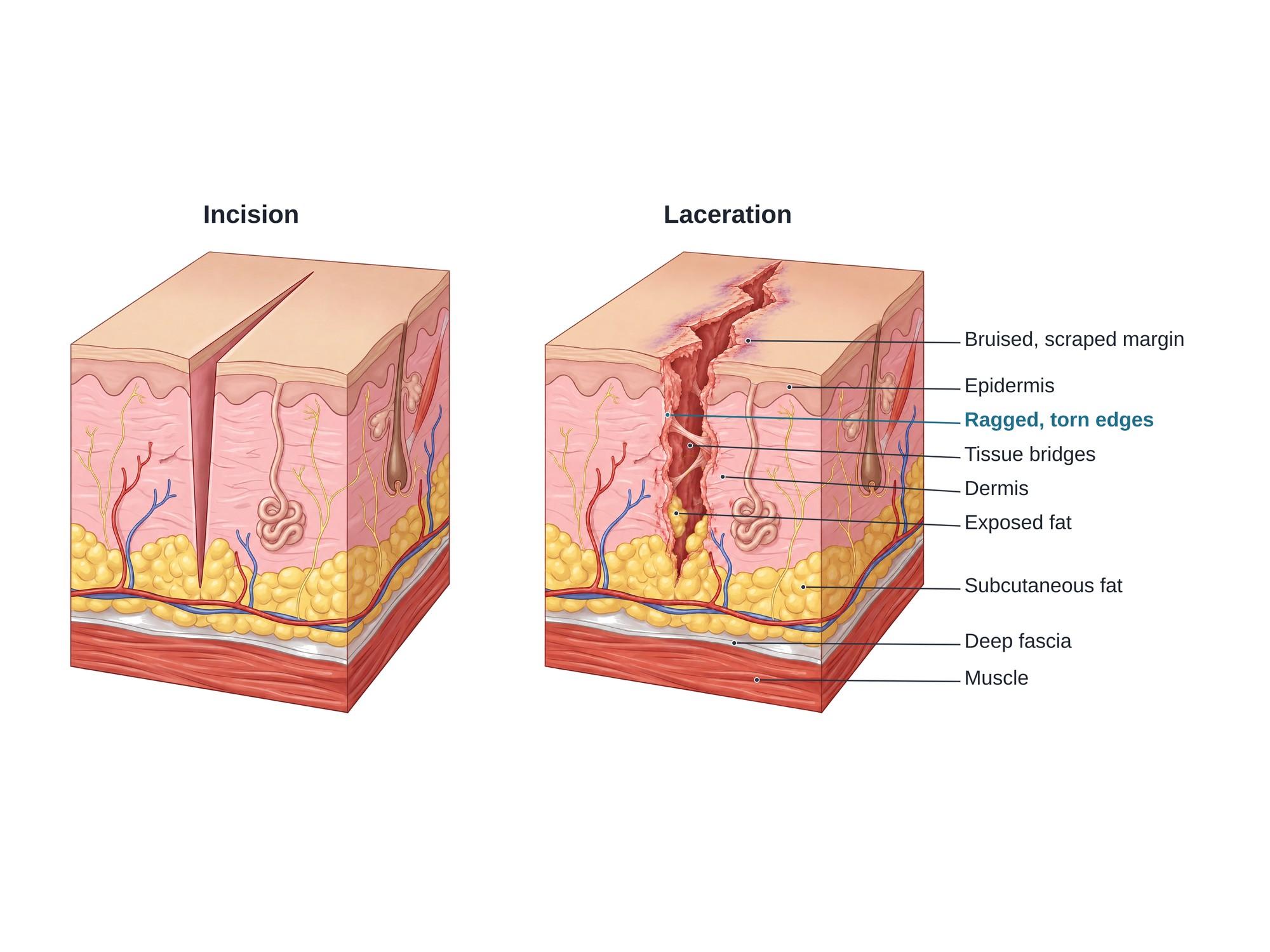
A laceration is a wound where the skin and the tissue under it are torn or split open. In the strict sense it is a tear from blunt force, such as a fall onto an edge, a blow, or a crash. A laceration has uneven edges, bruising around it, and strands of tissue that still cross the gap. A clean cut from a sharp edge is called an incised wound, though hospital records often call both lacerations. The illustration above shows the two side by side, through the same layers of skin.
The anatomy
Skin has two layers. The epidermis is the thin outer layer. The dermis below it is thicker and tough. It holds blood vessels, nerves, hair follicles and sweat glands. Under the skin is the subcutaneous fat (also called the hypodermis), which carries larger vessels and nerves. Below the fat is the deep fascia, a tough sheet that wraps the muscle.
How deep a laceration goes decides how it is treated. A wound through the dermis gapes open and usually needs closure. A wound through the fascia can reach muscle, tendons, nerves or arteries.
Laceration vs incision (cut)
| Feature | Laceration (tear) | Incision (cut) |
|---|---|---|
| Cause | Blunt force crushes and splits the skin | A sharp edge slices the skin |
| Edges | Ragged, uneven, often bruised or scraped | Clean, straight and even |
| Tissue bridges | Yes, strands of nerve, vessel and connective tissue cross the gap | No, everything is cut through |
| Shape | Irregular, star-shaped or split along bone | Straight, often longer than it is deep |
| Bleeding | Often less, because crushed vessels close up | Often more, because vessels are cleanly cut |
| Healing | More scarring and infection risk | Usually a thinner, neater scar |
This difference matters in forensic and legal work. Wound edges help show whether an injury came from a blunt object or a blade.
Types
| Type | What it looks like |
|---|---|
| Simple laceration | A single linear wound with clean edges, through skin only |
| Complex or stellate laceration | Ragged, star-shaped wound from a crushing blow |
| Flap laceration | A flap of skin lifted but still attached at one side (see avulsion injury) |
| Superficial laceration | Limited to the epidermis and dermis |
| Deep laceration | Reaches the fat, fascia, muscle, tendon, nerve or vessel |
| Contaminated laceration | Dirt, glass, gravel or bites in the wound |
Forensic examiners also describe lacerations by how they form. Split lacerations happen where skin is crushed against bone, like the scalp or shin. Tear lacerations come from skin being stretched past its limit. Crush lacerations come from heavy force over a wide area.
Causes
- Falls onto edges, stairs, curbs or hard floors
- Car, motorcycle and bicycle crashes
- Blows from fists or blunt objects
- Broken glass and sharp metal
- Machinery and workplace accidents
- Dog bites and other animal bites
Symptoms
- An open wound with a visible gap in the skin
- Bleeding, from oozing to steady flow
- Pain and swelling around the wound
- Bruising or scraping at the edges
- Numbness or weakness past the wound, which can mean a cut nerve or tendon
Diagnosis
A doctor looks at the wound and measures its length and depth. They check blood flow, feeling and movement past the wound. They test each tendon nearby, especially in the hand. Under good light, the wound is cleaned and explored for glass, dirt, or injured deeper structures. X-rays help find glass, metal, or a broken bone under the wound. A laceration over a broken bone may mean an open fracture, such as an open tibia and fibula fracture.
Treatment
- Stop the bleeding with firm, steady pressure.
- Clean the wound with large amounts of water or saline (irrigation).
- Numb the area with local anesthetic.
- Remove dead tissue and debris (debridement).
- Close the wound with stitches (sutures), staples, skin glue or tape strips. Deep wounds get dissolving stitches in the deeper layers first.
- Tetanus booster if needed, and antibiotics for bites or dirty wounds.
- Repair deeper injuries to tendons, nerves or arteries, often in the operating room.
Clean lacerations are best closed within about 12 to 18 hours. Face wounds can often be closed up to 24 hours later.
Recovery
The skin usually seals within a few days. Stitches come out in about 3 to 5 days on the face, 7 to 10 days on the scalp, arms and trunk, and 10 to 14 days on the legs, feet and over joints. The scar is red and raised at first. It slowly fades and flattens over 12 to 18 months. Scar tissue regains only part of the skin's original strength.
Complications
- Infection, more likely with dirty wounds, bites or late closure
- Wound dehiscence (the wound reopening)
- Visible scarring, including raised hypertrophic scars and keloids
- Nerve injury causing numbness or pain past the wound
- Tendon injury causing loss of movement
- Retained foreign body, such as glass left in the wound
Laceration vs abrasion and avulsion
An abrasion is a scrape that removes the top layers of skin without a deep gap. An avulsion tears a piece of tissue away or lifts a flap. A degloving injury is a severe avulsion that strips skin and fat off the tissue below. A contusion is a bruise with the skin left intact. Many crashes cause several of these at once.
How a laceration is shown in a personal injury case
Lacerations are common in car crashes, falls, dog bites and assaults. Medical records list them by site and length, such as "4 cm laceration, left forearm, closed with 6 sutures." A jury rarely sees how deep that wound went. A layered illustration shows which tissues were torn, why the wound needed repair, and why it left a lasting scar. It can also show the wound edges, which help explain how the injury happened. For how these images are used at trial, see demonstrative evidence and medical legal illustration.
FAQ
What is the medical meaning of laceration?+
A laceration is a wound where the skin and the tissue under it are torn or split open. Strictly, it means a tear caused by blunt force, like a fall onto a hard edge. In everyday hospital use, doctors also call most cuts lacerations, even ones made by glass or a knife.
What is another word for laceration?+
Common synonyms are cut, gash, tear, slash and wound. In medical records you may also see "lac" as a short form, or more exact terms like incised wound (a clean cut from a sharp edge) or avulsion (tissue torn away).
Is a laceration a tear?+
Yes. The word comes from the Latin for "to tear." In forensic medicine, a laceration is a tear from blunt force. It has ragged edges, bruising around it, and strands of tissue still bridging the gap. A clean cut from a sharp object is called an incised wound.
What does a skin laceration look like?+
It is an opening in the skin, often with uneven or jagged edges. The edges may be bruised or scraped. Deeper ones gape open and show yellow fat, and sometimes muscle or tendon. Lacerations over bone, like the scalp, shin or eyebrow, often split in a straight line and can look like a cut.
Does a laceration need stitches?+
Many do. A wound that gapes open, is deeper than the skin, is longer than about half an inch, sits on the face or over a joint, or keeps bleeding usually needs closure. Closure can be stitches, staples, skin glue or tape strips. Small, shallow cuts with edges that stay together can heal on their own.
How long does a laceration take to heal?+
The skin usually seals within a few days, and stitches come out in about 5 to 14 days, depending on the body part. The scar keeps remodeling and fading for 12 to 18 months. The healed skin never gets back its full original strength.
When is it too late to get stitches?+
Most clean lacerations are best closed within about 12 to 18 hours, and face wounds often up to 24 hours. Later than that, infection risk rises. A doctor may then leave the wound open to heal from the bottom up, or close it a few days later.
What is the difference between a laceration and an abrasion?+
A laceration goes through the full thickness of the skin and opens a gap. An abrasion is a scrape that removes the top layers of skin over an area, without a deep gap. Both often happen together in falls and crashes.
Need this illustration for a patient or a case?
Describe the injury or upload a scan and get a clear, labeled medical illustration for a consult, a chart or a case exhibit.
Try Natomy →