Carpal Tunnel Release: Surgery, Recovery & Risks
Carpal tunnel release cuts the transverse carpal ligament to take pressure off the median nerve.
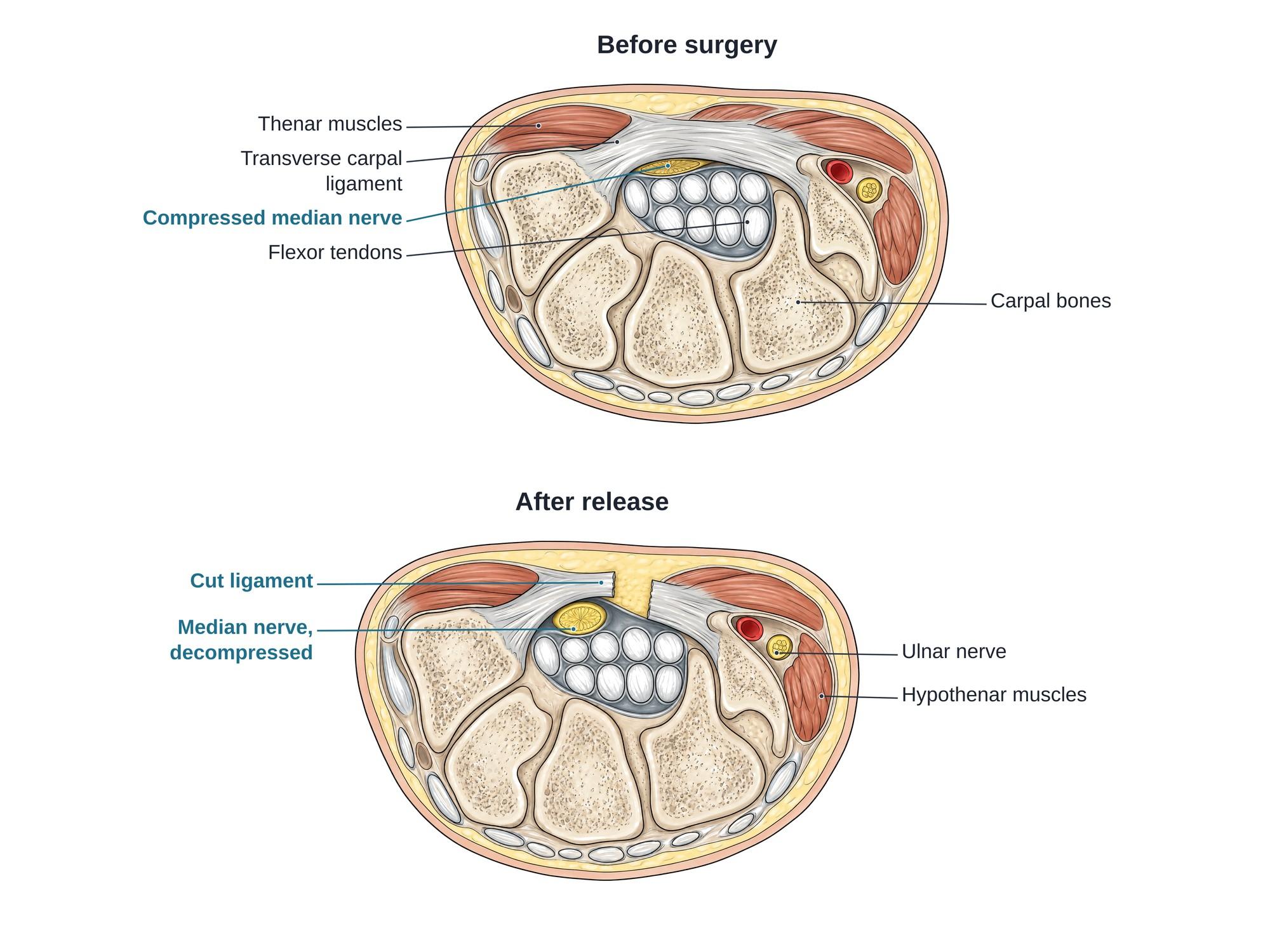
Carpal tunnel release is surgery that cuts the transverse carpal ligament to take pressure off the median nerve at the wrist. The ligament is a tough band that forms the roof of the carpal tunnel. When the tunnel is too tight, the median nerve is squeezed, which causes carpal tunnel syndrome. Cutting the ligament makes the tunnel bigger and frees the nerve. It is one of the most common hand operations. The illustration above shows the tunnel before surgery, with a flattened nerve, and after release, with the nerve round again.
The anatomy
The carpal tunnel is a narrow passage on the palm side of the wrist. Its floor and sides are the carpal bones, the eight small wrist bones. Its roof is the transverse carpal ligament (also called the flexor retinaculum). Nine tendons that bend the fingers and thumb pass through it, along with the median nerve. The nerve lies just under the ligament, on the thumb side. It gives feeling to the thumb, index, middle and half of the ring finger. It also powers the thenar muscles, the muscles at the base of the thumb. The ulnar nerve runs outside the tunnel, on the little finger side, so it is not affected. For the full anatomy, see hand and wrist anatomy.
Why it is done
Carpal tunnel release is done for carpal tunnel syndrome that does not get better with simpler care, or that is already severe. It is usually offered when:
- Numbness and tingling in the thumb and first fingers last for months despite a night splint
- Symptoms wake the person at night or make it hard to hold things
- A steroid injection helped only for a short time
- Nerve conduction studies (tests that measure how fast signals travel along the nerve) show moderate or severe slowing
- There is weakness or wasting of the thenar muscles, a sign of lasting nerve damage
Carpal tunnel syndrome can also follow a wrist injury. A Colles fracture or swelling after trauma can crowd the tunnel. Rarely, pressure builds quickly after an injury (acute carpal tunnel syndrome). That needs urgent release, sometimes along with a fasciotomy for compartment syndrome.
How the surgery is done
There are two main ways to cut the ligament. Both are usually outpatient surgery.
Open carpal tunnel release
- The hand is numbed with local anesthetic, a nerve block or general anesthesia. A tourniquet on the arm keeps the field clear.
- The surgeon makes a cut about 1 to 2 inches long in the palm, in line with the ring finger.
- The skin, fat and a thin layer of tissue (the palmar fascia) are opened to show the transverse carpal ligament.
- The ligament is cut along its full length, on the little finger side of the median nerve. This protects the nerve and its motor branch, the small branch to the thumb muscles.
- The surgeon checks that the ligament is fully divided and the nerve is free.
- The skin is closed with stitches, and a soft dressing goes on.
Endoscopic carpal tunnel release
- The surgeon makes one small cut in the wrist crease (or two small cuts, one in the wrist and one in the palm).
- A thin camera (endoscope) is passed into the tunnel under the ligament.
- A small blade cuts the ligament from the inside, while the surgeon watches on a screen.
- The small cut is closed.
Either way, the cut ends of the ligament spread apart, as in the lower panel above. Scar tissue later fills the gap. The tunnel stays larger, so the nerve has room.
Hardware
Carpal tunnel release uses no hardware. No plates, screws or implants are placed. The ligament is not repaired or replaced. Only the skin is stitched.
Recovery
- First days: keep the hand raised to reduce swelling. Move the fingers often. Light tasks like eating and typing are usually fine.
- 10 to 14 days: stitches come out. Numbness and night pain often improve within days, though some people take longer.
- Return to work: desk work often resumes in about 1 to 2 weeks. Jobs with heavy gripping, lifting or vibrating tools usually take about 4 to 8 weeks.
- Driving: often within a few days to 2 weeks, once the hand can grip the wheel safely.
- Hand therapy: some people need therapy for stiffness, scar care or strength.
- Long term: grip strength and soreness at the base of the palm can take 3 to 6 months to recover. If the nerve was badly damaged, some numbness or thumb weakness may stay.
Risks
- Pillar pain, soreness on either side of the scar at the base of the palm, which usually fades over months
- Tender or thick scar
- Weaker grip and pinch for a few months
- Incomplete release, where part of the ligament is left uncut and symptoms continue
- Injury to the median nerve, its motor branch or a nearby skin nerve (uncommon)
- Infection or slow wound healing
- Complex regional pain syndrome (CRPS), a rare condition with long-lasting pain, swelling and stiffness
- Return of symptoms years later, usually from scar tissue
How carpal tunnel release is shown in a personal injury case
Carpal tunnel release comes up in workers' compensation claims for repetitive work and vibrating tools. It also appears in personal injury cases after a wrist fracture, a crush injury, or a car crash where the hands braced on the steering wheel. Disputes often focus on whether the injury caused the syndrome or made an existing one worse, and on lasting numbness, weakness and lost work. Malpractice claims can involve a delayed diagnosis of acute carpal tunnel syndrome after a fracture, an incomplete release, or a nerve injured during surgery. A cross-section like the one above helps a jury see the tight tunnel, the flattened nerve and what the surgeon cut. For how these images are used at trial, see demonstrative evidence and medical legal illustration.
Related pages
FAQ
What is carpal tunnel release surgery used for?+
It treats carpal tunnel syndrome, which is pressure on the median nerve at the wrist. Cutting the ligament that forms the roof of the tunnel gives the nerve more room. This eases numbness, tingling and night pain in the thumb, index, middle and ring fingers, and stops the nerve damage from getting worse.
Can carpal tunnel be released without surgery?+
Mild or early carpal tunnel syndrome often improves without surgery. A wrist splint worn at night, changes to work tasks, and a steroid injection into the carpal tunnel are the usual first steps. These do not cut the ligament, so symptoms often come back. Surgery is the only way to release the tunnel for good.
How long is recovery from carpal tunnel surgery?+
Most people use the hand for light tasks within a few days. Desk work often resumes in about 1 to 2 weeks. Heavy gripping and manual work usually take about 4 to 8 weeks. Grip strength and soreness at the base of the palm can take 3 to 6 months to fully settle.
How long after carpal tunnel surgery can I drive?+
Many people drive again within a few days to 2 weeks. You should be off strong pain medicine and able to grip the wheel firmly and turn it safely. Your surgeon gives the final word.
Is carpal tunnel release done awake?+
Often, yes. Many surgeons use local anesthetic injected into the palm, sometimes with light sedation. Others use a nerve block or general anesthesia. The operation itself usually takes about 10 to 20 minutes, and you go home the same day.
Is open or endoscopic carpal tunnel release better?+
Both cut the same ligament and give similar long-term results. Endoscopic release uses a smaller cut and may allow a slightly faster return to work. Open release gives the surgeon a direct view and has a slightly lower risk of nerve injury in some studies. The choice usually depends on the surgeon's experience.
What happens if you overdo it after carpal tunnel surgery?+
Too much gripping or lifting early on can cause more swelling, pain at the base of the palm (pillar pain) and stiffness. It rarely undoes the surgery, because the ligament has already been cut. Rest, elevation and easing back on activity usually settle it.
Can carpal tunnel come back after surgery?+
True recurrence is uncommon. When symptoms come back, the cause may be scar tissue, an incomplete release of the ligament, or a second problem such as a pinched nerve in the neck. Testing sorts these out, and a repeat operation is sometimes needed.
Need a surgical illustration for consent or a case?
Describe the operation and get a clear, labeled medical illustration for patient consent, teaching or a case exhibit.
Try Natomy →