Spinal Cord Stimulator: Procedure, Side Effects & Recovery
A spinal cord stimulator places a lead over the spinal cord and a battery under the skin to calm chronic pain. See the lead, wire and generator in place.
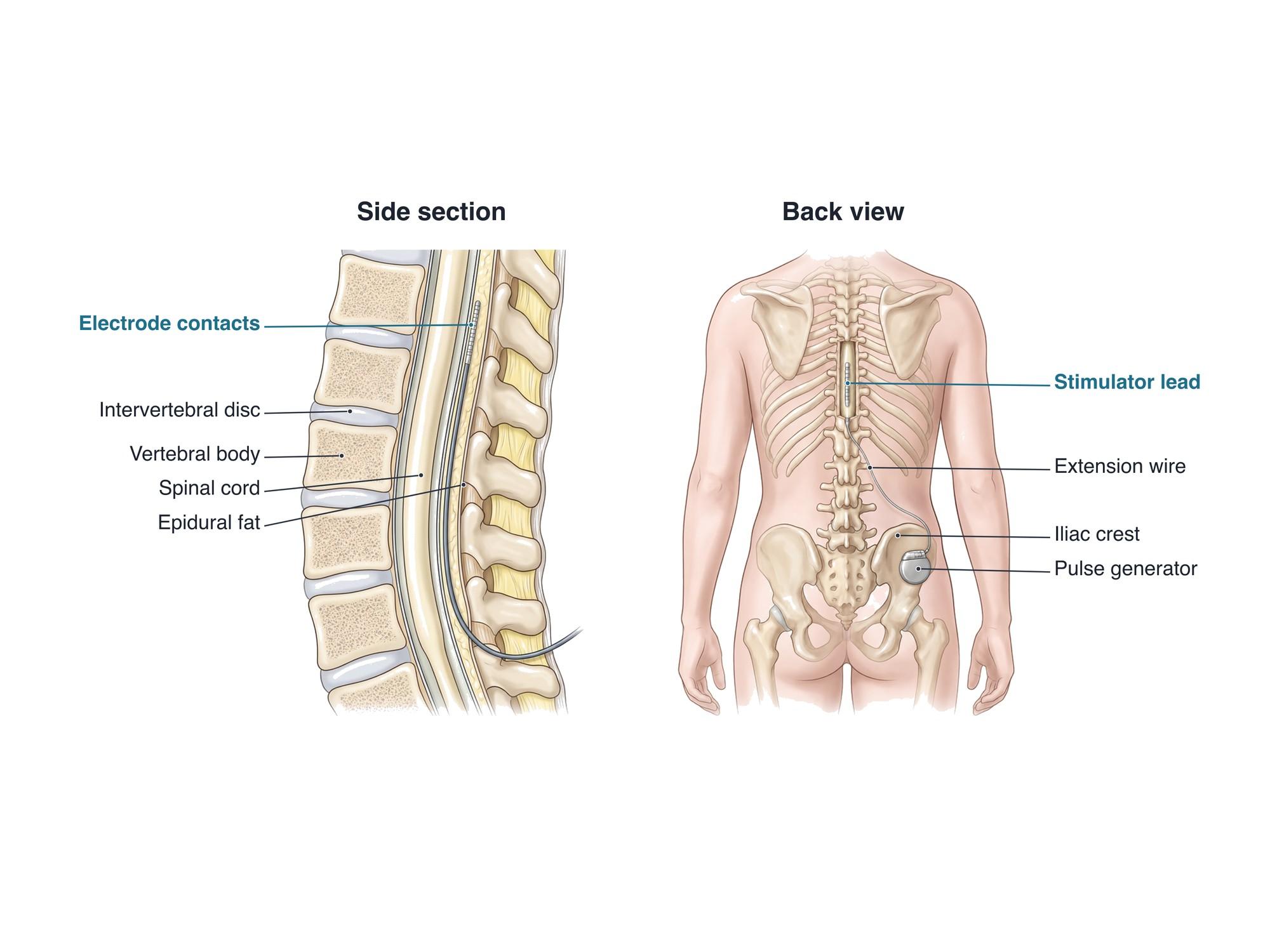
A spinal cord stimulator (SCS) is an implanted device that uses mild electrical pulses to reduce chronic pain. A thin lead with metal electrode contacts lies in the epidural space, the fat-filled space just behind the spinal cord's covering (the dura). An extension wire under the skin connects the lead to a pulse generator, a small battery placed under the skin, often in the upper buttock. The pulses change how pain signals travel up the spinal cord to the brain. The illustration above shows the lead behind the spinal cord in a side section, and the whole system from behind.
Why it is done
A spinal cord stimulator is used for long-lasting nerve pain that has not improved with other care, such as medicines, physical therapy and injections. It does not fix the cause of the pain. It aims to make the pain more manageable. Common reasons are:
- Failed back surgery syndrome (also called persistent spinal pain syndrome). Ongoing back and leg pain after spine surgery, such as a microdiscectomy or a fusion.
- Chronic radiculopathy. Lasting nerve pain down the leg from a pinched nerve root, for example after a lumbar disc herniation.
- Complex regional pain syndrome (CRPS). A severe pain condition after an injury, with swelling, color change and stiffness.
- Painful diabetic neuropathy in the feet and legs.
Most patients first have a psychological evaluation. This checks for depression, anxiety or other issues that can affect how well the device works.
How the surgery is done
Spinal cord stimulation happens in two stages: a trial, then a permanent implant.
- Trial. One or two thin leads are passed through a needle into the epidural space, guided by live X-ray (fluoroscopy). The leads exit through the skin and connect to an external battery worn on a belt. The trial lasts about 5 to 10 days. It is usually called a success if pain drops by about half or more.
- Trial leads removed. The temporary leads are pulled out. If the trial worked, the permanent implant is scheduled.
- Lead placement. For the permanent system, leads are placed again through a needle, or as a flat paddle lead through a small opening in the lamina (laminotomy). The lead tip usually sits over the lower thoracic spine, around T8 to T10, for back and leg pain.
- Anchoring. The lead is stitched to the tissue near the spine with a small anchor so it does not move.
- Tunneling. An extension wire is passed under the skin from the back to the battery site.
- Generator pocket. A pocket is made under the skin, most often in the upper buttock or flank. The pulse generator is connected and placed in it.
- Programming. The device is tested and programmed, often before the patient leaves the hospital.
Hardware
- Lead. A thin flexible cable with 8 or more electrode contacts at its tip. A paddle lead is a flat strip with contacts on one side.
- Extension wire. A cable that runs under the skin from the lead to the generator.
- Pulse generator (battery). A flat, rounded metal case about the size of a small stopwatch. It may be rechargeable through the skin or not rechargeable.
- Remote control. A handheld device that changes programs or turns stimulation on and off.
Recovery
- Most patients go home the same day or the next day.
- The incisions in the back and over the battery are sore for 1 to 2 weeks.
- For about 6 to 8 weeks, patients avoid bending, twisting, lifting and reaching overhead. Scar tissue forms around the lead during this time and holds it in place.
- Settings are adjusted at follow-up visits to cover the painful area.
- The battery needs replacing every few years, or about every 9 years or more for rechargeable systems.
Risks
- Lead migration. The lead shifts, so stimulation no longer covers the painful area. A revision surgery may be needed.
- Pain at the generator site.
- Infection of the lead or the battery pocket. This often means removing the device.
- Spinal fluid leak, which causes a headache when sitting or standing.
- Hardware problems, such as a broken lead or battery failure.
- Loss of benefit over time. Pain relief can fade over months or years.
- Bleeding or nerve injury near the spinal cord, which is rare but serious.
How a spinal cord stimulator is shown in a personal injury case
A spinal cord stimulator often appears in cases where back or leg pain lasts long after a car crash, a fall, or a workplace injury. It is common in workers' compensation claims and cases involving failed back surgery. The device is a major item in a life care plan, a written estimate of a patient's future medical needs and costs. That plan covers the trial, the implant, battery replacements every few years, programming visits, and possible revisions for life. A clear illustration shows the jury where the lead sits beside the spinal cord, how the wire runs under the skin, and why each part may need future surgery. For how these images are used at trial, see demonstrative evidence and medical legal illustration. For the normal bones and spinal canal at this level, see thoracic spine anatomy.
Related pages
FAQ
What is neurostimulation?+
Neurostimulation means using mild electrical pulses to change how nerves send signals. A spinal cord stimulator is one type. It sends pulses to the back of the spinal cord, which can reduce the pain signals that reach the brain.
Where are neurostimulators implanted?+
The lead goes in the epidural space, just behind the spinal cord, usually over the lower thoracic spine for back and leg pain. The battery, called a pulse generator, goes in a pocket under the skin, most often in the upper buttock, the flank or the lower abdomen.
How long does the battery last in a spinal cord stimulator?+
It depends on the device and settings. Non-rechargeable batteries often last about 2 to 5 years. Rechargeable systems often last about 9 years or more before the generator needs replacing. Replacing it is a short surgery through the old pocket.
Is it safe to have an MRI with a spinal cord stimulator?+
Many newer systems are approved for MRI under specific conditions, such as certain scanner types, body areas and settings. Older systems may not be. The patient should always tell the MRI team about the implant, and the team checks the device's MRI labeling first.
What are the side effects of a spinal cord stimulator?+
Common problems are the lead moving out of place, pain at the battery site, and stimulation that feels uncomfortable or covers the wrong area. Less common risks are infection, a spinal fluid leak with headache, and, rarely, bleeding or nerve injury near the spinal cord.
What does a spinal cord stimulator feel like?+
Older settings cause a tingling or buzzing feeling, called paresthesia, over the painful area. Many newer settings work without any tingling. Patients use a handheld remote to change programs or turn it off.
How long is recovery after a spinal cord stimulator implant?+
Most people go home the same day or the next day. Bending, twisting, lifting and reaching overhead are limited for about 6 to 8 weeks while scar tissue holds the lead in place. Light activity and desk work often resume within 1 to 2 weeks.
Can a spinal cord stimulator be removed?+
Yes. The lead and battery can be removed if the device stops helping, causes problems, or is no longer wanted. Removal is a smaller surgery than the implant. Studies suggest a notable share of devices are removed over the years, often because pain relief fades.
Need a surgical illustration for consent or a case?
Describe the operation and get a clear, labeled medical illustration for patient consent, teaching or a case exhibit.
Try Natomy →