ACDF Surgery: C5-C6 Neck Fusion & Recovery
ACDF surgery removes a damaged neck disc from the front and fuses the vertebrae with a cage and plate. See a C5-C6 ACDF illustrated before and after.
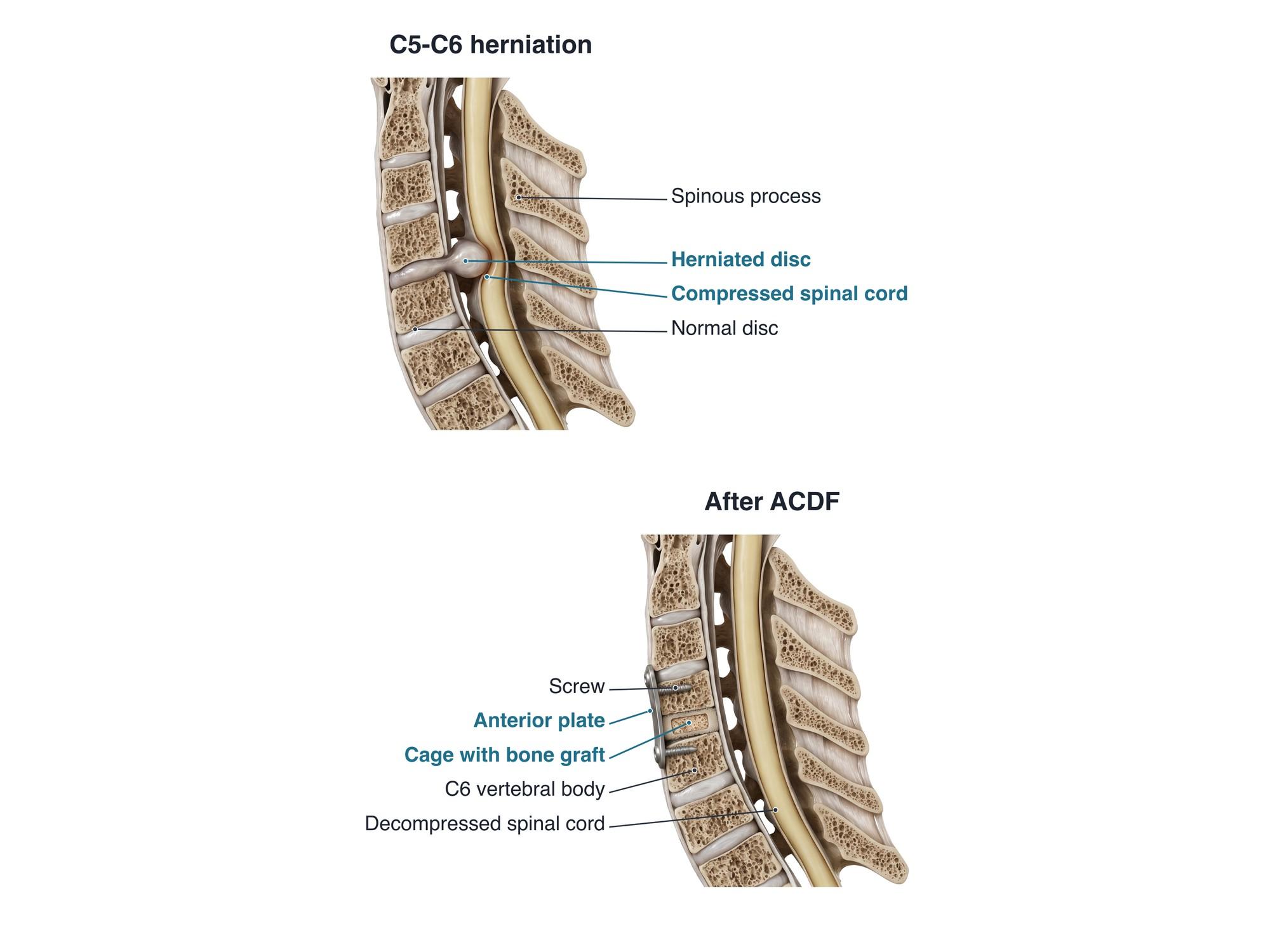
ACDF surgery (anterior cervical discectomy and fusion) is an operation on the neck done from the front. The surgeon removes a damaged or herniated disc that presses on the spinal cord or a nerve root. A spacer called a cage goes into the empty disc space, and a small metal plate with screws holds the two vertebrae still while they grow together (fuse). It is one of the most common spine operations, and C5-C6 is the most often treated level. The illustration above shows a C5-C6 herniated disc pressing on the spinal cord, then the same level after ACDF.
Why it is done
ACDF relieves pressure on the nerves of the neck. Common causes are:
- Cervical disc herniation, where soft disc material pushes into the spinal canal or the foramen
- Cervical spondylosis, arthritis with bone spurs and disc collapse
- Cervical stenosis, narrowing of the spinal canal
- Trauma, such as a disc injury or instability after a car crash
Symptoms that lead to surgery include:
- Radiculopathy: pain, numbness or weakness down one arm from a pinched nerve root
- Myelopathy: compression of the spinal cord itself, causing clumsy hands, trouble walking or balance problems
- Symptoms that persist despite 6 to 12 weeks of physical therapy, medicine and injections, or weakness that gets worse
How the surgery is done
A one-level ACDF usually takes about 1 to 2 hours. The patient lies on their back under general anesthesia.
- Incision. A short horizontal cut is made on the front of the neck, usually in a skin crease.
- Approach. The surgeon moves the windpipe and esophagus to one side and the carotid artery to the other. This opens a natural path to the front of the spine without cutting muscle. X-ray confirms the level.
- Discectomy. The damaged disc is removed. Any disc fragment or bone spur pressing on the spinal cord or nerve root is removed too, often under a microscope. A foraminotomy widens the nerve opening when needed.
- Cage. A cage made of PEEK plastic or titanium, filled with bone graft, is placed in the disc space. It restores the disc height.
- Plate and screws. A small titanium plate is screwed into the front of the vertebra above and below. It holds the level steady while the bones fuse.
- Closing. The tissues fall back into place, and the skin is closed with stitches or glue.
Hardware
| Part | What it does |
|---|---|
| Interbody cage | Fills the disc space, restores height, and holds bone graft |
| Bone graft | The patient's own bone, donor bone or a bone substitute that grows into a solid fusion |
| Anterior plate | A thin titanium plate on the front of the vertebral bodies |
| Screws | Usually two in each vertebral body, holding the plate |
Some surgeons use a stand-alone cage with built-in screws instead of a separate plate. The hardware usually stays in for life.
Recovery
- Most patients go home the same day or the next day.
- A sore throat, hoarseness and mild trouble swallowing are common for 1 to 3 weeks.
- A soft collar may be worn for comfort.
- Walking starts right away. Driving resumes when off narcotic pain medicine and able to turn the head safely.
- Desk work often resumes in 2 to 6 weeks. Heavy work may take 3 months or more.
- The bones fuse over about 3 to 6 months. X-rays follow the healing.
Risks
- Trouble swallowing (dysphagia) and hoarseness, usually temporary
- Recurrent laryngeal nerve injury, causing longer-lasting hoarseness, uncommon
- Non-union (pseudarthrosis), where the bones fail to fuse, more common in smokers and multi-level fusions
- Adjacent segment disease, wear of the disc above or below the fusion over years
- Hardware problems, such as a loose screw or a shifted cage
- Spinal cord or nerve root injury, rare but serious
- Esophageal injury, bleeding, infection, or a spinal fluid leak, rare
How ACDF surgery is shown in a personal injury case
ACDF is one of the most common surgeries in car crash cases, and C5-C6 and C6-C7 fusions often drive the value of a neck injury settlement. The defense usually argues that the disc problem was pre-existing degeneration. The plaintiff's side shows that the crash caused the herniation, or made a silent condition painful. An illustration based on the plaintiff's own MRI, before and after the fusion, shows the jury the compressed cord or nerve and the hardware now in the neck. It also explains future risks such as adjacent segment disease and possible future surgery. For how these images are used at trial, see demonstrative evidence and medical legal illustration. For the normal anatomy, see cervical spine anatomy.
Related pages
FAQ
What is the success rate of C5-C6 ACDF surgery?+
For arm pain from a pinched nerve root, most patients report good or excellent relief, and fusion rates for a single level are high. Results for neck pain alone are less predictable. Success is best when imaging shows clear compression that matches the symptoms.
How long is recovery after ACDF surgery?+
Most people go home the same day or the next day. Desk work often resumes in 2 to 6 weeks. Lifting is limited for about 6 to 12 weeks. The bones usually fuse in about 3 to 6 months, and some people wear a soft collar for comfort in the first weeks.
How long does it take for nerves to heal after neck surgery?+
Arm pain often improves within days. Numbness, tingling and weakness recover more slowly, as the nerve heals at roughly a millimeter a day. Improvement can continue for 6 to 12 months. Nerve damage that was severe before surgery may not fully recover.
Are there permanent restrictions after ACDF?+
Most people with a one- or two-level fusion return to normal activity, including work and exercise, once fused. Neck motion at the fused level is lost, which most people barely notice. Surgeons may advise against high-impact contact sports, especially after multi-level fusions.
Is neck pain common after spinal fusion surgery?+
Yes, in the first weeks. Soreness in the front and back of the neck, trouble swallowing, and a sore throat are common after surgery and usually fade over 2 to 6 weeks. Persistent neck pain months later should be checked for non-union or problems at the next level.
What complications can happen years after cervical fusion?+
The most common late problem is adjacent segment disease, wear of the disc above or below the fusion, which can lead to new symptoms and sometimes further surgery. Non-union (the bones not fusing) and hardware loosening are less common.
What are the risks of not having ACDF surgery?+
For arm pain alone, many people improve without surgery over weeks to months. When the spinal cord is compressed (myelopathy), with clumsy hands, balance problems or weakness, delay can lead to permanent damage. Progressive weakness is a reason not to wait.
Where is the incision for ACDF?+
A short horizontal incision, usually about 3 to 5 cm, is made on the front of the neck, often in a skin crease. It usually heals into a thin scar that is hard to see.
Need a surgical illustration for consent or a case?
Describe the operation and get a clear, labeled medical illustration for patient consent, teaching or a case exhibit.
Try Natomy →