Thoracic Outlet Syndrome: Symptoms, Types & Treatment
Thoracic outlet syndrome is compression of the nerves or vessels at the base of the neck. Learn the symptoms, tests, physical therapy and surgery.
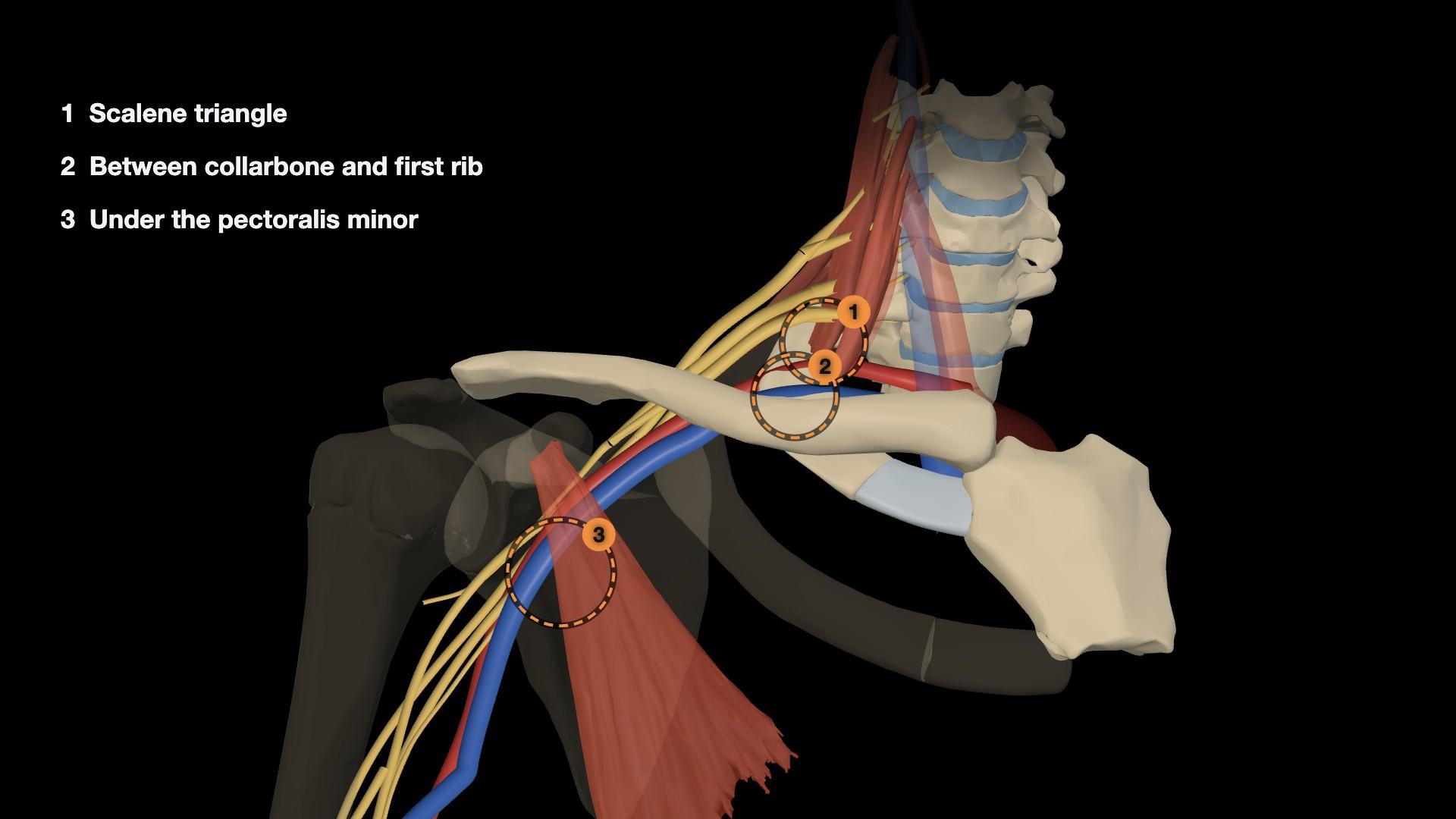
Thoracic outlet syndrome (TOS) is compression of the nerves or blood vessels that run from the base of the neck to the arm. The thoracic outlet is the space at the base of the neck bounded by the first rib, the scalene muscles and the collarbone (clavicle), extending under the pectoralis minor muscle. The brachial plexus (the nerve network for the arm), the subclavian artery and the subclavian vein all pass through it (Kaplan and Kanwal, StatPearls, 2023). A tight muscle, an extra rib or an injury can squeeze them, causing pain, numbness, weakness or swelling in the arm. For the bones and muscles around it, see shoulder anatomy. Neurogenic TOS is estimated at 2 to 3 new cases per 100,000 people a year (Illig et al., 2021). The illustration above compares a normal outlet with one compressed between the scalene muscles.
The anatomy
Nerves and vessels can be squeezed in three places on the way to the arm:
- Scalene triangle: the gap between the anterior scalene and middle scalene muscles, with the first rib as its floor. The brachial plexus and the subclavian artery pass through it. The subclavian vein runs in front of the anterior scalene, outside the triangle.
- Costoclavicular space: the gap between the clavicle and the first rib, where all three structures pass.
- Pectoralis minor space: under the pectoralis minor muscle, just below the collarbone near the shoulder. Compression here is sometimes called pectoralis minor syndrome.
The lower part of the brachial plexus (the C8 and T1 nerves) lies right on the first rib. That is why the ring and little fingers are often the first to go numb. For the nerve roots, see cervical spine anatomy.
Types
| Type | What is compressed | Main signs |
|---|---|---|
| Neurogenic (NTOS) | Brachial plexus | Pain, tingling and weakness in the arm and hand |
| Venous (VTOS) | Subclavian vein | Arm swelling, blue color, heavy arm, sometimes a clot |
| Arterial (ATOS) | Subclavian artery | Cold, pale hand, pain with use, clots to the fingers |
Neurogenic TOS is by far the most common. Of 526 patients referred to one specialist clinic with possible TOS, 82% had symptoms of the neurogenic type, 16% the venous type and 2% the arterial type (Illig et al., 2021). A blood clot in the vein after hard arm use is called Paget-Schroetter syndrome, or effort thrombosis.
Causes
TOS usually comes from a narrow outlet plus something that tightens it further:
- Extra or abnormal bone: a cervical rib (an extra rib from the seventh neck vertebra), an abnormal first rib, or a badly healed clavicle fracture. In a meta-analysis of 141 studies, cervical ribs were found in about 30% of TOS patients but only 1.1% of healthy people (Henry et al., 2018).
- Tight or enlarged muscles: thick scalene muscles, often in athletes, or fibrous bands that cross the outlet.
- Neck trauma: whiplash in a car crash or a fall can stretch the brachial plexus. In a study of 119 people with whiplash from road crashes, 38% had signs of brachial plexus irritation (Ide et al., 2001).
- Repetitive overhead work and sports: jobs and sports with frequent overhead arm movements repeatedly narrow the outlet.
- Posture and body shape: drooping shoulders, poor posture and heavy lifting add pressure.
Symptoms
Neurogenic TOS (Li et al., 2021):
- Pain in the neck, shoulder, upper chest or arm
- Numbness and tingling, often worst in the ring and little fingers and the inner forearm
- Weak grip, clumsy hand, tired arm
- Symptoms that get worse with the arms overhead, such as doing hair, driving or reaching
- Headaches at the back of the head
- In long-standing cases, wasting of the muscles at the base of the thumb
Venous TOS:
- Swelling of the whole arm, often after hard use
- A blue or dusky color and a heavy, aching arm
- Visible veins over the shoulder and chest
Arterial TOS:
- A cold, pale hand and fingers
- Arm pain that comes on with use and eases with rest
- Small sores or color change in the fingertips from tiny clots
Diagnosis
Neurogenic TOS has no single confirming test, so doctors combine the history, the exam and tests that rule out other causes:
- Arm-position tests: the elevated arm stress test (Roos test), the upper limb tension test and the Adson test try to reproduce symptoms as the outlet narrows (Li et al., 2021).
- Scalene block: a numbing injection into the anterior scalene. Short-term relief supports the diagnosis of neurogenic TOS.
- X-rays of the neck and chest: show a cervical rib, a long bony process on C7 or an old clavicle fracture.
- Ultrasound with the arm raised: shows whether flow in the artery or vein drops when the arm is lifted.
- CT or MR angiography and venography: map a narrowed artery, an aneurysm or a clot in the vein.
- Nerve studies (EMG and nerve conduction): often normal in mild cases, but help rule out cubital tunnel syndrome, carpal tunnel syndrome and a cervical disc herniation, which can cause similar numbness.
Treatment
Neurogenic TOS is treated without surgery first:
- Physical therapy: posture training, stretching of the scalenes and chest muscles, strengthening of the muscles that hold the shoulder blade, and nerve gliding exercises.
- Changing work and sport habits: less overhead work, breaks, and a better desk setup.
- Medication: anti-inflammatory pain relievers and muscle relaxants.
- Botulinum toxin injection: relaxes the scalene muscles for a few months in some patients.
When symptoms continue after months of good therapy, surgeons perform a thoracic outlet decompression. They remove the first rib (through the armpit or above the collarbone), cut or remove the anterior and middle scalene muscles (scalenectomy), and remove any cervical rib or fibrous band. In a meta-analysis of surgery for neurogenic TOS, 76% of patients improved after first rib removal through the armpit and 85% after a release above the collarbone that leaves the first rib in place (Yin et al., 2019).
Venous TOS with a clot is usually treated with clot-dissolving medicine (thrombolysis) or blood thinners, then first rib removal to stop it from coming back.
Arterial TOS needs surgery: removal of the first rib or cervical rib, plus repair or bypass of a damaged subclavian artery.
Recovery
With physical therapy, many people with neurogenic TOS improve, but full benefit often takes several months. After decompression surgery, therapy continues, and return to heavy overhead work or throwing takes time.
Complications
- Lasting nerve damage: weakness and wasting of hand muscles in long-standing compression
- Deep vein thrombosis of the arm, which can travel to the lungs
- Subclavian artery aneurysm and clots that block blood flow to the hand
- Chronic pain and loss of work ability
- Surgical risks: collapsed lung (pneumothorax), injury to the brachial plexus or nearby nerves, bleeding and recurrence. In the same meta-analysis, complications occurred in 23% of patients after first rib removal through the armpit and 13% after release above the collarbone (Yin et al., 2019).
A sudden, severe stretch of the same nerves causes a brachial plexus injury, a different condition that can share the same symptoms.
References
- Kaplan J, Kanwal A. Thoracic Outlet Syndrome. StatPearls Publishing, 2023.
- Illig KA, Rodriguez-Zoppi E, Bland T, et al. The Incidence of Thoracic Outlet Syndrome. Annals of Vascular Surgery. 2021;70:263-272.
- Henry BM, Vikse J, Sanna B, et al. Cervical Rib Prevalence and its Association with Thoracic Outlet Syndrome: A Meta-Analysis of 141 Studies with Surgical Considerations. World Neurosurgery. 2018;110:e965-e978.
- Ide M, Ide J, Yamaga M, et al. Symptoms and signs of irritation of the brachial plexus in whiplash injuries. Journal of Bone and Joint Surgery (British). 2001;83(2):226-229.
- Li N, Dierks G, Vervaeke HE, et al. Thoracic Outlet Syndrome: A Narrative Review. Journal of Clinical Medicine. 2021;10(5):962.
- Yin ZG, Gong KT, Zhang JB. Outcomes of Surgical Management of Neurogenic Thoracic Outlet Syndrome: A Systematic Review and Bayesian Perspective. Journal of Hand Surgery (American). 2019;44(5):416.e1-416.e17.
Related pages
- Shoulder anatomyThe normal anatomy of the shoulder.
- AC joint separationAn AC joint separation is a tear of the ligaments that hold the collarbone to the shoulder blade. Learn the Rockwood types, symptoms, treatment and recovery.
- Bankart lesionA Bankart lesion is a tear of the front lower labrum of the shoulder socket from a dislocation. Learn the types, bony Bankart, symptoms and treatment.
- Brachial plexus injuryA brachial plexus injury damages the nerves from the neck to the arm. Learn the types, symptoms, treatment and recovery time.
- Frozen shoulderFrozen shoulder (adhesive capsulitis) is a painful, stiff shoulder from a thickened joint capsule. Learn the symptoms, 3 stages, causes, exercises and treatment.
- Rotator cuff tearA rotator cuff tear is a tear in the shoulder tendons that lift and turn the arm. Learn the types, symptoms, surgery and recovery.
- Shoulder impingementShoulder impingement is pinching of a rotator cuff tendon and bursa under the acromion. Learn the symptoms, causes, tests, exercises and treatment options.
- SLAP tearA SLAP tear is a tear of the top of the shoulder labrum where the biceps tendon attaches. Learn the types, symptoms, treatment and recovery.
- SubluxationA subluxation is a partial dislocation: a joint slips part way out of place. Learn subluxation vs dislocation in the shoulder.
FAQ
How long does thoracic outlet syndrome pain last?+
It varies. Mild neurogenic TOS often improves over a few months of physical therapy and changes in posture and work habits. Symptoms that last despite good therapy may need surgery, and recovery after surgery usually takes several months. Venous and arterial TOS are treated sooner because of the risk of clots.
Does thoracic outlet syndrome go away?+
Many people with the neurogenic type improve with physical therapy and do not need surgery. A bony cause, such as a cervical rib, does not go away on its own, but symptoms can still settle with therapy. Venous and arterial TOS are usually treated directly because of the risk of clots.
Is thoracic outlet syndrome dangerous?+
The neurogenic type is painful but not life-threatening. Venous TOS can cause a blood clot in the arm vein, which can travel to the lungs. Arterial TOS can cause an aneurysm or small clots that block blood flow to the fingers. Sudden arm swelling, a cold pale hand, or chest pain with shortness of breath needs urgent care.
What is the test for thoracic outlet syndrome?+
No single test proves it. The doctor uses arm-position tests, such as the elevated arm stress test (holding both arms up and opening and closing the hands for up to 3 minutes), the upper limb tension test, and the Adson test. An injection that numbs the anterior scalene, ultrasound with the arm raised, X-rays to look for a cervical rib, and nerve studies help confirm it.
Can physical therapy fix thoracic outlet syndrome?+
Physical therapy is the first treatment for neurogenic TOS, and many people improve with it. It focuses on posture, stretching the scalene and chest muscles, strengthening the muscles that hold the shoulder blade, and gentle nerve gliding. It does not remove a cervical rib or a clot, so venous and arterial TOS usually need other treatment.
Can whiplash cause thoracic outlet syndrome?+
Yes. A neck injury can stretch the brachial plexus. In one study of 119 people with whiplash from road crashes, 38% had signs of brachial plexus irritation.
Can thoracic outlet syndrome cause jaw pain?+
Jaw pain is not a typical sign. TOS pain usually sits in the neck, shoulder, upper chest and arm. Some people also get headaches at the back of the head. Jaw pain with arm or chest pain should be checked for heart problems first.
Does thoracic outlet syndrome need surgery?+
Most neurogenic TOS is treated without surgery. Surgery is offered when months of therapy fail and the diagnosis is clear. Venous TOS with a clot and arterial TOS usually need surgery to remove the first rib or a cervical rib, and sometimes to repair the vein or artery.
Need this illustration for a patient or a case?
Describe the injury or upload a scan and get a clear, labeled medical illustration for a consult, a chart or a case exhibit.
Try Natomy →