SLAP Tear: Symptoms, Tests, Treatment & PT
A SLAP tear is a tear of the top of the shoulder labrum where the biceps tendon attaches. See it illustrated beside normal anatomy, plus tests and physical therapy.
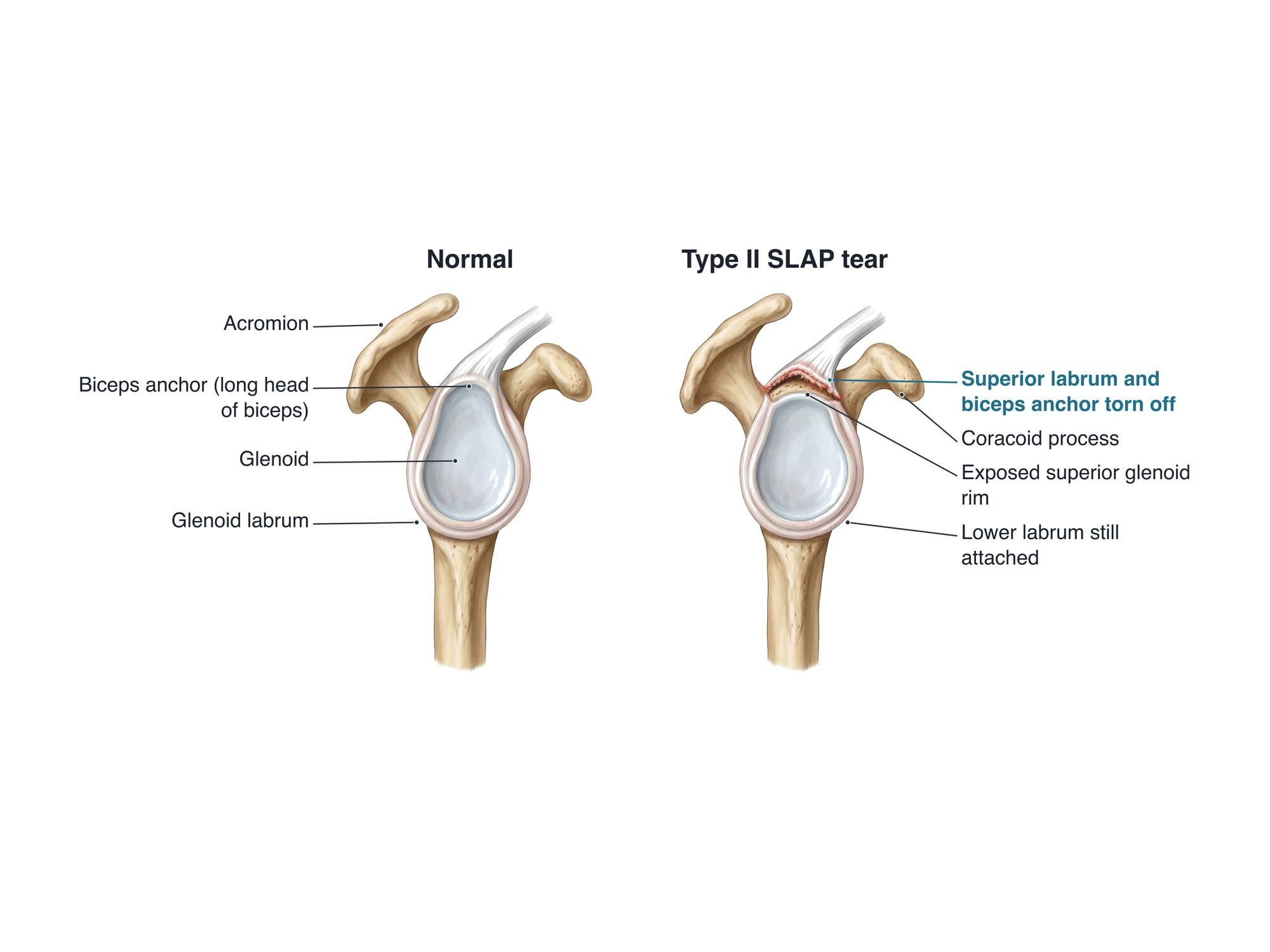
A SLAP tear is a tear of the superior labrum, the top part of the ring of cartilage around the shoulder socket. SLAP stands for Superior Labrum, Anterior to Posterior. The tear runs from front to back across the top of the socket, at the point where the long head of the biceps tendon attaches. It causes deep shoulder pain, clicking and catching, especially with overhead use. It is common in throwing athletes and after falls. The illustration above shows a normal labrum beside a SLAP tear, where the top of the labrum and the biceps anchor have pulled off the bone.
The anatomy
The shoulder is a ball-and-socket joint. The socket, called the glenoid, is a shallow dish on the shoulder blade (scapula). The glenoid labrum is a firm ring of fibrocartilage attached around the rim of the glenoid. It deepens the socket and helps hold the ball of the upper arm bone in place. At the top of the socket, the long head of the biceps tendon starts from the labrum and a small bump of bone. This attachment is called the biceps anchor. The acromion forms the roof of the shoulder behind, and the coracoid process hooks forward in front. For the full anatomy, see shoulder anatomy.
Types
The Snyder classification describes the four main types. Later systems add more.
| Type | What is torn | Usual treatment |
|---|---|---|
| I | Fraying of the top of the labrum; the anchor is still attached | Therapy, or simple cleanup (debridement) |
| II | Labrum and biceps anchor pulled off the bone (the most common type, shown above) | Therapy first; repair or biceps tenodesis if symptoms persist |
| III | Bucket-handle tear of the labrum; biceps anchor intact | Remove the torn flap |
| IV | Bucket-handle tear that extends into the biceps tendon | Repair or tenodesis, depending on the tendon damage |
Causes
- Repeated overhead throwing: the "peel-back" of the biceps anchor during the cocking phase of a throw, common in baseball pitchers, volleyball and tennis players
- Falling on an outstretched arm, which drives the ball of the arm bone up into the labrum
- A sudden pull on the arm, such as catching a heavy object or being yanked by a dog leash
- Bracing in a car crash, with force through the arm on the steering wheel or dashboard
- A shoulder dislocation
- Age-related wear in people over 40, often found with other changes in the shoulder
Symptoms
- Deep, hard-to-pinpoint pain inside the shoulder, often at the top or back
- Pain with overhead activity, throwing, or reaching behind the back
- Clicking, popping, catching or locking
- A feeling that the shoulder is loose or slipping
- Loss of throwing speed and power ("dead arm")
- Pain when lifting with the elbow bent, from strain on the biceps
Diagnosis
The doctor asks how the injury happened and examines motion, strength and stability. Several exam tests stress the biceps anchor. These include the O'Brien test (active compression), the crank test, the Speed test and the biceps load test. No single test is reliable alone, so they are combined. X-rays rule out bone problems. An MRI arthrogram, where dye is injected into the joint first, is the most useful scan. It shows dye tracking under the detached labrum. Some normal variations of the labrum can look like a tear on imaging. The final diagnosis is often made during arthroscopy, a camera look inside the joint.
Treatment
- Rest and activity changes: a break from throwing and overhead lifting
- Anti-inflammatory medicine and, sometimes, a steroid injection
- Physical therapy: strengthening the rotator cuff and the muscles that control the shoulder blade, and stretching a tight back of the shoulder. This is the first treatment for most people and works for many.
- Arthroscopic debridement: trimming frayed labrum for type I and III tears
- Arthroscopic SLAP repair: the labrum and biceps anchor are reattached to the bone with small suture anchors. This is usually for younger athletes with a type II tear.
- Biceps tenodesis: the biceps tendon is cut from the labrum and reattached lower on the arm bone. This is often preferred in patients over about 35 to 40, and when a repair has failed.
Recovery
With physical therapy alone, many people improve over 3 to 6 months. After a SLAP repair, the arm is usually in a sling for about 4 to 6 weeks to protect the anchor. Gentle motion starts early, and strengthening follows at about 6 to 12 weeks. Return to throwing or overhead sports often takes 6 to 12 months. After a biceps tenodesis, daily activities often resume sooner. A full return to heavy lifting usually takes about 3 to 4 months.
Complications
- Ongoing pain and catching
- Shoulder stiffness, especially after a repair
- Instability, or a tear that extends into the rest of the labrum
- Biceps tendon problems, including rupture
- A cyst next to the torn labrum that can press on the suprascapular nerve and weaken the shoulder
- Arthritis of the shoulder over time in some cases
How a SLAP tear is shown in a personal injury case
SLAP tears are common in personal injury cases after falls, car crashes and work injuries, where the arm was pulled or braced. The key question is often whether the tear came from the incident or from earlier wear, since some fraying of the labrum is common after age 40. The mechanism of injury, the timing of symptoms, and the MRI arthrogram findings all matter. The type of tear and whether surgery was needed affect damages and future care. A side view illustration like the one above shows a jury what the labrum is and what it looks like when it pulls off the bone. For how these images are used at trial, see demonstrative evidence and medical legal illustration.
Related pages
FAQ
Can a SLAP tear heal on its own?+
The torn labrum has a poor blood supply, so it usually does not reattach by itself. But many people still get back to full use without surgery. Physical therapy strengthens the muscles around the shoulder so the tear causes fewer symptoms.
Is a SLAP tear worse than a rotator cuff tear?+
Neither is always worse. A large rotator cuff tear can cause more weakness and is more likely to need repair, especially in older adults. A SLAP tear mainly causes deep pain and catching with overhead use. The two can also happen together.
How do I tell if I have a SLAP tear?+
Common signs are a deep ache in the shoulder, pain with overhead activity or throwing, and a catching, clicking or locking feeling. Only a doctor's exam and imaging can confirm it. An MRI arthrogram, an MRI with dye injected into the joint, is the most useful scan.
What does a torn labrum feel like?+
Most people describe a deep pain that is hard to point to, inside the shoulder. It often comes with clicking, catching or a feeling that the shoulder is slipping. Pain is worse when reaching overhead, throwing, or lifting with the arm behind the body.
Does physical therapy work for a SLAP tear?+
For many patients, yes. A 3 to 6 month program that strengthens the rotator cuff and shoulder blade muscles and stretches a tight back capsule is the usual first step. Surgery is considered if symptoms persist after a good trial of therapy.
What is the recovery time for SLAP tear surgery?+
After a SLAP repair, the arm is usually in a sling for about 4 to 6 weeks. Motion and strength work follow over several months. Return to throwing or overhead sports often takes 6 to 12 months. After a biceps tenodesis, recovery is often somewhat faster.
Is SLAP tear surgery worth it?+
It depends on the patient. Results of SLAP repair are less predictable in people over about 35 to 40, so biceps tenodesis is often chosen instead. In young overhead athletes, repair can work well, but a full return to the same level of throwing is not guaranteed.
Can a fall or car accident cause a SLAP tear?+
Yes. Falling on an outstretched arm, bracing against a dashboard or steering wheel, or a sudden pull on the arm can tear the superior labrum. SLAP tears also develop from repeated overhead throwing and from age-related wear.
Need this illustration for a patient or a case?
Describe the injury or upload a scan and get a clear, labeled medical illustration for a consult, a chart or a case exhibit.
Try Natomy →