Rotator Cuff Tear: Symptoms, Causes, Treatment & Recovery
A rotator cuff tear is a tear in the shoulder tendons that lift and turn the arm. Learn the types, symptoms, surgery and recovery.
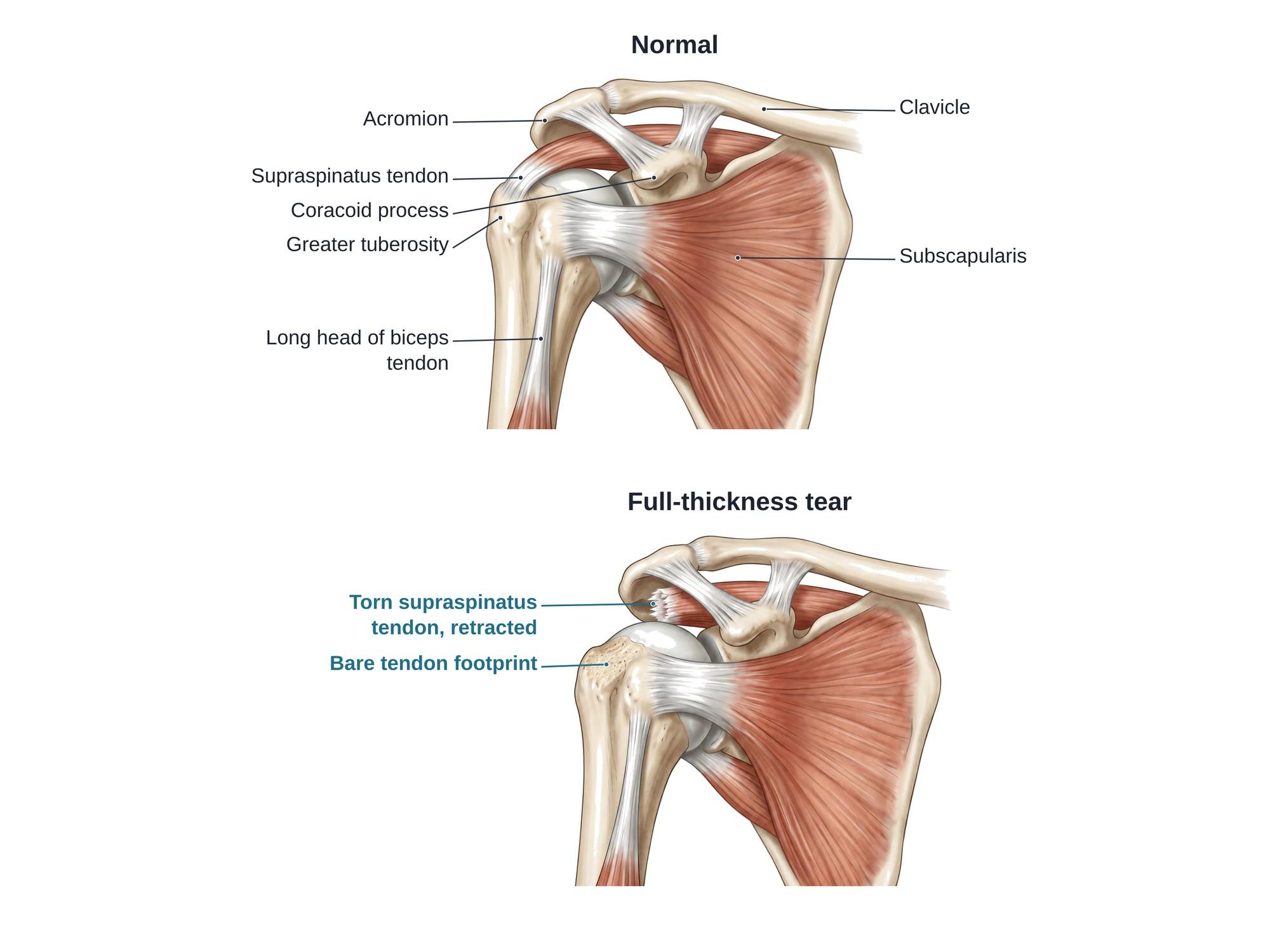
A rotator cuff tear is a tear in one or more of the four tendons that hold the ball of the upper arm bone in the shoulder socket. The four cuff muscles are the supraspinatus on top, the infraspinatus and teres minor behind, and the subscapularis in front. Their tendons blend into one cuff around the humeral head (see shoulder anatomy). A tear most often affects the supraspinatus tendon. It passes under the acromion, the bony roof of the shoulder, to attach to the greater tuberosity, a bump on the top of the humerus. In a full-thickness tear, the tendon tears all the way through and can pull away from the bone. Tears cause shoulder pain, night pain and weakness when lifting the arm. They come from falls, lifting injuries and age-related wear. In a village population study in Japan, 21% of 1,366 shoulders had a full-thickness tear, many without symptoms (Yamamoto et al., 2010). The illustration above shows a normal supraspinatus tendon beside a full-thickness tear that has pulled back from the bone.
Types
Rotator cuff tears are described by depth, size and cause.
| Type | What it means |
|---|---|
| Partial-thickness tear | The tendon is frayed or torn part of the way through. It can be on the joint side, the top (bursal) side, or inside the tendon. |
| Full-thickness tear | The tendon is torn all the way through, leaving a hole or a gap (shown above). |
| Small, medium, large, massive | A common size scale: small is under 1 cm, medium 1 to 3 cm, large 3 to 5 cm, and massive over 5 cm or two or more tendons. |
| Acute (traumatic) tear | A sudden tear from an injury, such as a fall or heavy lift. |
| Degenerative (chronic) tear | A tear that slowly develops from age-related wear of the tendon. |
Causes
- Falls onto an outstretched arm or the side of the shoulder
- Work injuries, such as catching or lifting a heavy load, or a sudden jerk on the arm
- Shoulder dislocation, especially in people over 40
- Car crashes, from bracing against the steering wheel or a seat belt injury
- Repeated overhead work or sports, such as painting, construction, tennis or swimming
- Age-related wear: the tendon thins and weakens with age, and bone spurs under the acromion can rub on it
Age is the strongest risk factor. In a study of 411 volunteers with no shoulder symptoms, tears were found in 13% of people aged 50 to 59 and in 51% of those over 80 (Tempelhof et al., 1999). In the Japanese population study, a history of trauma, the dominant arm and older age were the main risk factors (Yamamoto et al., 2010).
Symptoms
- Pain at the top and outer side of the shoulder, sometimes spreading down the upper arm
- Pain at night, especially when lying on the injured side
- Weakness when lifting the arm out to the side or overhead
- Pain or weakness when reaching behind the back or turning the arm outward
- A crackling feeling (crepitus) with some movements
- After an injury, a sudden pop, then pain and weakness right away
Large tears can make it hard to lift the arm at all. This is called pseudoparalysis: the muscles still work, but the torn cuff cannot center the ball in the socket.
Diagnosis
The doctor asks how the pain started and examines the shoulder's motion and strength. Strength tests check each tendon. These include the empty can test for the supraspinatus, external rotation strength for the infraspinatus, and the lift-off or belly-press test for the subscapularis. The drop arm sign, where the arm cannot be lowered slowly from the side, suggests a large tear.
X-rays show bone spurs, arthritis, or a humeral head that has moved up toward the acromion in long-standing large tears. Ultrasound and MRI show the tendon itself. On MRI, a full-thickness tear appears as a gap filled with fluid. MRI also shows how far the tendon has pulled back (retraction) and whether the muscle has shrunk or turned to fat (fatty infiltration). These findings help predict whether a repair can work.
Treatment
Nonsurgical treatment works for many people, especially older adults with degenerative tears:
- Rest and activity changes: avoiding heavy lifting and repeated overhead work
- Anti-inflammatory medicine and, sometimes, a steroid injection into the space under the acromion
- Physical therapy: stretching to restore motion, then strengthening of the remaining cuff and the shoulder blade muscles
In a multicenter study of 452 patients with full-thickness tears that were not caused by an injury, physical therapy worked for about 75% of patients over 2 years (Kuhn et al., 2013). Fewer than 25% chose surgery.
Surgery is considered for acute tears from an injury in active people, for tears that stay painful and weak after therapy, and for large tears in younger patients:
- Arthroscopic rotator cuff repair: the surgeon works through small cuts with a camera. The torn tendon is pulled back to the greater tuberosity and held with suture anchors, small implants in the bone that carry stitches. This is now the most common method.
- Open or mini-open repair: a larger incision, used for some large tears or when other work is needed.
- Subacromial decompression: shaving a bone spur from under the acromion, sometimes done with a repair.
- Biceps tenotomy or tenodesis, when the long head of the biceps tendon is also damaged.
- Options for tears that cannot be repaired: partial repair, a tendon transfer, a superior capsule reconstruction, or a reverse shoulder replacement when arthritis has set in.
In the United States, the number of rotator cuff repairs rose 141% from 1996 to 2006 (Colvin et al., 2012).
Recovery
Without surgery, most people improve within 6 to 12 weeks of physical therapy. After a repair, the arm stays in a sling, often with a small pillow, for about 4 to 6 weeks to protect the tendon while it heals to the bone. A therapist moves the arm gently during this time. Active motion follows, and strengthening usually starts around 12 weeks. Most people return to daily tasks in 3 to 4 months. Full strength and a return to heavy work or sports often take 6 to 12 months.
Complications
- Retear: the repaired tendon can fail to heal or tear again. In a review of 31 high-quality studies, 21% of repairs had retorn at 12 to 24 months (Longo et al., 2021). Older age, larger tears and fatty muscle raise the risk.
- Shoulder stiffness, or frozen shoulder, after injury or surgery
- Tear growth when a tear is left untreated
- Muscle wasting and fatty infiltration, which can make a later repair impossible
- Cuff tear arthropathy: a form of arthritis after a long-standing massive tear
- Surgical risks such as infection, nerve injury and anchor problems, which are uncommon
The long head of the biceps tendon and the labrum are often injured with the cuff. For a tear of the top of the labrum, see SLAP tear.
How a rotator cuff tear is shown in a personal injury case
Rotator cuff tears are common after falls, work injuries and car crashes. The key question is often whether the tear came from the incident or from earlier wear, since many people over 50 have tears without symptoms. Signs that point to an acute injury include sudden weakness right after the event, a clear mechanism such as a fall on the arm, and imaging findings such as fluid, swelling and a sharp-edged tear. Signs of a long-standing tear include severe retraction, muscle wasting and fatty infiltration. The need for surgery, a retear, or lasting weakness affects damages and future care. A front view illustration like the one above shows a jury where the tendon attaches and what it looks like when it tears away from the bone. For how these images are used at trial, see demonstrative evidence and medical legal illustration.
References
- Yamamoto A, Takagishi K, Osawa T, et al. Prevalence and risk factors of a rotator cuff tear in the general population. Journal of Shoulder and Elbow Surgery. 2010;19(1):116-120.
- Tempelhof S, Rupp S, Seil R. Age-related prevalence of rotator cuff tears in asymptomatic shoulders. Journal of Shoulder and Elbow Surgery. 1999;8(4):296-299.
- Kuhn JE, Dunn WR, Sanders R, et al. Effectiveness of physical therapy in treating atraumatic full-thickness rotator cuff tears: a multicenter prospective cohort study. Journal of Shoulder and Elbow Surgery. 2013;22(10):1371-1379.
- Colvin AC, Egorova N, Harrison AK, et al. National trends in rotator cuff repair. Journal of Bone and Joint Surgery (American). 2012;94(3):227-233.
- Longo UG, Carnevale A, Piergentili I, et al. Retear rates after rotator cuff surgery: a systematic review and meta-analysis. BMC Musculoskeletal Disorders. 2021;22(1):749.
Related pages
- Shoulder anatomyThe normal anatomy of the shoulder.
- SLAP tearA SLAP tear is a tear of the top of the shoulder labrum where the biceps tendon attaches. Learn the types, symptoms, treatment and recovery.
- SubluxationA subluxation is a partial dislocation: a joint slips part way out of place. Learn subluxation vs dislocation in the shoulder.
FAQ
What are the symptoms of a torn rotator cuff?+
The most common symptoms are pain at the top and outer side of the shoulder, pain at night when lying on that side, and weakness when lifting the arm out to the side or overhead. Some people feel a pop and sudden weakness after a fall. Others notice the pain slowly getting worse over months.
How do you fix a rotator cuff tear?+
Many tears are first treated with physical therapy, activity changes and, sometimes, a steroid injection. In one large study of tears that were not caused by an injury, about 3 in 4 people avoided surgery for 2 years with physical therapy. Acute tears from an injury in active people, and tears that stay painful and weak, are often repaired with surgery. The surgeon sews the tendon back onto the bone with small anchors.
How long can you go with a torn rotator cuff?+
Many small tears that are not caused by an injury stay stable for years with therapy. But a full-thickness tear does not heal back to the bone on its own, and some tears grow. Over time a torn tendon can pull back further and its muscle can turn to fat, which makes a repair harder. That is why acute tears from a fall or work injury are usually checked early, often within weeks.
How can you avoid a rotator cuff tear?+
You cannot prevent age-related wear entirely. Keeping the shoulder and shoulder blade muscles strong, avoiding long periods of heavy overhead work, lifting with good form, and not smoking all help. Treating shoulder pain early can stop a small problem from becoming a larger tear.
Can a rotator cuff tear heal on its own?+
A full-thickness tear does not grow back onto the bone by itself. However, the pain often settles, and the other muscles of the shoulder can learn to make up for it. A partial-thickness tear may stay stable, but it can also get bigger over time.
Do I need a sling for a rotator cuff tear?+
Not usually without surgery, because keeping the arm still can make the shoulder stiff. After a rotator cuff repair, a sling, often with a small pillow, is worn for about 4 to 6 weeks to protect the repair while it heals.
How long is recovery after rotator cuff surgery?+
The arm is in a sling for about 4 to 6 weeks. Gentle motion starts early with a therapist, and strengthening usually starts around 12 weeks. Most people return to daily activities in 3 to 4 months. Full strength and return to heavy work or sports often take 6 to 12 months.
Can a fall cause a rotator cuff tear?+
Yes. Falling onto an outstretched arm or onto the side of the shoulder, catching a heavy load, or a sudden pull on the arm can tear a rotator cuff tendon. In a population study, a history of trauma was one of the main risk factors for a tear. Tears after a fall are also common in older adults whose tendons were already worn.
Need this illustration for a patient or a case?
Describe the injury or upload a scan and get a clear, labeled medical illustration for a consult, a chart or a case exhibit.
Try Natomy →