Frozen Shoulder: Symptoms, Stages, Causes & Treatment
Frozen shoulder (adhesive capsulitis) is a painful, stiff shoulder from a thickened joint capsule. Learn the symptoms, 3 stages, causes, exercises and treatment.
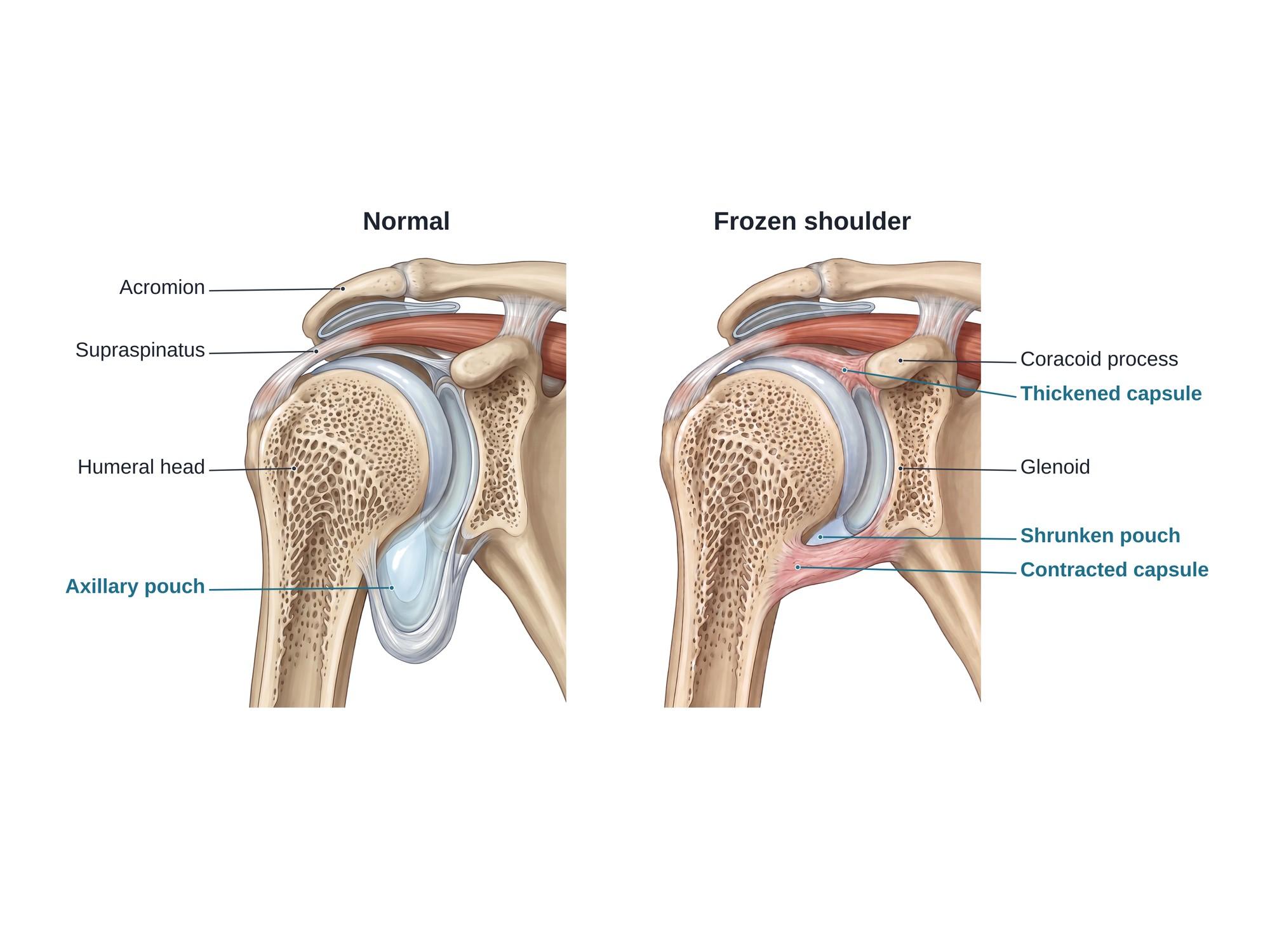
Frozen shoulder, or adhesive capsulitis, is a condition in which the shoulder joint becomes painful and then stiff because its lining thickens, scars and shrinks. The shoulder joint is a ball and socket. The humeral head, the ball at the top of the upper arm bone, sits in the shallow glenoid, the socket of the shoulder blade (see shoulder anatomy). A thin, loose sleeve of tissue, the joint capsule, surrounds the joint. Below the joint it hangs in a roomy fold, the axillary pouch, which gives the arm slack to lift overhead. In frozen shoulder the capsule becomes inflamed and then fibrotic (scarred). It contracts, the axillary pouch shrinks, and the arm loses motion in every direction. In U.S. Medicare data, about 0.35% of adults aged 65 and older had frozen shoulder in one year, roughly 142,000 people (Sarasua et al., 2021).
Stages
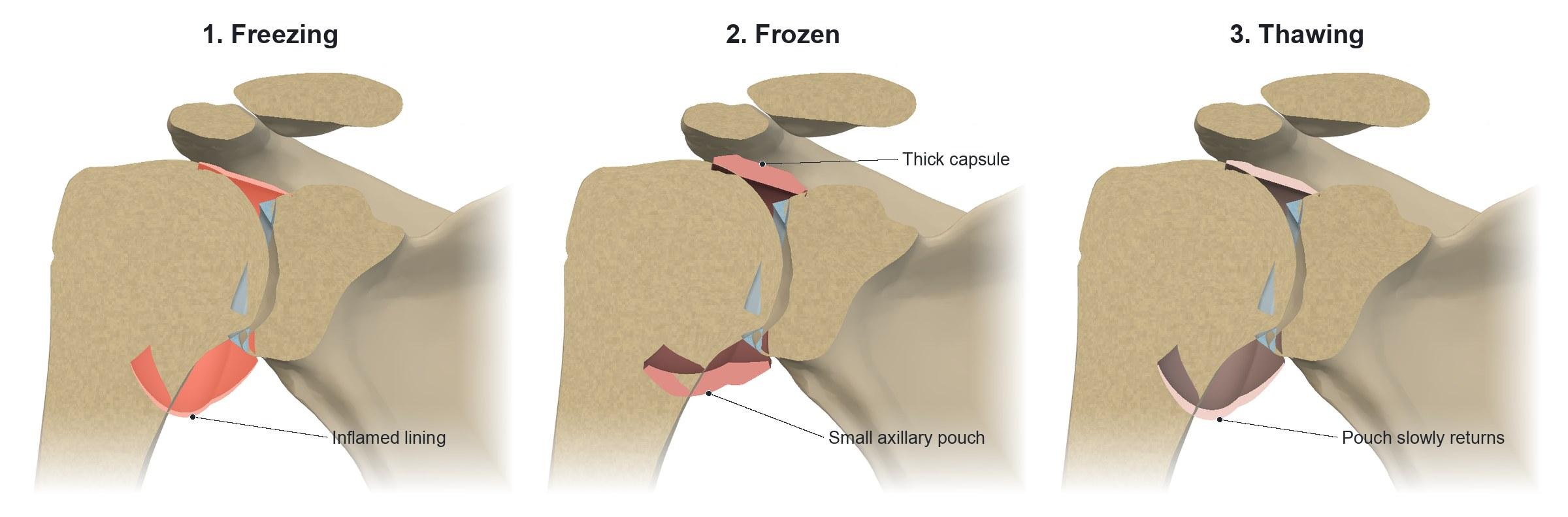
Frozen shoulder usually passes through three stages. Each one blends into the next, and the times varies significantly between individuals (Pandey and Madi, 2021).
- How long
- 2 to 6 months
- What happens
- Pain is the main problem, worst at night. The capsule lining (synovium) is inflamed, and motion starts to tighten.
- How long
- 4 to 12 months
- What happens
- Pain eases, but stiffness is at its worst. The capsule is now thick and scarred.
- How long
- 6 to 26 months
- What happens
- Pain is mild, and motion slowly comes back as the scarring softens.
Some surgeons use a 4-stage system instead. It adds an early stage of pain with full motion, before the stiffness sets in. In that system, stage 2 is freezing, stage 3 is frozen and stage 4 is thawing.
Causes
The exact trigger is not known. It starts as inflammation of the joint lining. Then cells called fibroblasts lay down scar tissue that thickens and shortens the capsule. The rotator interval, the front of the capsule near the coracoid process, and the coracohumeral ligament are often the first parts to thicken.
There are two kinds:
- Primary (idiopathic) frozen shoulder has no clear cause.
- Secondary frozen shoulder follows a known event, such as a shoulder injury, a proximal humerus fracture, a rotator cuff tear, or shoulder, chest or breast surgery. Keeping the arm still in a sling for a long time raises the risk.
Risk factors include:
- Age 40 to 60. In a long-term study of 223 patients, the average age at onset was 53 (Hand et al., 2008).
- Female sex. Women were affected 1.6 times as often as men in the same study.
- Diabetes. People with diabetes have about 3.7 times the odds of developing frozen shoulder (Dyer et al., 2023). About 13% of people with diabetes have it, and about 30% of people with frozen shoulder have diabetes (Zreik et al., 2016).
- Thyroid disease, especially an underactive thyroid (hypothyroidism)
- Parkinson's disease, stroke and Dupuytren's disease (thickening of the tissue in the palm)
- Immobilization after injury or surgery
Symptoms
The usual symptoms are:
- A dull, deep ache in the shoulder, often spreading to the outer upper arm
- Pain at night, and trouble sleeping on the affected side
- Sharp pain with sudden or end-of-range movements
- Stiffness that slowly gets worse, so the arm will not go as far even when someone else moves it
- Trouble reaching overhead, behind the back or behind the head, for example to brush hair, fasten a bra or reach a back pocket
- Loss of external rotation (turning the arm outward) first and most
This loss of passive motion, when the examiner moves the arm, is the key sign. In a rotator cuff tear or shoulder impingement, a doctor can usually still move the arm further than the patient can on their own. In frozen shoulder, the joint is blocked both ways.
Diagnosis
Frozen shoulder is a clinical diagnosis. The doctor takes a history and measures the active and passive range of motion of both shoulders. A frozen shoulder test is simply this exam: limited passive external rotation, often to less than half of the other side, with similar loss of lifting and inward turning. Blood sugar and thyroid tests are often checked.
Imaging is mainly used to rule out other causes. X-rays are usually normal, which helps exclude arthritis, a missed dislocation or a fracture. Ultrasound can show thickening of the rotator interval and the coracohumeral ligament. MRI can show a thickened capsule and coracohumeral ligament, and a small, tight axillary recess. MRI is not needed in most cases, but it can look for a rotator cuff tear or other damage after an injury.
Treatment
Most people get better without surgery. Nonsurgical care works for up to 90% of patients, and symptoms usually settle over 12 to 18 months (Pandey and Madi, 2021). Treatment depends on the stage.
Nonsurgical treatment:
- Steroid injection into the joint. A review of 65 randomized trials with 4,097 people found that an intra-articular corticosteroid injection was the only treatment clearly better than others for pain and function in the short term (Challoumas et al., 2020). It works best early, in the first year, combined with a home exercise program.
- Pain medicine, such as anti-inflammatory drugs, to allow sleep and stretching
- Physical therapy with gentle stretching. Forcing painful stretches in the freezing stage can make it worse.
- Hydrodilatation: the joint is filled with saline, usually with a steroid and local anesthetic, to stretch the tight capsule.
Frozen shoulder exercises are done gently, within mild discomfort, several times a day. Common ones are:
- Pendulum swings: lean forward and let the arm hang and swing in small circles
- Table or wall slides: slide the hand forward on a table or up a wall
- Towel stretch: hold a towel behind the back and pull the stiff arm up with the good arm
- Cross-body stretch: pull the arm across the chest with the other hand
- External rotation with a stick: elbow at the side, push the hand outward with a stick held in the other hand
A physical therapist sets the program for each stage. There is no proven way to cure frozen shoulder quickly. An early injection plus daily stretching is the best supported approach.
Surgery is considered when pain and stiffness continue after 6 to 9 months of good nonsurgical care (Pandey and Madi, 2021):
- Manipulation under anesthesia (MUA): while the patient is asleep, the surgeon moves the arm firmly to tear the tight capsule.
- Arthroscopic capsular release: through small cuts and a camera, the surgeon cuts the thickened capsule, the rotator interval and the coracohumeral ligament. It is now the preferred surgical option for many surgeons.
In a U.S. hospital study of 2,190 patients with frozen shoulder, 361 (16%) later had surgery (Kingston et al., 2018). Workers' compensation patients were 8 times as likely to have surgery as privately insured patients.
Recovery
Recovery is slow, and patience matters. Most people regain useful motion over 1 to 2 years. In the Oxford study of 223 patients followed for an average of 4.4 years, 59% had normal or near normal shoulders. The other 41% had some ongoing symptoms, mostly mild pain (Hand et al., 2008). After manipulation or capsular release, physical therapy starts within a day or two to keep the new motion. Daily stretching often continues for several months.
Complications
- Lasting stiffness and pain. In the Oxford study, 41% of patients still had some symptoms years later, and 6% of that group had severe pain and loss of function (Hand et al., 2008). Those with the worst symptoms at the start did worst.
- The other shoulder. About 20% of patients in that study had symptoms in both shoulders. A repeat episode in the same shoulder is rare.
- Risks of manipulation: a fracture of the humerus, a rotator cuff tear, a labral tear, shoulder dislocation and nerve injury. These are uncommon but serious (Pandey and Madi, 2021).
- Risks of arthroscopic release: those of any shoulder arthroscopy, such as infection and nerve injury.
- Loss of work and sleep for many months, especially in manual jobs.
References
- Sarasua SM, Floyd S, Bridges WC, et al. The epidemiology and etiology of adhesive capsulitis in the U.S. Medicare population. BMC Musculoskeletal Disorders. 2021;22(1):828.
- Pandey V, Madi S. Clinical guidelines in the management of frozen shoulder: an update!. Indian Journal of Orthopaedics. 2021;55(2):299-309.
- Hand C, Clipsham K, Rees JL, et al. Long-term outcome of frozen shoulder. Journal of Shoulder and Elbow Surgery. 2008;17(2):231-236.
- Dyer BP, Rathod-Mistry T, Burton C, et al. Diabetes as a risk factor for the onset of frozen shoulder: a systematic review and meta-analysis. BMJ Open. 2023;13(1):e062377.
- Zreik NH, Malik RA, Charalambous CP. Adhesive capsulitis of the shoulder and diabetes: a meta-analysis of prevalence. Muscles, Ligaments and Tendons Journal. 2016;6(1):26-34.
- Challoumas D, Biddle M, McLean M, et al. Comparison of treatments for frozen shoulder: a systematic review and meta-analysis. JAMA Network Open. 2020;3(12):e2029581.
- Kingston K, Curry EJ, Galvin JW, et al. Shoulder adhesive capsulitis: epidemiology and predictors of surgery. Journal of Shoulder and Elbow Surgery. 2018;27(8):1437-1443.
Related pages
- Shoulder anatomyThe normal anatomy of the shoulder.
- AC joint separationAn AC joint separation is a tear of the ligaments that hold the collarbone to the shoulder blade. Learn the Rockwood types, symptoms, treatment and recovery.
- Bankart lesionA Bankart lesion is a tear of the front lower labrum of the shoulder socket from a dislocation. Learn the types, bony Bankart, symptoms and treatment.
- Brachial plexus injuryA brachial plexus injury damages the nerves from the neck to the arm. Learn the types, symptoms, treatment and recovery time.
- Rotator cuff tearA rotator cuff tear is a tear in the shoulder tendons that lift and turn the arm. Learn the types, symptoms, surgery and recovery.
- Shoulder impingementShoulder impingement is pinching of a rotator cuff tendon and bursa under the acromion. Learn the symptoms, causes, tests, exercises and treatment options.
- SLAP tearA SLAP tear is a tear of the top of the shoulder labrum where the biceps tendon attaches. Learn the types, symptoms, treatment and recovery.
- SubluxationA subluxation is a partial dislocation: a joint slips part way out of place. Learn subluxation vs dislocation in the shoulder.
- Thoracic outlet syndromeThoracic outlet syndrome is compression of the nerves or vessels at the base of the neck. Learn the symptoms, tests, physical therapy and surgery.
FAQ
What are the first signs of frozen shoulder?+
It usually starts with a dull, deep ache in the shoulder and upper arm that comes on slowly, often with no clear injury. The pain is worse at night and with sudden reaching. Over weeks, it gets harder to reach behind the back, fasten a bra or reach a high shelf. Turning the arm outward is usually the first motion to be lost.
What is stage 3 of frozen shoulder?+
In the common 3-stage system, stage 3 is the thawing stage. The pain fades and motion slowly comes back, which can take 6 to 26 months. In the 4-stage system some surgeons use, stage 3 is the frozen stage, when the capsule is scarred, pain eases and stiffness is at its worst.
Why does frozen shoulder hurt more at night?+
In the early freezing stage the joint lining is inflamed. Lying on the shoulder presses on it, and rolling over in sleep stretches the tight capsule into its painful range. Sleeping on the other side with a pillow supporting the arm often helps.
How can I fix my frozen shoulder?+
Most people get better with nonsurgical care. A steroid injection into the joint in the painful stage, gentle stretching at home, and physical therapy are the main treatments. Pain medicine helps you keep moving. If the shoulder is still stiff and painful after 6 to 9 months of this care, a doctor may offer hydrodilatation, manipulation under anesthesia or an arthroscopic capsular release.
How long does frozen shoulder last?+
Most cases settle gradually over 12 to 18 months, though some take longer. In a long-term Oxford study of 223 patients, 59% had normal or near normal shoulders after an average of 4.4 years. The other 41% still had some symptoms. Most of these were mild, and only 6% of them were severe, with pain and loss of function.
Is frozen shoulder a disability?+
It can be, for a time. Loss of overhead reach and night pain can stop people doing manual work, driving or lifting for months. Whether it counts as a disability for a claim depends on how much function is lost and for how long, which a doctor records with range of motion measurements over time. Most people regain useful motion, but a small group keep lasting stiffness.
Can an injury or surgery cause frozen shoulder?+
Yes. Secondary frozen shoulder can follow a shoulder injury, a fracture, a rotator cuff tear or surgery, especially when the arm is kept still for a long time. Primary frozen shoulder comes on with no clear cause and is linked to diabetes and thyroid disease.
Will frozen shoulder come back?+
It rarely comes back in the same shoulder. The other shoulder can be affected, though. In the Oxford study, 20% of patients had symptoms in both shoulders, but none had a repeat episode in the same shoulder.
Need this illustration for a patient or a case?
Describe the injury or upload a scan and get a clear, labeled medical illustration for a consult, a chart or a case exhibit.
Try Natomy →