Ulnar Nerve Entrapment: Cubital Tunnel Symptoms & Surgery
Ulnar nerve entrapment (cubital tunnel syndrome) pinches the funny bone nerve at the elbow. Learn the causes, ulnar nerve pain, grades, surgery and recovery.
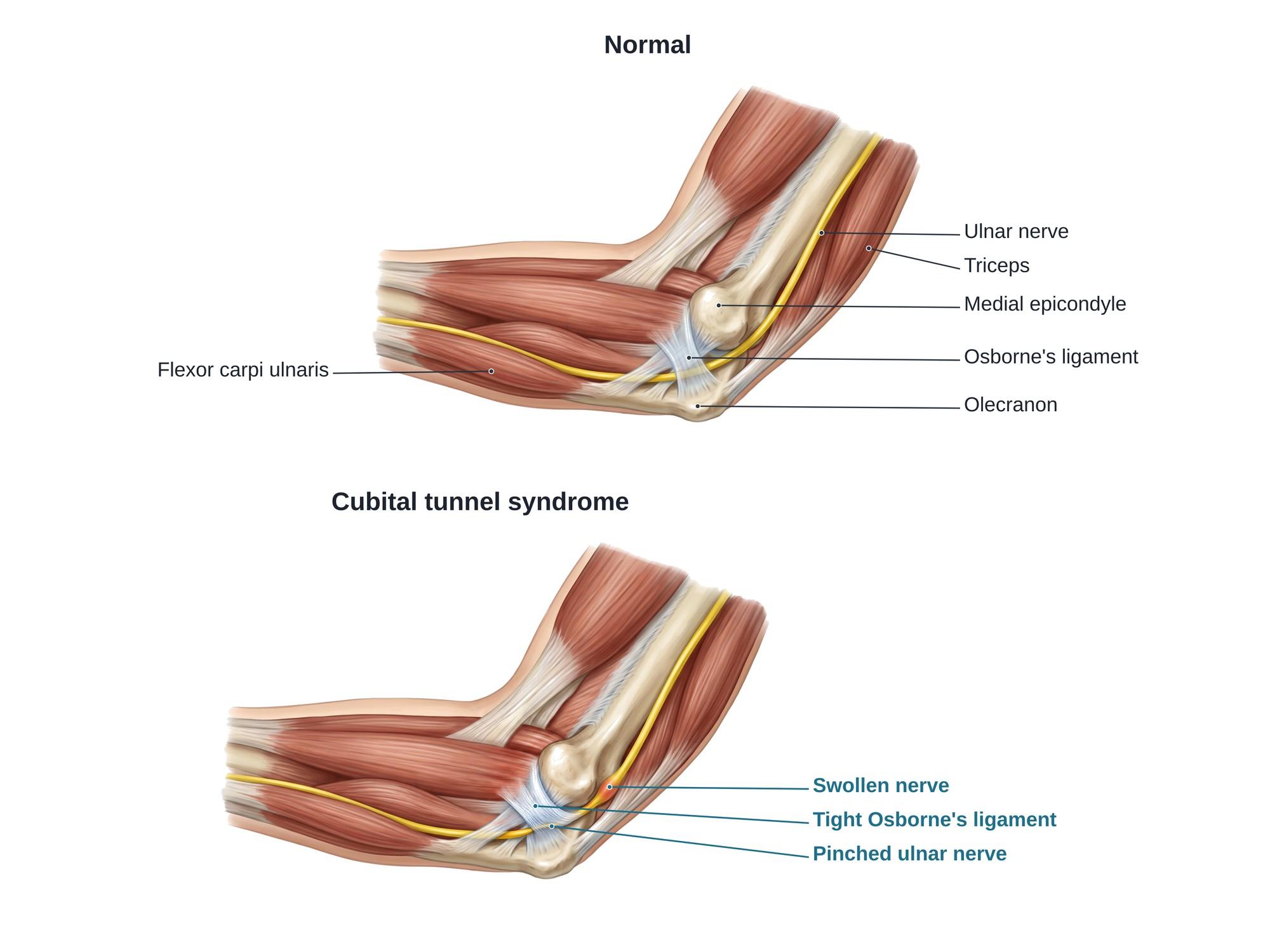
Ulnar nerve entrapment is pressure on the ulnar nerve, the "funny bone" nerve, usually where it passes behind the elbow. At the elbow it is called cubital tunnel syndrome, the second most common nerve entrapment of the arm after carpal tunnel syndrome (Burahee et al., 2021). The nerve runs in a groove behind the medial epicondyle, the bony knob on the inner side of the elbow. A band of tissue called Osborne's ligament forms the roof of this tunnel. When the tunnel tightens, the nerve is pinched. The result is numbness in the ring and little fingers and, later, weakness of the hand. In a Finnish national register, ulnar nerve entrapment was diagnosed in 36 men and 26 women per 100,000 people each year (Hulkkonen et al., 2020). For the bones and ligaments of the joint, see elbow anatomy.
The anatomy
The ulnar nerve comes from the C8 and T1 nerve roots, through the medial cord of the brachial plexus. It runs down the inner side of the arm, then passes behind the elbow through the cubital tunnel:
- Floor: the elbow joint capsule and the back part of the ulnar collateral ligament.
- Walls: the medial epicondyle in front and the olecranon, the point of the elbow, behind.
- Roof: Osborne's ligament , a fibrous band over the nerve between the medial epicondyle and the olecranon.
Below the tunnel, the nerve dives between the two heads of the flexor carpi ulnaris, a forearm muscle that bends the wrist. Bending the elbow stretches the nerve and tightens the roof, so the tunnel narrows. This is why symptoms are worse with the elbow bent.
Grades
The McGowan grading is a simple way to describe severity from the examination (Burahee et al., 2021):
- Findings
- Mild: tingling and a feeling of clumsiness, no weakness or wasting
- Findings
- Moderate: numbness and weakness of the small hand muscles, with or without some wasting
- Findings
- Severe: marked weakness or paralysis of the small hand muscles, with clear wasting
Nerve conduction studies add a measure of how badly the nerve is working, which helps plan treatment.
Causes
The nerve can be squeezed at several points around the elbow. The cubital tunnel under Osborne's ligament is the most common. Others are the arcade of Struthers above the elbow and the deep fascia of the flexor carpi ulnaris below it.
- Long periods with the elbow bent: phone use, desk work, sleeping with the arms bent.
- Leaning on the elbow: on a desk, car door armrest or chair arm.
- Repetitive work and sport: manual labor, throwing, and lifting. In Siena, Italy, men in an area dominated by manual work had a rate of 57 per 100,000 a year, against 33 for men overall (Mondelli et al., 2005).
- Elbow injuries: a direct blow to the inner elbow, elbow dislocations, and fractures around the elbow.
- Ulnar nerve subluxation: the nerve snaps forward over the medial epicondyle when the elbow bends, which irritates it over time.
- Arthritis and masses: bone spurs, a ganglion cyst, or an extra muscle (anconeus epitrochlearis) inside the tunnel.
- Risk factors: older age and male sex. In a Korean study of 43,189 patients, diabetes was linked to a higher risk (Lee et al., 2026). In the Siena study, the average age at diagnosis was 56 (Mondelli et al., 2005).
Symptoms
Ulnar nerve pain and tingling follow the nerve's path:
- Numbness or tingling in the ring and little fingers, often the first sign
- Numbness on the back of the hand on the little finger side
- Aching on the inner side of the elbow, sometimes shooting down the forearm
- Symptoms that wake you at night or come on when the elbow is bent for a while
- Clumsiness and weak grip, trouble with buttons, keys or opening jars
- Muscle wasting in the web between the thumb and index finger, and between the hand bones
- Clawing of the ring and little fingers in severe cases
- A snapping feeling at the elbow if the nerve subluxes
Diagnosis
- History and examination. The doctor maps the numbness and tests the hand muscles. Tapping over the nerve behind the elbow may cause tingling into the fingers (Tinel's sign). Holding the elbow fully bent may bring on symptoms (elbow flexion test). Froment's sign shows weakness of the thumb-pinching muscle.
- Nerve conduction studies and EMG. These measure how fast signals cross the elbow and whether the hand muscles have lost their nerve supply. Slowing across the elbow confirms the site and shows the severity.
- Ultrasound. The nerve looks swollen just above or inside the tunnel, as in the illustration. Moving the elbow during the scan shows whether the nerve slips out of its groove.
- X-rays look for old fractures, arthritis or bone spurs. MRI is used when a mass is suspected.
- Ruling out look-alikes. A pinched C8 nerve root in the neck (see cervical disc herniation), thoracic outlet syndrome and ulnar nerve compression at the wrist can all cause numbness in the same fingers.
Treatment
Nonsurgical care comes first for mild and moderate cases:
- Avoid leaning on the elbow and long periods with it bent.
- Wear a night splint or soft pad that keeps the elbow fairly straight.
- Nerve gliding exercises ("ulnar nerve flossing") from a hand therapist.
- Anti-inflammatory medicine for pain.
A systematic review of 844 patients found moderate evidence that education, activity changes and splinting help mild and moderate cases (Kooner et al., 2019).
Ulnar nerve surgery is offered when symptoms last despite this, or when there is weakness or wasting. In Finland, 47% of men and 43% of women diagnosed with an ulnar nerve entrapment had an operation (Hulkkonen et al., 2020). The main options:
- In situ decompression: the surgeon cuts Osborne's ligament and the tight fascia around the nerve, leaving the nerve in place. It can be done open or with an endoscope. It works much like carpal tunnel release does for the median nerve at the wrist.
- Anterior transposition: the nerve is freed and moved in front of the medial epicondyle, under the skin, within the muscle, or under the muscle. It is often used when the nerve subluxes or after a fracture.
- Medial epicondylectomy: part of the medial epicondyle is shaved off so the nerve can glide.
- Nerve transfer: in severe, long-standing cases, a nearby motor nerve branch may be joined to the ulnar nerve in the lower forearm to speed recovery of the hand muscles.
A network meta-analysis of 30 studies and 2,894 operated arms found that 87% of patients improved after surgery, and that open in situ decompression had the best results with the fewest complications (Wade et al., 2020).
Recovery
After a simple decompression, most people start moving the elbow early. A transposition often needs a short period in a splint and a longer return to heavy work. Tingling usually improves first, over weeks to months. Strength and muscle bulk recover slowly, and severe wasting may not fully return. Hand therapy helps restore grip and range of motion.
Complications
Of the condition, when untreated or severe:
- Permanent numbness in the ring and little fingers
- Lasting weakness, muscle wasting and clawing of the hand
Of surgery, which are uncommon:
- In the Wade meta-analysis, 3% of patients had a complication after surgery and 2% needed another operation (Wade et al., 2020).
- Injury to the medial antebrachial cutaneous nerve, a skin nerve near the incision, causing numbness or a painful scar
- The ulnar nerve slipping over the epicondyle after in situ decompression
- Symptoms that persist or come back, sometimes needing revision surgery
- Elbow stiffness, bruising or wound problems
References
- Burahee AS, Sanders AD, Shirley C, et al. Cubital tunnel syndrome. EFORT Open Reviews. 2021;6(9):743-750.
- Hulkkonen S, Lampainen K, Auvinen J, et al. Incidence and operations of median, ulnar and radial entrapment neuropathies in Finland: a nationwide register study. Journal of Hand Surgery (European Volume). 2020;45(3):226-230.
- Mondelli M, Giannini F, Ballerini M, et al. Incidence of ulnar neuropathy at the elbow in the province of Siena (Italy). Journal of the Neurological Sciences. 2005;234(1-2):5-10.
- Kooner S, Cinats D, Kwong C, et al. Conservative treatment of cubital tunnel syndrome: a systematic review. Orthopedic Reviews. 2019;11(2):7955.
- Wade RG, Griffiths TT, Flather R, et al. Safety and outcomes of different surgical techniques for cubital tunnel decompression: a systematic review and network meta-analysis. JAMA Network Open. 2020;3(11):e2024352.
- Lee JI, Park JW, Park CM, et al. Risk factors for idiopathic cubital tunnel syndrome: development and surgical intervention from a nationwide population-based cohort study. Bone & Joint Journal. 2026;108-B(5):657-662.
Related pages
- Elbow anatomyThe normal anatomy of the elbow.
- Biceps tendon ruptureA biceps tendon rupture is a tear of the biceps tendon at the elbow (distal) or shoulder (proximal). Learn the symptoms, tests, surgery and recovery time.
- Golfer's elbow vs tennis elbowGolfer's elbow hurts on the inner elbow, tennis elbow on the outer elbow. Compare the tendons, causes, symptoms, treatment, recovery time and when surgery helps.
FAQ
How long does it take to recover from ulnar nerve release surgery?+
Recovery depends on the operation and on how severe the damage was. A transposition, where the nerve is moved in front of the elbow, usually needs a longer rest than a simple release. Numbness often eases over weeks to months. Weakness and muscle wasting recover slowly, and may not fully recover when they were severe before surgery.
What causes tingling from the elbow to the hand?+
Tingling down the inner forearm into the ring and little fingers is the classic pattern of ulnar nerve entrapment at the elbow. The same fingers can also tingle from a pinched C8 nerve root in the neck, thoracic outlet syndrome, or ulnar nerve compression at the wrist. Sudden tingling in the left arm with chest pain, shortness of breath or sweating is a medical emergency and needs a call to emergency services, not a nerve exam.
How should I sleep with ulnar nerve compression?+
Keep the elbow fairly straight at night. Bending the elbow stretches the ulnar nerve and squeezes the cubital tunnel, so sleeping with the arms bent under a pillow or the head often brings on numbness. A night splint, or a towel wrapped loosely around the elbow, helps keep it straighter.
Can massage help ulnar nerve entrapment?+
Massage has not been shown to free a compressed ulnar nerve. Pressing on the nerve behind the elbow can make symptoms worse. Education, avoiding leaning on the elbow, and night splinting have the best support for mild cases.
Is cubital tunnel syndrome the same as ulnar nerve entrapment?+
Cubital tunnel syndrome is the most common form of ulnar nerve entrapment. The ulnar nerve can also be pinched higher in the arm, lower in the forearm, or at the wrist in Guyon's canal, but the elbow is the most common site.
Does ulnar nerve entrapment need surgery?+
Not always. Mild cases often improve with activity changes and a night splint. Surgery is offered when symptoms last for months despite this, or when there is weakness or muscle wasting. In one large network meta-analysis, 87% of patients improved after surgery.
What are ulnar nerve flossing exercises?+
Nerve gliding, or flossing, moves the elbow, wrist and fingers through a sequence so the ulnar nerve slides gently in its path. They are often added to splinting in mild cases.
Can ulnar nerve entrapment be permanent?+
It can be. Long-standing, severe compression can leave permanent weakness of the small hand muscles, muscle wasting between the thumb and index finger, and clawing of the ring and little fingers. Treating it before the muscles waste gives the best chance of a full recovery.
Need this illustration for a patient or a case?
Describe the injury or upload a scan and get a clear, labeled medical illustration for a consult, a chart or a case exhibit.
Try Natomy →