Shoulder Impingement Syndrome: Symptoms, Causes & Treatment
Shoulder impingement is pinching of a rotator cuff tendon and bursa under the acromion. Learn the symptoms, causes, tests, exercises and treatment options.
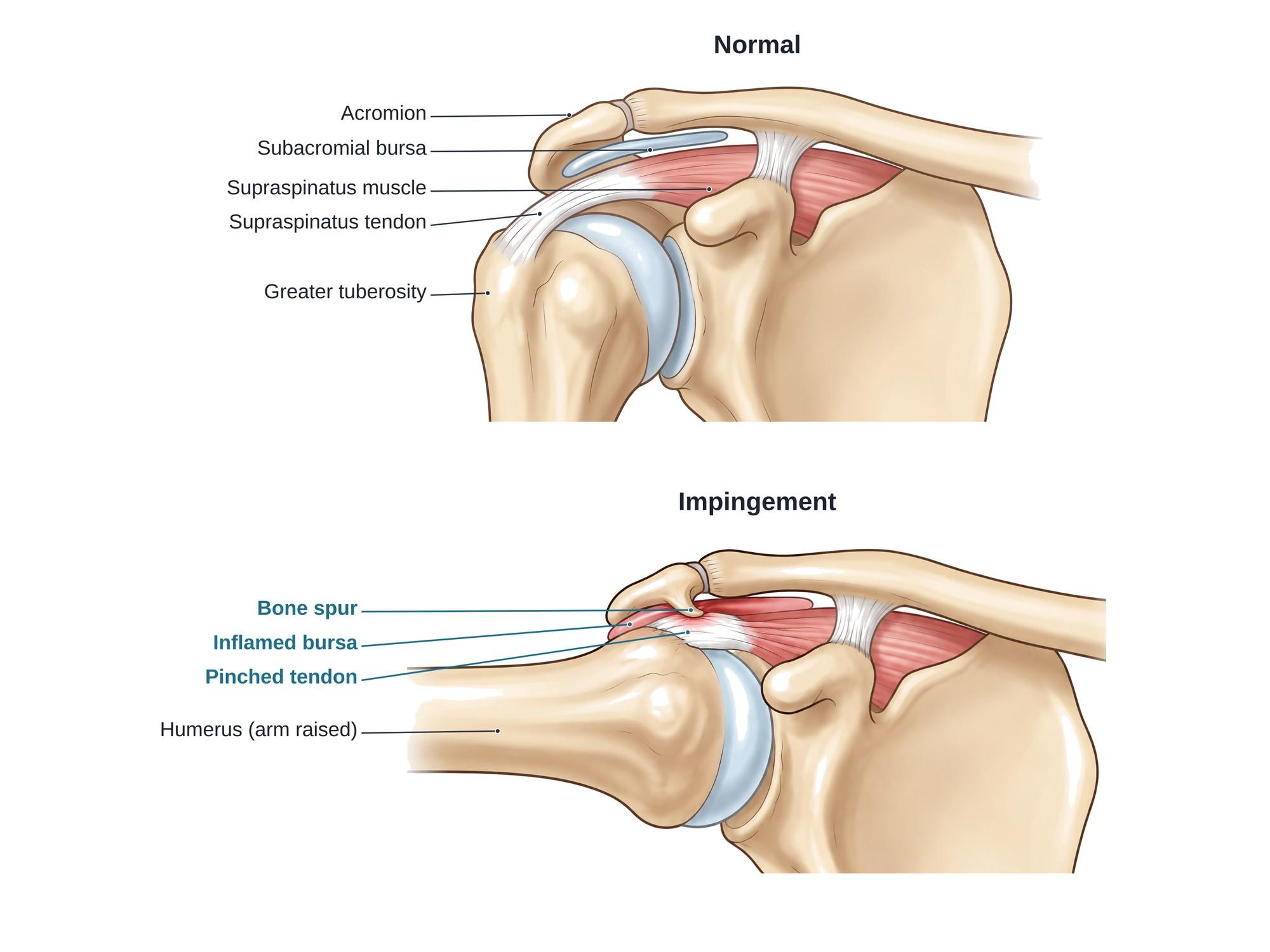
Shoulder impingement is pinching of a rotator cuff tendon and the bursa above it under the bony roof of the shoulder when the arm is raised. The rotator cuff is a group of four muscles whose tendons hold the ball of the upper arm bone (the humeral head) in its socket (see shoulder anatomy). The one on top, the supraspinatus tendon, runs through a narrow gap under the acromion to attach on the greater tuberosity, a bump on the top of the humerus. A thin fluid sac, the subacromial bursa, lets the tendon glide in this gap. When the arm is lifted out to the side or overhead, the gap narrows. If the space is already tight, for example from a bone spur (osteophyte) under the acromion, the tendon and bursa get squeezed. They become sore and swollen, which is called tendinitis and bursitis. Doctors now often call the condition subacromial pain syndrome. It is common in people who work with their arms overhead and in overhead sports such as swimming, tennis and baseball. The illustration above shows a normal shoulder above a raised arm with the tendon and bursa pinched under a bone spur.
Types
| Type | What it means |
|---|---|
| External (subacromial) impingement | The supraspinatus tendon and bursa are pinched under the acromion. This is the common form, shown above. |
| Internal impingement | The underside of the rotator cuff is pinched against the back edge of the socket. It is seen in throwing athletes. |
| Subcoracoid impingement | The subscapularis tendon at the front is pinched under the coracoid process. It is less common. |
The shape of the acromion matters. Doctors describe three shapes: type I (flat), type II (curved) and type III (hooked). A hooked acromion leaves less room for the tendon.
Stages
Charles Neer, the surgeon who named the condition, described it as a process that gets worse over time.
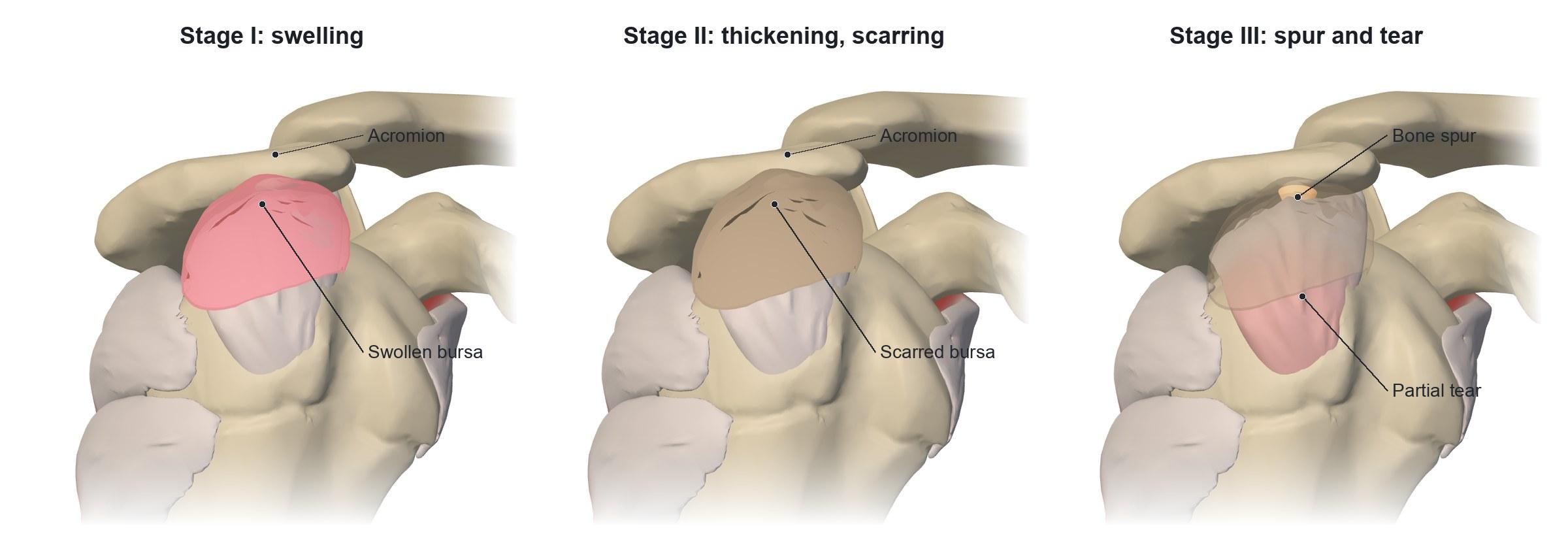
- What happens to the tendon
- Swelling and bleeding in the tendon and bursa. It usually goes away with rest.
- What happens to the tendon
- The tendon and bursa thicken and scar (fibrosis) after repeated episodes.
- What happens to the tendon
- Bone spurs form and the rotator cuff tendon can tear.
Causes
Impingement comes from too little room under the acromion, a weak or tired rotator cuff, or both.
- Repeated overhead work, such as painting, drywall, electrical work, stocking shelves and assembly lines
- Overhead sports, such as swimming, tennis, volleyball and pitching
- Heavy lifting and forceful arm work
- A hooked or sloped acromion, or bone spurs under the acromion or at the AC joint
- Weak rotator cuff or shoulder blade muscles, which let the humeral head ride up when the arm is raised
- Poor posture, with rounded shoulders that tip the acromion forward
- Age-related wear of the rotator cuff tendon
Work demands play a large role. In a systematic review of work factors, raising the upper arm 45 degrees or more for at least 15% of the workday was linked to 2.4 times the odds of impingement (van Rijn et al., 2010). Lifting more than 20 kg more than 10 times a day and highly repetitive arm work were also linked to it.
Symptoms
- Pain at the top and outer side of the shoulder, often spreading toward the middle of the upper arm
- Pain when lifting the arm out to the side or overhead, worst in the middle part of the lift (the painful arc)
- Pain when reaching behind the back or into a back pocket
- Pain at night, especially when lying on that side
- A feeling of catching or weakness when raising the arm
- Pain that starts slowly over weeks, often after a change in work or training
Pain that runs below the elbow with numbness or tingling points to a nerve problem in the neck instead.
Diagnosis
The doctor asks about work, sports and when the pain started. The exam checks motion and strength of each rotator cuff tendon. Two common tests squeeze the tendon under the acromion on purpose:
- Neer test: the doctor holds the shoulder blade still and lifts the straight arm forward and up. Pain suggests impingement.
- Hawkins-Kennedy test: the arm is raised forward to shoulder height with the elbow bent, then turned inward. Pain suggests impingement.
For the Neer impingement test, a numbing medicine (lidocaine) is injected under the acromion. If the pain goes away during the Neer test afterward, the problem is likely in that space.
X-rays can show the shape of the acromion, bone spurs, calcium deposits in the tendon and arthritis of the AC joint. In a study of 850 adults sent to a shoulder clinic for suspected impingement, X-rays showed calcium in the tendon in 24%, a hooked acromion in 16% and a spur on the outer acromion in 11% (Andrea et al., 2024). Ultrasound shows a thickened bursa and can show the tendon move under the acromion. MRI shows swelling in the tendon and bursa and rules out a rotator cuff tear.
Treatment
Nonsurgical treatment is the first choice and works for most people:
- Rest and activity changes: less overhead work, lighter loads, and keeping the elbows below shoulder height for a while
- Ice and anti-inflammatory medicine, such as ibuprofen or naproxen
- Physical therapy: stretching the back of the shoulder, then strengthening the rotator cuff and the muscles that move the shoulder blade, plus posture work
- A steroid injection into the subacromial space, to calm pain so the exercises can be done
- Return to work or sport in steps, with changes to technique or workstation height
Surgery is an option when months of other care fail. The usual operation is arthroscopic subacromial decompression. Through small cuts and a camera, the surgeon removes the inflamed bursa and shaves the bone spur and the underside of the acromion (acromioplasty). In England, the use of decompression rose 91%, from 15,112 operations in 2007/2008 to 28,802 in 2016/2017 (Jones et al., 2019).
Two placebo-controlled trials then tested it. In the CSAW trial of 313 patients, decompression gave no extra benefit over a camera-only operation at 6 months (Beard et al., 2018). In the FIMPACT trial of 210 patients, decompression gave no benefit over a camera-only operation at 2 years (Paavola et al., 2018), and still none at 10 years (Kanto et al., 2025). For adults with shoulder pain for more than 3 months, a BMJ guideline panel states: "The guideline panel makes a strong recommendation against surgery" (Vandvik et al., 2019).
Surgery is still used for related problems. A torn tendon may need a rotator cuff repair. Arthritis of the AC joint may need removal of the end of the collarbone.
Recovery
Most people improve over several weeks to a few months of home exercises and physical therapy. Pain often eases first, and strength and overhead motion come back later. Overhead workers and athletes return to full duty in steps, once they can raise the arm without pain. Recovery time can matter at work. In a Danish study of patients diagnosed in specialist care who had jobs, impingement cost an average of 27 lost workdays in the first 6 months (Clausen et al., 2021).
After decompression surgery, a sling is worn for comfort for a few days. Gentle motion starts early. Most people return to light work within weeks. Heavy or overhead work usually waits a few months, until strength returns.
Complications
- Chronic shoulder pain that does not settle with treatment
- Rotator cuff tear: years of pinching can wear the tendon thin until it tears (see rotator cuff tear)
- Stiffness or frozen shoulder, when pain keeps the arm from moving. In the CSAW trial, all six study-related complications were frozen shoulders (Beard et al., 2018). See frozen shoulder.
- Weakness and lost time from work or sport
- Surgical risks, such as infection, stiffness and continued pain, which are uncommon
Tears of the top of the labrum can also cause pain with overhead activity. See SLAP tear.
References
- van Rijn RM, Huisstede BM, Koes BW, et al. Associations between work-related factors and specific disorders of the shoulder: a systematic review of the literature. Scandinavian Journal of Work, Environment and Health. 2010;36(3):189-201.
- Andrea LC, Svendsen SW, Frost P, et al. Radiographic findings in patients suspected of subacromial impingement syndrome: prevalence and reliability. Skeletal Radiology. 2024;53(11):2477-2490.
- Jones T, Carr AJ, Beard D, et al. Longitudinal study of use and cost of subacromial decompression surgery: the need for effective evaluation of surgical procedures to prevent overtreatment and wasted resources. BMJ Open. 2019;9(8):e030229.
- Beard DJ, Rees JL, Cook JA, et al. Arthroscopic subacromial decompression for subacromial shoulder pain (CSAW): a multicentre, pragmatic, parallel group, placebo-controlled, three-group, randomised surgical trial. Lancet. 2018;391(10118):329-338.
- Paavola M, Malmivaara A, Taimela S, et al. Subacromial decompression versus diagnostic arthroscopy for shoulder impingement: randomised, placebo surgery controlled clinical trial. BMJ. 2018;362:k2860.
- Kanto K, Bäck M, Ibounig T, et al. Arthroscopic subacromial decompression versus placebo surgery for subacromial pain syndrome: 10 year follow-up of the FIMPACT randomised, placebo surgery controlled trial. BMJ. 2025;391:e086201.
- Vandvik PO, Lähdeoja T, Ardern C, et al. Subacromial decompression surgery for adults with shoulder pain: a clinical practice guideline. BMJ. 2019;364:l294.
- Clausen MB, Nielsen MF, Merrild MB, et al. High incidence of lost workdays in patients with subacromial impingement syndrome. Danish Medical Journal. 2021;68(6):A07200496.
Related pages
- Shoulder anatomyThe normal anatomy of the shoulder.
- AC joint separationAn AC joint separation is a tear of the ligaments that hold the collarbone to the shoulder blade. Learn the Rockwood types, symptoms, treatment and recovery.
- Bankart lesionA Bankart lesion is a tear of the front lower labrum of the shoulder socket from a dislocation. Learn the types, bony Bankart, symptoms and treatment.
- Brachial plexus injuryA brachial plexus injury damages the nerves from the neck to the arm. Learn the types, symptoms, treatment and recovery time.
- Frozen shoulderFrozen shoulder (adhesive capsulitis) is a painful, stiff shoulder from a thickened joint capsule. Learn the symptoms, 3 stages, causes, exercises and treatment.
- Rotator cuff tearA rotator cuff tear is a tear in the shoulder tendons that lift and turn the arm. Learn the types, symptoms, surgery and recovery.
- SLAP tearA SLAP tear is a tear of the top of the shoulder labrum where the biceps tendon attaches. Learn the types, symptoms, treatment and recovery.
- SubluxationA subluxation is a partial dislocation: a joint slips part way out of place. Learn subluxation vs dislocation in the shoulder.
- Thoracic outlet syndromeThoracic outlet syndrome is compression of the nerves or vessels at the base of the neck. Learn the symptoms, tests, physical therapy and surgery.
FAQ
How do you help shoulder impingement?+
Most people get better without surgery. The first steps are rest from overhead work and sports, pain medicine such as ibuprofen, and a physical therapy program that strengthens the rotator cuff and the muscles around the shoulder blade. A steroid injection into the space under the acromion can calm pain enough to do the exercises. Surgery is only considered when symptoms last for months despite this care.
What is rotator cuff tendinitis?+
Rotator cuff tendinitis is irritation of the rotator cuff tendons, most often the supraspinatus tendon at the top of the shoulder. It is closely linked to impingement. When the tendon is pinched again and again under the acromion, it becomes sore and swollen. Many doctors now group impingement, bursitis and rotator cuff tendinitis together as subacromial pain syndrome.
What could be causing pain in the top of my shoulder?+
Common causes include shoulder impingement, rotator cuff tendinitis or a rotator cuff tear, arthritis or a separation of the acromioclavicular (AC) joint, and frozen shoulder. A pinched nerve in the neck can also send pain to the top of the shoulder. A doctor can usually tell these apart with an exam, and sometimes with X-rays, ultrasound or MRI.
Is shoulder impingement a pinched nerve?+
No. In shoulder impingement, a tendon and a bursa are pinched, not a nerve. A pinched nerve usually starts in the neck (cervical radiculopathy). It tends to cause pain that runs down the arm past the elbow, often with numbness, tingling or weakness in the hand. Impingement pain stays mostly in the shoulder and upper arm and gets worse when the arm is raised.
How long does shoulder impingement take to heal?+
Mild cases often settle in a few weeks of rest and exercise. Most people improve over several weeks to a few months of physical therapy. Pain that has lasted a long time, or impingement with a bone spur or a partial tendon tear, can take longer. Returning to overhead work or sports too early is a common reason for symptoms to come back.
Does shoulder impingement need surgery?+
Usually not. Two large trials with a placebo surgery group found that removing bone from under the acromion worked no better than a camera-only operation. A guideline panel in the BMJ made a strong recommendation against this surgery for long-lasting shoulder pain. Surgery may still be needed for a related problem, such as a large rotator cuff tear.
What exercises should I avoid with shoulder impingement?+
Avoid movements that cause sharp pain, especially lifting the arm overhead with weight. Common ones to pause are overhead presses, upright rows, wide-grip pull-downs behind the neck, and dips. Your therapist will add overhead work back slowly once the rotator cuff and shoulder blade muscles are stronger.
Why can't I put my arm behind my back without pain?+
Reaching behind the back turns the arm inward and stretches the front and top of the shoulder. This can squeeze an irritated rotator cuff tendon and bursa, so it often hurts with impingement or tendinitis. It is also hard to do with a frozen shoulder or a tear of the subscapularis tendon at the front of the shoulder.
Need this illustration for a patient or a case?
Describe the injury or upload a scan and get a clear, labeled medical illustration for a consult, a chart or a case exhibit.
Try Natomy →