Subluxation vs Dislocation: Shoulder, Causes & Treatment
A subluxation is a partial dislocation: a joint slips part way out of place. Learn subluxation vs dislocation in the shoulder.
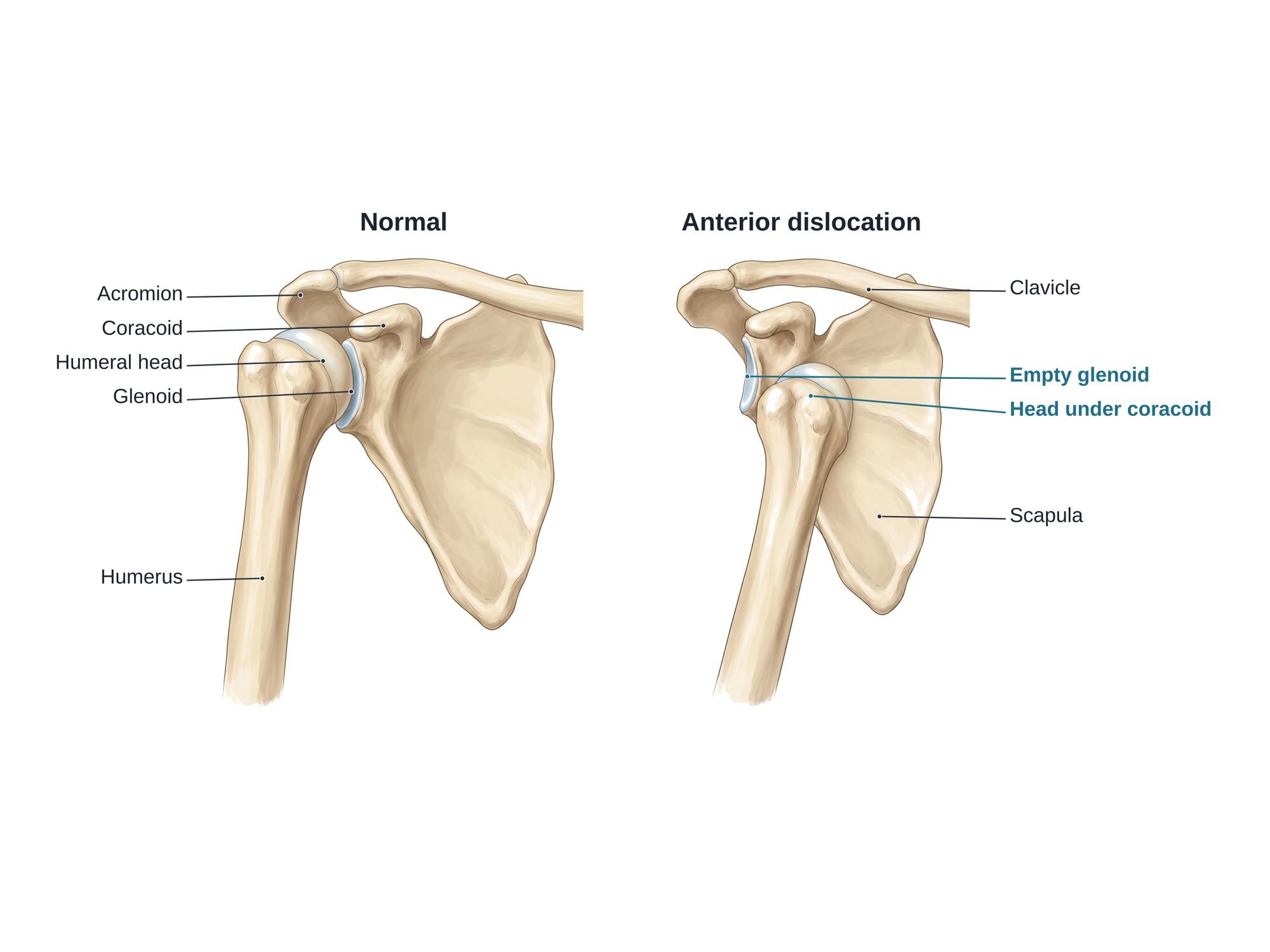
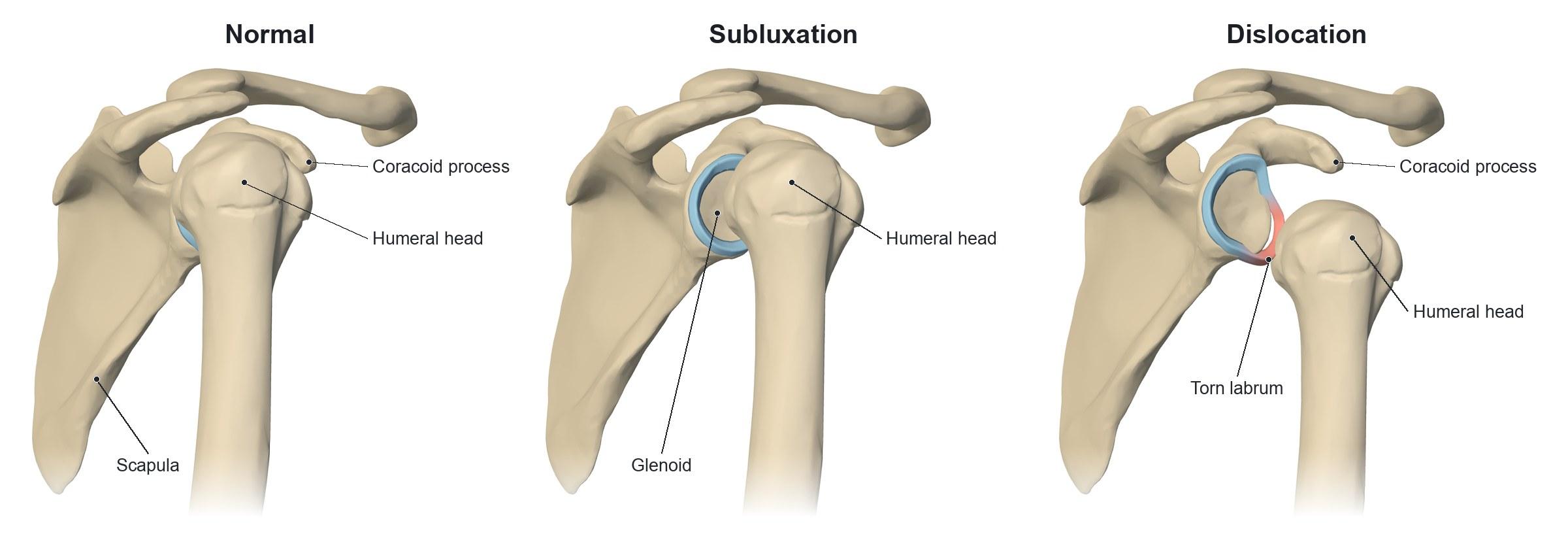
A subluxation is a partial dislocation of a joint. The two bones slip part of the way out of line, but their joint surfaces still touch. A dislocation is a full separation, where the joint surfaces no longer touch at all. Any joint can sublux, but the shoulder is the most common joint to slip out of place. In the shoulder (the glenohumeral joint), the round humeral head at the top of the upper arm bone sits against the glenoid, a shallow socket on the shoulder blade, a little like a golf ball on a tee. The labrum (a rim of cartilage), the joint capsule and the rotator cuff muscles hold the ball in place (see the shoulder anatomy page). In a study of young adults at West Point, subluxations made up 84.6% of shoulder instability events, and full dislocations the rest (Owens et al., 2007). The figure above shows a normal shoulder beside an anterior dislocation.
Subluxation vs dislocation
| Subluxation | Dislocation | |
|---|---|---|
| Joint surfaces | Still partly touching | Fully separated |
| Return to place | Often slips back by itself | Usually needs a doctor to reduce it |
| Typical feeling | A slip or clunk, then brief pain | Severe pain, the arm locked in one position |
| Shape of the shoulder | Often looks normal after | Squared-off shoulder, a bulge in front |
| Tissue damage | Stretched capsule, sometimes a labral tear | Torn capsule and labrum more often, bone injury possible |
Both are forms of shoulder instability, which means the ball does not stay centered in the socket. Both can stretch or tear the same tissues. A shoulder that has subluxed or dislocated once is more likely to do it again.
Types
Doctors describe a subluxation or dislocation by the direction the bone moves.
- Anterior. The humeral head moves forward. This is by far the most common type. In the West Point study, 80.3% of instability events were anterior (Owens et al., 2007). In the usual form, the head ends up in front of and below the glenoid, under the coracoid process, a bony part of the shoulder blade. This is called a subcoracoid dislocation, as in the figure.
- Posterior. The head moves backward. It is linked to seizures and electric shocks, when strong muscles pull the arm inward. It is easy to miss on a first exam.
- Inferior. The head moves straight down, with the arm stuck overhead. This is rare.
- Multidirectional. A loose joint slips in more than one direction, often in people with naturally lax ligaments.
Subluxation also happens in other joints. Examples include the kneecap (patellar subluxation), the elbow in toddlers (nursemaid's elbow), the hip in some babies (developmental dysplasia of the hip), the lens of the eye, and a tooth that is loosened by a blow. A vertebra that slips forward on the one below is called anterolisthesis, a form of spondylolisthesis.
Causes
Most shoulder subluxations and dislocations follow a force on an arm that is raised and turned outward. That position levers the head forward out of the socket.
- Falls, especially onto an outstretched hand
- Contact sports such as football, hockey, rugby and wrestling
- Car and motorcycle crashes
- Workplace accidents and falls from a height
- Seizures and electric shocks (posterior dislocation)
In the United States, about 23.9 shoulder dislocations per 100,000 people a year reach an emergency department (Zacchilli and Owens, 2010). In that study, 71.8% were in men, and the rate peaked between ages 20 and 29. Falls caused 58.8% of them.
A shoulder can also slip with little force once it is loose from an earlier injury. In people with a stroke, the shoulder can sag out of its socket because the muscles around it are weak.
Symptoms
- A sudden slip, shift or clunk in the shoulder
- Sharp pain that eases once the joint goes back in
- A dead arm feeling, brief numbness or weakness down the arm
- Fear of putting the arm in the same position again, called apprehension
- With a full dislocation: severe pain, a squared-off shoulder, a bulge in the front, and an arm held out slightly from the body and turned out
- Numbness over the outer shoulder if the axillary nerve is stretched
Diagnosis
The doctor asks how the injury happened and examines the shoulder. They check the pulse and feeling in the arm, because nerves and blood vessels run close to the joint. In a person with recurring subluxations, the apprehension test and the relocation test help. The arm is moved into the risky position. Fear or pain that eases when the doctor pushes the head back suggests anterior instability.
X-rays confirm a dislocation and show where the head sits. They also show fractures, such as a chip off the front of the glenoid (a bony Bankart lesion) or a dent in the back of the humeral head (a Hill-Sachs lesion). After a subluxation, the X-ray often looks normal because the joint has gone back in. An MRI, often with dye in the joint, shows a torn labrum, capsule or rotator cuff.
Treatment
- Reduction. A dislocated shoulder is put back into the socket, usually in the emergency department with pain relief or sedation. A subluxed shoulder has often gone back on its own.
- Check after reduction. The doctor rechecks nerves and blood flow and takes new X-rays.
- Sling. A short period in a sling eases pain. Long immobilization has not been shown to change the long-term result.
- Physical therapy. Exercises restore motion, then strengthen the rotator cuff and the muscles around the scapula.
- Surgery for a shoulder that keeps slipping or has bone loss. A Bankart repair reattaches the torn labrum and capsule to the glenoid, usually by arthroscopy. A Latarjet procedure moves a piece of the coracoid onto the front of the glenoid to rebuild lost bone.
Surgery is often offered sooner to young athletes because their risk of the shoulder slipping again is high. In a long-term Swedish study, almost half of people who had a first dislocation before age 25 went on to have stabilizing surgery (Hovelius and Rahme, 2016).
Recovery
After a simple subluxation, many people return to daily tasks in a few weeks. Return to contact sports usually takes about 6 to 12 weeks of rehab. A full dislocation takes longer. After surgery, the arm is often in a sling for about 4 to 6 weeks, and a full return to sport can take 4 to 6 months or more.
The biggest concern is recurrence. In a study of 252 patients aged 15 to 35 treated without surgery, 55.7% had further instability within two years of a first anterior dislocation (Robinson et al., 2006). That rose to 66.8% by five years. Young men had the highest risk.
Complications
- Recurrent instability, the shoulder slipping again with less force each time
- Labral tears, including a Bankart tear at the front of the socket and a SLAP tear at the top
- Bone injury, such as a Hill-Sachs lesion, a bony Bankart lesion, or a fracture of the greater tuberosity or proximal humerus
- Rotator cuff tears, more common in people over 40
- Axillary nerve injury, causing numbness over the outer shoulder and weakness lifting the arm
- Arthritis. In the Swedish study, 34% of shoulders had moderate to severe dislocation arthritis 25 years after a first dislocation (Hovelius and Rahme, 2016)
The torn ligaments and capsule are a kind of sprain. See sprain vs strain for how ligament and muscle injuries differ. Nerve stretch can leave burning or tingling pain, explained in nociceptive vs neuropathic pain.
Subluxation in chiropractic use
Many search results for "subluxation" come from chiropractors. In chiropractic care, a vertebral subluxation means a spinal joint they believe is stuck or not moving normally. It is not the same as a medical subluxation. A medical subluxation is a joint partly out of place, which can be measured on an X-ray. In medical records, a subluxation of the spine usually means a real shift of one vertebra on another, such as after a neck injury.
How subluxation is shown in a personal injury case
Subluxations and dislocations are common after car crashes, falls and workplace accidents. A subluxation can be hard for a jury to picture, because the joint is often back in place by the time of the X-ray. The record may say "normal X-ray" while the MRI shows a torn labrum or capsule. A medical illustration shows where the ball moved, which tissues were stretched or torn, and why the shoulder may keep slipping or wear out early. Normal and injured views side by side make the change easy to follow. For how these images are used at trial, see demonstrative evidence and medical legal illustration.
References
- Owens BD, Duffey ML, Nelson BJ, DeBerardino TM, Taylor DC, Mountcastle SB. The incidence and characteristics of shoulder instability at the United States Military Academy. Am J Sports Med. 2007.
- Zacchilli MA, Owens BD. Epidemiology of shoulder dislocations presenting to emergency departments in the United States. J Bone Joint Surg Am. 2010.
- Hovelius L, Rahme H. Primary anterior dislocation of the shoulder: long-term prognosis at the age of 40 years or younger. Knee Surg Sports Traumatol Arthrosc. 2016.
- Robinson CM, Howes J, Murdoch H, Will E, Graham C. Functional outcome and risk of recurrent instability after primary traumatic anterior shoulder dislocation in young patients. J Bone Joint Surg Am. 2006.
Related pages
- Shoulder anatomyThe normal anatomy of the shoulder.
- Rotator cuff tearA rotator cuff tear is a tear in the shoulder tendons that lift and turn the arm. Learn the types, symptoms, surgery and recovery.
- SLAP tearA SLAP tear is a tear of the top of the shoulder labrum where the biceps tendon attaches. Learn the types, symptoms, treatment and recovery.
FAQ
What is a joint subluxation?+
A subluxation is a partial dislocation. The two bones of a joint slip part of the way apart, but their joint surfaces still touch. Often the joint slips back into place on its own within seconds. In a full dislocation, the joint surfaces lose all contact.
What is an example of a subluxation?+
Common examples are a shoulder that slips forward and then pops back in during a tackle, a kneecap that slides toward the outside of the knee and returns, and nursemaid's elbow in young children. Each is a joint that partly comes out of place.
What is the difference between a subluxation and a dislocation?+
It is a matter of degree. In a subluxation, the joint surfaces still partly touch, and the joint often goes back by itself. In a dislocation, the surfaces are fully separated, and the joint usually stays out until a doctor puts it back, called a reduction.
Can a subluxation fix itself?+
The joint often slides back into place by itself. The torn or stretched ligaments and capsule still need time to heal. Rest, a short time in a sling or brace, and physical therapy help. Repeated subluxations can mean the joint has become unstable and may need surgery.
How long does it take to recover from a shoulder subluxation?+
Many people get back to daily activities in a few weeks. Return to sports usually takes about 6 to 12 weeks of physical therapy. Recovery is longer after a full dislocation, or after surgery to repair the labrum, which often takes 4 to 6 months.
Is a subluxation the same as a chiropractic subluxation?+
No. In medicine, a subluxation is a joint that has partly come out of place, which can be seen on an X-ray. Chiropractors also use the term vertebral subluxation for a spinal joint they believe is not moving normally. That is a different idea and is not a partial dislocation.
What does a shoulder subluxation feel like?+
People often describe a sudden slipping or shifting feeling, a clunk, and a sharp pain. The arm may feel numb or weak for a short time, sometimes called a dead arm. The pain usually eases once the joint settles back into place.
Do subluxations come back?+
They can. In young athletes, more than half of first-time shoulder dislocations lead to further instability within two years. The risk is highest in young men. Strength training helps, and surgery is an option when the shoulder keeps slipping.
Need this illustration for a patient or a case?
Describe the injury or upload a scan and get a clear, labeled medical illustration for a consult, a chart or a case exhibit.
Try Natomy →