Bankart Lesion: Types, Bony Bankart, Symptoms & Treatment
A Bankart lesion is a tear of the front lower labrum of the shoulder socket from a dislocation. Learn the types, bony Bankart, symptoms and treatment.
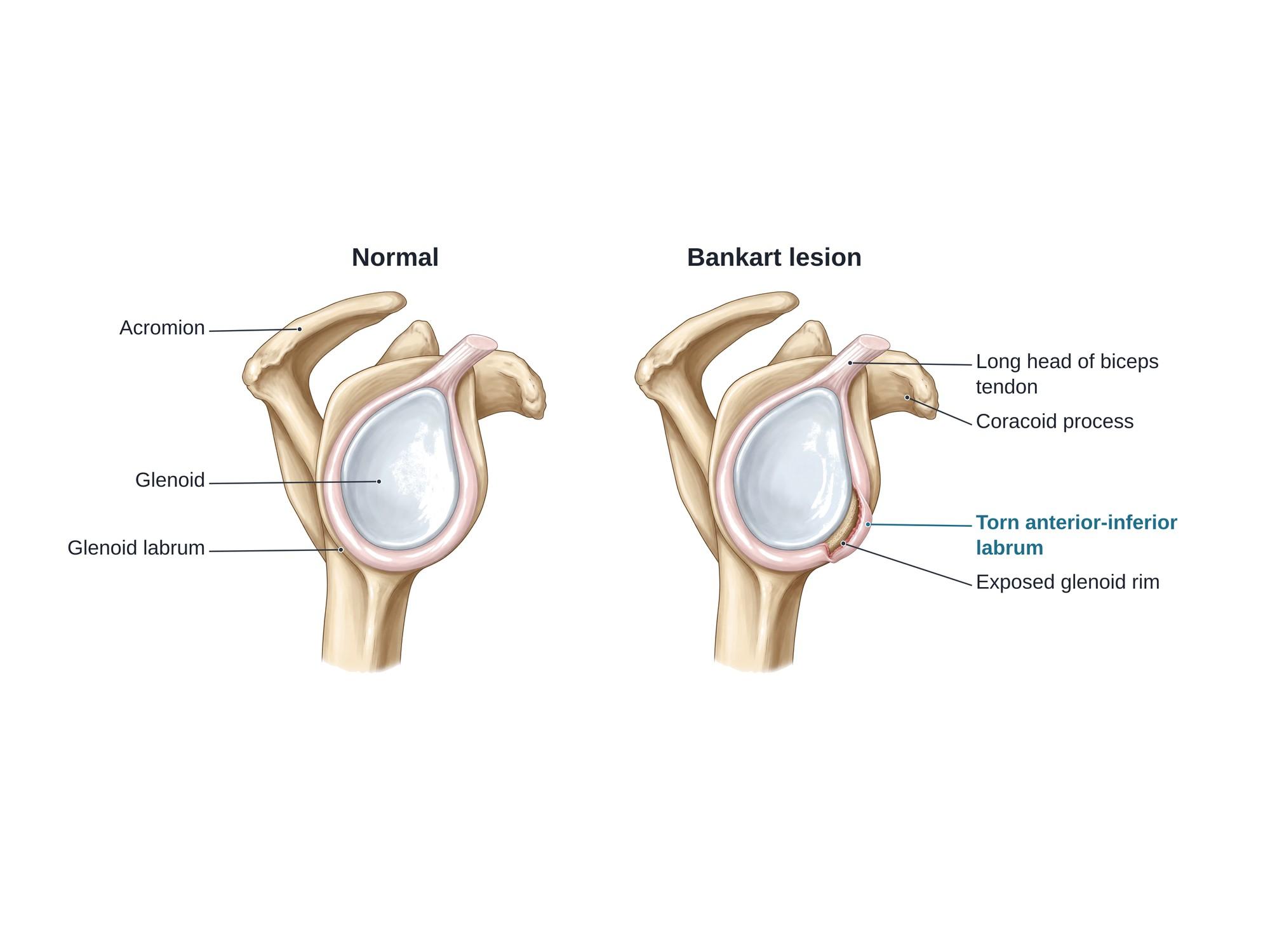
A Bankart lesion is a tear of the front lower part of the glenoid labrum, the ring of firm cartilage around the rim of the shoulder socket. It happens during an anterior shoulder dislocation, when the ball of the arm bone (the humeral head) is forced out the front of the socket and pulls the labrum off the bone. The socket, called the glenoid, is small and shallow. The labrum deepens it, and the inferior glenohumeral ligament attaches to the labrum at the front lower edge. When that part tears away, the shoulder loses one of its main restraints (see shoulder anatomy). A Bankart lesion is very common after a dislocation. In a review of 22 studies with 1,920 shoulders, it was found in 59% after a first dislocation and in 66% after repeat dislocations (Rutgers et al., 2022). The illustration above shows a normal labrum beside one with a Bankart lesion.
Types
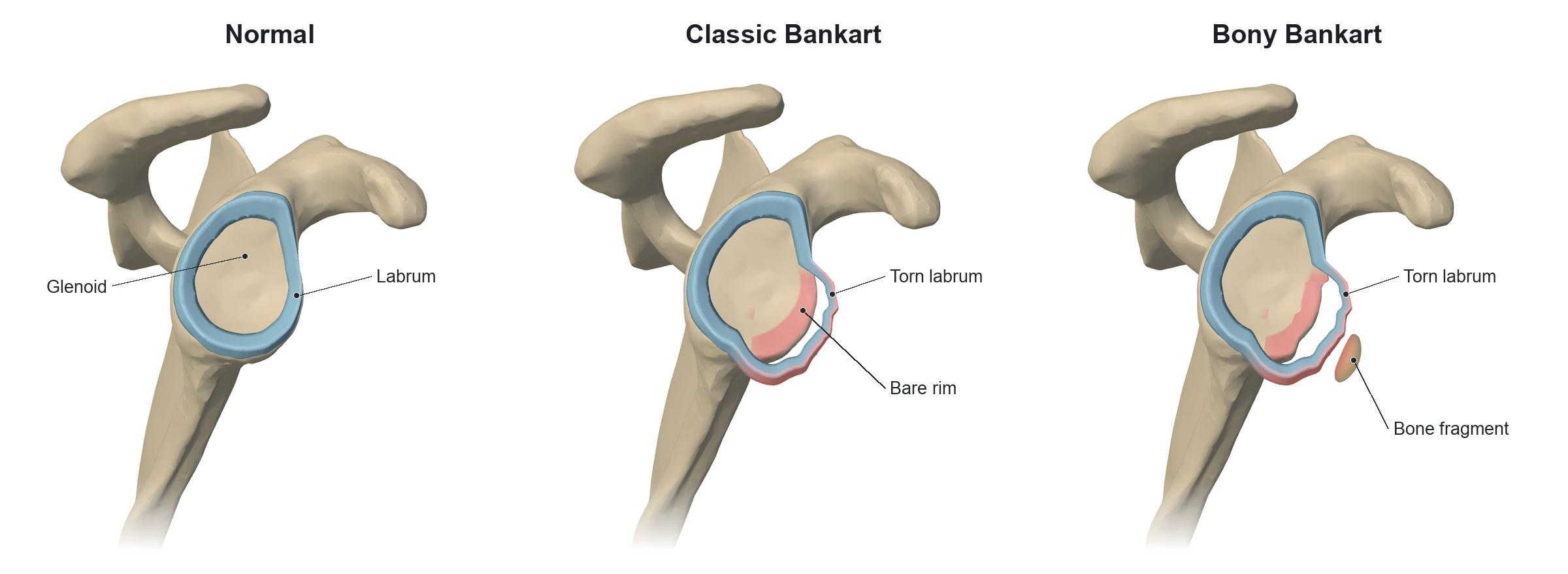
The classic Bankart lesion is a soft tissue tear. Doctors also name several variants by what tears and where it ends up.
| Type | What is torn | Why it matters |
|---|---|---|
| Classic Bankart | Labrum and ligament pulled off the front lower glenoid rim | The most common pattern; usually repaired with anchors |
| Bony Bankart | Labrum plus a piece of the glenoid rim breaks off | Narrows the socket; large pieces need surgery |
| Perthes lesion | Labrum torn off, but the lining of the bone (periosteum) stays intact | Labrum can look in place and be missed on MRI |
| ALPSA lesion | Labrum and periosteum peel off and heal lower down the glenoid neck | Higher risk of repeat dislocation after repair |
| GLAD lesion | Shallow labral tear with a flap of joint cartilage | Usually from a fall, not a dislocation; shoulder stays stable |
| Reverse Bankart | Back lower labrum torn | From a posterior dislocation; much rarer |
ALPSA stands for anterior labroligamentous periosteal sleeve avulsion. GLAD stands for glenolabral articular disruption.
Causes
A Bankart lesion is caused by the humeral head being forced out the front of the socket. The usual position is an arm that is raised, turned out and pushed backward. A tackle, a fall on an outstretched hand or a hard block can all do this. A partial slip, called a subluxation, can also tear the labrum.
Shoulder dislocations are common. A US study of emergency visits from 1997 to 2021 estimated about 1.9 million shoulder dislocations, a rate of about 25 per 100,000 people a year. In that study, 72% were in males and 53% were related to sports (Becker et al., 2024). Common settings include:
- Contact sports, such as football, rugby, hockey, wrestling and basketball
- Falls, from a ladder, on ice or down stairs
- Car, motorcycle and bicycle crashes
- Work injuries and assaults
- Seizures and electric shock, which more often cause a posterior dislocation and a reverse Bankart lesion
The same dislocation often dents the back of the humeral head, a Hill-Sachs lesion. A Bankart lesion and a Hill-Sachs lesion together are sometimes called a bipolar injury, since both sides of the joint are damaged.
Symptoms
- Sudden, severe shoulder pain at the time of injury
- A shoulder that looks squared off or out of place until it is put back
- Pain and bruising for several weeks after the joint is reduced
- A feeling that the shoulder may slip out (apprehension), mostly with the arm raised and turned out
- Clicking, catching or a "dead arm" feeling with overhead motion
- Weakness and a loss of trust in the shoulder during sports or lifting
- Repeat dislocations or subluxations, sometimes with small moves such as reaching or rolling over in bed
Diagnosis
- History and exam. The doctor asks how the shoulder came out and how many times. The apprehension test and relocation test check whether raising and turning out the arm makes the patient fear a dislocation, and whether pressing the ball back eases it. The doctor also checks the axillary nerve and blood flow to the arm.
- X-rays. These confirm the dislocation and that the joint is back in place. A bony Bankart lesion may show as a small chip of bone off the front lower rim of the glenoid. A soft tissue Bankart lesion does not show on X-ray.
- MRI or MR arthrogram. These are the main tests. In an MR arthrogram, dye is injected into the joint first. The dye runs into the gap between the labrum and the bone, which shows the tear clearly. MRI also shows the bone bruise of a Hill-Sachs lesion and other injuries such as a SLAP tear or a rotator cuff tear.
- CT scan. A 3D CT measures how much bone is missing from the front of the glenoid. This guides the choice of surgery.
Treatment
Putting the joint back in (reduction). A dislocated shoulder is put back in place first, usually in the emergency department with pain medicine or sedation.
Nonsurgical care. After a first dislocation, many people wear a sling for a short time, then do physical therapy. Therapy strengthens the rotator cuff and the muscles that steady the shoulder blade. This works best for older, less active adults. In young, active people the shoulder often comes out again. In a pooled analysis of 5 randomized trials of first-time dislocations, 47% of patients treated in a sling had the shoulder become unstable again, compared with 6% of those who had surgery (Belk et al., 2023).
Surgery is advised for repeat dislocations, young athletes in contact sports, and large bony Bankart lesions. Options include:
- Arthroscopic Bankart repair. Through small cuts, the surgeon roughens the bare glenoid rim and places small anchors in the bone. The anchor stitches tie the labrum and ligament back onto the rim and tighten the loose capsule.
- Bony Bankart fixation. A large rim fragment is pulled back into place with stitches or held with screws.
- Remplissage (French for "filling in"). Added when there is also a Hill-Sachs lesion. The infraspinatus tendon is stitched into the dent so it can no longer catch on the socket.
- Latarjet procedure. A piece of the coracoid process, a hook of bone on the front of the shoulder blade, is moved to the front of the glenoid and held with screws. It makes the socket wider and is used when a lot of glenoid bone is lost.
- Open Bankart repair. The same repair done through a larger cut, still used by some surgeons for revision surgery and collision athletes.
Recovery
- After a dislocation treated without surgery, a sling is often worn for a short time, then physical therapy follows for several weeks.
- After Bankart repair, a sling is usually worn for several weeks to protect the repair while the labrum heals to the bone.
- Physical therapy starts with gentle motion, then strengthening.
- Most people return to desk work within weeks. Heavy labor, throwing and contact sports usually take several months.
- Some loss of turning the arm out is common after surgery.
Complications
- Repeat dislocation, the main problem, with or without surgery. In a review of 4,582 shoulders after arthroscopic Bankart repair, glenoid bone loss made repeat instability about 2.4 times as likely. An off-track Hill-Sachs lesion made it about 3.2 times as likely (Verweij et al., 2021).
- Growing bone loss. In a study of 714 athletes followed for 4 years, a single dislocation or subluxation removed about 7% of the glenoid's width. In 5 of 6 shoulders with repeat events, a bony Bankart lesion was found (Dickens et al., 2019).
- Shoulder arthritis over time, more likely after many dislocations and after some repairs.
- Nerve injury at the time of dislocation, most often the axillary nerve, which powers the deltoid muscle.
- Associated injuries, such as a Hill-Sachs lesion, a SLAP tear, a rotator cuff tear in older adults, or a proximal humerus fracture.
- Stiffness and loss of motion after surgery.
Other shoulder injuries from the same kinds of falls and crashes include an AC joint separation, which affects the joint on top of the shoulder rather than the socket.
How a Bankart lesion is shown in a personal injury case
A Bankart lesion is a common finding after a shoulder dislocation from a car crash, a fall on a wet floor, a work accident or an assault. On MRI or MR arthrogram it is objective proof that the humeral head was forced out of the socket and tore tissue, not just strained a muscle. A bony Bankart lesion is a fracture and can also be seen on X-ray or CT. Because each dislocation can make the tear and bone loss worse, the number of dislocations and the imaging timeline matter when the cause is disputed. A Bankart lesion in a young, active person supports the need for surgery and the risk of future dislocations and arthritis. A medical illustration of a normal labrum beside a torn one helps a jury see what tore and why the shoulder keeps slipping out. For how these images are used at trial, see demonstrative evidence and medical legal illustration.
References
- Rutgers C, Verweij LPE, Priester-Vink S, et al. Recurrence in traumatic anterior shoulder dislocations increases the prevalence of Hill-Sachs and Bankart lesions: a systematic review and meta-analysis. Knee Surgery, Sports Traumatology, Arthroscopy. 2022;30(6):2130-2140.
- Becker B, Spadafore S, Oberle L, et al. Epidemiology of Shoulder Dislocation Treated at Emergency Departments in the United States Between 1997 and 2021. Orthopaedic Journal of Sports Medicine. 2024;12(3):23259671241234930.
- Belk JW, Wharton BR, Houck DA, et al. Shoulder Stabilization Versus Immobilization for First-Time Anterior Shoulder Dislocation: A Systematic Review and Meta-analysis of Level 1 Randomized Controlled Trials. American Journal of Sports Medicine. 2023;51(6):1634-1643.
- Verweij LPE, van Spanning SH, Grillo A, et al. Age, participation in competitive sports, bony lesions, ALPSA lesions, > 1 preoperative dislocations, surgical delay and ISIS score > 3 are risk factors for recurrence following arthroscopic Bankart repair: a systematic review and meta-analysis of 4584 shoulders. Knee Surgery, Sports Traumatology, Arthroscopy. 2021;29(12):4004-4014.
- Dickens JF, Slaven SE, Cameron KL, et al. Prospective Evaluation of Glenoid Bone Loss After First-time and Recurrent Anterior Glenohumeral Instability Events. American Journal of Sports Medicine. 2019;47(5):1082-1089.
Related pages
- Shoulder anatomyThe normal anatomy of the shoulder.
- AC joint separationAn AC joint separation is a tear of the ligaments that hold the collarbone to the shoulder blade. Learn the Rockwood types, symptoms, treatment and recovery.
- Brachial plexus injuryA brachial plexus injury damages the nerves from the neck to the arm. Learn the types, symptoms, treatment and recovery time.
- Frozen shoulderFrozen shoulder (adhesive capsulitis) is a painful, stiff shoulder from a thickened joint capsule. Learn the symptoms, 3 stages, causes, exercises and treatment.
- Rotator cuff tearA rotator cuff tear is a tear in the shoulder tendons that lift and turn the arm. Learn the types, symptoms, surgery and recovery.
- Shoulder impingementShoulder impingement is pinching of a rotator cuff tendon and bursa under the acromion. Learn the symptoms, causes, tests, exercises and treatment options.
- SLAP tearA SLAP tear is a tear of the top of the shoulder labrum where the biceps tendon attaches. Learn the types, symptoms, treatment and recovery.
- SubluxationA subluxation is a partial dislocation: a joint slips part way out of place. Learn subluxation vs dislocation in the shoulder.
- Thoracic outlet syndromeThoracic outlet syndrome is compression of the nerves or vessels at the base of the neck. Learn the symptoms, tests, physical therapy and surgery.
FAQ
Is a Bankart lesion the same as a labrum tear?+
A Bankart lesion is one kind of labrum tear. It is a tear of the front lower part of the labrum, the rim of cartilage around the shoulder socket, caused by the ball popping out the front. A SLAP tear is a different labrum tear at the top of the socket, where the biceps tendon attaches.
How is a Bankart lesion repaired?+
Most are repaired with keyhole (arthroscopic) surgery. The surgeon puts small anchors into the rim of the glenoid and uses their stitches to tie the torn labrum and ligament back onto the bone. When a lot of bone is missing from the socket, a Latarjet procedure or a bone graft is used instead.
What is a bony Bankart lesion?+
A bony Bankart lesion is a Bankart tear that breaks off a piece of the front lower rim of the glenoid along with the labrum. It is a small fracture of the socket. Large pieces leave the socket narrower and are more likely to need surgery.
What is the difference between a Bankart lesion and a Hill-Sachs lesion?+
They come from the same injury, an anterior shoulder dislocation. A Bankart lesion is on the socket side: the labrum is torn off the front of the glenoid. A Hill-Sachs lesion is on the ball side: a dent in the back of the humeral head. Many shoulders have both.
Can a Bankart lesion heal without surgery?+
The labrum often does not heal back in the right place on its own. Some people, mostly older and less active adults, do well with a sling and physical therapy. Young, active people have a high chance of dislocating again without surgery. In 5 trials, 47% of people treated in a sling had the shoulder become unstable again, compared with 6% after surgery.
Does a reverse Bankart tear need surgery?+
Not always. A reverse Bankart lesion is a tear of the back lower labrum after a posterior dislocation. Many are treated first with physical therapy. Surgery to repair the back of the labrum is advised when the shoulder keeps slipping out the back or pain does not settle.
How long does recovery from Bankart repair take?+
A sling is usually worn for several weeks after surgery. Physical therapy then restores motion and strength over a few months. Most people return to light work within weeks, while throwing and contact sports usually take several months.
Can a Bankart lesion get worse?+
Yes. Each new dislocation can tear the labrum further and wear away more bone from the front of the glenoid. In a study of athletes, a single dislocation or subluxation removed about 7% of the glenoid's width, and shoulders with repeat events had lost much more.
Need this illustration for a patient or a case?
Describe the injury or upload a scan and get a clear, labeled medical illustration for a consult, a chart or a case exhibit.
Try Natomy →