AC Joint Separation: Types, Symptoms & Treatment
An AC joint separation is a tear of the ligaments that hold the collarbone to the shoulder blade. Learn the Rockwood types, symptoms, treatment and recovery.
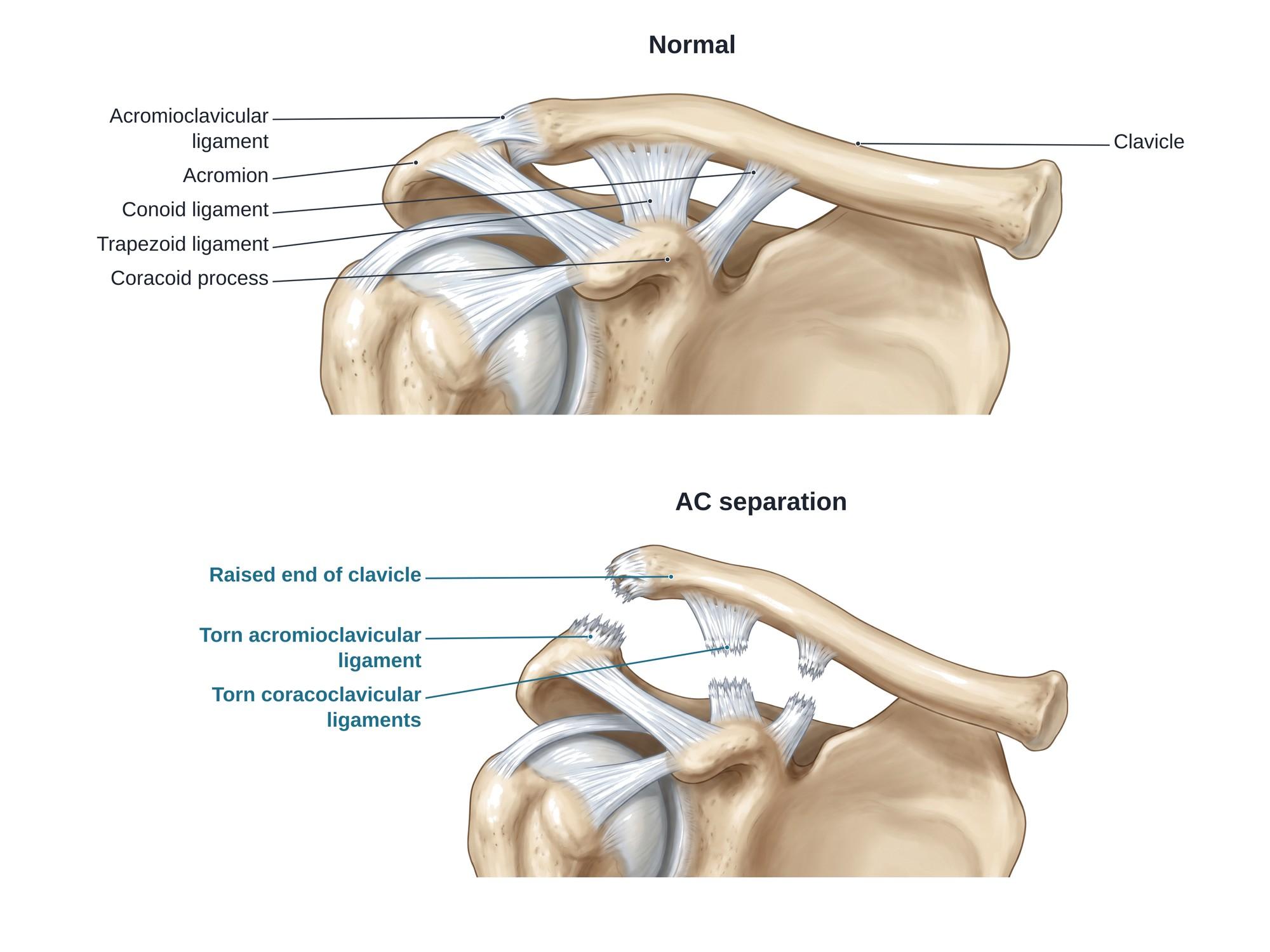
An AC joint separation, or separated shoulder, is an injury to the ligaments that hold the collarbone (clavicle) to the shoulder blade (scapula). The acromioclavicular (AC) joint sits on top of the shoulder, where the outer end of the clavicle meets the acromion, the flat bony roof of the shoulder blade (see shoulder anatomy). Two sets of ligaments keep it steady. The acromioclavicular ligament wraps the joint itself. The stronger coracoclavicular ligaments (the trapezoid and conoid ligaments) tie the clavicle down to the coracoid process, a hook of bone on the front of the shoulder blade. In a separation these ligaments stretch or tear, and the shoulder drops away from the clavicle, so the end of the clavicle sticks up. In a study of 2,650 shoulder injuries in Oslo, 11% involved the AC joint, a rate of about 45 per 100,000 people a year (Skjaker et al., 2021). The illustration above shows a normal AC joint above a complete separation.
Grades
Doctors grade an AC joint separation with the Rockwood classification. It is based on which ligaments are torn and which way, and how far, the clavicle moves. On X-ray, the key measure is the coracoclavicular distance, the gap between the coracoid and the underside of the clavicle.

- What is torn
- AC ligament sprained; coracoclavicular ligaments intact
- What happens to the clavicle
- No shift; X-rays look normal
- What is torn
- AC ligament torn; coracoclavicular ligaments sprained
- What happens to the clavicle
- Clavicle end rides slightly higher than the acromion
- What is torn
- AC and coracoclavicular ligaments both torn
- What happens to the clavicle
- Clavicle end sits above the acromion; the coracoclavicular gap is clearly wider
- What is torn
- Both ligament groups torn
- What happens to the clavicle
- Clavicle is pushed backward into or through the trapezius muscle
- What is torn
- Both ligament groups torn, plus the muscle covering over the joint
- What happens to the clavicle
- Clavicle sits very high, just under the skin; the gap is up to several times normal
- What is torn
- Both ligament groups torn
- What happens to the clavicle
- Clavicle is driven down under the acromion or coracoid (very rare)
Types I and II are called low-grade injuries. Types III to VI are high-grade injuries.
Causes
Most AC joint separations come from a direct blow to the top of the shoulder with the arm at the side. The acromion is driven down, and the clavicle stays up. A fall on an outstretched hand or elbow can also push the joint apart from below. Common settings include:
- Falls onto the shoulder, from a bike, a ladder, on ice or from standing
- Bicycle and motorcycle crashes, where the rider lands on the point of the shoulder
- Contact sports, such as football, hockey, rugby and wrestling
- Skiing, snowboarding and martial arts
- Car crashes and work injuries
AC joint injuries are mostly an injury of young, active men. In the Oslo study, the median age was 32, and 82% of patients were men. Sports caused 53% of AC joint injuries, and football (soccer) and cycling were the most common sports (Skjaker et al., 2021). In a Swedish study of 158 adults, traffic accidents and older age raised the risk of a high-grade separation, and 85 of the 158 injuries were high-grade (Nordin et al., 2020).
Symptoms
- Sudden pain on top of the shoulder at the time of the fall
- Swelling and bruising over the AC joint
- A bump or step on top of the shoulder, where the end of the clavicle sticks up (type II and higher)
- Pain when lifting the arm overhead or reaching across the chest
- Tenderness when pressing on the AC joint
- Pain when lying on the injured side
- A shoulder that looks lower than the other side in high-grade injuries
- In type IV, pain at the back of the shoulder, with the clavicle pushed backward
Diagnosis
- History and exam. The doctor asks how the fall happened and presses on the AC joint. The cross-body adduction test brings the arm across the chest. Pain on top of the shoulder points to the AC joint. The doctor also checks the neck, the nerves and the blood flow of the arm.
- X-rays. These are the main test. A front view aimed at the AC joint (the Zanca view) shows how high the clavicle sits and the coracoclavicular distance. Doctors often X-ray both shoulders to compare. An axillary view, taken from below the armpit, shows a type IV clavicle pushed backward. X-rays also rule out a fracture of the clavicle, the acromion or the coracoid.
- MRI. Not needed for most separations. It can show the torn ligaments and other shoulder injuries, such as a rotator cuff tear or a SLAP tear.
An AC separation is a different injury from a shoulder dislocation. In a dislocation, the ball of the arm bone comes out of the socket (the glenohumeral joint), which can tear the labrum (a Bankart lesion) or dent the humeral head (a Hill-Sachs lesion). A partial slip of the AC joint, as in a type II injury, is a kind of subluxation.
Treatment
Types I and II are treated without surgery. Care includes ice, pain medicine and a sling for comfort, usually for a few days to 2 weeks. Gentle motion starts as soon as the pain allows, followed by physical therapy to rebuild strength.
Type III is the type doctors debate. Most are now treated without surgery first. In a trial of 85 patients with acute type III separations, shoulder function at 2 years was the same with or without surgery. Surgery led to a slower recovery, and 17% of surgical patients needed a second operation. Only 3% of the nonsurgical group later needed surgery to stabilize the joint (Tauber et al., 2023). Surgery may still be offered to heavy laborers, overhead athletes, or people whose shoulder stays painful or weak after several months of therapy.
Types IV, V and VI usually need surgery. The goal is to put the clavicle back in line with the acromion and hold it there while the ligaments heal. Common options are:
- Suture button fixation. Strong sutures run through small holes in the clavicle and coracoid, held by metal buttons. It is often done with an arthroscope (a small camera).
- Hook plate. A metal plate is screwed to the clavicle, with a hook that slides under the acromion to hold the clavicle down. The plate is usually removed after the ligaments heal. This is a form of ORIF (open reduction and internal fixation).
- Ligament reconstruction. For older (chronic) injuries, a tendon graft is looped around the coracoid and through the clavicle to rebuild the coracoclavicular ligaments.
Recovery
- Type I: pain usually eases within a couple of weeks, and most people return to normal use soon after.
- Type II: usually several weeks before sports or heavy lifting.
- Type III without surgery: often a few months before full sports. A bump on the shoulder usually stays.
- After surgery: a sling for several weeks, then physical therapy. Heavy lifting and contact sports usually wait several months.
- Most people regain good shoulder function. Some keep mild pain with overhead work or push-ups.
Complications
- A lasting bump on top of the shoulder, common after type II and higher injuries
- Ongoing pain or weakness, mostly with overhead lifting, push-ups and bench press
- AC joint arthritis and distal clavicle osteolysis (wearing away of the end of the clavicle) months or years later
- Shoulder blade problems (scapular dyskinesis), where the shoulder blade moves abnormally and causes fatigue
- Loss of reduction after surgery, where the clavicle drifts back up. In a study of 36 patients treated with a suture button device, 25% lost more than 3 mm of the correction, and these patients had worse AC joint scores (Çarkçı et al., 2020).
- Surgical complications, such as infection, hardware irritation, a fracture through a drill hole in the clavicle or coracoid, and the need for hook plate removal
How an AC joint separation is shown in a personal injury case
AC joint separations are common in bike and motorcycle crashes, car crashes, falls on wet floors or stairs, and work injuries. X-rays give objective proof of a high-grade injury. The raised clavicle and the wider coracoclavicular gap can be measured and compared with the uninjured side. The Rockwood type helps explain why one patient healed with a sling and another needed surgery, a hook plate removal, or long physical therapy. A lasting bump, pain with overhead work and later arthritis can support claims of permanent impairment and future care. A medical illustration of a normal AC joint compared with a separated one helps a jury see which ligaments tore and why the collarbone now sticks up. For how these images are used at trial, see demonstrative evidence and medical legal illustration.
References
- Skjaker SA, Enger M, Engebretsen L, et al. Young men in sports are at highest risk of acromioclavicular joint injuries: a prospective cohort study. Knee Surgery, Sports Traumatology, Arthroscopy. 2021;29(7):2039-2045.
- Nordin JS, Olsson O, Lunsjö K. Acromioclavicular joint dislocations: incidence, injury profile, and patient characteristics from a prospective case series. JSES International. 2020;4(2):246-250.
- Tauber M, Hoffelner T, Lehmann L, et al. Prospective Multicenter Randomized Controlled Trial of Surgical Versus Nonsurgical Treatment for Acute Rockwood Type 3 Acromioclavicular Injury. Orthopaedic Journal of Sports Medicine. 2023;11(8):23259671231190411.
- Çarkçı E, Polat AE, Gürpınar T. The frequency of reduction loss after arthroscopic fixation of acute acromioclavicular dislocations using a double-button device, and its effect on clinical and radiological results. Journal of Orthopaedic Surgery and Research. 2020;15(1):136.
Related pages
- Shoulder anatomyThe normal anatomy of the shoulder.
- Bankart lesionA Bankart lesion is a tear of the front lower labrum of the shoulder socket from a dislocation. Learn the types, bony Bankart, symptoms and treatment.
- Brachial plexus injuryA brachial plexus injury damages the nerves from the neck to the arm. Learn the types, symptoms, treatment and recovery time.
- Frozen shoulderFrozen shoulder (adhesive capsulitis) is a painful, stiff shoulder from a thickened joint capsule. Learn the symptoms, 3 stages, causes, exercises and treatment.
- Rotator cuff tearA rotator cuff tear is a tear in the shoulder tendons that lift and turn the arm. Learn the types, symptoms, surgery and recovery.
- Shoulder impingementShoulder impingement is pinching of a rotator cuff tendon and bursa under the acromion. Learn the symptoms, causes, tests, exercises and treatment options.
- SLAP tearA SLAP tear is a tear of the top of the shoulder labrum where the biceps tendon attaches. Learn the types, symptoms, treatment and recovery.
- SubluxationA subluxation is a partial dislocation: a joint slips part way out of place. Learn subluxation vs dislocation in the shoulder.
- Thoracic outlet syndromeThoracic outlet syndrome is compression of the nerves or vessels at the base of the neck. Learn the symptoms, tests, physical therapy and surgery.
FAQ
Will an AC joint separation heal on its own?+
Most do. Type I and II separations heal with rest, a sling for a short time and physical therapy. Many type III separations also do well without surgery. The torn ligaments heal with scar tissue, but a bump on top of the shoulder often stays, even when the shoulder works well.
How do you know if your AC joint is separated?+
The usual signs are pain right on top of the shoulder after a fall onto it, swelling, and a bump where the collarbone meets the shoulder blade. Lifting the arm overhead or reaching across the chest hurts. A doctor confirms it with an exam and X-rays, sometimes comparing both shoulders.
How do they fix a separated AC joint?+
Most separations are treated without surgery. When surgery is needed, usually for type IV, V and VI injuries, the surgeon puts the clavicle back in line and holds it down. Common methods are a suture button device that loops the clavicle to the coracoid, a hook plate, or a tendon graft that rebuilds the coracoclavicular ligaments.
Is a separated shoulder the same as a dislocated shoulder?+
No. A separated shoulder is an injury to the AC joint, where the collarbone meets the top of the shoulder blade. A dislocated shoulder is when the ball of the arm bone comes out of the socket (the glenohumeral joint). A dislocation can cause a Bankart lesion or a Hill-Sachs lesion; a separation does not.
How to sleep with an AC joint separation?+
Most people sleep best on their back or on the uninjured side, with a pillow under the injured arm. Some sleep propped up in a recliner for the first week or two. Lying on the injured shoulder presses on the AC joint and usually hurts until it heals.
How long does an AC joint separation take to heal?+
A type I separation often feels better within a couple of weeks. A type II usually takes several weeks. A type III treated without surgery often takes a few months before full sports. After surgery, a sling is used for several weeks, and return to contact sports usually takes several months.
Will the bump on my shoulder go away?+
Often it does not. In a type II or higher separation, the end of the clavicle stays raised after the ligaments heal. The bump is usually a cosmetic issue and does not mean the shoulder is weak. Surgery can lower it, but surgery is not done for the bump alone in most cases.
Can an AC joint separation cause arthritis?+
Yes. Damage to the joint surfaces can lead to arthritis of the AC joint months or years later. It causes pain on top of the shoulder with overhead lifting and reaching across the body. If it does not settle with rest, injections or therapy, a surgeon can remove a small piece of the end of the clavicle.
Need this illustration for a patient or a case?
Describe the injury or upload a scan and get a clear, labeled medical illustration for a consult, a chart or a case exhibit.
Try Natomy →