Schmorl Node: Causes, Symptoms & Treatment
A Schmorl node is disc material pushed up or down through the vertebral endplate into the bone. See it beside a normal disc, with causes and treatment.
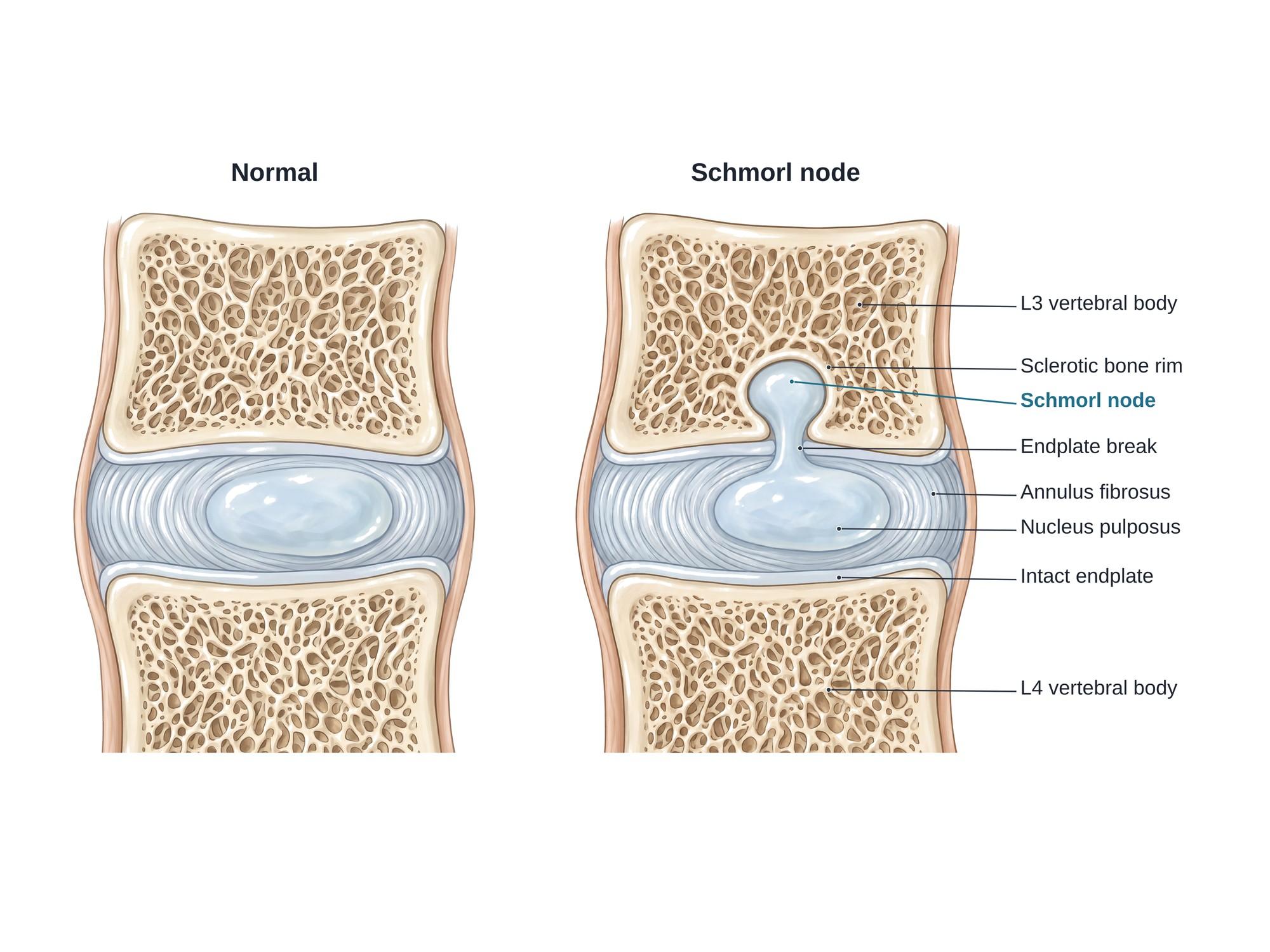
A Schmorl node is disc material that has pushed up or down through the vertebral endplate into the spongy bone of the vertebral body. It is a vertical herniation of the disc, into the bone instead of toward the nerves. Schmorl nodes are very common in the lumbar and lower thoracic spine. Most cause no symptoms and are found by chance on imaging. A new node can cause back pain for a while. The illustration above shows a normal L3-L4 disc beside a Schmorl node in the lower endplate of L3.
The anatomy
Each intervertebral disc has a tough outer ring, the annulus fibrosus, and a soft gel center, the nucleus pulposus. Above and below the disc are the endplates. Each endplate is a thin layer of cartilage over a thin plate of bone. The endplate holds the disc in place and lets nutrients pass into it. Behind the endplate is the cancellous bone of the vertebral body, a sponge of bone struts filled with marrow. When the endplate is weak, pressure in the nucleus can push it through. For the full anatomy, see lumbar spine anatomy.
Types
| Type | What it looks like | What it usually means |
|---|---|---|
| Chronic (old) | A small, well-defined dent with a thin rim of dense, sclerotic bone | Common, stable, usually painless |
| Acute (new) | A node with swelling (bone marrow edema) in the bone around it | Recent, can be painful for weeks to months |
| Giant | A large node, sometimes more than a third of the endplate | Rare, can weaken the vertebral body |
| Multiple | Nodes at several levels, often in the thoracic spine | Seen with Scheuermann disease and disc degeneration |
Causes
- Weak spots in the endplate: small gaps left from development, such as old blood vessel channels or notochord remnants.
- Disc degeneration: wear of the disc and endplate with age. Schmorl nodes are often found with other degenerative changes, such as bone spurs on the spine.
- Axial load: a sudden vertical force through the spine, such as a fall onto the buttocks, a jump from a height, or a heavy lift.
- Weak bone: osteoporosis, and less often bone disease such as Paget disease, infection or tumor.
- Scheuermann disease: a growth disorder of the thoracic spine in teenagers, with wedged vertebrae and many nodes.
- Genetics: family studies show that a tendency to Schmorl nodes is partly inherited.
Symptoms
- Usually none, especially for old nodes
- Deep, central back pain at the level of a new node
- Pain that is worse with standing, bending or lifting
- Tenderness when the spine at that level is pressed
Schmorl nodes rarely press on a nerve root. Leg pain, numbness or weakness points to another problem, such as a herniated disc or spinal stenosis.
Diagnosis
Schmorl nodes are usually found on imaging done for back pain or another reason. On X-ray, a node shows as a small notch in the endplate, often with a dense, sclerotic edge. CT shows the bony defect and its rim clearly. MRI shows the disc material inside the bone. MRI also shows bone marrow edema, swelling in the marrow around a new node. Edema usually means the node is recent and may be the source of pain. Related signal changes in the bone next to the endplate are called Modic changes. Doctors also make sure the finding is not a fracture, an infection or a tumor.
Treatment
- No treatment: for nodes found by chance without symptoms.
- Activity changes: a short break from heavy lifting and impact.
- Medicines: anti-inflammatories and short courses of other pain medicine.
- Physical therapy: core strengthening and posture work.
- Vertebroplasty: bone cement injected into the vertebral body, for a rare node that stays painful for months. It is similar to the cement step in treating a compression fracture.
- Surgery: very rarely, a fusion when a giant node weakens the vertebra or pain does not settle.
Recovery
Pain from a new Schmorl node usually improves over several weeks to a few months. The bone marrow swelling fades as the bone heals. The node itself stays, usually as a small dent with a sclerotic rim. Most people return to normal activity.
Complications
- Persistent back pain from an acute node
- Faster wear of the disc at that level (disc degeneration), since the disc loses some of its nucleus
- Weakening or collapse of the vertebral body with a giant node
- Rarely, being confused with a fracture, infection or tumor on imaging
How Schmorl nodes are shown in a personal injury case
Schmorl nodes often appear on spine imaging taken after a car crash or a fall. The defense usually argues they are old, degenerative findings that were there before the injury. The plaintiff may argue a node is new, or that an old one was made painful. Bone marrow edema around a node on MRI suggests a recent injury, and comparison with any earlier imaging is often decisive. A side section illustration like the one above shows the jury what a Schmorl node is: disc material inside the bone, not a pinched nerve. For how these images are used at trial, see demonstrative evidence and medical legal illustration.
Related pages
- Lumbar spine anatomyThe normal anatomy of the lumbar spine.
- Annular tearAn annular tear is a crack in the tough outer ring of a spinal disc, a common MRI finding in back pain cases. See it illustrated beside a normal disc.
- AnterolisthesisAnterolisthesis is a vertebra slipped forward over the one below, most often L4 on L5. See it illustrated beside normal anatomy.
- Facet arthropathyFacet arthropathy is arthritis of the small joints at the back of the spine, most often at L4-L5 and L5-S1. See it illustrated beside normal facet joints.
- Foraminal stenosisForaminal stenosis is narrowing of the opening where a nerve root leaves the spine, often at L4-L5 or L5-S1. See it illustrated beside normal anatomy.
- Lumbar disc herniationA herniated disc is disc gel pushed through a tear in its outer ring, often pressing on a nerve root. See protrusion, extrusion and sequestration illustrated.
- Modic changesModic changes are endplate and bone marrow changes next to a worn disc, seen on MRI as type 1, 2 or 3. See each type beside a normal spine.
- Spinal osteophytesOsteophytes are bone spurs that grow on the vertebrae as the spine wears with age. See them illustrated beside a normal lumbar spine.
- SpondylolisthesisSpondylolisthesis is a vertebra that has slipped forward over the one below, often L5 on S1 after a pars fracture. See it illustrated beside normal anatomy.
FAQ
What is a small Schmorl node?+
A small Schmorl node is a shallow dent where a little disc material has pushed into the endplate of a vertebra. Small nodes are very common on spine imaging. Most cause no symptoms and need no treatment. They are usually reported as an incidental finding.
Are Schmorl nodes dangerous?+
Usually not. Most are old, stable and painless. A new node can be painful for weeks to months while the bone around it is inflamed. Doctors also make sure the finding is not a fracture, infection or tumor, which can look similar on some scans.
What causes a Schmorl node?+
Pressure on the disc pushes nucleus pulposus through a weak spot in the endplate. Weak spots can be present from development, or come from disc degeneration, osteoporosis or other bone disease. A sudden axial load, such as a fall onto the buttocks or a heavy lift, can also cause one.
What are the symptoms of a Schmorl node?+
Most cause none. An acute node can cause deep, central back pain at that level. The pain is often worse with standing, bending or lifting. Schmorl nodes do not usually pinch a nerve root, so leg pain points to another problem, such as a disc herniation.
Do Schmorl nodes go away?+
The dent in the bone usually stays for life, but the pain from a new node often settles over weeks to months. The swelling in the bone marrow around an acute node fades as the bone heals and forms a sclerotic rim.
How are Schmorl nodes treated?+
Most need no treatment. A painful node is treated like other back pain: activity changes, anti-inflammatory medicine and physical therapy. Rarely, a node that stays painful for months is treated with vertebroplasty (bone cement) or, very rarely, surgery.
Is a Schmorl node a disability?+
On its own, rarely. Most people with Schmorl nodes work and live normally. Disability claims usually depend on the overall spine condition, such as degenerative disc disease, and on proven loss of function, not on the node itself.
Can a car accident cause a Schmorl node?+
A strong vertical load on the spine can cause a new, painful node. Most nodes seen after a crash are old, though. Bone marrow swelling around the node on MRI points to a recent one, and comparing with any earlier imaging helps tell new from old.
Need this illustration for a patient or a case?
Describe the injury or upload a scan and get a clear, labeled medical illustration for a consult, a chart or a case exhibit.
Try Natomy →