Anterolisthesis: Grades, Causes & Treatment, Illustrated
Anterolisthesis is a vertebra slipped forward over the one below, most often L4 on L5. See it illustrated beside normal anatomy.
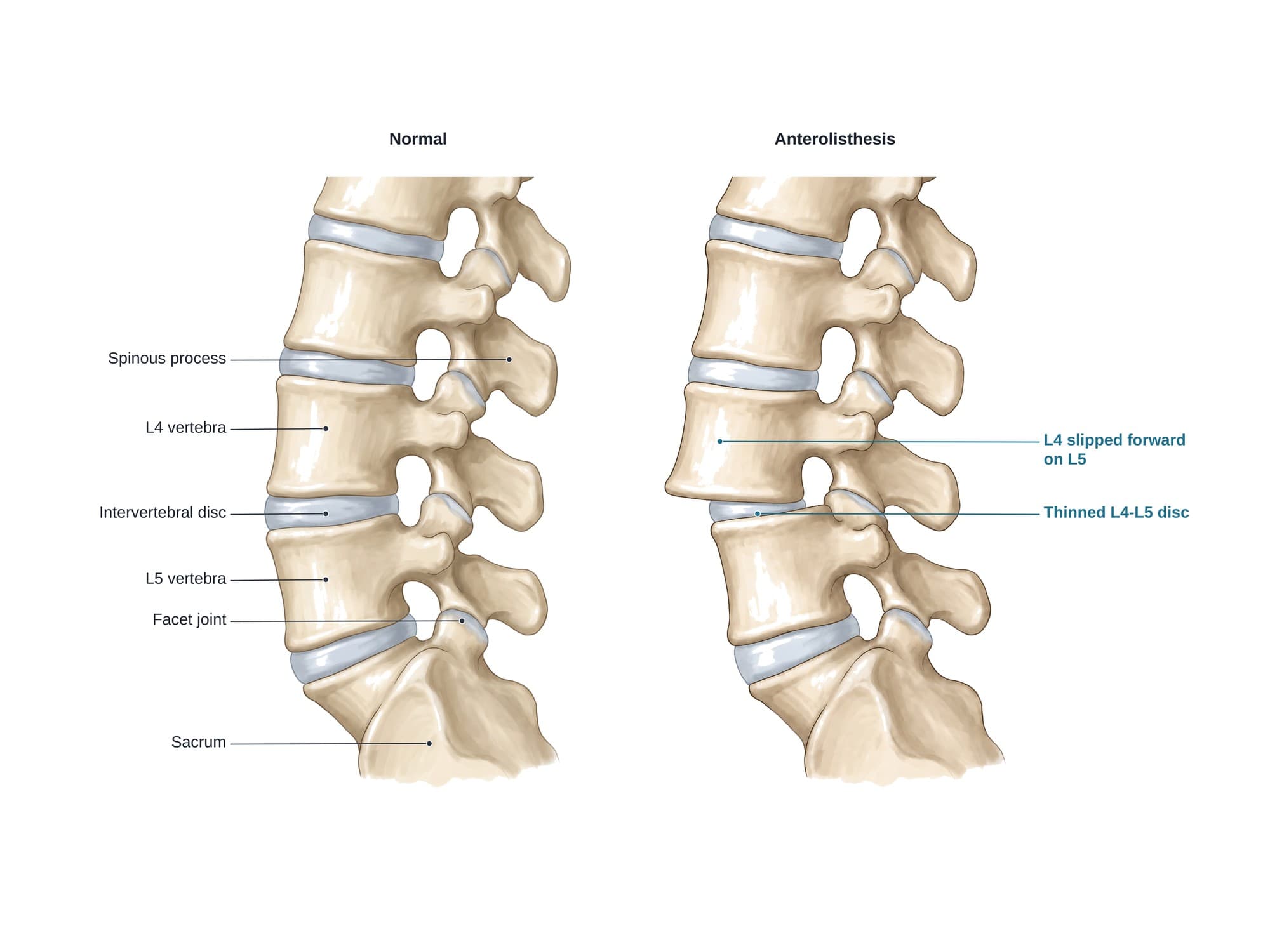
Anterolisthesis is a forward slip of one vertebra over the vertebra below it. It is most common in the lower back, especially L4 on L5 and L5 on S1. The slip is graded by how far the upper vertebra has moved, from grade I (less than a quarter of the vertebral body) to grade IV. Many people have no symptoms, but a slip can narrow the spinal canal and the nerve openings, causing back pain and leg pain. The illustration above shows a normal lower lumbar spine beside grade II anterolisthesis of L4 on L5.
The anatomy
Each lumbar vertebra has a solid vertebral body in front and a ring of bone behind it that encloses the spinal canal. Behind the body, paired facet joints link each vertebra to the next and stop it from sliding forward. The intervertebral disc sits between the bodies and cushions them. The pars interarticularis is the narrow bridge of bone between the upper and lower facets. When the facets wear out or the pars breaks, the vertebra can slide forward. For the full anatomy, see lumbar spine anatomy.
Grades
The Meyerding grade measures how far the upper vertebral body has moved forward, as a share of the depth of the body below:
| Grade | Slip | What it usually means |
|---|---|---|
| I | Up to 25% | Common, often without symptoms |
| II | 25% to 50% | Can narrow the canal and nerve openings |
| III | 50% to 75% | High grade, more often needs surgery |
| IV | 75% to 100% | High grade |
| V (spondyloptosis) | More than 100% | The vertebra has slipped completely off the one below |
Causes
- Degenerative: wear of the facet joints and disc with age lets the vertebra drift forward with the pars intact. This is the usual cause in adults over 50, most often at L4-L5, and is more common in women.
- Isthmic: a stress fracture or defect of the pars interarticularis (spondylolysis) lets the vertebral body slide forward while the back of the arch stays behind. It often starts in adolescence, usually at L5-S1, and is linked to sports with repeated back arching such as gymnastics and football.
- Traumatic: a fracture of the posterior elements from a high-energy injury.
- Dysplastic: a congenital abnormality of the facets.
- Pathologic: bone weakened by tumor or infection.
- Iatrogenic: instability after earlier spine surgery that removed bone.
Symptoms
- Low back pain, often worse with standing, walking or arching back
- Stiffness and tight hamstrings
- Pain, numbness or tingling in the buttocks and legs (sciatica) when a nerve root is pinched
- Leg heaviness or cramping with walking that eases when sitting or leaning forward (neurogenic claudication from spinal stenosis)
- Rarely, weakness or changes in bladder or bowel control, which need urgent care
Diagnosis
A doctor examines posture, movement, strength, reflexes and sensation in the legs. The slip is seen on a side view X-ray of the lumbar spine: the back edge of the upper vertebral body sits in front of the back edge of the one below, and the distance is measured to give the grade. Flexion and extension X-rays, taken bending forward and back, show whether the slip moves (instability). Oblique views or CT show a pars defect. MRI shows the discs, the narrowed spinal canal and any pinched nerve roots.
Treatment
- Activity changes and short rest from aggravating movements
- Physical therapy: core strengthening, flexion exercises and hamstring stretching
- Medicines: anti-inflammatories and short courses of other pain medicine
- Epidural steroid injections for leg pain from nerve compression
- Bracing, mainly for adolescents with a fresh pars stress fracture
- Surgery: decompression to free the nerves, usually with spinal fusion using screws and rods (and often a spacer in the disc space) to stop the slip from moving. It is considered for high-grade slips, progressive nerve problems, or pain that fails months of treatment.
Recovery
Most people with a low-grade slip improve with several weeks to a few months of physical therapy. After decompression and fusion, walking starts within a day or two; desk work often resumes in about 4 to 8 weeks, and the fusion usually takes 6 to 12 months to become solid.
Complications
- Progression of the slip
- Spinal stenosis and chronic nerve compression
- Persistent back or leg pain
- A herniated disc at the same or a nearby level, which can add to nerve compression
- After fusion: nonunion, hardware problems, and extra wear at the levels above or below (adjacent segment disease)
How anterolisthesis is shown in a personal injury case
Anterolisthesis often comes up after car crashes and falls, where the question is whether the slip was caused or made worse by the injury, or was already there. Degenerative slips are common in older adults, so comparing earlier and later imaging, and flexion and extension views that show new instability, matters. A side view illustration like the one above makes the slip, the thinned disc and the narrowed space for the nerves easy for a jury to see. For how these images are used at trial, see demonstrative evidence and medical legal illustration.
Related pages
FAQ
Is anterolisthesis the same as spondylolisthesis?+
Anterolisthesis is the most common kind of spondylolisthesis. Spondylolisthesis means any slip of one vertebra on another; anterolisthesis is a slip forward. A slip backward is called retrolisthesis.
Is anterolisthesis serious?+
Most cases are low grade (grade I or II) and are managed without surgery. It becomes more serious when the slip narrows the spinal canal or the openings for the nerves enough to cause leg pain, numbness or weakness, or when it keeps progressing.
Can anterolisthesis get worse?+
It can, but many low-grade slips stay stable for years. Progression is more likely in young people with a pars defect during growth spurts. Degenerative slips in older adults usually progress slowly, if at all.
What does anterolisthesis feel like?+
Many people feel nothing. When it does cause symptoms, the usual ones are low back pain that is worse standing or walking, stiffness, and pain, tingling or heaviness in the buttocks and legs that eases when sitting or bending forward.
Does anterolisthesis need surgery?+
Usually not. Physical therapy, activity changes, anti-inflammatory medicine and sometimes injections help most people. Surgery, usually decompression with spinal fusion, is considered for high-grade slips, worsening nerve symptoms, or pain that does not improve after several months of treatment.
Is anterolisthesis permanent?+
The slip itself does not reverse without surgery, but the symptoms often settle. Many people with a stable, low-grade anterolisthesis live normally once the back muscles are strengthened.
Can a car accident or fall cause anterolisthesis?+
Trauma can cause a traumatic slip, usually with a fracture of the posterior elements, and it can also make a pre-existing slip painful or unstable. Comparing current imaging with any earlier imaging helps separate a new injury from long-standing change.
What exercises help anterolisthesis?+
Programs usually focus on core and hip strengthening and flexion-based exercises, under a physical therapist's guidance. Heavy lifting with the back arched and high-impact twisting are often limited while symptoms are active.
Need this illustration for a patient or a case?
Describe the injury or upload a scan and get a clear, labeled medical illustration for a consult, a chart or a case exhibit.
Try Natomy →