Knee Dislocation: Types, Symptoms & Treatment
A knee dislocation is when the tibia is forced off the femur, tearing several ligaments and risking the popliteal artery. Learn the types, symptoms and treatment.
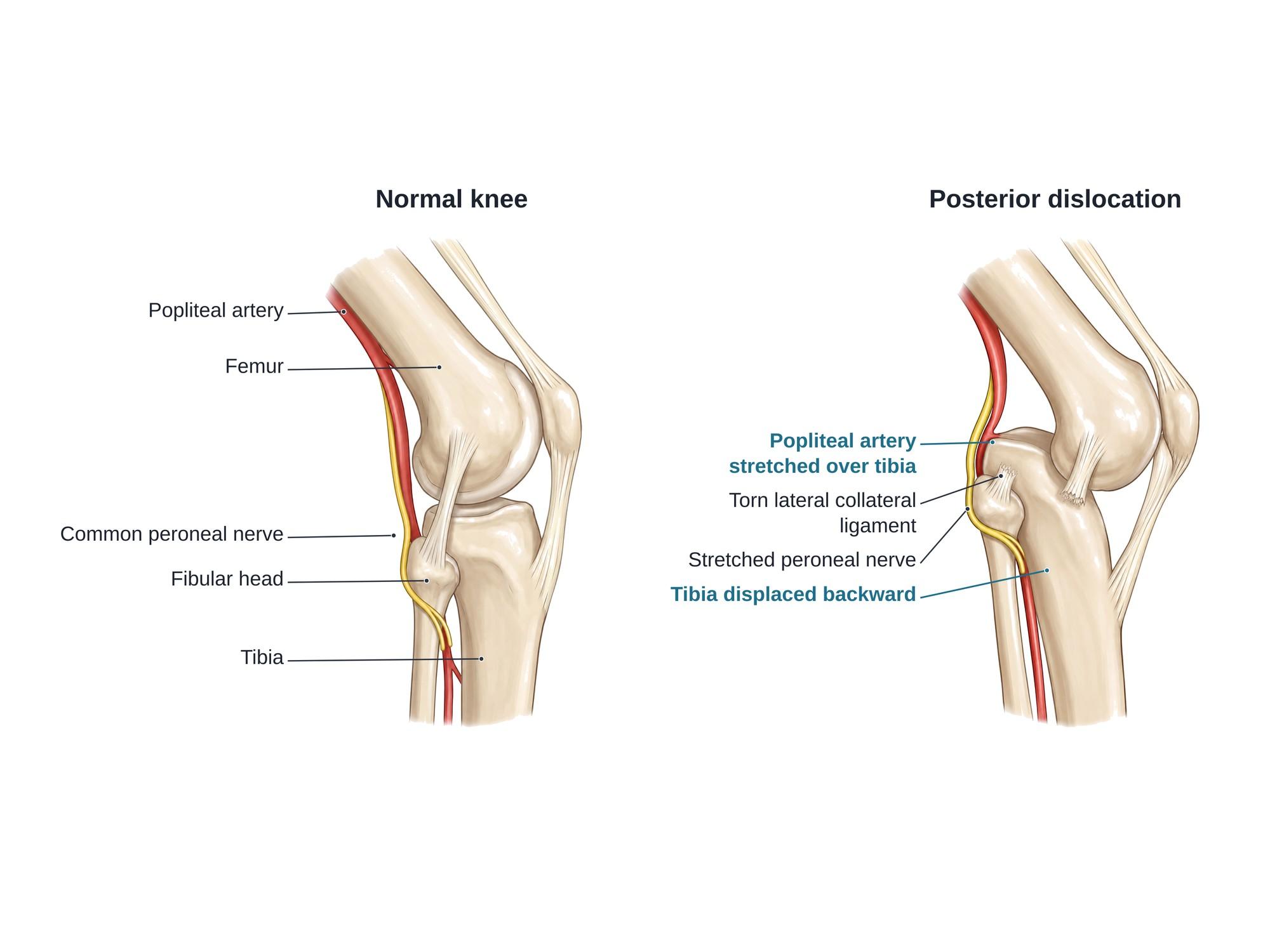
A knee dislocation is a serious injury in which the top of the tibia (shinbone) is forced completely off the end of the femur (thighbone). The two bones lose contact at the joint. Four main ligaments hold the knee together: the anterior cruciate ligament (ACL) and posterior cruciate ligament (PCL) inside the joint, and the medial and lateral collateral ligaments on each side (see knee anatomy). A dislocation tears at least two of them, so doctors also call it a multiligament knee injury. Behind the knee lie the popliteal artery, the main blood supply to the leg, and the common peroneal nerve, which lifts the foot. Both can be torn or stretched. In a review of 37,087 knee dislocations, 11% had an artery injury and 20% had a nerve injury (Constantinescu et al., 2023). The illustration above shows a normal knee beside a posterior dislocation.
Types
Doctors describe a knee dislocation in two ways: by the direction the tibia moved, and by which ligaments tore.
By direction, the tibia can move forward (anterior), backward (posterior), to the inside (medial), to the outside (lateral) or twist (rotatory). Anterior dislocations often follow hyperextension, when the knee is bent backward too far. Posterior dislocations often follow a blow to the front of the shin, as in a dashboard injury. Many dislocations go back into place on their own before the patient reaches the hospital, so the direction is often unknown.
By the ligaments torn, doctors use the Schenck classification (StatPearls):
| Type | Ligaments torn | Notes |
|---|---|---|
| KD I | One cruciate ligament plus a collateral ligament | The ACL or the PCL stays intact |
| KD II | Both cruciates (ACL and PCL) | Both collateral ligaments intact |
| KD III-M | Both cruciates and the MCL | The most common pattern |
| KD III-L | Both cruciates and the lateral side (LCL and posterolateral corner) | High risk of peroneal nerve injury |
| KD IV | All four main ligaments | Most unstable |
| KD V | Dislocation with a fracture | A fracture-dislocation |
In a prospective study of 303 patients, KD III-M made up 52% of knee dislocations. Patients with the lateral pattern (KD III-L) had 42 times the odds of a peroneal nerve injury (Moatshe et al., 2017).
Causes
A large force must push the tibia off the femur. Common causes include:
- Car and motorcycle crashes, including the dashboard injury, where the bent knee strikes the dash
- Pedestrians struck by a car, with the bumper hitting the knee
- Falls, from a height or on stairs
- Contact sports, such as football and rugby
- Low-energy falls in people with obesity, sometimes called ultra-low-velocity dislocations
In the study of 303 patients, the average age was 38 and 65% were men. Half of the injuries were high energy and half were low energy (Moatshe et al., 2017).
Symptoms
- Severe pain right after the injury
- A knee that looks deformed or out of line, if it is still dislocated
- Fast swelling, though a torn joint capsule can let the fluid leak away, so swelling may be less than expected
- A knee that feels loose and gives way in several directions
- Numbness on the top of the foot, or weakness lifting the foot or toes (foot drop), from a peroneal nerve injury
- A cold, pale foot or a weak pulse, from an artery injury
A knee that has already gone back into place can look nearly normal. The ligament and artery injuries are still there.
Diagnosis
A knee dislocation is treated as an emergency. The first steps check the blood supply to the leg.
- Reduction. If the knee is still out of place, the doctor puts it back right away, under sedation.
- Pulse check. The doctor feels the pulses at the ankle and foot and compares them with the other leg. Normal pulses do not rule out an artery injury.
- Ankle-brachial index (ABI). This compares the blood pressure at the ankle with the pressure in the arm. In a prospective study of 38 knee dislocations, every patient with an ABI under 0.90 had an artery injury needing surgery, and no patient at or above it did (Mills et al., 2004).
- CT angiography. A CT scan with dye in the arteries shows a torn, blocked or narrowed popliteal artery. It is done when the pulses or the ABI are abnormal.
- Nerve exam. The doctor tests feeling on the top of the foot and the strength to lift the foot and big toe.
- X-rays show whether the knee is in place and whether there is a fracture, such as a tibial plateau fracture.
- MRI shows which ligaments are torn and any damage to the menisci and cartilage.
Treatment
Emergency care comes first:
- The knee is put back into place and held in a splint or brace.
- An artery injury is repaired right away, usually with a bypass graft taken from a vein. In the 2023 review, 62% of patients with an artery injury had surgical repair (Constantinescu et al., 2023).
- After the blood flow is restored, the surgeon may cut open the muscle compartments of the leg, a fasciotomy, to prevent compartment syndrome.
- A knee that will not stay in place may be held with an external fixator, a frame of pins and bars outside the leg.
Speed matters. A classic 1977 review of 245 knee dislocations found that artery repair had to be done within 6 to 8 hours. Back then, 86% of patients not treated within that time lost the leg (Green and Allen, 1977). Results are better today. In a 2014 review, 12% of artery injuries still ended in amputation (Medina et al., 2014).
Ligament surgery follows, often within the first few weeks once the swelling settles:
- Reconstruction of the torn cruciate ligaments with tendon grafts, as in ACL reconstruction and PCL reconstruction
- Repair or reconstruction of the collateral ligaments and the posterolateral corner, the group of ligaments and tendons on the back and outer side of the knee
- Repair of torn menisci and fixation of any fracture
Some surgeons rebuild all the ligaments in one operation. Others do it in stages. Older or less active patients are sometimes treated in a brace instead.
Recovery
- Weeks 0 to 6: a hinged brace and crutches, with limited weight on the leg. Gentle motion starts early to prevent stiffness.
- Weeks 6 to 12: walking without crutches and physical therapy for motion and thigh strength.
- Months 3 to 6: strengthening, balance and a slow return to normal activities.
- Months 9 to 12 or more: running, sports and heavy work, if the knee is stable and strong.
A peroneal nerve injury slows recovery. In a series of 27 patients with this nerve injury, 69% regained the strength to lift the foot against gravity. The rate was 83% after a partial nerve injury and 38% after a complete one (Krych et al., 2014). See peroneal nerve injury.
Complications
- Popliteal artery injury, which can lead to loss of the leg. In the review of 37,087 dislocations, amputation was reported in 2.2% (Constantinescu et al., 2023), sometimes with a below-knee amputation.
- Peroneal nerve injury with foot drop, found in 19% of patients in the 303-patient study (Moatshe et al., 2017).
- Compartment syndrome, from swelling or after blood flow returns.
- Stiffness and loss of knee bending, the most common problem after surgery.
- Ongoing looseness of the knee, or failure of a graft.
- Early arthritis from damage to the cartilage and menisci.
- Blood clots in the leg veins (deep vein thrombosis).
- Infection after surgery or after an open dislocation.
A knee dislocation often comes with other injuries in the same knee, such as an ACL tear, a PCL tear, an MCL tear and a meniscus tear.
References
- Constantinescu D, Luxenburg D, Syros A, et al. Vascular Injury After Knee Dislocation: A Meta-Analysis Update. Journal of the American Academy of Orthopaedic Surgeons. 2023;31(4):e198-e206.
- Mohseni M, Mabrouk A, Simon LV. Knee Dislocation. StatPearls Publishing, 2024.
- Moatshe G, Dornan GJ, Løken S, et al. Demographics and Injuries Associated With Knee Dislocation: A Prospective Review of 303 Patients. Orthopaedic Journal of Sports Medicine. 2017;5(5):2325967117706521.
- Mills WJ, Barei DP, McNair P. The value of the ankle-brachial index for diagnosing arterial injury after knee dislocation: a prospective study. Journal of Trauma. 2004;56(6):1261-1265.
- Green NE, Allen BL. Vascular injuries associated with dislocation of the knee. Journal of Bone and Joint Surgery (American). 1977;59(2):236-239.
- Krych AJ, Giuseffi SA, Kuzma SA, et al. Is peroneal nerve injury associated with worse function after knee dislocation? Clinical Orthopaedics and Related Research. 2014;472(9):2630-2636.
- Medina O, Arom GA, Yeranosian MG, et al. Vascular and nerve injury after knee dislocation: a systematic review. Clinical Orthopaedics and Related Research. 2014;472(9):2621-2629.
Related pages
- Knee anatomyThe normal anatomy of the knee.
- ACL tearAn ACL tear is a torn ligament inside the knee that lets the shin slide forward. Learn the grades, symptoms, surgery and recovery time.
- Meniscus tearA meniscus tear is a rip in the knee's C-shaped cartilage, most often the medial meniscus.
- Patellar dislocationA patellar dislocation is a kneecap that slides out of its groove, almost always to the outside. Causes, MPFL tears, patellar instability, treatment and recovery.
- Patellar tendon ruptureA patellar tendon rupture is a tear of the tendon below the kneecap, so the knee cannot straighten. Learn the types, symptoms and treatment.
- Patellar tendonitisPatellar tendonitis (jumper's knee) is overuse damage to the tendon below the kneecap. Learn the symptoms, stages, treatment and recovery time.
- PCL tearA PCL tear is an injury to the ligament that stops the shin from sliding back, often from a dashboard blow. Learn the symptoms, grades and recovery time.
- Quadriceps tendon ruptureA quadriceps tendon rupture is a tear of the tendon above the kneecap. A complete tear stops the knee straightening. Learn symptoms, surgery and recovery.
FAQ
What is the difference between a knee dislocation and a dislocated kneecap?+
A knee dislocation is when the tibia (shinbone) comes off the femur (thighbone). It tears several ligaments and can injure the main artery behind the knee. It is a surgical emergency. A dislocated kneecap (patellar dislocation) is when only the kneecap slides out of its groove, usually to the outside. It is far more common and much less dangerous.
My knee popped out of place and then right back in. Is that a dislocation?+
Often it is the kneecap that slips out and back, not the whole knee. But a true knee dislocation can also pop back in on its own before the patient reaches the hospital. A knee that looks normal can still hide torn ligaments and an artery injury. Anyone with a knee that gave way badly after a fall or crash, with severe pain, swelling or a loose feeling, should be checked in an emergency department.
Is a knee dislocation an emergency?+
Yes. About 1 in 9 knee dislocations injures an artery. If blood flow to the leg is not restored within about 6 to 8 hours, the leg may be lost. Doctors check the pulses and the ankle-brachial index right away, even if the knee has already gone back into place.
How long does it take to recover from a knee dislocation?+
Recovery is long. After ligament reconstruction, most people use a brace and crutches for about 6 weeks and do physical therapy for months. A return to sports or heavy work often takes 9 to 12 months, and some people never get back to their old level.
Can you walk with a dislocated knee?+
Usually not while it is out of place. The knee is deformed, very painful and unstable. After it is put back, walking is often possible in a brace with crutches, but the knee may give way because several ligaments are torn.
Does a knee dislocation always need surgery?+
Most do. Several ligaments are usually torn, and they rarely heal well enough on their own. Surgery repairs or rebuilds them, often within the first few weeks. An artery injury needs emergency surgery. A few older or less active patients are treated in a brace or an external frame instead.
What causes a knee dislocation?+
High-energy injuries such as car and motorcycle crashes, falls from a height and contact sports are the classic causes. In a dashboard injury, the bent knee hits the dashboard and the tibia is driven backward. Low-energy injuries, such as a simple fall, can also dislocate the knee, mostly in people with obesity.
What are the long-term effects of a dislocated knee?+
Many people have stiffness, some looseness, pain and early arthritis. About 1 in 5 have a peroneal nerve injury, which can cause foot drop. A smaller number lose the leg after an artery injury, mostly when blood flow was not restored in time.
Need this illustration for a patient or a case?
Describe the injury or upload a scan and get a clear, labeled medical illustration for a consult, a chart or a case exhibit.
Try Natomy →