Meniscus Tear: Types, Symptoms & Treatment
A meniscus tear is a rip in the knee's C-shaped cartilage, most often the medial meniscus.
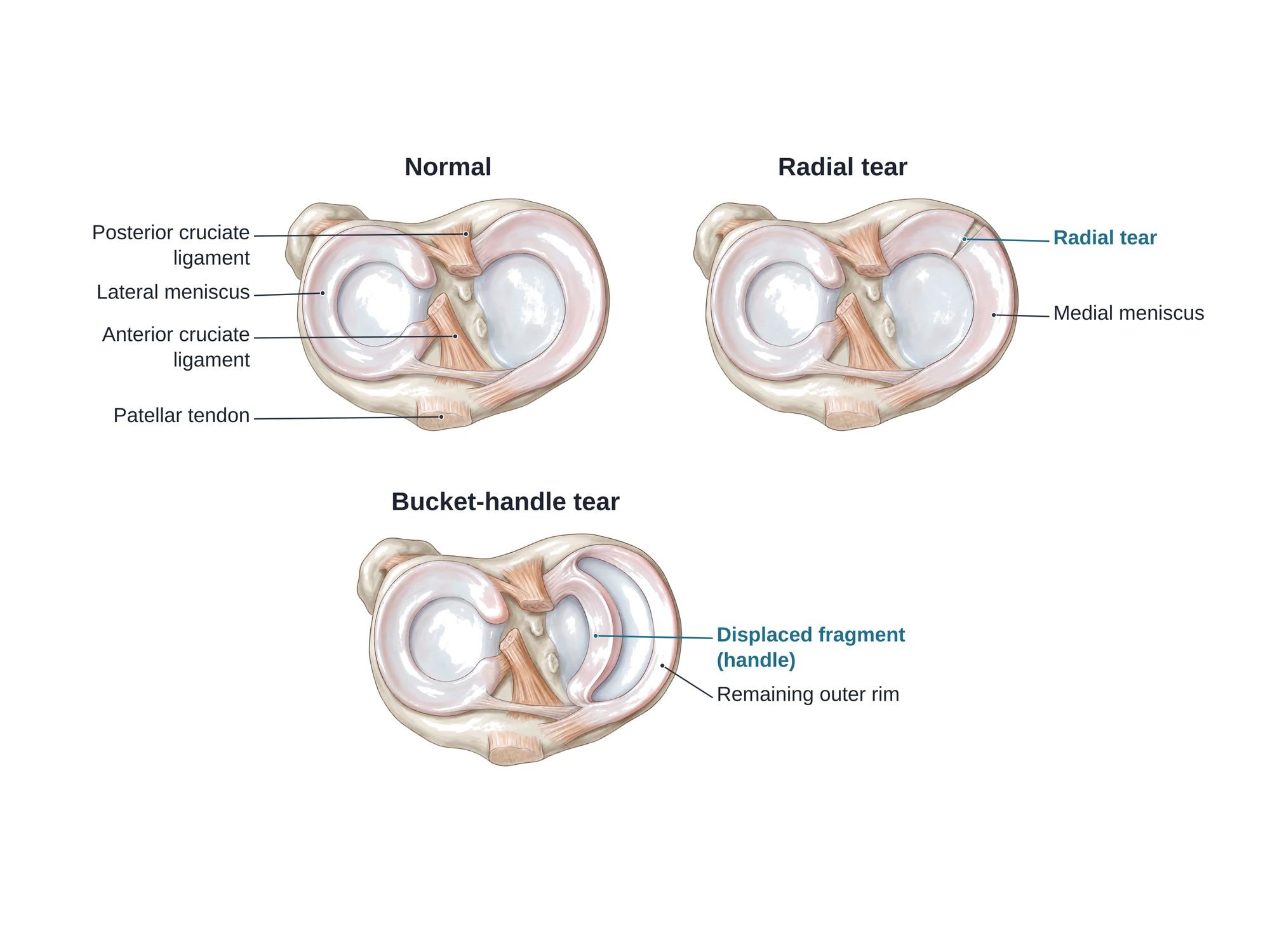
A meniscus tear is a rip in one of the two menisci, the C-shaped pads of cartilage that sit on top of the shinbone (tibia) in the knee. The menisci cushion the joint, spread body weight and help keep the knee steady (see knee anatomy). The medial meniscus, on the inner side of the knee, tears most often. In young people a tear usually comes from a twist on a bent knee. In older people the cartilage weakens with age and can tear from a small movement, like getting up from a squat. In active-duty US service members, about 8 meniscus injuries happened per 1,000 person-years (Jones et al., 2012). The illustration above shows normal menisci beside a radial tear and a bucket-handle tear.
The anatomy
Each meniscus is a wedge of tough, rubbery tissue called fibrocartilage. The medial meniscus is larger and shaped like a C. It is firmly attached to the joint capsule and the medial collateral ligament, so it moves less and is more easily trapped and torn. The lateral meniscus, on the outer side, is smaller and almost round, and it moves more. Each one has a front end (the anterior horn), a middle (the body) and a back end (the posterior horn). The ends are anchored to the bone by short ligaments called roots.
Only the outer third of each meniscus has a good blood supply. Doctors call it the red zone. The inner part, the white zone, has almost none. This explains why a tear near the rim may heal after repair, while one near the inner edge usually does not.
Types
Meniscus tears are named for their shape and direction.
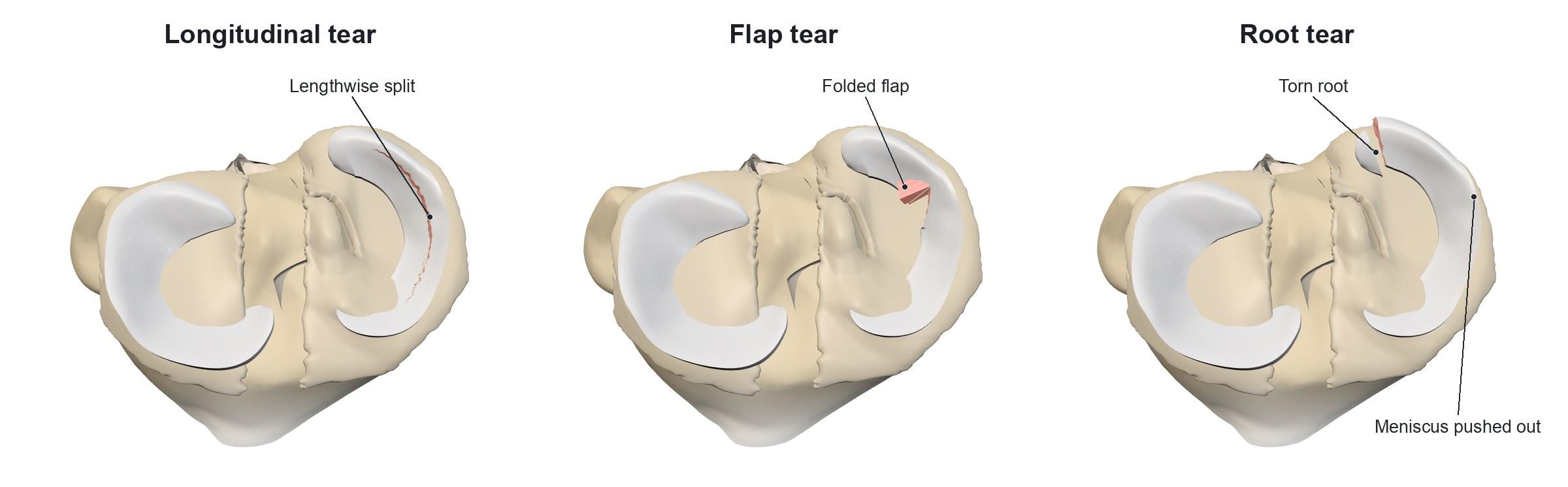
| Type | What it looks like | What it means |
|---|---|---|
| Radial tear | A split from the inner edge out toward the rim | Breaks the ring of fibers that carries load. A full-width tear works like a missing meniscus. |
| Bucket-handle tear | A long lengthwise tear with the inner strip flipped into the center of the knee | Often locks the knee. Usually needs surgery soon. |
| Longitudinal tear | A lengthwise split along the curve | Common with ACL tears. Near the rim it can often be repaired. |
| Horizontal tear | A split that divides the meniscus into top and bottom layers | Usually degenerative, in older adults. |
| Flap tear | A small tongue of tissue that folds over | Can catch in the joint and cause sharp pain. |
| Complex tear | Two or more tear patterns together | Usually degenerative and hard to repair. |
| Root tear | A tear at or near the bone anchor at either end | The meniscus can slide out of place. Linked to fast-onset arthritis. |
Tears are also called traumatic (from a single injury, usually in younger people) or degenerative (from age-related wear, usually after about 40).
Medial vs lateral meniscus tear
| Medial meniscus tear | Lateral meniscus tear | |
|---|---|---|
| Where the pain is | Inner side of the knee | Outer side of the knee |
| How common | More common | Less common |
| Usual cause | Twisting injury, or wear with age | Twisting injury, often with an acute ACL tear |
| Link to ACL tear | Becomes more common when an ACL tear is left unstable for months | Common at the time of the ACL injury |
Causes
A meniscus tear happens when the femur grinds and twists on the tibia while the knee is bent and bearing weight. The meniscus gets pinched between the two bones and splits.
- Pivoting or cutting in sports such as soccer, basketball, football and skiing
- Deep squatting or kneeling, then turning or standing up
- A fall where the foot stays planted and the body turns
- A car or motorcycle crash where the knee twists or hits the dashboard
- A work injury, such as lifting while twisting or slipping on a wet floor
Meniscus tears often come with an ACL tear. When the ACL is torn, the tibia slides forward and the medial meniscus takes extra load. Each later giving-way episode can tear it further.
Risk rises with age. In the same military study, men had about 18% more meniscus injuries than women. People over 40 had them more than 4 times as often as those under 20 (Jones et al., 2012).
Symptoms
Meniscus tear symptoms often start with a pop, then build over a day or two:
- Pain at the joint line, on the inner side for a medial tear and the outer side for a lateral tear
- Swelling and stiffness that come on over 24 to 48 hours
- Pain with twisting, squatting or kneeling
- Catching or clicking, from a loose flap moving in the joint
- Locking, where the knee gets stuck and cannot fully straighten. This is typical of a bucket-handle tear.
- A feeling that the knee gives way
- An ache at night, often worse after a busy day
Many tears cause no symptoms. In a study of 991 adults aged 50 to 90, 61% of those with a meniscus tear on MRI had no knee pain, aching or stiffness in the past month (Englund et al., 2008).
Diagnosis
The doctor asks how the injury happened and checks the knee. Common exam tests for a medial meniscus tear include:
- Joint line tenderness: pain when the doctor presses along the gap between the femur and tibia
- McMurray test: the doctor bends, twists and straightens the knee to feel for a click and pain
- Thessaly test: the patient stands on the leg with the knee slightly bent and twists the body
X-rays do not show the meniscus. They are taken to look for fractures and arthritis. MRI is the main test. A tear shows as a bright line inside the normally dark meniscus that reaches its surface. A bucket-handle tear can show the flipped fragment lying in the center of the knee. MRI also checks for an ACL tear, bone bruises and cartilage damage. Arthroscopy, a look inside the knee with a small camera, confirms the tear and can treat it at the same time.
Treatment
Torn meniscus treatment depends on the tear type, where it is, the person's age and whether the knee locks.
Without surgery. Most degenerative tears and many small tears are treated first with rest, ice, compression and raising the leg. Anti-inflammatory medicine and a few weeks of physical therapy to strengthen the thigh and hip muscles usually follow. A steroid injection may help pain when arthritis is also present. In a trial of 351 patients aged 45 and older with a meniscus tear and arthritis, surgery plus therapy did not improve function more than therapy alone at 6 months. Still, 30% of the therapy group chose surgery within 6 months (Katz et al., 2013).
Surgery. Surgery is done through small cuts with a camera (arthroscopy). It is advised when the knee locks, when a fragment is displaced, or when pain lasts despite therapy.
- Partial meniscectomy. The surgeon trims away the torn, unstable tissue and keeps as much healthy meniscus as possible. This is common for tears in the white zone and for degenerative tears.
- Meniscus repair. The surgeon stitches the torn edges together. Repair works best for tears near the rim in younger people, and it protects the knee from arthritis better than trimming. In a 2026 review, about 22% of repaired bucket-handle tears failed, and failures rose with longer follow-up. Medial repairs failed more often than lateral ones (Soleymani Nejad et al., 2026).
- Root repair. A torn root is stitched back to the bone through a small tunnel in the tibia.
- Meniscus transplant. In a young person who has lost most of a meniscus, a donor meniscus can be placed.
When the ACL is also torn, the meniscus is usually repaired or trimmed during ACL reconstruction. Some studies find repairs fail less often when done together with the reconstruction, but a 2026 review found no clear difference (Soleymani Nejad et al., 2026).
Recovery
Meniscus surgery recovery time depends on the operation:
- After a partial meniscectomy: walking within a few days, daily activities in 1 to 2 weeks, and sport in about 4 to 6 weeks.
- After a repair: crutches and often a brace for 4 to 6 weeks, with limits on deep bending. Running starts at about 3 to 4 months. Sport usually returns at 4 to 6 months.
- Without surgery: many people improve over 6 to 12 weeks of physical therapy.
Complications
- Knee arthritis. Losing meniscus tissue puts more load on the cartilage. Large meniscectomies and untreated root tears raise this risk the most.
- Repair failure, where the stitched tear opens again and needs another operation
- Locked knee, from a displaced bucket-handle fragment
- Further tearing, especially if an unstable ACL tear is not treated
- Stiffness and weak thigh muscles after surgery
- Infection, blood clots and nerve irritation, which are rare after arthroscopy
References
- Jones JC, Burks R, Owens BD, et al. Incidence and risk factors associated with meniscal injuries among active-duty US military service members. Journal of Athletic Training. 2012;47(1):67-73.
- Englund M, Guermazi A, Gale D, et al. Incidental meniscal findings on knee MRI in middle-aged and elderly persons. New England Journal of Medicine. 2008;359(11):1108-1115.
- Katz JN, Brophy RH, Chaisson CE, et al. Surgery versus physical therapy for a meniscal tear and osteoarthritis. New England Journal of Medicine. 2013;368(18):1675-1684.
- Soleymani Nejad A, Keyhani S, Soleymanha M, et al. Failure rates increase over time and are higher following medial arthroscopic bucket-handle meniscal repair: A systematic review and meta-analysis. Journal of Experimental Orthopaedics. 2026;13(3):e70854.
Related pages
- Knee anatomyThe normal anatomy of the knee.
- ACL tearAn ACL tear is a torn ligament inside the knee that lets the shin slide forward. Learn the grades, symptoms, surgery and recovery time.
- Patellar tendon ruptureA patellar tendon rupture is a tear of the tendon below the kneecap, so the knee cannot straighten. Learn the types, symptoms and treatment.
FAQ
Will walking on a torn meniscus make it worse?+
Walking in a straight line on flat ground is usually safe and rarely makes a tear bigger. Deep squats, twisting on a planted foot and heavy kneeling are what load the torn edge. If the knee locks, catches or keeps swelling, stop and see a doctor, since a loose flap can get caught in the joint.
Can a torn meniscus heal on its own?+
Tears in the outer edge of the meniscus have a blood supply and can heal, especially small ones in young people. Tears in the inner part have almost no blood supply and do not heal on their own. Many small or wear-and-tear tears still stop hurting with rest, physical therapy and time.
How do you reduce swelling from a torn meniscus?+
Rest the knee from sports, use ice for 15 to 20 minutes a few times a day, wrap it with a compression sleeve and raise the leg above the heart. Anti-inflammatory medicine can help if your doctor says it is safe. Swelling that keeps coming back after activity is a sign to get the knee checked.
What are the symptoms of a medial meniscus tear?+
Pain along the inner side of the knee, at the joint line, is the main sign. Other symptoms are swelling over a day or two, pain with twisting or squatting, and catching or locking. Some people feel the knee give way. Many tears in older adults cause no symptoms at all.
What exercises help a meniscus tear?+
Physical therapy usually starts with straight leg raises, quad sets, gentle range of motion and stationary cycling. It then adds hamstring and hip strengthening, mini squats and balance work. Deep squats, lunges past 90 degrees and pivoting are avoided early. A therapist adjusts the plan to the tear and any surgery.
Is there an age limit for meniscus surgery?+
There is no strict age limit. Age matters because degenerative tears in people over about 45, often with arthritis, usually do as well with physical therapy as with surgery. Repair is favored in younger people with fresh tears. Older people with a locked knee or a displaced fragment may still need surgery.
How long is meniscus surgery recovery time?+
After a trim (partial meniscectomy), most people walk within days and return to sport in about 4 to 6 weeks. After a repair, the stitched tissue needs time to heal. Crutches or a brace are common for several weeks, and return to sport often takes 4 to 6 months.
What does a torn meniscus feel like at night?+
Many people notice a dull ache at night, especially after a busy day on their feet. Lying with the knee bent or twisted can press on the tear. A pillow between or under the knees often helps. Night pain that is severe or constant needs a check for other causes.
Need this illustration for a patient or a case?
Describe the injury or upload a scan and get a clear, labeled medical illustration for a consult, a chart or a case exhibit.
Try Natomy →