ACL Tear: Symptoms, Surgery & Recovery Time
An ACL tear is a torn ligament inside the knee that lets the shin slide forward. Learn the grades, symptoms, surgery and recovery time.
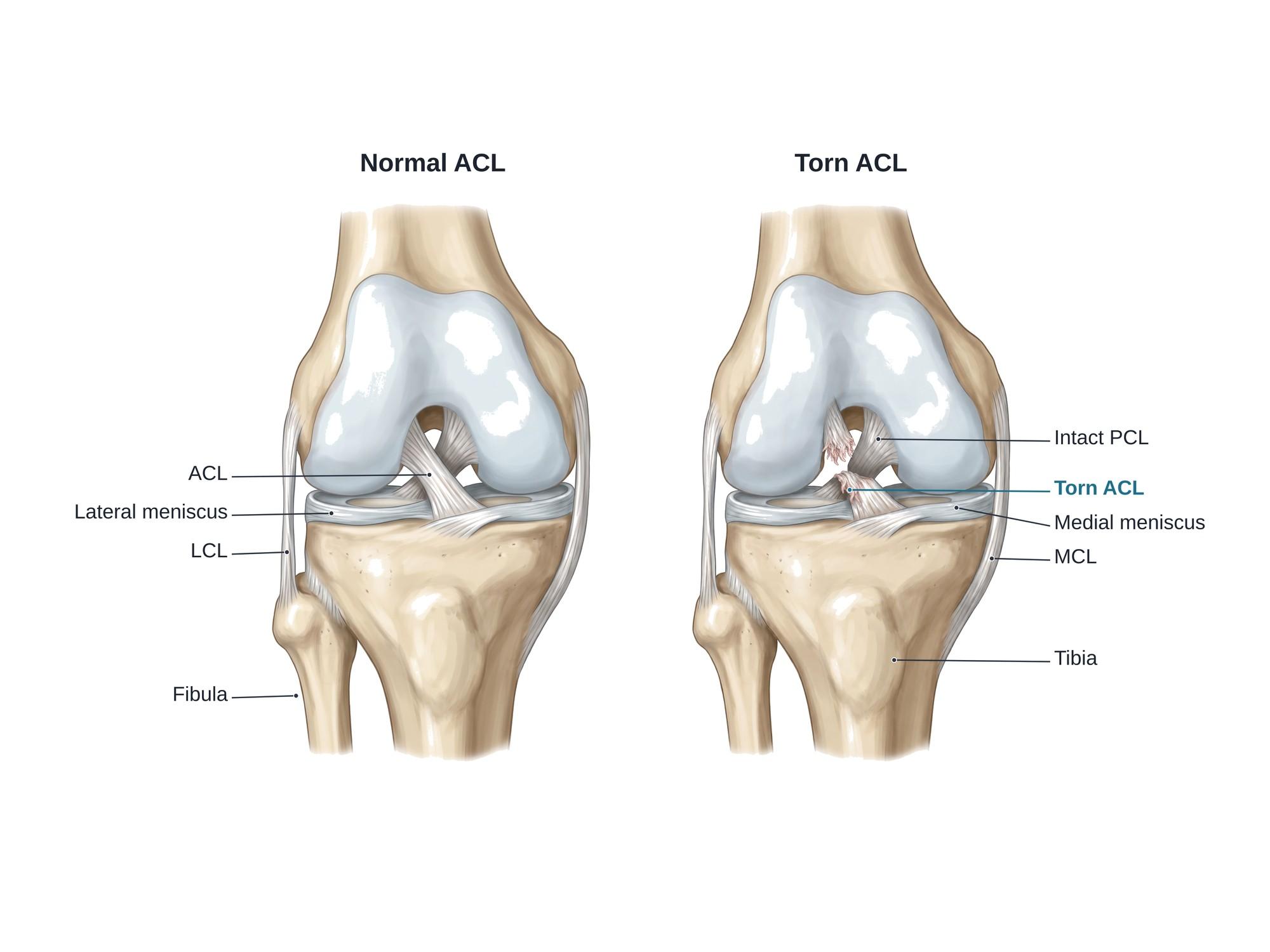
An ACL tear is a tear of the anterior cruciate ligament, a strong band inside the knee that keeps the shinbone (tibia) from sliding forward under the thighbone (femur). It crosses the posterior cruciate ligament (PCL) in the middle of the joint, while the medial and lateral collateral ligaments (MCL and LCL) run down the sides and two C-shaped cartilage pads, the menisci, cushion the joint (see knee anatomy). It usually tears during a sudden stop, a twist or a bad landing, in sports or in a crash. A complete tear makes the knee feel loose and give way. Isolated ACL tears happen in about 68.6 people per 100,000 each year (Sanders et al., 2016). Many active people choose surgery to rebuild it. The illustration above shows a normal ACL beside a torn one.
Grades
Doctors grade ACL injuries like other ligament sprains.
- What happens to the ACL
- Stretched, with small tears in the fibers
- What it means
- The knee is still stable. Treated with rest and rehab.
- What happens to the ACL
- Partly torn
- What it means
- The knee may feel a little loose. Rare.
- What happens to the ACL
- Completely torn (a rupture)
- What it means
- The knee is unstable. The most common type.
Most ACL injuries are complete tears. A tear can also pull a small piece of bone off where the ligament attaches. This is called an avulsion fracture, and it is more common in children.
Causes
Most ACL tears are noncontact injuries. Nothing hits the knee. The ligament tears when the body twists or stops over a planted foot:
- Cutting, pivoting or changing direction fast, as in soccer, basketball or football
- Landing from a jump with the knee straight or bent inward
- Stopping suddenly while running
- Skiing falls where the ski twists the leg
Contact injuries also happen:
- A blow to the side or front of the knee, as in a football tackle
- A car crash where the knee strikes the dashboard or the leg twists in the footwell
- A motorcycle crash or a fall from a height
ACL tears are most common in young, active people. In one 21-year population study, the rate peaked at ages 19 to 25 in males and ages 14 to 18 in females (Sanders et al., 2016). Female athletes tear the ACL more often than male athletes in the same sports. Likely reasons include landing mechanics, muscle balance and hormones.
Symptoms
ACL tear symptoms usually start at the moment of injury:
- A pop felt or heard inside the knee
- Pain deep in the knee, and trouble keeping weight on it
- Fast swelling, often within a few hours. This is bleeding into the joint, called a hemarthrosis.
- Loss of full motion, especially straightening the knee
- A feeling that the knee is unstable or gives way, mostly when turning
ACL pain location is usually deep inside the knee or along the joint line, not in one spot on the surface. After the swelling settles, pain often fades. The main problem then is a knee that shifts or buckles.
Diagnosis
The doctor asks how the injury happened and checks the knee for swelling and stability. Three exam tests check whether the tibia slides forward too far:
- The Lachman test, with the knee bent about 30 degrees. It is the most sensitive test.
- The anterior drawer test, with the knee bent 90 degrees.
- The pivot shift test, which reproduces the giving-way feeling.
X-rays do not show the ligament. They are taken to look for fractures, such as a small avulsion flake at the side of the tibia (a Segond fracture), which strongly suggests an ACL tear. MRI shows the torn ligament and checks for other injuries. These include meniscus tears, MCL injuries and bone bruises on the femur and tibia. Bone bruises in a typical pattern show the knee shifted at the moment of injury.
Treatment
Treatment depends on the person's age, activity and other knee injuries.
Without surgery. People who do not play pivoting sports may do well with physical therapy. Therapy builds the quadriceps and hamstring muscles so they steady the knee. A brace may help during some activities. The ACL does not heal, so the knee may still give way with sudden turns.
ACL surgery (reconstruction). Most active people and athletes choose surgery. The torn ACL is not sewn back together. It is replaced with a graft:
- The surgeon looks into the knee through small incisions with a camera (arthroscopy).
- Any torn meniscus is repaired or trimmed.
- A graft is taken. Common choices are the middle third of the patellar tendon, the hamstring tendons or the quadriceps tendon. A donor graft (allograft) is another option.
- Tunnels are drilled in the tibia and femur, where the ACL attached.
- The graft is passed through the tunnels and held with screws or buttons.
Surgery is usually done after the swelling settles and the knee moves well again, often a few weeks after the injury. Taking a patellar tendon graft weakens that tendon for a time. A rare later problem is a patellar tendon rupture.
Recovery
ACL recovery time after surgery is long:
- Weeks 0 to 2: crutches, ice and early motion. The first goal is to straighten the knee fully.
- Weeks 2 to 6: walking without crutches, bending past 90 degrees and building the thigh muscles.
- Months 3 to 6: jogging, balance training and strength work.
- Months 6 to 12: jumping, cutting and sport drills. Return to sport is based on strength and hop tests, not time alone.
Most people return to some sport. In a review of 7,556 patients, 81% returned to any sport, 65% to their preinjury level and 55% to competitive sport (Ardern et al., 2014).
Complications
- Another ACL tear. In a review of 19 studies, 15% of patients tore the graft or the ACL in the other knee after surgery. The rate was 23% in athletes under 25 who returned to sport (Wiggins et al., 2016).
- Meniscus and cartilage damage, from the injury or from later giving-way episodes
- Knee arthritis. In a meta-analysis, 20% of ACL-injured knees had moderate or severe arthritis at least 10 years later, compared with 4.9% of the uninjured knees (Ajuied et al., 2014).
- Stiffness, mostly loss of full straightening
- Pain at the graft site, such as front-of-knee pain when kneeling
- Infection and blood clots in the leg veins (deep vein thrombosis)
- Graft failure from a poorly placed tunnel or a graft that stretches
ACL tears often happen together with other injuries. An ACL tear, an MCL tear and a medial meniscus tear together are sometimes called the "unhappy triad." A strong force can also break the top of the tibia, a tibial plateau fracture.
How an ACL tear is shown in a personal injury case
ACL tears follow car and motorcycle crashes, slips and falls, and work and sports injuries. In a car crash, the knee may hit the dashboard, or the leg may twist with the foot braced on the floor. The defense may argue the tear came from an old sports injury, or that the knee had wear and tear before. MRI findings help answer this. Fresh swelling and bone bruises point to a recent injury. An illustration of the plaintiff's own knee, normal beside torn, shows the jury where the ligament tore and why the knee gives way. A second figure can show the reconstruction with its graft and screws. For how these images are used at trial, see demonstrative evidence and medical legal illustration.
References
- Sanders TL, Maradit Kremers H, Bryan AJ, et al. Incidence of Anterior Cruciate Ligament Tears and Reconstruction: A 21-Year Population-Based Study. American Journal of Sports Medicine. 2016;44(6):1502-1507.
- Ardern CL, Taylor NF, Feller JA, et al. Fifty-five per cent return to competitive sport following anterior cruciate ligament reconstruction surgery: an updated systematic review and meta-analysis including aspects of physical functioning and contextual factors. British Journal of Sports Medicine. 2014;48(21):1543-1552.
- Wiggins AJ, Grandhi RK, Schneider DK, et al. Risk of Secondary Injury in Younger Athletes After Anterior Cruciate Ligament Reconstruction: A Systematic Review and Meta-analysis. American Journal of Sports Medicine. 2016;44(7):1861-1876.
- Ajuied A, Wong F, Smith C, et al. Anterior cruciate ligament injury and radiologic progression of knee osteoarthritis: a systematic review and meta-analysis. American Journal of Sports Medicine. 2014;42(9):2242-2252.
Related pages
FAQ
Can you still walk on a torn ACL?+
Yes, most people can walk on a torn ACL once the first pain and swelling settle, often within a few days to weeks. Walking in a straight line uses little of the ACL. The problem is twisting, pivoting and sudden stops, where the knee may give way.
Will a torn ACL heal on its own?+
A complete ACL tear does not heal back together on its own. The torn ends sit in joint fluid and pull apart, so they do not reconnect. Some people cope well without surgery by strengthening the muscles around the knee and avoiding pivoting sports. Partial tears can sometimes do well with rehab alone.
What does ACL pain feel like?+
Many people feel or hear a pop at the moment of injury, then pain deep inside the knee. The knee swells within a few hours. Later, the main feeling is often instability, a sense that the knee shifts or buckles, more than constant pain.
How do you fix a torn ACL?+
The usual repair is ACL reconstruction. The surgeon replaces the torn ligament with a tendon graft, often from the patient's patellar tendon, hamstring or quadriceps tendon, or from a donor. The graft is passed through tunnels drilled in the femur and tibia and fixed in place, usually through small keyhole incisions.
How long is recovery after ACL surgery?+
Most people walk without crutches in a few weeks and return to daily life in a few months. Return to cutting and pivoting sports usually takes 9 to 12 months. In a large review, about 65% of patients got back to their preinjury level of sport.
What happens if a torn ACL is not treated?+
Without a working ACL, the knee may keep giving way during sports or quick turns. Each giving-way episode can tear a meniscus or damage cartilage. Over years, this raises the risk of knee arthritis.
How do you know if you tore your ACL or MCL?+
An ACL tear usually comes from a twist or a sudden stop, with a pop and fast swelling inside the joint. An MCL sprain usually comes from a blow to the outside of the knee, with pain on the inner side and less swelling. The two often happen together. An exam and an MRI tell them apart.
Can you tear your ACL again after surgery?+
Yes. In a large review, about 1 in 7 patients injured the graft or the ACL in the other knee after surgery. The risk is higher in athletes under 25 who return to sport.
Need this illustration for a patient or a case?
Describe the injury or upload a scan and get a clear, labeled medical illustration for a consult, a chart or a case exhibit.
Try Natomy →