PCL Tear: Symptoms, Grades, Treatment & Recovery
A PCL tear is an injury to the ligament that stops the shin from sliding back, often from a dashboard blow. Learn the symptoms, grades and recovery time.
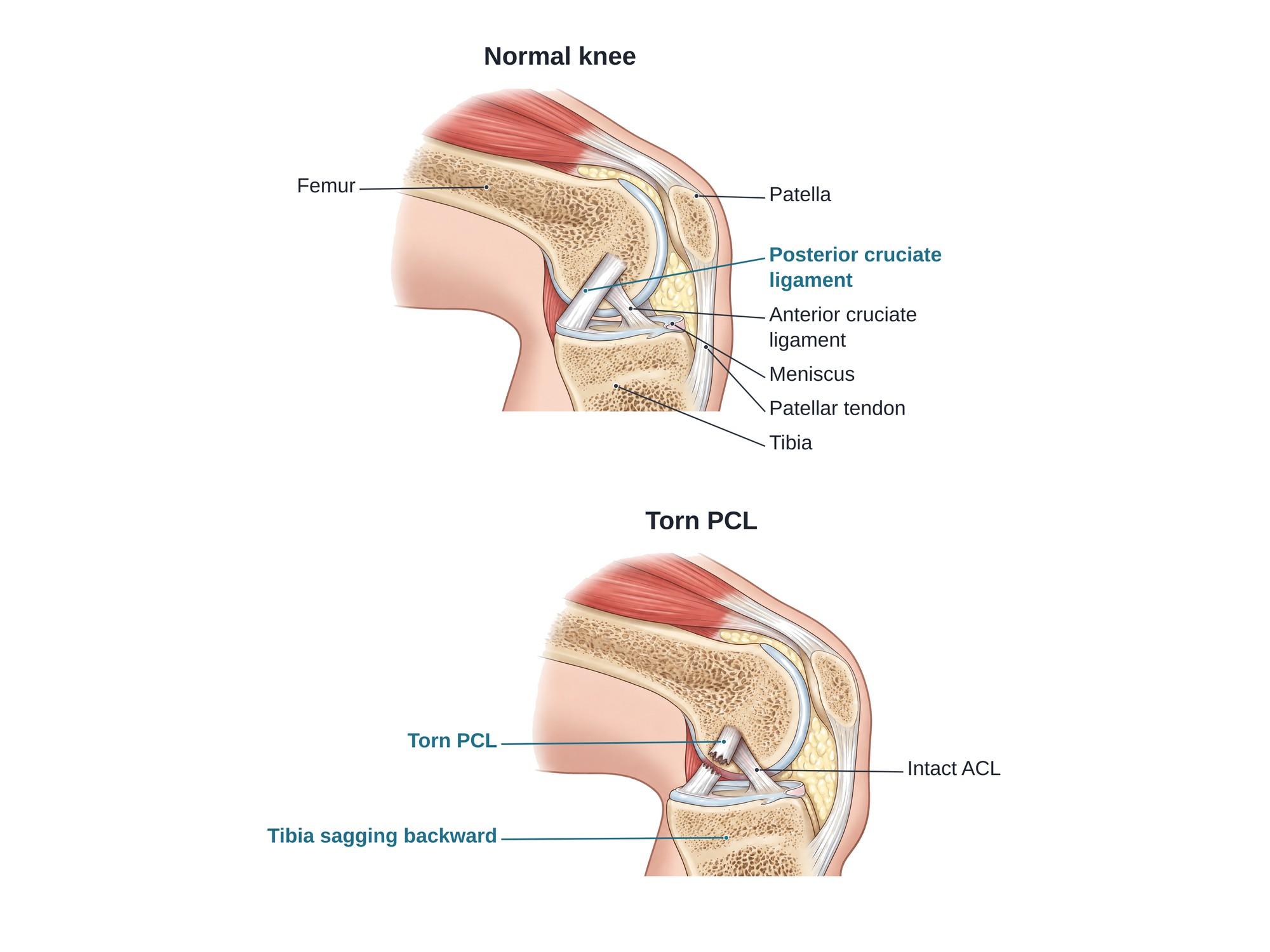
A PCL tear is a sprain or rupture of the posterior cruciate ligament, a strong band inside the knee joint. The PCL runs from the back of the top of the tibia up and forward to the inside of the femur. It crosses the anterior cruciate ligament (ACL) in an X and stops the tibia from sliding backward under the femur (see knee anatomy). It is the largest and strongest ligament in the knee. A PCL tear most often happens when the front of the shin hits something hard with the knee bent, as in a dashboard injury in a car crash. Isolated, complete PCL tears are rare, with about 1.8 new cases per 100,000 people a year (Sanders et al., 2017). PCL damage is more common after major trauma. One study found it in up to 38% of trauma patients with an acute knee injury and blood in the joint (Winkler et al., 2021). The illustration above shows a normal PCL beside a torn PCL, with the tibia sagging backward.
Grades
Doctors grade a PCL tear by how far the tibia moves backward under the femur when it is pushed (posterior tibial translation). In a normal knee, the front edge of the tibia sits a little in front of the femoral condyles, the rounded ends of the femur. A tear that comes with injuries to other ligaments is called a combined PCL injury, whatever the grade.
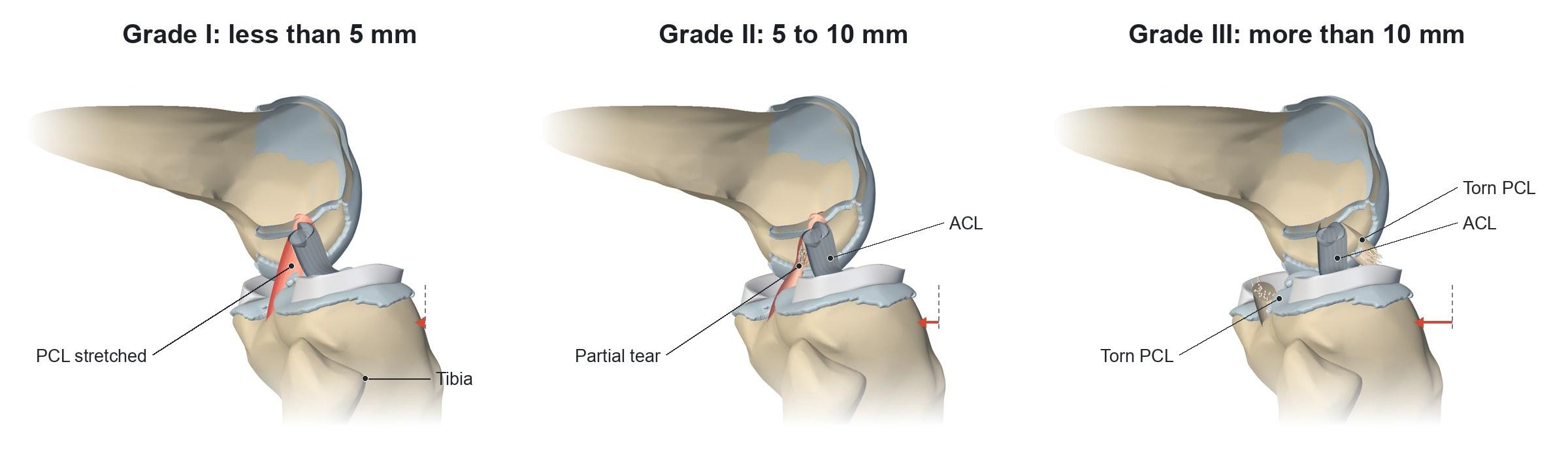
- Backward shift of the tibia
- Less than 5 mm
- What it means
- Partial tear; the tibia still sits in front of the femur
- Backward shift of the tibia
- 5 to 10 mm
- What it means
- Partial tear; the front of the tibia is level with the femur
- Backward shift of the tibia
- More than 10 mm
- What it means
- Complete tear; the tibia sags behind the femur
Grades I and II are partial tears with stretched or torn fibers. Grade III is a complete rupture of the ligament (Winkler et al., 2021). A grade III tear often means other structures are injured too, most often the posterolateral corner, the group of ligaments and tendons on the back and outer side of the knee.
Causes
The PCL tears when a strong force drives the top of the tibia backward. Common ways it happens:
- Dashboard injury. In a car crash, the bent knee hits the dashboard and the tibia is pushed back.
- Fall onto a bent knee, with the foot pointed down, so the front of the tibia strikes the ground first.
- Contact sports, such as football, soccer and rugby, from a tackle or a blow to the shin.
- Hyperextension, when the knee is forced to bend backward.
- Motorcycle and bicycle crashes and knee dislocations, which often tear several ligaments at once.
Crashes and sports cause most PCL tears. In a series of 1,000 patients who had PCL reconstruction, 39% were hurt in sports and 35% in traffic accidents (Schlumberger et al., 2020). In that series, combined injuries were the rule after crashes. In car accidents, 92% of PCL tears came with at least one other torn ligament. A PCL tear may come with an ACL tear, an MCL tear, a meniscus tear or a tibial plateau fracture.
Symptoms
PCL tear symptoms are often milder than those of an ACL tear. Many people do not feel a pop and can still walk, so the injury is easy to miss.
- Pain in the knee, often at the back of the knee
- Swelling that starts within hours of the injury
- Stiffness and trouble bending the knee fully
- Bruising or a scrape on the front of the shin, where it hit the dashboard or the ground
- A feeling that the knee is loose or wobbly, mostly going down stairs or slopes
- Pain at the front of the knee or kneecap over time, from extra load on the joint
- Trouble kneeling, squatting or running
Diagnosis
- History and exam. A blow to the front of the shin with the knee bent points to a PCL tear. The posterior drawer test is the main test: with the knee bent 90 degrees, the doctor pushes the shin backward and feels how far it moves. In the posterior sag sign, the tibia drops back under the femur when the hip and knee are bent with the leg relaxed. The quadriceps active test and the dial test check the PCL and the posterolateral corner.
- X-rays. These look for a fracture or a bony avulsion, where the PCL pulls a piece of bone off the back of the tibia. Stress X-rays taken while the shin is pushed backward measure the backward shift in millimeters, which sets the grade.
- MRI. This shows the torn ligament, where it tore (at the femur, in the middle or at the tibia) and any injury to the menisci, cartilage and other ligaments. A partial tear looks thickened with a bright signal inside it. A complete tear shows a gap or a wavy, loose ligament.
- Checking blood flow. After a high-energy injury, the doctor checks the pulses in the foot. A knee dislocation can injure the popliteal artery behind the knee.
Treatment
Nonsurgical treatment is used for most isolated grade I and II tears, and for some isolated grade III tears:
- A brace, often a PCL brace with a pad behind the calf that holds the tibia forward
- Rest, ice and elevation for the first days
- Physical therapy focused on the quadriceps, the muscles on the front of the thigh, which help hold the tibia forward
- Avoiding exercises that pull the tibia backward early on, such as hamstring curls
Surgery is advised for complete tears that leave the knee unstable, for combined ligament injuries and for bony avulsions:
- PCL reconstruction. The torn ligament is replaced with a tendon graft, from the patient or a donor, passed through tunnels drilled in the tibia and femur. It is similar to ACL reconstruction. A single-bundle graft rebuilds the larger, front part of the PCL. A double-bundle graft rebuilds both parts.
- Avulsion repair. When the PCL pulls off a piece of bone, the piece is put back and held with a screw or sutures.
- Multiligament reconstruction. When other ligaments are torn, such as the posterolateral corner, they are repaired or rebuilt at the same time.
In a review of 27 studies with 5,197 patients with isolated PCL tears, both surgery and nonsurgical care gave good function, and 70% returned to sports. Reconstruction left the knee tighter (Schroven et al., 2022).
Recovery
- Grade I and II tears: most people use a brace and do physical therapy for weeks to a few months. Many return to sports once strength and motion are back.
- Grade III tears without surgery: recovery takes longer, and some looseness often remains.
- After PCL reconstruction: a brace is worn for several weeks, often with limited weight on the leg at first. Therapy goes on for months. Return to sports usually takes many months, often close to a year.
- Quadriceps strength is the key to a good result, whichever treatment is used.
Complications
- Arthritis. A knee that stays loose wears faster, mostly in the inner compartment and behind the kneecap. In a population study, people with isolated PCL tears were about 6 times as likely to develop symptomatic arthritis over 12 years as people without the injury (Sanders et al., 2017). In the review above, arthritis was found in 22% after reconstruction and in 44% after nonsurgical care (Schroven et al., 2022).
- Ongoing instability, mostly with a missed posterolateral corner injury.
- Meniscus tears and cartilage damage over time.
- Stiffness and loss of motion after surgery.
- Graft stretching or failure after reconstruction.
- Nerve or artery injury, which is rare but serious, mostly after a knee dislocation or during surgery near the back of the knee.
How a PCL tear is shown in a personal injury case
A PCL tear is the classic dashboard injury of a car crash. The bent knee strikes the dashboard and the tibia is driven backward, so the mechanism links the injury directly to the crash. A bruise or scrape on the front of the shin, a posterior drawer test and an MRI showing the torn ligament are objective proof. Because many people can still walk at first, a PCL tear is sometimes found only weeks later. The records then need to tie the knee pain back to the crash. Stress X-rays give the backward shift in millimeters, which sets the grade. In a car crash, most PCL tears come with other torn ligaments, which supports the need for surgery and a long recovery. The higher risk of arthritis over time matters for future medical costs. A medical illustration of a normal knee beside one with a torn PCL helps a jury see how the tibia sags backward once the ligament is gone. For how these images are used at trial, see demonstrative evidence and medical legal illustration.
References
- Sanders TL, Pareek A, Barrett IJ, et al. Incidence and long-term follow-up of isolated posterior cruciate ligament tears. Knee Surgery, Sports Traumatology, Arthroscopy. 2017;25(10):3017-3023.
- Winkler PW, Zsidai B, Wagala NN, et al. Evolving evidence in the treatment of primary and recurrent posterior cruciate ligament injuries, part 1: anatomy, biomechanics and diagnostics. Knee Surgery, Sports Traumatology, Arthroscopy. 2021;29(3):672-681.
- Schlumberger M, Schuster P, Eichinger M, et al. Posterior cruciate ligament lesions are mainly present as combined lesions even in sports injuries. Knee Surgery, Sports Traumatology, Arthroscopy. 2020;28(7):2091-2098.
- Schroven W, Vles G, Verhaegen J, et al. Operative management of isolated posterior cruciate ligament injuries improves stability and reduces the incidence of secondary osteoarthritis: a systematic review. Knee Surgery, Sports Traumatology, Arthroscopy. 2022;30(5):1733-1743.
Related pages
- Knee anatomyThe normal anatomy of the knee.
- ACL tearAn ACL tear is a torn ligament inside the knee that lets the shin slide forward. Learn the grades, symptoms, surgery and recovery time.
- Knee dislocationA knee dislocation is when the tibia is forced off the femur, tearing several ligaments and risking the popliteal artery. Learn the types, symptoms and treatment.
- Meniscus tearA meniscus tear is a rip in the knee's C-shaped cartilage, most often the medial meniscus.
- Patellar dislocationA patellar dislocation is a kneecap that slides out of its groove, almost always to the outside. Causes, MPFL tears, patellar instability, treatment and recovery.
- Patellar tendon ruptureA patellar tendon rupture is a tear of the tendon below the kneecap, so the knee cannot straighten. Learn the types, symptoms and treatment.
- Patellar tendonitisPatellar tendonitis (jumper's knee) is overuse damage to the tendon below the kneecap. Learn the symptoms, stages, treatment and recovery time.
- Quadriceps tendon ruptureA quadriceps tendon rupture is a tear of the tendon above the kneecap. A complete tear stops the knee straightening. Learn symptoms, surgery and recovery.
FAQ
What are the symptoms of a PCL tear?+
Pain and swelling in the knee, pain at the back of the knee, stiffness and trouble bending, and a feeling that the knee is loose or unstable. Many people can still walk, and there is often no pop. Symptoms can be mild at first, so a PCL tear is easy to miss.
How does a PCL tear happen?+
Most often a hard blow to the front of the shin with the knee bent, which pushes the tibia backward. The classic case is a knee hitting the dashboard in a car crash. A fall onto a bent knee, a tackle and a hyperextended knee can also tear the PCL.
Can a PCL tear heal on its own?+
Partial tears (grade I and II) often heal well without surgery, with a brace and physical therapy. Complete tears may heal in a lengthened, loose position, and the knee can stay somewhat unstable.
Can you walk with a torn PCL?+
Usually, yes. Many people walk soon after the injury, especially with a partial tear. Going down stairs or slopes, kneeling and squatting are often harder, because the PCL controls the tibia most when the knee is bent.
How long does a PCL tear take to heal?+
A grade I or II tear usually takes weeks to a few months of bracing and therapy. A complete tear treated without surgery takes longer. After PCL reconstruction, return to sports usually takes many months, often close to a year.
Does a PCL tear need surgery?+
Not always. Isolated partial tears are usually treated without surgery. Surgery is advised for complete tears that leave the knee unstable, for bony avulsions, and when other ligaments are also torn, which is common after car crashes.
What is the difference between a PCL tear and an ACL tear?+
The two cruciate ligaments cross inside the knee. The ACL stops the tibia from sliding forward and usually tears with a twist or a sudden stop. The PCL stops the tibia from sliding backward and usually tears from a direct blow to the front of the shin. PCL tears are much less common.
Can a PCL tear cause arthritis?+
Yes. A knee that stays loose puts more load on the cartilage. In one long-term study, people with isolated PCL tears were about 6 times as likely to develop symptomatic arthritis as people without the injury.
Need this illustration for a patient or a case?
Describe the injury or upload a scan and get a clear, labeled medical illustration for a consult, a chart or a case exhibit.
Try Natomy →