Patellar Tendon Rupture: Symptoms, Surgery & Recovery Time
A patellar tendon rupture is a tear of the tendon below the kneecap, so the knee cannot straighten. See it illustrated beside normal anatomy, plus recovery time.
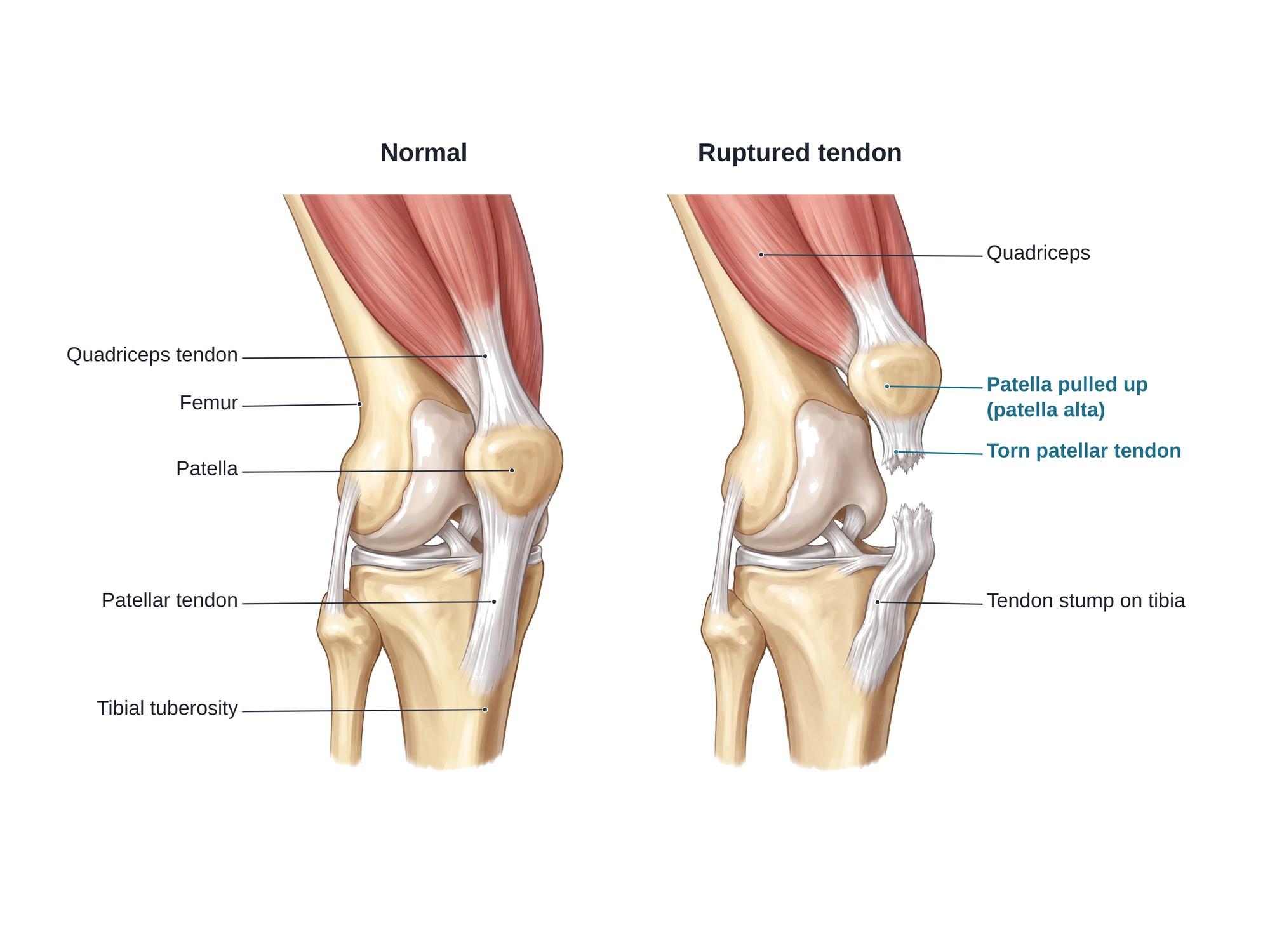
A patellar tendon rupture is a tear of the strong tendon that joins the bottom of the kneecap (patella) to the shinbone (tibia). This tendon is the last link in the knee's extensor mechanism, the chain that straightens the knee. When it tears completely, the thigh muscle pulls the kneecap upward and the person cannot straighten the knee. A complete tear usually needs surgery. The illustration above shows a normal tendon beside a ruptured one.
The anatomy
The large thigh muscle in front is the quadriceps. It narrows into the quadriceps tendon, which attaches to the top of the patella. The patellar tendon runs from the bottom of the patella to a bump on the front of the tibia called the tibial tuberosity. When the quadriceps contracts, this chain pulls the shin forward and straightens the knee. Some books call the patellar tendon the patellar ligament, because it joins bone to bone. For the full layout, see knee anatomy.
Types
Tears are grouped by how much of the tendon is torn and where.
| Type | What tears | What it means |
|---|---|---|
| Partial tear | Some of the tendon fibers | The knee can still straighten. Often treated in a brace. |
| Complete tear | The whole width of the tendon | The knee cannot straighten. Needs surgery. |
| Inferior pole tear | The tendon pulls off the bottom of the patella | The most common site. Sometimes a small flake of bone comes off too. |
| Midsubstance tear | The middle of the tendon | Less common. Often after direct trauma or a weak tendon. |
| Tibial tuberosity avulsion | The tendon pulls off the tibia | Rare. Seen mostly in teenagers. |
A complete tear is also called a rupture. A partial tear is sometimes searched for as a patellar tendon sprain or strain.
Causes
Most ruptures happen when the quadriceps contracts hard while the knee is bent. This is called an eccentric contraction, a muscle pulling while it is being stretched. Common examples:
- Landing from a jump, as in basketball or volleyball
- Missing a step on stairs and catching the body weight on a bent knee
- A fall with the foot planted and the knee bending under the body
- A direct blow to the front of the knee, as on a car dashboard
A healthy tendon is very strong. Many tears happen in a tendon already weakened by:
- Long-standing patellar tendinitis (jumper's knee)
- Steroid injections into or near the tendon
- Fluoroquinolone antibiotics, such as ciprofloxacin
- Kidney failure, diabetes, rheumatoid arthritis or lupus
- Earlier knee surgery, such as an ACL graft taken from the patellar tendon or a knee replacement
Symptoms
- A tearing or popping feeling below the kneecap
- Sudden pain and swelling in the front of the knee
- Bruising below the kneecap
- The knee buckles or gives way
- Inability to straighten the knee or lift the straight leg (a failed straight leg raise)
- A dent or soft gap just below the kneecap
- A kneecap that sits higher than on the other side
A partial tear may cause pain and weakness, but the person can still straighten the knee.
Diagnosis
The doctor first checks whether the patient can straighten the knee against gravity. They feel for a gap below the kneecap and compare its height with the other knee.
A side X-ray shows the kneecap sitting too high, called patella alta. Doctors measure this with ratios such as the Insall-Salvati ratio, which compares the tendon length with the kneecap length. A small bone flake may show a tear off the lower pole. Ultrasound shows the torn tendon ends and the gap. MRI shows partial tears and where the tendon tore, and checks for other knee injuries. It can also show signs of earlier tendinitis.
Treatment
Partial tears with a working extensor mechanism are usually treated without surgery. The knee is held straight in a brace for about 3 to 6 weeks. Physical therapy then restores motion and strength.
Complete tears are repaired with surgery, ideally within about 2 to 3 weeks:
- An incision is made down the front of the knee.
- Strong sutures are woven through the torn tendon end.
- For a tear off the patella, the sutures pass through small drill tunnels in the kneecap and are tied over the top. Suture anchors in the bone are another option.
- A wire or strong suture loop around the kneecap and tibia may protect the repair while it heals.
- The surgeon checks that the kneecap sits at the right height before closing.
When a tear is weeks or months old, the tendon may be shortened and scarred. Then the surgeon may rebuild it with a tendon graft, from the patient's hamstring or a donor.
A related injury is a patella fracture, a break of the kneecap itself that also disrupts the extensor mechanism.
Recovery
Recovery time after patellar tendon rupture surgery is long, and usually follows these stages:
- Weeks 0 to 6: a hinged brace, often locked straight for walking. Bending is slowly allowed, about 30 degrees more every week or two. Crutches at first.
- Weeks 6 to 12: the brace comes off. Physical therapy works on full bending and quadriceps strength.
- Months 3 to 6: strengthening, balance and normal walking on stairs.
- Months 6 to 12: running, jumping and return to sport or heavy work, once strength is close to the other leg.
Most people regain a functional knee. Some keep mild thigh weakness or lose a few degrees of bending.
Complications
- Knee stiffness, including loss of full bending
- Quadriceps weakness and thigh muscle wasting
- Re-rupture of the repaired tendon
- Patella baja, a kneecap that heals too low, or a kneecap left too high
- Infection or wound problems over the front of the knee
- Blood clots in the leg veins (deep vein thrombosis)
- Anterior knee pain and pain when kneeling
- Poorer results when the repair is delayed
How patellar tendon rupture is shown in a personal injury case
Patellar tendon ruptures follow falls on stairs, slips on wet floors, and car crashes where the knee strikes the dashboard. The defense may argue the tendon was already weak from tendinitis, steroid injections or a medical condition. The plaintiff's side may answer that a weak tendon can still need a specific event to tear. An illustration of the plaintiff's own knee, normal beside ruptured, shows the jury why the kneecap rode up and why the leg could not straighten. A second figure can show the surgical repair. For how these images are used at trial, see demonstrative evidence and medical legal illustration.
Related pages
FAQ
Does a torn patellar tendon need surgery?+
A complete tear almost always needs surgery, because the tendon ends pull apart and cannot heal on their own. Surgery works best within about 2 to 3 weeks of the injury. A small partial tear, where the person can still straighten the knee against gravity, can often heal in a brace that keeps the knee straight.
What does a ruptured patellar tendon feel like?+
Most people feel a sudden tearing or popping below the kneecap, then sharp pain and fast swelling. The knee buckles. They usually cannot lift the straight leg off the bed or straighten the knee. A soft dent can often be felt below the kneecap.
Can you walk with a torn patellar tendon?+
With a complete tear, walking is very hard and the knee gives way, because nothing pulls the shin straight. Some people can shuffle with the knee locked straight. With a partial tear, walking may be possible but painful.
How common are patellar tendon ruptures?+
They are uncommon. They happen most often in active people under about 40, and more often in men. Many people who tear the tendon had some earlier tendon weakness, such as long-standing tendinitis (jumper's knee).
How long is recovery after patellar tendon surgery?+
The knee is usually kept in a brace for about 6 weeks, with bending slowly increased. Walking without crutches often returns at about 6 to 8 weeks. Most people return to normal daily life in 3 to 4 months. Sports and heavy work usually take 6 months to a year.
What is the difference between a patellar tendon rupture and a quadriceps tendon rupture?+
Both tear the knee's straightening mechanism. A patellar tendon rupture is below the kneecap, so the kneecap rides up (patella alta). A quadriceps tendon rupture is above the kneecap, so the kneecap sits low. Quadriceps tears are more common in people over 40.
Can a patellar tendon rupture heal without surgery?+
A complete rupture does not heal well without surgery. The kneecap stays pulled up and the knee stays weak. Partial tears with an intact ability to straighten the knee can heal with a brace and physical therapy.
Is a patellar tendon rupture permanent?+
With a timely repair, most people get back a strong knee and good motion. Some lose a little thigh strength or full bending. Results are worse when repair is delayed for weeks, because the tendon shortens and scars.
Need this illustration for a patient or a case?
Describe the injury or upload a scan and get a clear, labeled medical illustration for a consult, a chart or a case exhibit.
Try Natomy →