Below Knee Amputation: Procedure, Recovery & Risks
A below knee amputation removes the lower leg through the tibia and fibula and pads the bone ends with calf muscle. See the cut level and the residual limb.
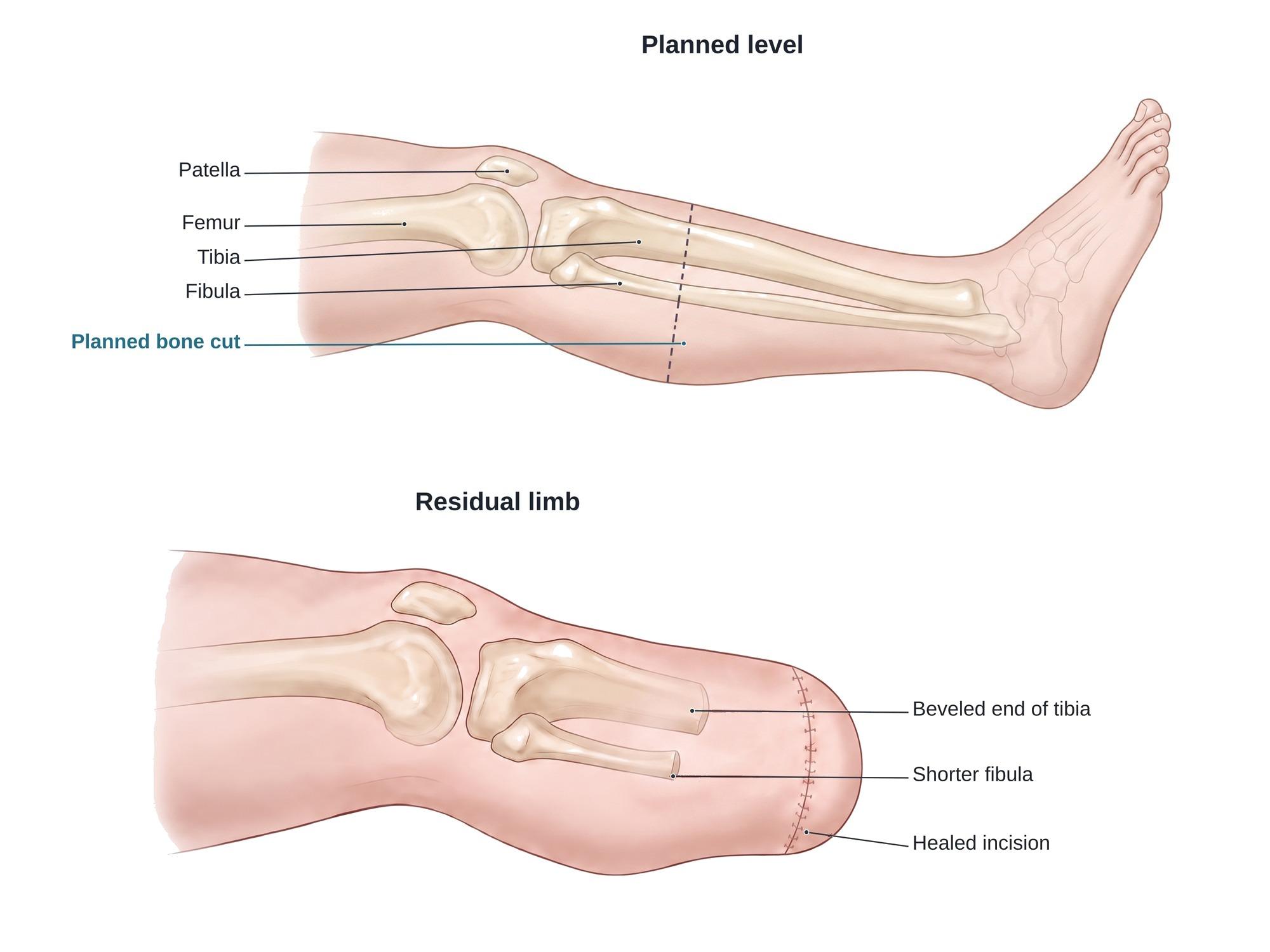
A below knee amputation (BKA), also called a transtibial amputation, is surgery to remove the lower leg through the tibia (shin bone) and fibula (the thin outer leg bone). The knee joint is kept. The bone ends are padded with calf muscle and covered with skin, forming a residual limb (stump) that can later fit a prosthesis (artificial leg). The illustration above shows the planned cut level, then the healed residual limb.
Why it is done
A below knee amputation is done when the foot or lower leg cannot be saved, or when saving it would cause more harm than help. Common reasons are:
- Peripheral artery disease (PAD), where blocked arteries starve the leg of blood.
- Diabetes with foot ulcers, deep infection or gangrene (dead tissue).
- Severe trauma, such as a crushed or mangled leg from a car, motorcycle or industrial accident. See tibia and fibula fracture.
- Failed limb salvage, where an open fracture, infection or nonunion keeps coming back after many surgeries.
- Compartment syndrome with dead muscle that cannot recover. See fasciotomy.
- Bone or soft tissue tumors, which are less common.
Surgeons try to keep the knee whenever the tissue there can heal. Walking with a below knee prosthesis takes much less energy than walking with an above knee one.
How the surgery is done
The surgery usually takes about 1 to 2 hours. It is done under general or spinal anesthesia, often with a nerve block for pain control.
- Marking the level. The tibia is usually cut about 12 to 15 cm below the knee joint, near the junction of its upper and middle thirds. This leaves enough bone to work a prosthesis, as shown by the dashed line in the top panel.
- Skin incision. The most common design is the long posterior flap. The front incision crosses the shin at the cut level. The side incisions run down the calf, so a long flap of calf skin and muscle stays attached at the back.
- Vessels and nerves. The arteries and veins are tied off. The main nerves are pulled down gently, cut cleanly, and allowed to pull back into the muscle. This lowers the risk of a painful nerve end (neuroma).
- Bone cuts. The tibia is cut with a saw. Its front edge is beveled (rounded off) so it does not press on the skin. The fibula is cut 1 to 2 cm shorter than the tibia.
- Muscle flap. The calf muscles at the back (mainly the gastrocnemius and soleus) are folded forward over the bone ends. They are stitched to the tissue at the front of the tibia. This padding is called a myoplasty, or a myodesis when the muscle is attached to the bone.
- Closing. The skin is closed over the end, often with a drain. A soft or rigid dressing protects the limb and controls swelling.
Recovery
- The hospital stay is often about 3 to 7 days. Many patients then go to a rehab center.
- Therapy starts within days: moving in bed, transfers, and using a walker or wheelchair.
- Keeping the knee straight when resting helps prevent a tight knee (flexion contracture).
- The incision usually heals in about 4 to 8 weeks.
- Swelling is controlled with wraps or a shrinker sock to shape the limb.
- A first prosthesis is often fitted about 6 to 12 weeks after surgery. The socket is changed as the limb shrinks over the first year.
Risks
- Wound healing problems, more common with diabetes, smoking and poor circulation.
- Infection, which may need more surgery.
- Re-amputation at a higher level, sometimes above the knee, if the wound does not heal.
- Phantom limb pain and phantom sensation, feeling the missing part of the leg.
- Residual limb pain, including a painful nerve end (neuroma) or bone spurs.
- Knee contracture, which can make fitting a prosthesis harder.
- Blood clots, heart attack and stroke, especially in people with vascular disease.
- Higher risk of death in the years after surgery for people with diabetes and blocked arteries, mostly because of their underlying disease.
How below knee amputation is shown in a personal injury case
A below knee amputation is one of the most serious outcomes in a crash, workplace or medical malpractice case. It may follow a crushed leg, a missed compartment syndrome, a delayed diagnosis of a blocked artery, or an infection that was not treated in time. Damages include the surgery, rehab, a lifetime of prostheses and socket changes, home changes, lost earnings, and phantom pain. An illustration that shows the level of the cut and the bone ends left inside the residual limb helps a jury understand what was removed and why a prosthesis must be replaced over time. For how these images are used at trial, see demonstrative evidence and medical legal illustration. For the normal knee that the surgery aims to keep, see knee anatomy. For how a tibia fracture is fixed when the leg can be saved, see intramedullary nailing.
Related pages
- Knee anatomyThe normal anatomy of the knee.
- Intramedullary nailingIntramedullary nailing fixes a broken tibia or femur with a metal rod inside the bone. See the nail and locking screws beside the original fracture.
- Tibial plateau fracture surgeryTibial plateau fracture surgery lifts a sunken knee joint surface and holds it with a plate and screws. See the fracture and the repair side by side.
FAQ
How long does it take to amputate a leg below the knee?+
The surgery itself usually takes about 1 to 2 hours. In some cases, such as a severe infection, it is done in two stages a few days apart: first a quick operation to remove the infected part, then the final closure.
How long is recovery after a below knee amputation?+
The incision usually heals in about 4 to 8 weeks. A first prosthesis is often fitted about 6 to 12 weeks after surgery, once swelling goes down. Learning to walk well with it takes several more months, so full recovery often takes most of a year.
Can you die from getting your leg amputated?+
The surgery carries real risk, mostly because of the health problems that lead to it. People with diabetes, poor circulation, heart disease or kidney disease have a much higher risk of death in the months and years after a major amputation. Healthy younger patients after trauma do much better.
Why do people with diabetes have a high death rate after amputation?+
The amputation is often a sign of advanced disease. The same diabetes and blocked arteries that caused the foot wound also affect the heart, kidneys and brain. Less activity after amputation, infections, and wounds on the other leg add to the risk.
Is it better to amputate above or below the knee?+
When it is possible, below the knee is usually better. Keeping the knee makes walking with a prosthesis much easier and uses less energy. An above knee amputation is chosen when the knee area is too damaged, infected or poorly supplied with blood to heal.
What is phantom limb pain?+
Phantom limb pain is pain that feels like it comes from the part of the leg that was removed. It is common after amputation. It often improves over months, and it is treated with medicines, therapy and sometimes nerve procedures.
What does a below knee amputation stump look like?+
The healed residual limb, often called the stump, is rounded at the end. The bone ends are covered and padded by calf muscle, and a scar runs across the end. Swelling goes down over the first months, and the limb is shaped with wraps or a shrinker sock before a prosthesis is fitted.
Can you walk after a below knee amputation?+
Most people who were walking before the amputation can walk again with a prosthesis, especially when the knee is kept. Success depends on overall health, strength, balance and the fit of the socket.
Need a surgical illustration for consent or a case?
Describe the operation and get a clear, labeled medical illustration for patient consent, teaching or a case exhibit.
Try Natomy →