Patellar Tendonitis: Symptoms, Treatment & Recovery Time
Patellar tendonitis (jumper's knee) is overuse damage to the tendon below the kneecap. Learn the symptoms, stages, treatment and recovery time.
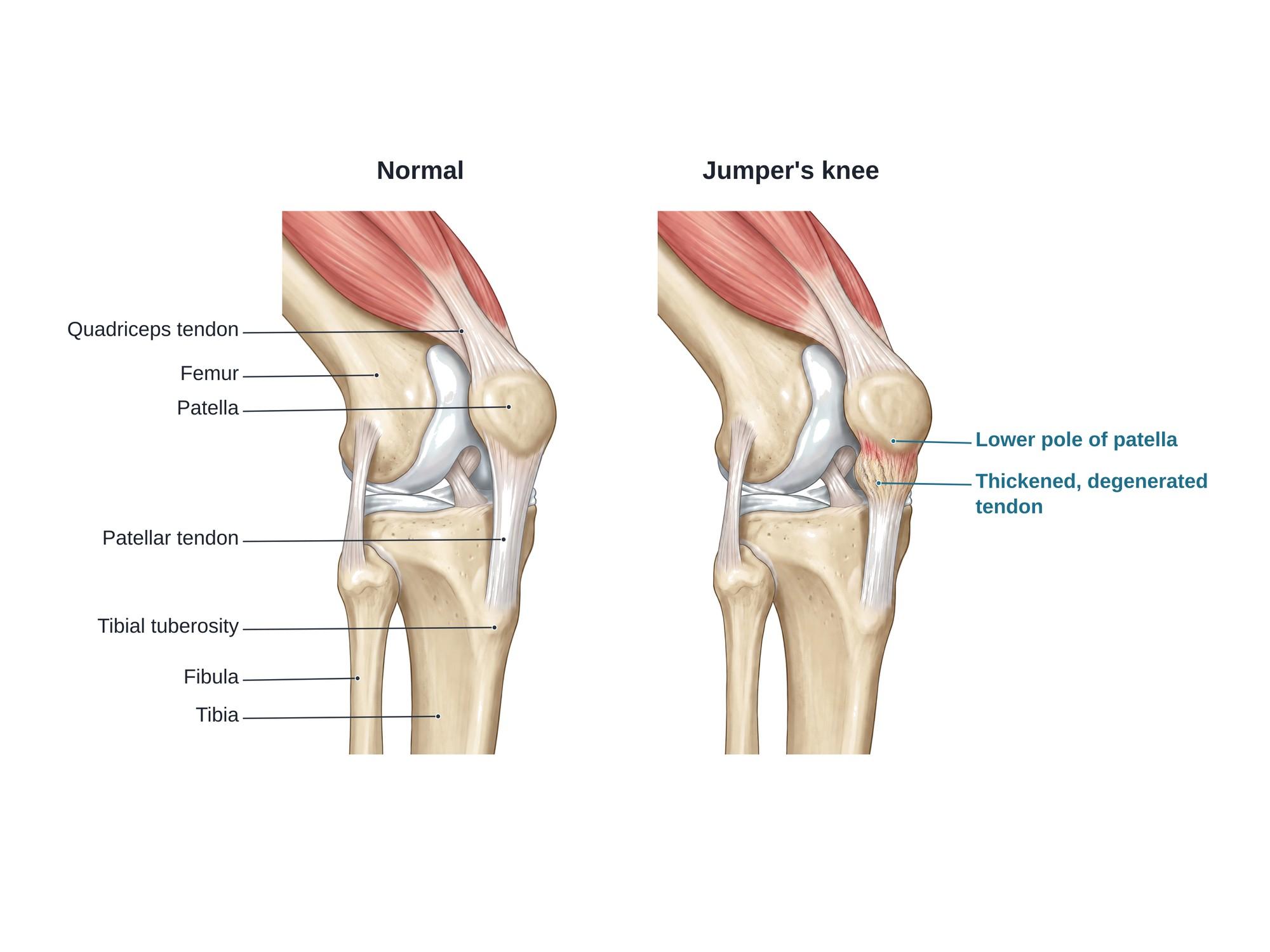
Patellar tendonitis, also called jumper's knee or patellar tendinopathy, is an overuse injury of the patellar tendon. This tendon joins the bottom of the kneecap (patella) to a bump on the front of the shinbone called the tibial tuberosity. It is the last link in the knee's extensor mechanism, the chain of thigh muscle, tendons and kneecap that straightens the knee (see knee anatomy). Repeated jumping and landing load the tendon more than it can recover from. The upper part of the tendon, at the lower pole (bottom tip) of the kneecap, then thickens and wears. A review of 28 studies found it in 18% of athletes but only 0.1% of the general population (Nutarelli et al., 2023). The illustration above shows a normal tendon beside a thickened, degenerated one.
Stages
Doctors often grade jumper's knee by how pain relates to activity. This is the Blazina system, from the paper that named the condition (Blazina et al., 1973). The original system had three stages. A fourth stage, for a complete tear, was added later (Roels et al., 1978).
- Pain
- Pain only after activity
- Effect on sport
- None
- Pain
- Pain during and after activity
- Effect on sport
- Can still play at a normal level
- Pain
- Constant pain during and after activity
- Effect on sport
- Harder to play at a normal level
- Pain
- Complete tear of the tendon
- Effect on sport
- Cannot straighten the knee
Stage 4 is a patellar tendon rupture, a separate injury that needs surgery.
Causes
The patellar tendon stores and releases energy like a spring each time you jump, land or change direction. Symptoms start when the load rises faster than the tendon can adapt. Researchers now see it mainly as a degenerative problem from overuse, not just inflammation (Nutarelli et al., 2023). Under strain, the tendon fibers become disorganized, the tendon thickens, and small new blood vessels grow in.
Jumping sports carry the highest risk. In the same review, 25% of volleyball players and 21% of basketball players had it, against 6% of soccer players (Nutarelli et al., 2023).
Risk factors include:
- Jumping sports, such as volleyball, basketball and high jump
- A sudden rise in training, more games, or a new season
- More training hours, and some playing surfaces
- A stiff landing technique that loads the tendon hard
- Male sex: 17% of male athletes had it, against 11% of female athletes
- Adult athletes: 21% of athletes 18 and older, against 10% of younger ones (Nutarelli et al., 2023)
Symptoms
- Pain just below the kneecap, at the bottom tip of the patella
- Pain that starts with jumping, landing, running or squatting
- Pain going down stairs, kneeling, or sitting with the knee bent for a long time
- Stiffness at the start of activity, which may ease after warming up
- Tenderness when pressing on the tendon below the kneecap
- In later stages, pain during sport that limits how well you can play
Pain is usually at the front of the knee. Sudden severe pain with a pop, and trouble straightening the knee, suggests a tear instead.
Diagnosis
The diagnosis is mostly made by history and examination. The doctor presses on the tendon just below the kneecap to find the sore spot. A single-leg decline squat on a slanted board often brings on the pain. Many clinics track symptoms with the VISA-P questionnaire, scored out of 100.
Imaging helps confirm it or rule out other causes. Ultrasound shows a thickened tendon with a darker, damaged zone. This is usually in the back (deep) part of the tendon near the lower pole of the kneecap. Doppler ultrasound can show new blood vessel growth (Theodorou et al., 2023). MRI shows a thickened tendon with a bright signal in the damaged area and checks the rest of the knee. X-rays do not show the tendon, but can show bone changes.
Other causes of pain at the front of the knee include patellofemoral pain, fat pad irritation, and in teenagers, Osgood-Schlatter disease at the tibial tuberosity.
Treatment
Patellar tendonitis treatment starts without surgery. The aim is to load the tendon in a way it can handle, then build it up.
- Load management. Cut back jumping and other painful activity, without full rest. Some mild pain is often allowed.
- Exercise therapy. This is the core of treatment. Programs include slow heavy leg presses and squats, and eccentric squats on a decline board (lowering under load). Many programs run for about 12 weeks, then jumping is added back step by step.
- Patellar tendon strap or brace. A band worn just below the kneecap eases pain during sport for some people. Study results are mixed.
- Ice and pain medicine can help pain for a short time.
- Injections and shockwave therapy. Platelet-rich plasma (PRP) and extracorporeal shockwave therapy are used when exercise alone fails. Steroid injections into the tendon are avoided, as they are linked to tendon rupture.
Patellar tendonitis surgery is usually considered only after about 6 months of good non-surgical care has failed. The surgeon removes the damaged tissue from the tendon, either through an open cut or by arthroscopy. Success rates in one systematic review were 91% for arthroscopic surgery and 87% for open surgery (Theodorou et al., 2023). The evidence is weak, though. In a Cochrane review, a trial of 40 adults found open surgery gave no clinically important benefit over eccentric exercise at 12 months (Dan et al., 2019).
Recovery
Patellar tendonitis recovery time depends on the stage and how long the pain has been there.
- Mild, early cases: often improve once the training load is lowered.
- Long-standing cases: usually need months of steady strengthening. Many exercise programs run for 12 weeks, and some people need longer.
- After surgery: in the same review, return to sport took an average of 3.9 months after arthroscopic surgery and 8.3 months after open surgery (Theodorou et al., 2023).
Return to sport is based on symptoms and strength, not the calendar. The tendon should tolerate hopping and landing with little pain that settles by the next day.
Complications
- Long-lasting pain. Jumper's knee often comes back or lingers for years. In a study of young elite volleyball players followed for 11 years, 19% of those with jumper's knee quit competitive volleyball because of it (Visnes et al., 2024). Knee function was still lower in the affected knees.
- Patellar tendon rupture. This is uncommon. Steroid injections into the tendon are linked to tendon rupture.
- Thigh muscle weakness from months of reduced activity.
- Surgical risks, such as infection, stiffness and continued pain, if surgery is needed.
A related injury above the kneecap is a quadriceps tendon rupture. Quadriceps tendonitis, overuse pain where the thigh tendon meets the top of the kneecap, is the same kind of problem one level higher.
References
- Nutarelli S, da Lodi CMT, Cook JL, et al. Epidemiology of patellar tendinopathy in athletes and the general population: a systematic review and meta-analysis. Orthopaedic Journal of Sports Medicine. 2023;11(6):23259671231173659.
- Blazina ME, Kerlan RK, Jobe FW, et al. Jumper's knee. Orthopedic Clinics of North America. 1973;4(3):665-678.
- Theodorou A, Komnos G, Hantes M. Patellar tendinopathy: an overview of prevalence, risk factors, screening, diagnosis, treatment and prevention. Archives of Orthopaedic and Trauma Surgery. 2023;143(11):6695-6705.
- Dan M, Phillips A, Johnston RV, et al. Surgery for patellar tendinopathy (jumper's knee). Cochrane Database of Systematic Reviews. 2019;9:CD013034.
- Visnes H, Bache-Mathiesen LK, Yamaguchi T, et al. Long-term prognosis of patellar tendinopathy (jumper's knee) in young, elite volleyball players: tendon changes 11 years after baseline. American Journal of Sports Medicine. 2024;52(13):3314-3323.
- Roels J, Martens M, Mulier JC, et al. Patellar tendinitis (jumper's knee). American Journal of Sports Medicine. 1978;6(6):362-368.
Related pages
- Knee anatomyThe normal anatomy of the knee.
- ACL tearAn ACL tear is a torn ligament inside the knee that lets the shin slide forward. Learn the grades, symptoms, surgery and recovery time.
- Knee dislocationA knee dislocation is when the tibia is forced off the femur, tearing several ligaments and risking the popliteal artery. Learn the types, symptoms and treatment.
- Meniscus tearA meniscus tear is a rip in the knee's C-shaped cartilage, most often the medial meniscus.
- Patellar dislocationA patellar dislocation is a kneecap that slides out of its groove, almost always to the outside. Causes, MPFL tears, patellar instability, treatment and recovery.
- Patellar tendon ruptureA patellar tendon rupture is a tear of the tendon below the kneecap, so the knee cannot straighten. Learn the types, symptoms and treatment.
- PCL tearA PCL tear is an injury to the ligament that stops the shin from sliding back, often from a dashboard blow. Learn the symptoms, grades and recovery time.
- Quadriceps tendon ruptureA quadriceps tendon rupture is a tear of the tendon above the kneecap. A complete tear stops the knee straightening. Learn symptoms, surgery and recovery.
FAQ
Where is the patellar tendon?+
It is the strong band just below the kneecap. It runs from the bottom of the kneecap (patella) to a bump on the front of the shinbone called the tibial tuberosity. You can feel it as a firm cord below the kneecap when the leg is straight and relaxed.
How long does patellar tendonitis take to heal?+
Mild cases often improve once the training load is cut back. Long-standing cases usually need months of steady strengthening, and many exercise programs run for 12 weeks. Surgery is usually considered only after about 6 months of good treatment has failed.
Is it OK to keep playing sport with patellar tendonitis?+
Many athletes keep training while pain stays mild and settles by the next day. Pain that gets worse during play, or is worse the next morning, means the load is too high. Ignoring it can turn a short problem into one that lasts for years.
Do patellar tendon straps or braces help?+
A strap worn just below the kneecap eases pain during sport for some people, though study results are mixed. It does not heal the tendon, so it is used alongside a strengthening program.
Is patellar tendonitis the same as jumper's knee?+
Yes. Jumper's knee is the common name. Doctors often use the term patellar tendinopathy, because long-standing cases show wear in the tendon more than inflammation.
What is the difference between patellar tendonitis and quadriceps tendonitis?+
Both are overuse problems of the tendons that straighten the knee. Patellar tendonitis hurts below the kneecap. Quadriceps tendonitis hurts just above the kneecap, where the thigh muscle tendon attaches.
Can patellar tendonitis lead to a tendon rupture?+
It is uncommon. Steroid injections into the tendon are linked to rupture, so doctors avoid them.
Does patellar tendonitis need surgery?+
Rarely. Most people get better with load changes and exercise therapy. Surgery is kept for pain that lasts despite about 6 months of good non-surgical care.
Need this illustration for a patient or a case?
Describe the injury or upload a scan and get a clear, labeled medical illustration for a consult, a chart or a case exhibit.
Try Natomy →