Quadriceps Tendon Rupture: Symptoms, Surgery & Recovery Time
A quadriceps tendon rupture is a tear of the tendon above the kneecap. A complete tear stops the knee straightening. Learn symptoms, surgery and recovery.
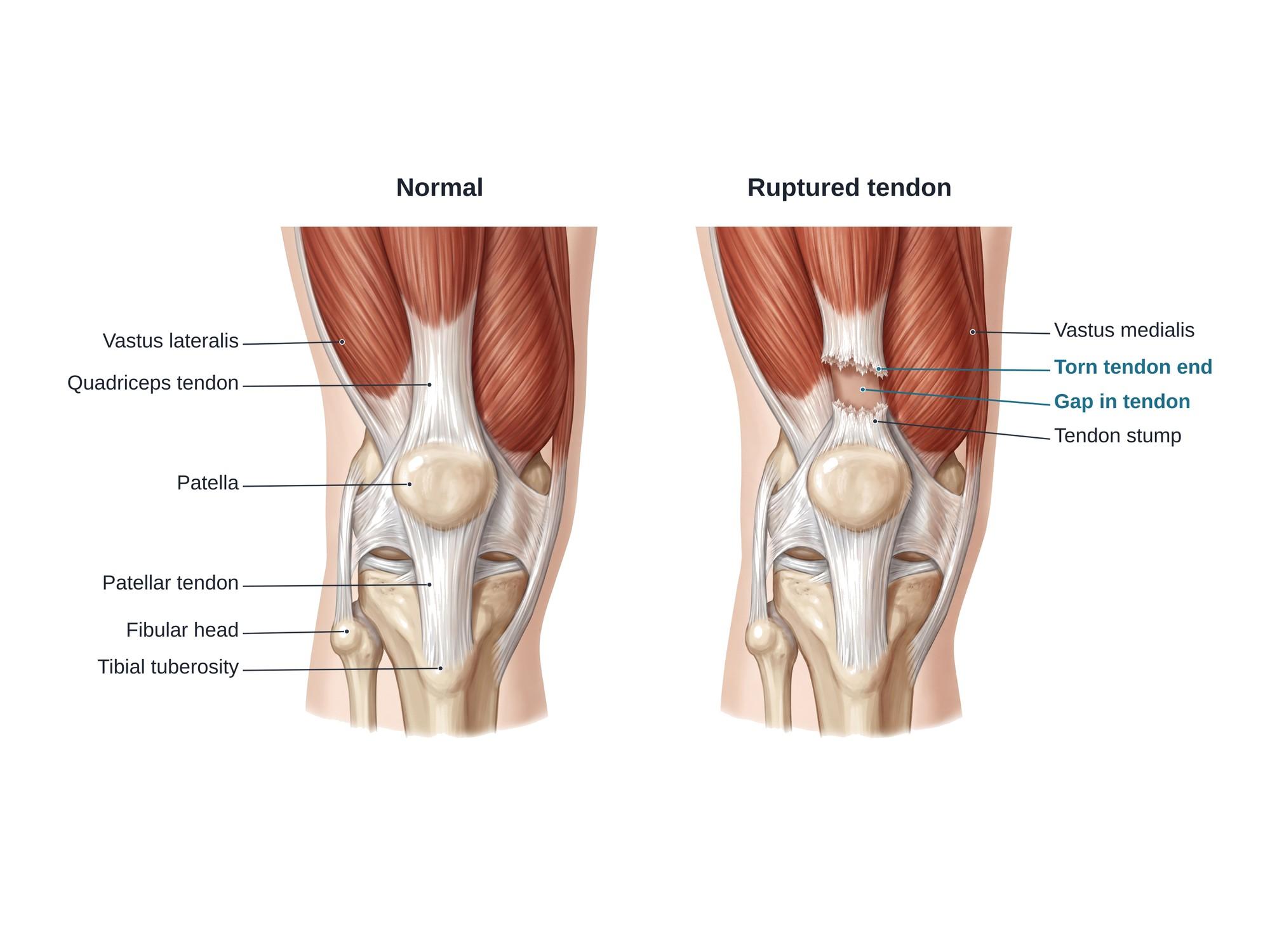
A quadriceps tendon rupture is a tear of the thick tendon that joins the thigh muscles to the top of the kneecap (patella). The quadriceps is the large muscle group on the front of the thigh. Its four parts merge into one tendon just above the kneecap. That tendon is the first link in the knee's extensor mechanism, the chain that straightens the knee (see knee anatomy). When the tendon tears completely, the muscle can no longer pull the kneecap, so the person cannot straighten the knee. The injury is uncommon, at about 1.4 cases per 100,000 people a year, and it mostly affects people 40 and older (Arnold et al., 2022). A complete tear needs surgery. The illustration above shows a normal tendon beside a ruptured one.
Types
Tears are grouped by how much of the tendon is torn and how long ago it happened.
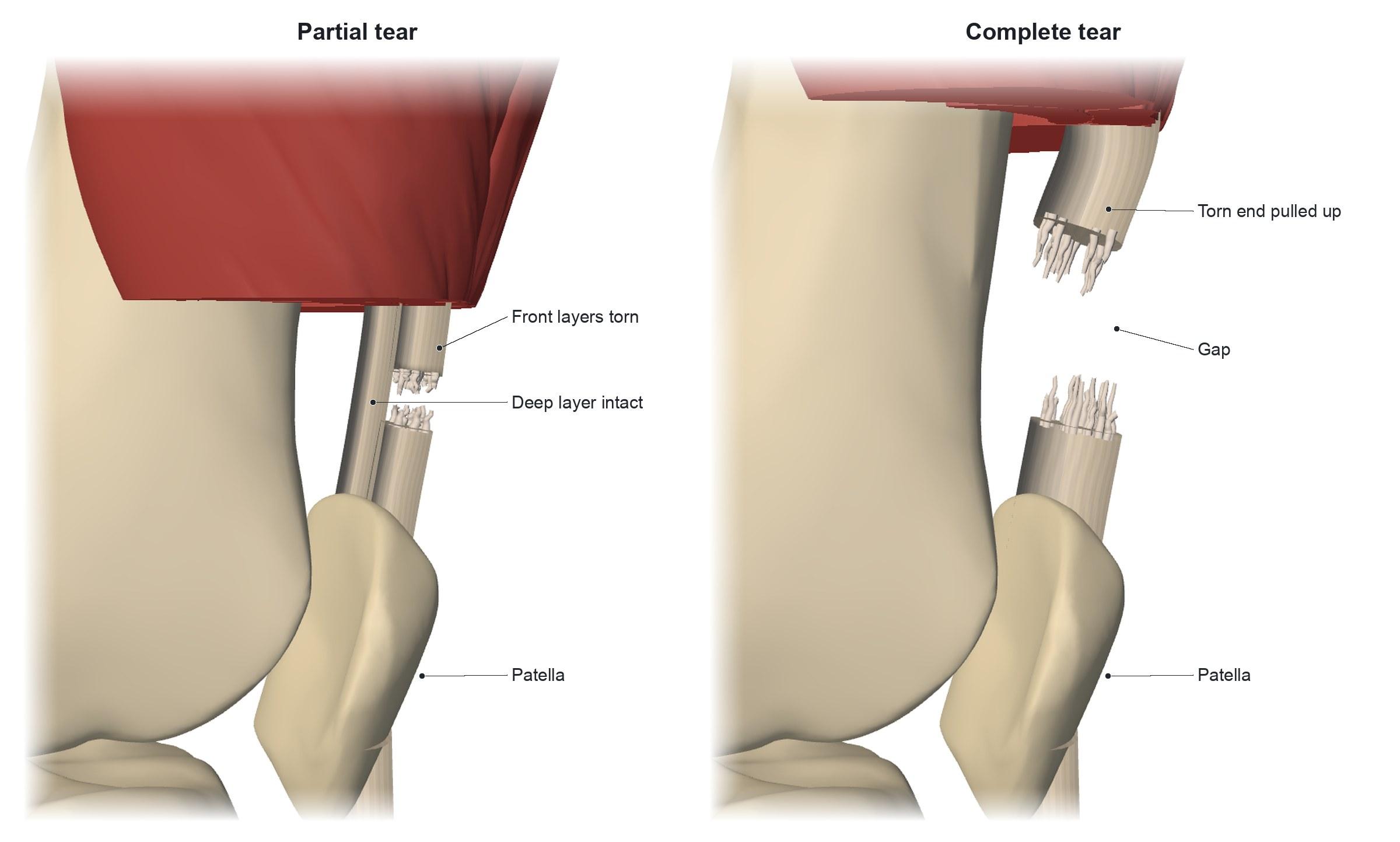
| Type | What tears | What it means |
|---|---|---|
| Partial tear | Some of the tendon layers | The knee can still straighten. Often treated in a brace. |
| Complete tear | The full width of the tendon | The knee cannot straighten. Needs surgery. |
| Acute tear | A tear found and treated soon after injury | The torn ends can usually be sewn back to the kneecap. |
| Chronic tear | A tear left for weeks or more | The tendon shortens and scars. Repair often needs a graft. |
The quadriceps tendon is built in three layers. A partial tear may involve only one or two of them. A complete tear is also called a rupture.
Causes
Most tears happen when the quadriceps contracts hard while the knee is bent. This is an eccentric contraction, a muscle pulling while it is being stretched. The most common way it happens is a simple fall (Arnold et al., 2022). Common examples:
- Tripping or missing a step and catching the body weight on a bent knee
- Slipping with the foot planted, so the knee bends under the body
- Landing from a jump
- Less often, a direct blow or a cut to the front of the thigh
Tears happen most in middle-aged men (Rao et al., 2022). A healthy tendon is very strong, so many tears happen in a tendon weakened by age or disease. Conditions that raise the risk include (Arnold et al., 2022):
- Chronic kidney disease and secondary hyperparathyroidism
- Diabetes
- Rheumatoid arthritis, lupus and gout
- Peripheral vascular disease
Steroid use, obesity and earlier knee surgery can weaken the tendon too. Quadriceps tendon ruptures make up about 9% of knee extensor mechanism injuries seen in US emergency rooms. In that national study, they rose by about 5% a year from 2001 to 2020 (Lyons et al., 2023).
Symptoms
- A tearing or popping feeling just above the kneecap
- Sudden pain and swelling at the front of the knee
- Bruising above the knee
- The knee buckles or gives way when standing
- Inability to straighten the knee or lift the straight leg off the bed (a failed straight leg raise)
- A dent or soft gap just above the kneecap
- A kneecap that sits lower or looser than on the other side
A partial tear causes pain and weakness, but the person can still straighten the knee.
Diagnosis
The doctor first checks whether the patient can straighten the knee against gravity. They feel for a gap above the kneecap. Swelling can hide the gap, so this injury is sometimes missed at first.
A side X-ray may show the kneecap sitting low, called patella baja. It may also show a small flake of bone pulled off the top of the kneecap, or soft tissue swelling above it. Ultrasound shows the torn tendon ends and the gap between them. MRI is the most accurate test. It shows whether the tear is partial or complete and how far the tendon has pulled back (Arnold et al., 2022). Tears in both knees at once can happen, mostly in people with kidney disease or other risk factors.
Treatment
Partial tears with a working extensor mechanism are usually treated without surgery. The knee is held straight in a brace for several weeks. Physical therapy then restores motion and strength.
Complete tears need prompt surgery. Repair is usually done soon after the injury, before the tendon shortens and scars:
- An incision is made down the front of the knee, over the tear.
- Strong sutures are woven up and down the torn tendon end.
- Most often, the sutures pass through small tunnels drilled lengthwise through the kneecap and are tied at its lower end. This is called a transosseous repair.
- Suture anchors, small screws or plugs set into the top of the kneecap, are an alternative to the tunnels (Arnold et al., 2022).
- The surgeon repairs any torn tissue beside the kneecap (the retinaculum) and checks the repair as the knee bends.
For a chronic tear, the tendon may be too short to reach the kneecap. The surgeon may lengthen it or rebuild it with a tendon graft.
A related injury is a patellar tendon rupture, a tear below the kneecap. A patella fracture also breaks the extensor mechanism.
Recovery
Quadriceps tendon rupture recovery time is long. A typical course after surgery:
- Weeks 0 to 6: a hinged brace, locked straight for walking. Many surgeons allow full weight on the leg in the brace early. Bending is slowly increased.
- Weeks 6 to 12: the brace is unlocked and then removed. Therapy works on full bending and quadriceps strength.
- Months 3 to 6: strengthening, balance and stairs. Many people return to desk or light work.
- Months 6 to 12: running, jumping, sports and heavy labor, once strength is close to the other leg.
Early movement with full weight bearing in a brace is now recommended (Arnold et al., 2022). In a study of 38 patients aged 40 or younger, 91% of workers returned to work at an average of 3.9 months. Only 63% of athletes returned to their sport, at an average of 8.8 months (Rao et al., 2022).
Complications
- Knee stiffness, mostly loss of full bending
- Quadriceps weakness and thigh muscle wasting
- Ongoing pain at the front of the knee. In the study above, 32% still had knee pain and stiffness about 6 years after surgery (Rao et al., 2022).
- Re-rupture of the repaired tendon
- Infection or wound problems
- Blood clots in the leg veins (deep vein thrombosis)
- Bone forming in the tendon (heterotopic ossification)
- Poorer results when the repair is delayed
For how figures like this one are used in injury cases, see medical legal illustration. Other knee injuries on the atlas include knee dislocation and ACL reconstruction.
References
- Arnold EP, Sedgewick JA, Wortman RJ, et al. Acute quadriceps tendon rupture: presentation, diagnosis, and management. JBJS Reviews. 2022;10(2).
- Lyons JG, Mian HM, Via GG, et al. Trends and epidemiology of knee extensor mechanism injuries presenting to United States emergency departments from 2001 to 2020. The Physician and Sportsmedicine. 2023;51(2):183-192.
- Rao S, Johnson EE, D'Amore T, et al. Outcomes after repair of quadriceps tendon rupture in patients aged 40 years and younger. Orthopaedic Journal of Sports Medicine. 2022;10(5):23259671221097107.
Related pages
- Knee anatomyThe normal anatomy of the knee.
- ACL tearAn ACL tear is a torn ligament inside the knee that lets the shin slide forward. Learn the grades, symptoms, surgery and recovery time.
- Knee dislocationA knee dislocation is when the tibia is forced off the femur, tearing several ligaments and risking the popliteal artery. Learn the types, symptoms and treatment.
- Meniscus tearA meniscus tear is a rip in the knee's C-shaped cartilage, most often the medial meniscus.
- Patellar dislocationA patellar dislocation is a kneecap that slides out of its groove, almost always to the outside. Causes, MPFL tears, patellar instability, treatment and recovery.
- Patellar tendon ruptureA patellar tendon rupture is a tear of the tendon below the kneecap, so the knee cannot straighten. Learn the types, symptoms and treatment.
- Patellar tendonitisPatellar tendonitis (jumper's knee) is overuse damage to the tendon below the kneecap. Learn the symptoms, stages, treatment and recovery time.
- PCL tearA PCL tear is an injury to the ligament that stops the shin from sliding back, often from a dashboard blow. Learn the symptoms, grades and recovery time.
FAQ
Can you walk with a ruptured quadriceps tendon?+
With a complete tear, walking is very hard. The knee buckles because nothing pulls the leg straight. Some people can shuffle with the knee held stiff and straight. With a partial tear, walking is often possible but painful and weak.
How serious is a quadriceps tendon rupture?+
A complete rupture is a serious injury. The knee cannot straighten on its own, so standing, walking and stairs are unsafe. It needs surgery, ideally soon after the injury. Most people get a working knee back, but recovery takes months.
Does a torn quadriceps tendon need surgery?+
A complete tear needs surgery, because the torn ends pull apart and do not heal on their own. A small partial tear, where the person can still straighten the knee and lift the straight leg, can often heal in a brace that holds the knee straight.
What is the difference between a pulled quad and a quadriceps tendon rupture?+
A pulled quad is a strain of the muscle fibers in the thigh. It causes pain and tightness, but the knee still straightens. A quadriceps tendon rupture is a tear of the tendon just above the kneecap. The person usually cannot straighten the knee or lift the straight leg.
How long is recovery after quadriceps tendon surgery?+
The knee is kept in a brace for about 6 weeks, with bending slowly increased. Therapy then rebuilds motion and strength. In one study of younger adults, most workers went back to work about 4 months after surgery. In that study, athletes who returned to sport did so at about 9 months on average.
What is the difference between a quadriceps tendon rupture and a patellar tendon rupture?+
Both tears break the knee's straightening mechanism. A quadriceps tendon rupture is above the kneecap, and the kneecap may sit low. A patellar tendon rupture is below the kneecap, and the kneecap rides high. Quadriceps tears are more common in people over 40.
What happens if a quadriceps tendon tear is not treated?+
A complete tear left alone does not heal well. The muscle pulls the tendon end up and it scars short. The knee stays weak and gives way. A late repair is harder and often needs a tendon graft, and the results are usually worse.
Is a quadriceps tendon rupture permanent?+
With a timely repair, most people regain a strong, useful knee. Some are left with stiffness, thigh weakness or pain. In one study of patients 40 and younger, about a third still had knee pain and stiffness years later.
Need this illustration for a patient or a case?
Describe the injury or upload a scan and get a clear, labeled medical illustration for a consult, a chart or a case exhibit.
Try Natomy →