ACL Surgery: Reconstruction Steps, Grafts & Recovery
ACL surgery replaces a torn ACL with a tendon graft passed through tunnels in the tibia and femur. Learn the steps, graft choices, recovery time and risks.
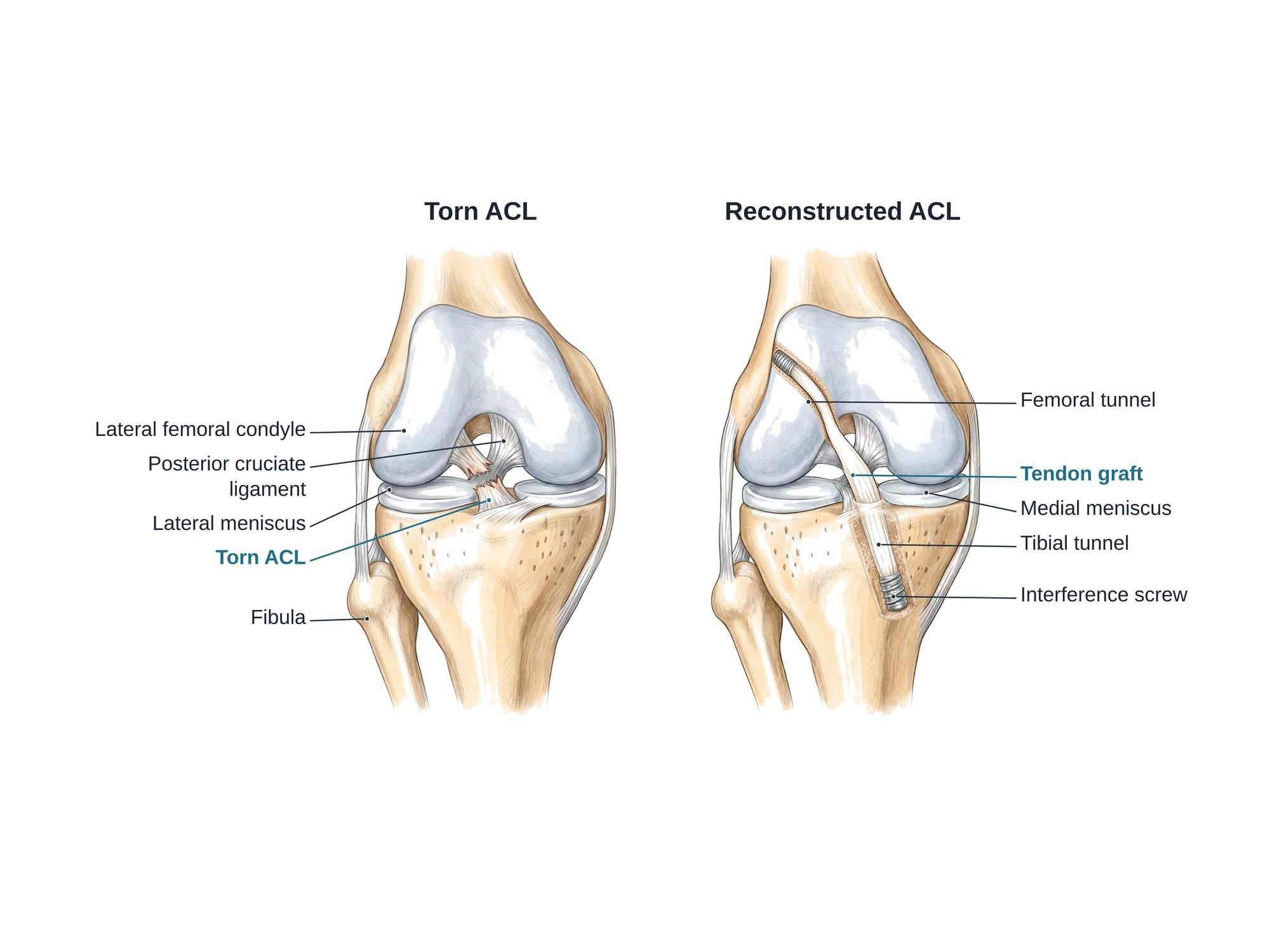
ACL surgery usually means ACL reconstruction: replacing a torn anterior cruciate ligament with a tendon graft. The ACL is a strong band inside the knee. It runs from the inner wall of the outer (lateral) femoral condyle down to the front of the tibia, and it stops the shinbone from sliding forward (see knee anatomy). A torn ACL does not heal on its own, so the surgeon does not sew it back together. Instead, a graft is passed through tunnels drilled in the tibia and femur and fixed with screws or buttons. About 130,000 ACL reconstructions were done in the United States in 2006, and 95% were outpatient surgery (Mall et al., 2014). That number has since fallen. In a US insurance claims study from 2010 to 2020, 196,589 of 931,186 ACL tears were treated with reconstruction, and the rate of reconstruction fell by about 3.6% a year (Bergstein et al., 2025). The illustration above shows a torn ACL beside the same knee after reconstruction.
Why it is done
An ACL tear makes the knee loose. The tibia can shift forward and rotate under the femur. People feel this as the knee giving way, mostly with turns, cuts and sudden stops. Each episode can damage a meniscus or the joint cartilage.
Surgery is usually advised for:
- Athletes who want to return to cutting, pivoting or jumping sports
- People whose knee keeps giving way in daily life, despite physical therapy
- People with physical jobs, such as construction or police work
- A torn ACL with a repairable meniscus tear
- Several torn ligaments in the same knee
People who are less active, and who do not play pivoting sports, may do well with physical therapy alone. Surgery is often done a few weeks after the injury. By then the swelling has settled and the knee can straighten fully. Operating on a stiff, swollen knee may raise the risk of stiffness afterward.
How the surgery is done
ACL reconstruction is usually done with arthroscopy, a keyhole technique with a small camera. This is why it is also called arthroscopic ACL reconstruction. It is done under general or regional anesthesia.
- Examine the knee. Under anesthesia, the surgeon tests how loose the knee is. Small incisions are made at the front of the knee for the camera and tools.
- Treat other damage. A torn meniscus is repaired or trimmed. Loose cartilage is smoothed.
- Harvest the graft. The surgeon takes a strip of tendon, such as the middle of the patellar tendon or two hamstring tendons. A donor graft may be used instead. The graft is trimmed and sized.
- Clear the old ACL. The torn stumps are removed. Small remnants are often left to mark the original attachment sites, called the footprints.
- Drill the tibial tunnel. A guide aims a drill from the front inner surface of the tibia up to the ACL footprint on the tibial spine, the raised area between the two tibial plateaus.
- Drill the femoral tunnel. A second tunnel is drilled into the inner wall of the lateral femoral condyle, at the ACL's original femoral footprint. Placing this tunnel in the right spot is key to a stable knee.
- Pass the graft. The graft is pulled up through the tibial tunnel, across the joint and into the femoral tunnel. It now runs in the same path as the old ACL.
- Fix the graft. The femoral end is fixed first. The knee is cycled, the graft is pulled tight, and then the tibial end is fixed.
- Check and close. The surgeon checks that the graft does not rub on the roof of the notch when the knee straightens. The small incisions are closed.
Graft choices
| Graft | Where it comes from | Main points |
|---|---|---|
| Patellar tendon | Middle third of the patient's own patellar tendon, with a bone block at each end | Bone-to-bone healing and a long track record. Can cause pain when kneeling. |
| Hamstring tendons | Two tendons from the back of the patient's thigh, folded into a thick strand | Smaller incision and less kneeling pain. |
| Quadriceps tendon | Central strip of the tendon above the kneecap | Thick graft. |
| Allograft | A tendon from a deceased donor | No harvest wound. May fail more often in young, active patients. |
Graft choice also affects infection risk. In a meta-analysis of 21 studies, patellar tendon grafts had a 77% lower rate of deep infection than hamstring grafts (Bansal et al., 2018). Taking the patellar tendon weakens it for a time, and a rare later problem is a patellar tendon rupture.
Hardware
The graft needs to be held firmly while it grows into the bone tunnels. This takes several months. Common devices are:
- Interference screws. A screw is driven into the tunnel beside the graft. It wedges the graft or its bone block against the tunnel wall. Screws may be metal (titanium) or absorbable material that the body slowly replaces.
- Cortical (suspensory) buttons. A small metal plate sits on the outer surface of the femur or tibia. The graft hangs from it by a loop of strong suture. Buttons are common on the femoral side with hamstring grafts.
- Cross pins. Pins placed across the femoral tunnel through the graft loop.
- Staples or a screw and washer. Used on the tibia, below the tunnel exit, for soft tissue grafts.
The hardware is usually left in for life. It comes out only if it causes pain, becomes infected, or blocks a later revision surgery.
Recovery
How long ACL surgery recovery takes depends on the graft, other repairs and the person's goals. A typical timeline after ACL surgery is:
- Weeks 0 to 2: crutches, a brace in some cases, ice and raising the leg. The first goal is full straightening of the knee.
- Weeks 2 to 6: walking without crutches, bending past 90 degrees, and quadriceps strengthening. Desk work is often possible in this period.
- Months 3 to 4: jogging in a straight line, cycling and balance work.
- Months 6 to 9: jumping, cutting and sport drills. Physical jobs often resume by this stage.
- Months 9 to 12: return to cutting and pivoting sports, based on strength and hop tests, not time alone.
Time off work after ACL surgery varies most with the job. A desk worker may be back within a few weeks. A person who climbs, lifts or kneels may need several months.
Most people return to some sport. In a review of 7,556 patients, 81% returned to any sport, 65% to their preinjury level and 55% to competitive sport (Ardern et al., 2014).
The surgery itself has a real cost. In US claims data on commercially insured patients, the median cost of the procedure was about $9,400 (Herzog et al., 2017). Physical therapy adds to that over the months that follow.
Risks
Short-term risks include:
- Infection of the wound or the joint. A deep infection may need repeat surgery to wash out the knee.
- Blood clots in the leg veins (deep vein thrombosis)
- Stiffness, mostly loss of full straightening. Scar tissue at the front of the graft can form a nodule called a cyclops lesion.
- Nerve irritation, often numbness on the outer side of the shin from a small skin nerve cut during graft harvest
- Pain at the graft site, such as front-of-knee pain when kneeling
Long-term risks include:
- Graft failure or a new tear. In a review of 19 studies, 15% of patients injured the graft or the ACL in the other knee. The rate was 23% in athletes under 25 who returned to sport (Wiggins et al., 2016). A poorly placed tunnel can lead to graft failure. This may need revision ACL surgery.
- Knee arthritis. In a study of 10,565 patients, 12% were diagnosed with knee arthritis within 5 years of reconstruction. Older age, obesity, smoking and meniscus surgery raised the risk (Bodkin et al., 2020).
- Tunnel widening, where the bone tunnels enlarge over time. It matters mostly if a revision is needed.
A strong force can also break the top of the tibia along with the ligament, a tibial plateau fracture, which is treated differently.
References
- Mall NA, Chalmers PN, Moric M, et al. Incidence and trends of anterior cruciate ligament reconstruction in the United States. American Journal of Sports Medicine. 2014;42(10):2363-2370.
- Bansal A, Lamplot JD, VandenBerg J, et al. Meta-analysis of the Risk of Infections After Anterior Cruciate Ligament Reconstruction by Graft Type. American Journal of Sports Medicine. 2018;46(6):1500-1508.
- Ardern CL, Taylor NF, Feller JA, et al. Fifty-five per cent return to competitive sport following anterior cruciate ligament reconstruction surgery: an updated systematic review and meta-analysis including aspects of physical functioning and contextual factors. British Journal of Sports Medicine. 2014;48(21):1543-1552.
- Herzog MM, Marshall SW, Lund JL, et al. Cost of Outpatient Arthroscopic Anterior Cruciate Ligament Reconstruction Among Commercially Insured Patients in the United States, 2005-2013. Orthopaedic Journal of Sports Medicine. 2017;5(1):2325967116684776.
- Wiggins AJ, Grandhi RK, Schneider DK, et al. Risk of Secondary Injury in Younger Athletes After Anterior Cruciate Ligament Reconstruction: A Systematic Review and Meta-analysis. American Journal of Sports Medicine. 2016;44(7):1861-1876.
- Bodkin SG, Werner BC, Slater LV, et al. Post-traumatic osteoarthritis diagnosed within 5 years following ACL reconstruction. Knee Surgery, Sports Traumatology, Arthroscopy. 2020;28(3):790-796.
- Bergstein VE, Ahiarakwe U, Haft M, et al. Decreasing Incidence of Anterior Cruciate Ligament Tears and Increasing Utilization of Anterior Cruciate Ligament Reconstruction in the United States From 2010 to 2020. Arthroscopy. 2025;41(6):1912-1918.
Related pages
- Knee anatomyThe normal anatomy of the knee.
- Below knee amputationA below knee amputation removes the lower leg through the tibia and fibula and pads the bone ends with calf muscle. See the cut level and the residual limb.
- Intramedullary nailingIntramedullary nailing fixes a broken tibia or femur with a metal rod inside the bone. See the nail and locking screws beside the original fracture.
- Tibial plateau fracture surgeryTibial plateau fracture surgery lifts a sunken knee joint surface and holds it with a plate and screws. See the fracture and the repair side by side.
FAQ
What does recovery look like after ACL surgery?+
Most people use crutches for 1 to 2 weeks and work on fully straightening the knee first. Walking without a limp, bending the knee and building the thigh muscles come over the next 6 weeks. Jogging usually starts around 3 to 4 months. Return to cutting and pivoting sports usually takes 9 to 12 months and depends on strength and hop tests.
How long does ACL surgery take?+
The operation itself usually takes a few hours or less. It is usually done as outpatient surgery, so most people go home the same day. Extra repairs, such as a meniscus repair, can make it longer.
Can I run with a torn ACL?+
Some people can jog in a straight line once the swelling settles, but the knee may give way with any turn or sudden stop. Each giving-way episode can tear a meniscus or damage cartilage. After reconstruction, running usually starts around 3 to 4 months, once the surgeon and therapist clear it.
What are the long-term effects of ACL surgery?+
Most people get a stable knee and return to sport. Some have kneeling pain, a small loss of motion or weaker thigh muscles. Knee arthritis is the main long-term concern. In a study of 10,565 patients, about 12% were diagnosed with knee arthritis within 5 years of surgery. A second ACL tear is also possible.
How do you strengthen the knee after ACL surgery?+
Physical therapy starts within days. Early work focuses on tightening the quadriceps, straightening the knee and walking normally. Later stages add squats, leg presses, balance training, then jumping and cutting drills. Strength of the operated leg should reach about the level of the other leg before sports.
Is walking too much after ACL surgery bad?+
Too much walking in the first weeks can increase swelling and pain and slow the return of full motion. Short, frequent walks with crutches as advised are better than long ones. Swelling that keeps rising is a sign to rest and raise the leg, and to tell the surgical team.
How much does ACL surgery cost?+
Costs vary by hospital, surgeon and insurance. In a US study of commercially insured patients, the median cost of the surgery itself was about $9,400. That figure does not include the months of physical therapy that follow.
Can you tear the ACL again after surgery?+
Yes. In a large review, about 15% of patients tore the graft or the ACL in the other knee. The rate was 23% in athletes under 25 who returned to sport. A careful return to sport lowers the risk.
Need a surgical illustration for consent or a case?
Describe the operation and get a clear, labeled medical illustration for patient consent, teaching or a case exhibit.
Try Natomy →