Fasciotomy: Compartment Syndrome Surgery & Recovery
A fasciotomy cuts open the tight fascia around leg muscles to relieve compartment syndrome. See the four leg compartments released, illustrated.
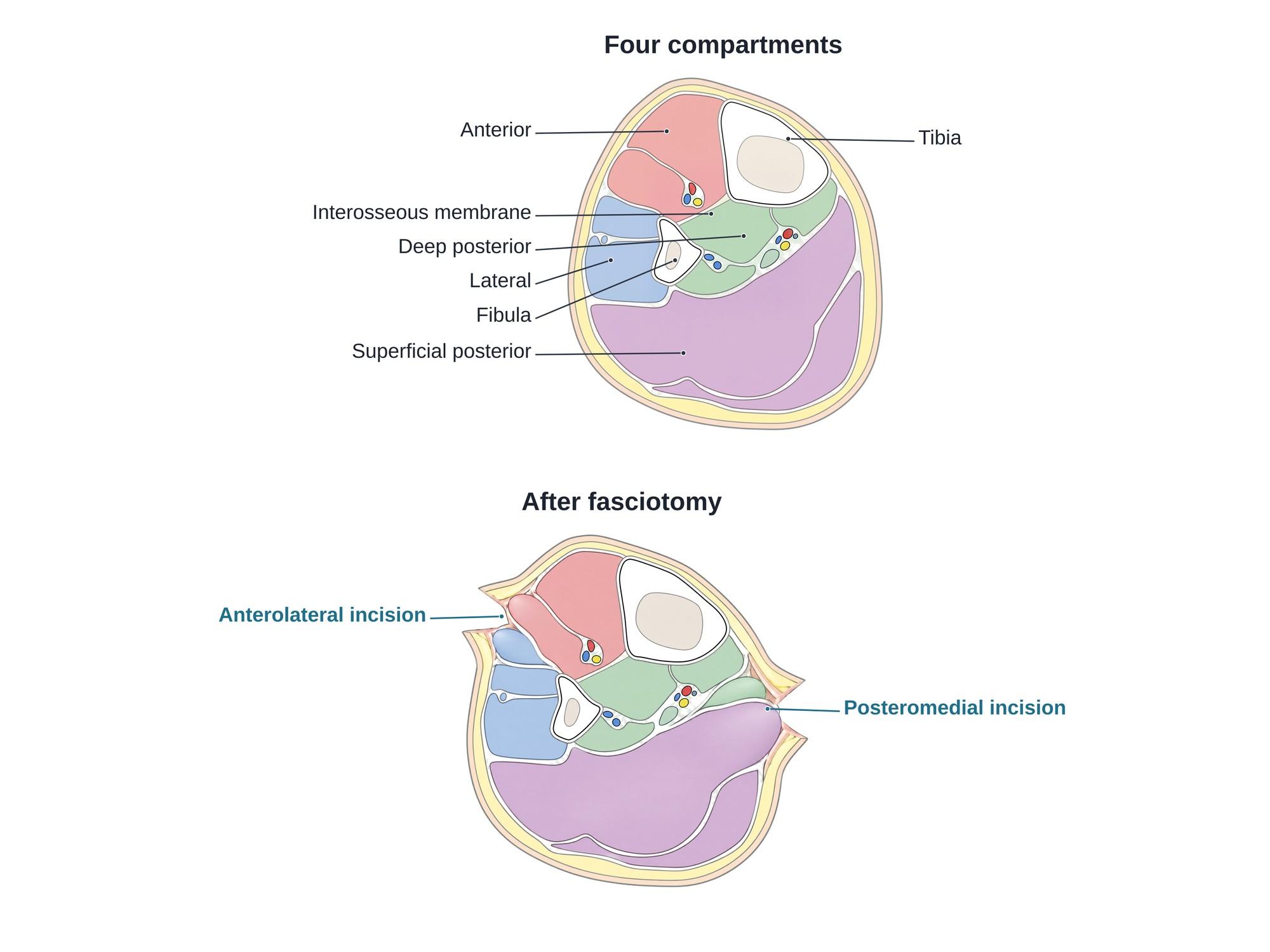
A fasciotomy is surgery that cuts open the fascia, the tough sheet of tissue that wraps a group of muscles, to relieve dangerous pressure inside it. It is the treatment for acute compartment syndrome, when swelling or bleeding inside a closed muscle compartment cuts off blood flow to the muscles and nerves. Without a quick release, the tissue can die within hours. The lower leg is the most common site. The illustration above shows a cross-section of the leg before and after a two-incision fasciotomy that opens all four compartments.
The anatomy
The lower leg has two bones, the tibia (shin bone) on the inner side and the thin fibula on the outer side. A sheet called the interosseous membrane joins them. Fascia and the bones divide the muscles into four compartments:
| Compartment | Main muscles | Nerve inside |
|---|---|---|
| Anterior | Tibialis anterior, toe extensors | Deep peroneal nerve |
| Lateral | Peroneus longus and brevis | Superficial peroneal nerve |
| Superficial posterior | Gastrocnemius, soleus | Sural nerve branches |
| Deep posterior | Tibialis posterior, toe flexors | Tibial nerve |
Fascia does not stretch. When the muscles swell, the pressure rises instead. For the nerves, see lower limb nerves.
Why it is done
A fasciotomy is done for acute compartment syndrome. Common causes:
- Fractures, above all a tibia and fibula fracture or a tibial plateau fracture
- Crush injuries in car crashes and workplace accidents
- Restored blood flow after an artery repair, when the muscles swell as blood returns
- Tight casts or bandages, burns, or lying on a limb for hours
The key warning sign is pain out of proportion to the injury. The pain gets worse when the toes are stretched passively. The leg feels tense and hard. Numbness, weakness and loss of pulse come late. Doctors may measure compartment pressure with a needle when the exam is unclear.
A planned fasciotomy can also treat chronic exertional compartment syndrome (CECS). This is pain that comes on with running and fades with rest. It is not an emergency.
How the surgery is done
The standard operation for the leg is a two-incision, four-compartment fasciotomy:
- Anesthesia. General anesthesia, usually as an emergency. A tourniquet is not used, so the surgeon can judge blood flow to the muscle.
- Anterolateral incision. A long cut on the outer side of the leg, between the tibia and the fibula. The surgeon finds the septum that divides the anterior and lateral compartments and protects the superficial peroneal nerve.
- Anterior and lateral release. The fascia is cut along the length of each compartment. The swollen muscle bulges out at once.
- Posteromedial incision. A second long cut on the inner side of the calf, just behind the edge of the tibia. The saphenous vein and nerve are kept safe.
- Superficial and deep posterior release. The fascia over the calf muscles is opened. The soleus is then lifted off the back of the tibia to open the deep posterior compartment.
- Checking the muscle. Any dead muscle is removed. Healthy muscle is pink, bleeds when cut and twitches.
- Leaving the wounds open. The skin is not closed. Moist dressings or a vacuum dressing cover the wounds. Any fracture is stabilized, often with an external fixator, a nail or ORIF.
- Return to surgery. Every 2 to 3 days the wounds are cleaned. They are closed or covered with a skin graft once the swelling goes down.
Some surgeons open all four compartments through a single lateral incision. The goal is the same: every compartment fully released.
Recovery
- First week: hospital stay, leg raised to heart level, dressing changes and repeat trips to surgery.
- Wound closure: usually within about 5 to 10 days, by stitches or a skin graft.
- Weeks 2 to 6: walking with support as the fracture and wounds allow, with physical therapy.
- 3 to 6 months: strength and endurance return. Recovery is slower when muscle was damaged before the release.
After a planned fasciotomy for CECS, most people return to running in about 2 to 3 months.
Risks
- Large scars and skin graft areas, which can be tender or pale
- Infection of the open wounds
- Numbness from injury to a skin nerve near the incisions
- Muscle bulging through the opened fascia, and chronic swelling
- Weakness and foot drop when muscle or nerve died before the release
- Contracture, a stiff, clawed foot from scarred, shortened muscle (ischemic contracture)
- Kidney injury from the breakdown products of dead muscle, in severe cases
How fasciotomy is shown in a personal injury case
Fasciotomy often follows the fractures and crush injuries that bring a personal injury case. The long open wounds, repeat operations and skin grafts show how serious the injury was. A missed or late diagnosis of compartment syndrome is also a common medical malpractice claim, since the release must happen within hours. A cross-section like the one above lets a jury see the four compartments, why swelling inside them is so dangerous, and what the surgeon had to cut to save the leg. It also explains the lifelong scars. For how these images are used at trial, see demonstrative evidence and medical legal illustration.
Related pages
FAQ
What is a fasciotomy for compartment syndrome?+
It is emergency surgery for acute compartment syndrome, when swelling inside a closed muscle compartment raises the pressure high enough to cut off blood flow. The surgeon cuts the tough fascia that wraps the compartment so the muscles can swell outward and blood can reach them again. In the lower leg, all four compartments are usually opened.
What is chronic exertional compartment syndrome?+
Chronic exertional compartment syndrome (CECS) is pain and tightness in a compartment that comes on with exercise, most often running, and fades with rest. It is not an emergency. If rest and changes in training do not help, a planned fasciotomy of the affected compartments, often through smaller incisions, can relieve it.
What is compartment pressure testing used for?+
A needle connected to a pressure monitor is placed into the compartment to measure the pressure inside it. It helps confirm compartment syndrome when the exam is unclear, for example in a patient who is sedated or cannot describe pain. In chronic exertional compartment syndrome, pressures are measured before and after exercise.
How long does it take to recover from a leg fasciotomy?+
The wounds are usually closed or skin grafted within about a week. Walking often resumes within a few weeks, but full recovery takes several months, especially if muscle was damaged before the release. Recovery also depends on the injury that caused the compartment syndrome, such as a tibia fracture.
Why are fasciotomy wounds left open?+
The swollen muscle needs room. Closing the skin right away would squeeze the compartment again. The wounds are covered with dressings or a vacuum dressing and closed a few days later once swelling goes down, either with stitches or a skin graft.
What are the long-term side effects of a fasciotomy?+
Large scars, numbness or tingling near the incisions, a feeling of muscle bulging through the open fascia, swelling, and sometimes weakness or chronic pain. If the release came late, dead muscle can cause lasting weakness, foot drop or a stiff, clawed foot.
Do compression socks help compartment syndrome?+
No. Compression adds pressure to a compartment that is already too tight. In suspected acute compartment syndrome, casts and tight dressings are loosened or removed, the leg is kept at heart level, and the patient goes to surgery. Compression is sometimes used later, after the wounds heal, to control swelling.
How fast must a fasciotomy be done?+
As soon as possible once acute compartment syndrome is diagnosed. Muscle and nerve begin to die after a few hours without enough blood flow, and damage after about 6 hours is often permanent. It is a surgical emergency.
Need a surgical illustration for consent or a case?
Describe the operation and get a clear, labeled medical illustration for patient consent, teaching or a case exhibit.
Try Natomy →