Biceps Tendon Rupture: Distal vs Proximal Tears & Treatment
A biceps tendon rupture is a tear of the biceps tendon at the elbow (distal) or shoulder (proximal). Learn the symptoms, tests, surgery and recovery time.
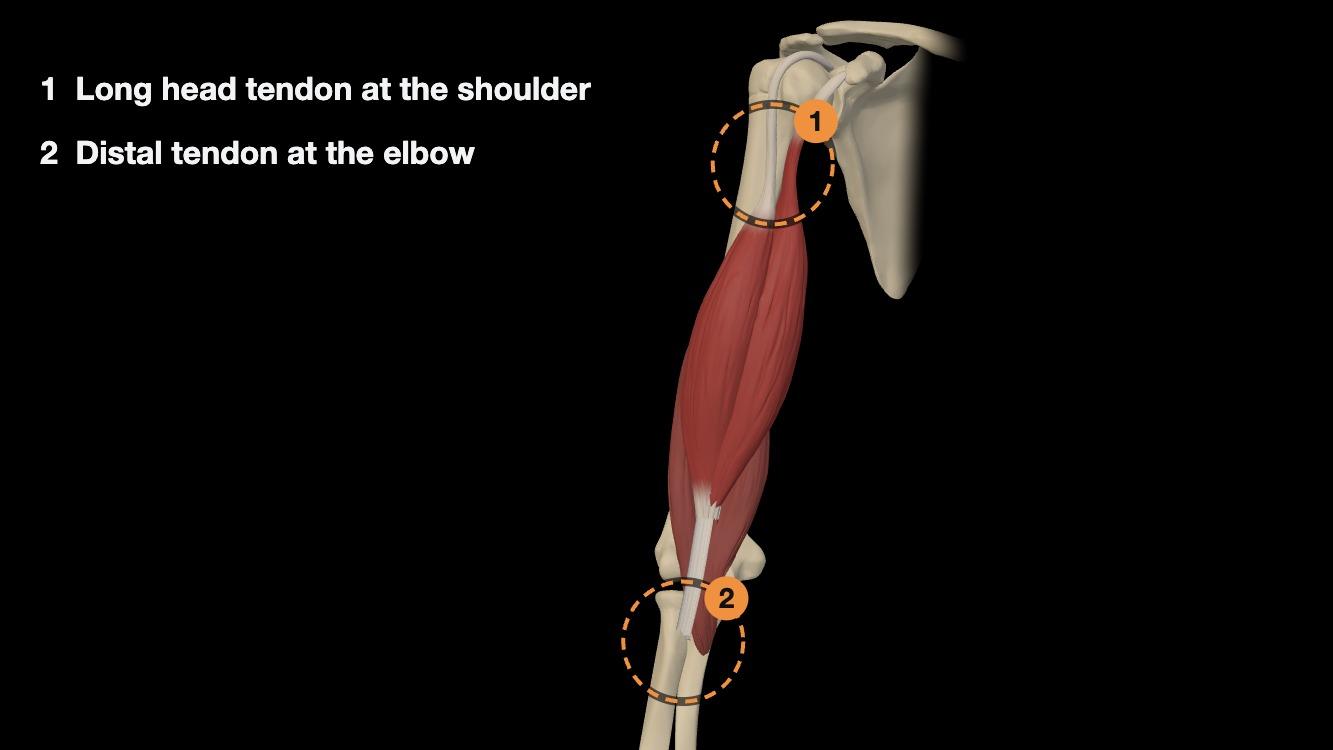
A biceps tendon rupture is a tear of one of the tendons that hold the biceps muscle to bone. The biceps sits on the front of the upper arm. At the top, two tendons fix it to the shoulder blade: the long head and the short head. At the bottom, one distal biceps tendon crosses the front of the elbow and attaches to the radial tuberosity, a bump on the radius just below the elbow (Anand et al., 2026). The biceps turns the palm up (supination) and helps bend the elbow. A tear at the elbow is a distal rupture. A tear at the shoulder, most often of the long head, is a proximal rupture (Anand et al., 2026). Distal ruptures affect about 2.6 per 100,000 people a year in the United States, and 95% are men (Kelly et al., 2015). For the bones and joints involved, see elbow anatomy and shoulder anatomy.
Types
| Type | Where it tears | What it means |
|---|---|---|
| Distal rupture | The tendon pulls off the radial tuberosity at the elbow | Lasting weakness turning the palm up. Usually repaired. |
| Partial distal tear | Some fibers stay attached at the elbow | Pain and some weakness. Often treated without surgery at first. |
| Proximal long head rupture | The long head tendon tears at the shoulder | Popeye bulge. Usually treated without surgery. |
| Short head rupture | The short head tendon tears at the coracoid | Rare. |
Distal vs proximal biceps tendon rupture
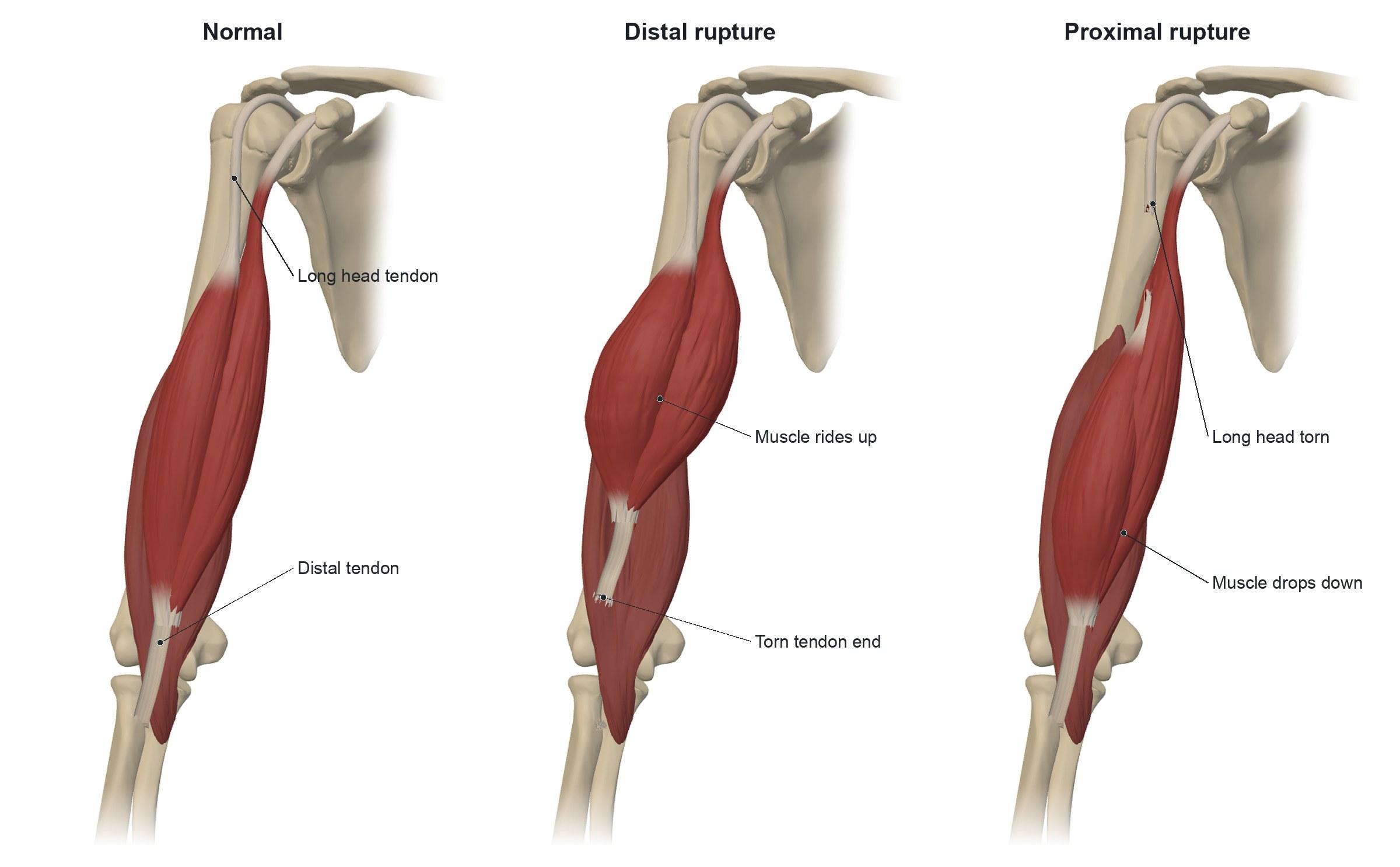
| Feature | Distal rupture | Proximal rupture |
|---|---|---|
| Where | Front of the elbow | Front of the shoulder |
| Typical patient | Men in their 40s lifting a heavy load | Adults over 50 with shoulder wear |
| Bulge | Muscle rides up (reverse Popeye) | Muscle drops down (Popeye) |
| Strength loss | Large, mostly turning the palm up | Small for most people |
| Usual treatment | Surgical repair | Rest and therapy |
Causes
A distal rupture happens when a bent elbow is suddenly forced straight while the biceps is working hard. The muscle is lengthening under load, an eccentric contraction. Typical moments are catching a falling heavy object, lifting furniture or materials at work, and a bar slipping during weight training. In one study, every patient described this mechanism (Safran and Graham, 2002).
Risk factors for a distal rupture:
- Male sex and middle age. The average age in one regional group was 46 (Kelly et al., 2015).
- Smoking. Smokers had 7.5 times the risk of a distal rupture (Safran and Graham, 2002).
- Higher body weight (Kelly et al., 2015).
A proximal long head rupture often happens with little force, in a tendon already worn by years of shoulder use. It is closely tied to rotator cuff disease. In a group of 27 patients with an acute long head rupture, 93% had rotator cuff disease on MRI (Vestermark et al., 2018). See rotator cuff tear and SLAP tear, which involves the labrum where the long head starts.
Symptoms
- A pop at the elbow or shoulder at the moment of injury
- Sharp pain that eases over days to weeks
- Bruising on the front of the elbow and forearm (distal) or the upper arm (proximal)
- A bulge in the arm: higher up after a distal tear, lower down after a proximal tear
- A gap at the front of the elbow where the tendon cord used to be
- Weakness turning the palm up, such as using a screwdriver or a doorknob
- Weaker elbow bending, and cramping of the biceps with use
Diagnosis
The diagnosis is mostly made by examination. The hook test is the key check for a distal tear. With the elbow bent and the palm up, the examiner tries to hook a finger under the tendon from the outer side. If there is no cord to hook, the tendon is likely torn. The doctor also compares the shape of the biceps with the other arm and tests supination strength.
Imaging confirms the tear and shows how far the tendon has pulled back. Ultrasound shows the tendon end and fluid where it tore. MRI shows partial tears and the gap between the tendon end and the radial tuberosity. X-rays are normal in most cases but can rule out a fracture, such as a radial head fracture. For a proximal tear, the doctor also checks the rotator cuff.
Treatment
Distal rupture. Most active adults have the tendon reattached to the radial tuberosity. Surgery done through one cut at the front of the elbow (single-incision repair) fixes the tendon with a cortical button, suture anchors or an interference screw. A double-incision repair adds a second cut on the back of the forearm. The fixation methods give similar results (Cuzzolin et al., 2021). Repair is most straightforward within about 4 weeks. Tears treated later are called chronic. Direct repair can still work when enough tendon remains, and otherwise a graft is used (Tzeuton et al., 2023).
Surgery restores much more strength. In a review of 53 studies and 1,380 patients, supination strength reached 89% of the other arm after surgery, but 63% without it (Cuzzolin et al., 2021). Treatment without surgery (rest, a sling, then therapy) may suit older or less active people, or people too ill for surgery.
Partial distal tear. Rest, a short period in a splint and physical therapy come first. Surgery is considered if pain and weakness last.
Proximal long head rupture. Most people do well with ice, rest, pain relief and therapy. The short head still holds the muscle to the shoulder blade, so strength loss is small for most people. A biceps tenodesis, which fixes the torn tendon to the upper humerus, may suit manual workers, athletes, people bothered by the bulge or cramping, and people having rotator cuff repair.
Recovery
After a distal repair, the elbow is protected in a splint or brace at first. Motion and then strength return in stages over several months. Heavy lifting waits until the surgeon clears it. After a proximal tear treated without surgery, pain usually settles with time. The bulge stays.
Complications
- Numbness on the outer forearm from stretch of the lateral antebrachial cutaneous nerve, a skin nerve beside the tendon. In the large review, 10% of surgical patients had a temporary sensory nerve injury (Cuzzolin et al., 2021).
- Posterior interosseous nerve palsy, weakness lifting the fingers and thumb. Temporary motor nerve injury affected 1.6% (Cuzzolin et al., 2021).
- Heterotopic ossification, extra bone forming near the elbow, seen in 10% (Cuzzolin et al., 2021). It can limit turning the forearm.
- Re-rupture of the repaired tendon, which is uncommon
- Lasting weakness in supination and fatigue with repeated use, mostly after a distal tear left unrepaired
- Cosmetic bulge and cramping after a proximal tear
Because many of these tears happen while lifting at work, they often come up in workers' compensation claims, where a medical legal illustration can show the torn tendon. Similar tendon ruptures elsewhere in the body include Achilles tendon rupture and patellar tendon rupture.
References
- Anand P, Mabrouk A, Chang KV. Biceps Tendon Rupture. StatPearls Publishing, 2026.
- Kelly MP, Perkinson SG, Ablove RH, et al. Distal Biceps Tendon Ruptures: An Epidemiological Analysis Using a Large Population Database. American Journal of Sports Medicine. 2015;43(8):2012-2017.
- Safran MR, Graham SM. Distal biceps tendon ruptures: incidence, demographics, and the effect of smoking. Clinical Orthopaedics and Related Research. 2002;(404):275-283.
- Vestermark GL, Van Doren BA, Connor PM, et al. The prevalence of rotator cuff pathology in the setting of acute proximal biceps tendon rupture. Journal of Shoulder and Elbow Surgery. 2018;27(7):1258-1262.
- Cuzzolin M, Secco D, Guerra E, et al. Operative Versus Nonoperative Management for Distal Biceps Brachii Tendon Lesions: A Systematic Review and Meta-analysis. Orthopaedic Journal of Sports Medicine. 2021;9(10):23259671211037311.
- Tzeuton S, Johns W, Campbell B, et al. Outcomes and Patient Satisfaction of Delayed Distal Biceps Repairs without Graft Augmentation: A Systematic Review. JBJS Reviews. 2023;11(5).
Related pages
- Elbow anatomyThe normal anatomy of the elbow.
- Golfer's elbow vs tennis elbowGolfer's elbow hurts on the inner elbow, tennis elbow on the outer elbow. Compare the tendons, causes, symptoms, treatment, recovery time and when surgery helps.
- Ulnar nerve entrapmentUlnar nerve entrapment (cubital tunnel syndrome) pinches the funny bone nerve at the elbow. Learn the causes, ulnar nerve pain, grades, surgery and recovery.
FAQ
Which is worse, a proximal or a distal biceps tendon rupture?+
A distal rupture at the elbow is usually more serious. It causes a lasting loss of strength when turning the palm up, so most active adults have it repaired. A proximal rupture of the long head at the shoulder often heals well without surgery, because the short head still holds the muscle to the shoulder blade.
What happens if you rupture your bicep tendon?+
Most people feel a sudden pop and sharp pain, then bruising and swelling. The muscle balls up in the arm. With a distal tear, the elbow still bends, because the brachialis does most of that work, but turning a key or a screwdriver becomes weak.
When is it too late to repair a torn bicep tendon?+
A distal tear is most straightforward to repair within about 4 weeks. After that it counts as a chronic tear, and the tendon may have pulled back and scarred. A late repair is still possible. If enough tendon remains, it can often be reattached directly. If not, a tendon graft bridges the gap.
Is a ruptured tendon worse than a tear?+
They mean much the same thing. Rupture usually means a complete tear, where the tendon has come fully off the bone. A partial tear leaves some fibers attached, so the arm keeps more strength and surgery is less often needed.
How do doctors test for a torn bicep tendon?+
For a distal tear, the hook test is the main one. With the elbow bent and the palm up, the examiner tries to hook a finger under the tendon at the front of the elbow. If there is no cord to hook, the tendon is likely torn. An MRI or ultrasound confirms it and shows partial tears.
Can I still work out with a torn bicep tendon?+
Not with a fresh distal tear, which needs an orthopedic surgeon's opinion first. With a proximal long head tear, many people return to the gym after a period of rest and therapy. Supination strength after a distal tear treated without surgery averaged about 63% of the other arm in one large review.
Does a biceps tendon rupture heal on its own?+
The tendon does not grow back to the bone. The arm adapts, and pain usually settles with time. That is often enough after a proximal tear, but after a distal tear many people are left with lasting weakness unless the tendon is repaired.
What is the Popeye sign?+
A bulge in the arm after the biceps tendon tears, like the cartoon sailor's forearm. When the long head tears at the shoulder, the muscle drops toward the elbow. When the distal tendon tears at the elbow, the muscle rides up toward the shoulder, called a reverse Popeye sign.
Need this illustration for a patient or a case?
Describe the injury or upload a scan and get a clear, labeled medical illustration for a consult, a chart or a case exhibit.
Try Natomy →