Golfer's Elbow vs Tennis Elbow: Key Differences
Golfer's elbow hurts on the inner elbow, tennis elbow on the outer elbow. Compare the tendons, causes, symptoms, treatment, recovery time and when surgery helps.
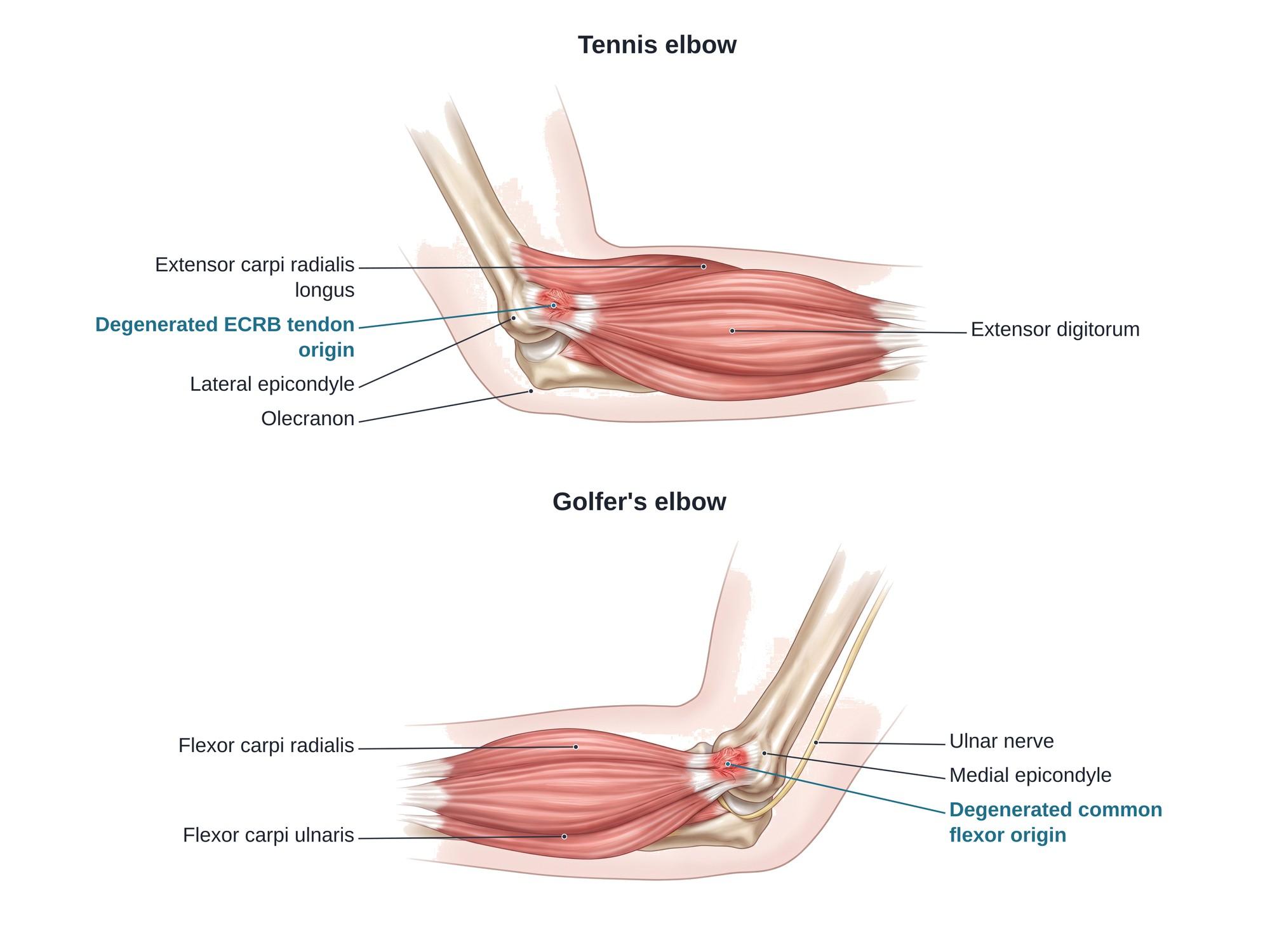
Golfer's elbow vs tennis elbow comes down to which side of the elbow hurts. Both are overuse injuries of a tendon. Tennis elbow, or lateral epicondylitis, affects the lateral epicondyle. There the forearm extensor muscles, which pull the wrist and fingers back, join in a shared tendon called the common extensor origin. The tendon most often hurt is the extensor carpi radialis brevis (ECRB). Golfer's elbow, or medial epicondylitis, affects the medial epicondyle. There the flexor muscles, which bend the wrist and turn the palm down, join at the common flexor origin. Despite the "-itis", both are a slow breakdown of the tendon, called tendinosis, not a true inflammation. Tennis elbow is about three times as common as golfer's elbow. In a Finnish population study, 1.3% of adults aged 30 to 64 had tennis elbow and 0.4% had golfer's elbow (Shiri et al., 2006). For the bones and ligaments of the joint, see elbow anatomy.
Golfer's elbow vs tennis elbow at a glance
| Feature | Tennis elbow | Golfer's elbow |
|---|---|---|
| Medical name | Lateral epicondylitis | Medial epicondylitis |
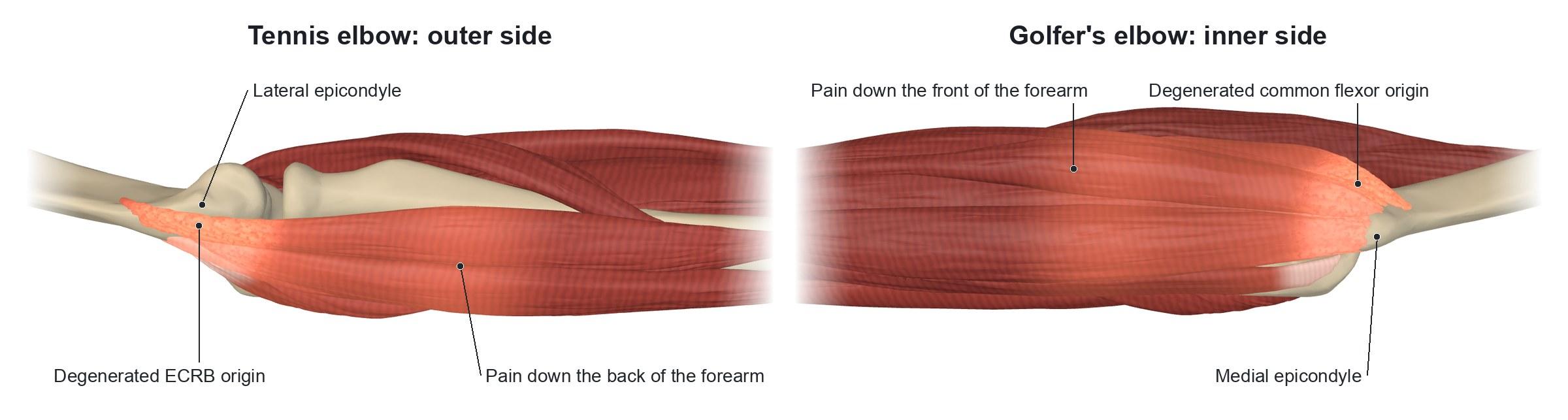
| Where it hurts | Outer elbow, down the back of the forearm | Inner elbow, down the front of the forearm |
| Bony bump | Lateral epicondyle | Medial epicondyle |
| Tendon involved | Common extensor origin, mainly ECRB | Common flexor origin (pronator teres and flexor carpi radialis) |
| Movements that hurt | Gripping, lifting palm down, wrist extension against resistance | Wrist flexion and turning the palm down against resistance |
| How common | About 1 in 75 adults | About 1 in 250 adults |
| Nerve involved | Rarely (radial tunnel syndrome can mimic it) | Ulnar nerve irritation in about half of surgical cases |
| Typical sports | Racquet sports, one-handed backhand | Golf, throwing, overhead serves |
Causes
Both come from repeated loading of the forearm muscles. Each grip, lift or twist pulls on the small tendon origin. Over months, tiny tears outpace repair. The tendon fibers become disorganized and weak.
Tennis elbow is linked to repeated, forceful gripping and twisting of the forearm:
- Racquet sports, especially a one-handed backhand
- Using a hammer, screwdriver, wrench or paint brush
- Lifting with the palm facing down
Golfer's elbow comes from wrist flexion and forearm rotation:
- The golf downswing, and hitting the ground behind the ball
- Throwing, javelin and the tennis serve
- Carrying heavy loads, hammering and other forceful gripping work
Despite the names, most patients do not play tennis or golf. Work is a bigger factor. In the Finnish study, the odds of tennis elbow were 5.6 times higher in people whose work combined repetitive and forceful arm movements. Smoking was linked to both conditions, and obesity to golfer's elbow. Both were most common between ages 45 and 54, and men and women were affected equally (Shiri et al., 2006). A review of prospective studies in workers found that forearm rotation for more than 4 hours a day raised the odds of tennis elbow by 85% (Bretschneider et al., 2022).
Symptoms
Tennis elbow:
- Pain on the bony bump on the outside of the elbow
- Pain spreading down the back of the forearm
- Pain when gripping, shaking hands, lifting a cup or turning a doorknob
- A weak grip
Golfer's elbow:
- Pain on the bony bump on the inside of the elbow
- Pain spreading down the inner forearm toward the wrist
- Pain when bending the wrist, turning the palm down or making a fist
- Numbness or tingling in the ring and little fingers when the ulnar nerve is irritated
In both, the elbow still bends and straightens fully. A stiff, locked or swollen joint points to another problem, such as arthritis or a loose body.
Diagnosis
A doctor makes the diagnosis by examination. Tennis elbow is tender just in front of and below the lateral epicondyle. Pain comes on with resisted wrist extension, pulling the hand back against the examiner. Pain on resisted extension of the middle finger points to the ECRB. Golfer's elbow is tender just in front of and below the medial epicondyle. Pain comes on with resisted wrist flexion and resisted forearm pronation (turning the palm down).
Imaging is not needed in most cases. X-rays are usually normal. Ultrasound shows a thickened, darker tendon origin, sometimes with a tear or new blood vessels. MRI shows a bright signal in the tendon and helps rule out ligament tears.
Doctors also rule out look-alikes:
- Ulnar nerve entrapment at the inner elbow, which causes numbness in the ring and little fingers. See ulnar nerve entrapment, and types of nerve injury for how nerve damage is graded.
- Radial tunnel syndrome, a pinched radial nerve branch, which hurts a little lower on the outer forearm.
- Cervical radiculopathy, a pinched nerve root in the neck, which can send pain to the elbow. See radiculopathy.
- A radial head fracture after a fall, which hurts on the outer elbow and limits motion.
Treatment
Most people get better without surgery. Treatment is the same for both sides.
- Change the load. Cut back on the grip, lift or swing that hurts. Lift with the palm up, use tools with thicker handles, and take breaks.
- Strengthen. A physical therapist starts slow, controlled wrist exercises (often eccentric, lowering a light weight). These are the core of treatment.
- Brace. A counterforce strap just below the elbow can ease pain during activity. A wrist splint at night can rest the extensors.
- Pain relief. Ice and short courses of anti-inflammatory pills help some people.
- Injections. A corticosteroid (cortisone) shot eases pain for a few weeks but makes long-term results worse. In a trial of 165 patients with tennis elbow, pain came back within a year in 54% after a steroid shot, against 12% after a placebo shot (Coombes et al., 2013). Platelet-rich plasma (PRP), made from the patient's own blood, is an option some surgeons use.
- Surgery. For pain that lasts for months despite other care, the surgeon removes the damaged tendon tissue from its origin, through a small open cut or an arthroscope. For golfer's elbow, the ulnar nerve is decompressed or moved forward when it is also pinched.
Surgery is uncommon. In a Minnesota population study, 3.2% of people with tennis elbow had surgery within 2 years of diagnosis after 2009. About 1 in 10 patients who still had symptoms at 6 months needed surgery (Sanders et al., 2015).
Recovery
Both conditions heal slowly, because tendons have a poor blood supply. Many people improve within a few months, and some take a year or longer. Return to sport or heavy work is gradual, guided by pain.
After surgery, the elbow rests in a sling or splint for a short time. Gentle motion starts within days to weeks. Strengthening follows, and full return to heavy use takes several months.
Golfer's elbow with a pinched ulnar nerve recovers less well. In a Mayo Clinic series of 30 elbows treated with surgery, 24 of 25 elbows with no or mild nerve problems had a good or excellent result. Only 2 of 5 with moderate or severe nerve problems did (Gabel and Morrey, 1995).
Complications
- Recurrence. Tennis elbow came back within 2 years in 8.5% of patients in the Minnesota study (Sanders et al., 2015). It is more likely after steroid shots.
- Chronic pain. A small group keeps pain for more than a year, which can limit work that needs gripping.
- Ulnar neuritis with golfer's elbow. In the Mayo series, 16 of the 30 elbows also had ulnar nerve problems (Gabel and Morrey, 1995).
- Tendon or skin damage from injections, such as thinning or loss of skin color at the injection site.
- Surgical risks, including infection, nerve injury, and elbow instability if the lateral or medial collateral ligament is damaged.
References
- Shiri R, Viikari-Juntura E, Varonen H, Heliövaara M. Prevalence and determinants of lateral and medial epicondylitis: a population study. American Journal of Epidemiology. 2006;164(11):1065-1074.
- Bretschneider SF, Los FS, Eygendaal D, et al. Work-relatedness of lateral epicondylitis: systematic review including meta-analysis and GRADE. American Journal of Industrial Medicine. 2022;65(1):41-50.
- Coombes BK, Bisset L, Brooks P, et al. Effect of corticosteroid injection, physiotherapy, or both on clinical outcomes in patients with unilateral lateral epicondylalgia: a randomized controlled trial. JAMA. 2013;309(5):461-469.
- Sanders TL, Maradit Kremers H, Bryan AJ, et al. The epidemiology and health care burden of tennis elbow: a population-based study. American Journal of Sports Medicine. 2015;43(5):1066-1071.
- Gabel GT, Morrey BF. Operative treatment of medial epicondylitis: influence of concomitant ulnar neuropathy at the elbow. Journal of Bone and Joint Surgery (American). 1995;77(7):1065-1069.
Related pages
- Elbow anatomyThe normal anatomy of the elbow.
- Biceps tendon ruptureA biceps tendon rupture is a tear of the biceps tendon at the elbow (distal) or shoulder (proximal). Learn the symptoms, tests, surgery and recovery time.
- Ulnar nerve entrapmentUlnar nerve entrapment (cubital tunnel syndrome) pinches the funny bone nerve at the elbow. Learn the causes, ulnar nerve pain, grades, surgery and recovery.
FAQ
How do you know if you have tennis elbow or golfer's elbow?+
Find the sore spot. Tennis elbow hurts on the bony bump on the outside of the elbow, and gripping or lifting with the palm down makes it worse. Golfer's elbow hurts on the bump on the inside of the elbow, and bending the wrist or turning the palm down against resistance makes it worse. A doctor confirms which one it is by pressing on each epicondyle and testing the wrist against resistance.
What does tennis elbow feel like?+
It feels like a burning or aching pain on the outer elbow that can spread down the back of the forearm. It flares with gripping, shaking hands, turning a doorknob, lifting a cup or a kettle, or typing. The grip often feels weak. The elbow itself still bends and straightens fully.
Can you have golfer's elbow and tennis elbow at the same time?+
Yes. Some people, often manual workers, have both, on the inner and the outer side of the same elbow. The two are treated the same way, so having both does not change the plan. It does make a nerve or neck problem worth ruling out.
Is squeezing a ball good for tennis elbow?+
Not at first. Hard gripping loads the sore tendon and can flare the pain. Once pain settles, gentle grip work is part of a graded strengthening plan. Wrist extension exercises, done slowly with a light weight, usually come first.
Can you prevent tennis elbow?+
You can lower the risk. Use a lighter tool or racquet with a larger grip, keep the wrist straight when you lift, lift with the palm up when you can, and take breaks from repeated gripping or twisting. Strong forearm muscles also help. Smoking is linked to both conditions, and obesity to golfer's elbow.
How long does golfer's elbow or tennis elbow take to heal?+
Most cases settle without surgery, but slowly. Many people improve over a few months, and some take a year or more. In a large US study, about 1 in 10 patients who still had tennis elbow pain at 6 months went on to need surgery.
Do cortisone shots help tennis elbow?+
They ease pain for a few weeks, but the long-term result is worse. In a well-known trial, 54% of patients who got a steroid injection had their pain come back within a year, against 12% after a placebo injection. Most doctors now try exercise and activity changes first.
When does tennis or golfer's elbow need surgery?+
Surgery is for pain that lasts for months despite good non-surgical care. The surgeon removes the damaged part of the tendon at its origin and lets healthy tissue heal. For golfer's elbow, the ulnar nerve is released or moved at the same time when it is also pinched.
Need this illustration for a patient or a case?
Describe the injury or upload a scan and get a clear, labeled medical illustration for a consult, a chart or a case exhibit.
Try Natomy →