Rotator Cuff Surgery: Repair, Recovery Time & Risks
Rotator cuff surgery sews a torn shoulder tendon back onto the bone with suture anchors. Learn how it is done, the recovery timeline and the risks.
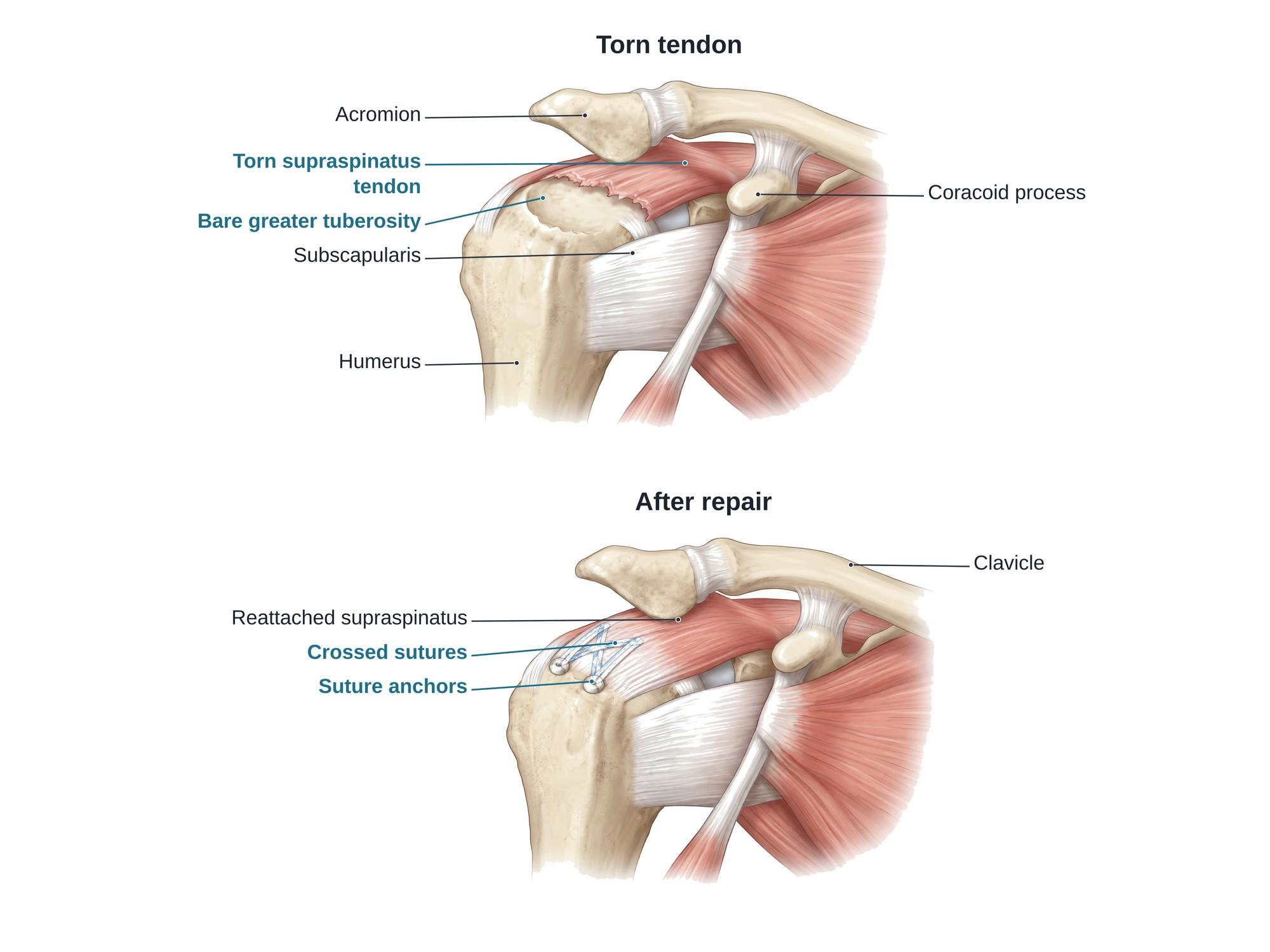
Rotator cuff repair (rotator cuff surgery) is an operation to sew a torn shoulder tendon back onto the bone. The rotator cuff is four muscles whose tendons wrap the ball of the shoulder and hold it in its socket while the arm lifts and turns. The tendon that tears most often is the supraspinatus, which runs under the acromion (the bony roof of the shoulder) to attach on the greater tuberosity, a bump on the top of the upper arm bone (humerus). In a repair, the surgeon pulls the torn tendon back to that spot and holds it down with suture anchors, small implants set in the bone that carry strong stitches. Among commercially insured US adults aged 18 to 64, there were about 165 repairs per 100,000 people each year from 2007 to 2016, and the rate was rising (Yanik et al., 2021). For the anatomy, see shoulder anatomy. For the injury itself, see rotator cuff tear.
Why it is done
- Acute tears from an injury, such as a fall on the arm or a hard pull at work, in people who were active and strong before
- Full-thickness tears that stay painful and weak after several months of physical therapy
- Large tears in younger people, since a tear left alone can grow and the muscle can waste away
- Partial tears that involve more than about half of the tendon thickness and do not improve with therapy (thinner partial tears are usually trimmed, not repaired)
Not every tear needs surgery. Many older adults with tears from wear do well with physical therapy. Surgery is less useful when the tendon has pulled far back and the muscle has turned to fat, because the tendon may not reach the bone or heal there.
How the surgery is done
Most repairs are done with an arthroscope, a thin camera put into the shoulder through a small cut. In 2016, 83% of US repairs in the study above were arthroscopic and 99% were outpatient (Yanik et al., 2021).
- Anesthesia and positioning. General anesthesia, often with a nerve block in the neck (an interscalene block) to numb the arm for many hours. The patient sits up in a beach chair position or lies on one side.
- Portals. The surgeon makes three to five small cuts, each about 1 cm, for the camera and instruments.
- Look inside the joint. The surgeon checks the cartilage, the labrum and the long head of the biceps tendon. A SLAP tear or a damaged biceps tendon may be treated at the same time.
- Subacromial space. The camera moves into the space under the acromion. Inflamed tissue (bursa) is cleared. A bone spur under the acromion may be shaved (acromioplasty).
- Prepare the tear. Frayed tendon edges are trimmed. The bare footprint on the greater tuberosity is lightly roughened so fresh bleeding bone can help the tendon heal.
- Place the anchors. Anchors are drilled or tapped into the greater tuberosity. Each carries one or more sutures.
- Pass the sutures. The sutures are passed through the tendon and the tendon is pulled back over the footprint.
- Tie down the tendon. In a single-row repair, one line of anchors holds the tendon edge. In a double-row repair, as in the illustration, a medial row near the cartilage and a lateral row lower on the tuberosity press the tendon flat over the whole footprint, with sutures crossing over the top (a suture bridge).
- Close. The small cuts are closed and the arm goes into a sling, often with a small pillow that holds the arm slightly away from the body.
An open or mini-open repair uses a larger cut over the shoulder. It is still used for some large tears, revisions, and when other work such as a tendon transfer is needed.
Hardware
| Implant | What it does |
|---|---|
| Suture anchor | A small screw-like or push-in implant set in the bone of the greater tuberosity that holds sutures |
| Knotless anchor | An anchor that locks the sutures under tension without tied knots, used in the outer row and often the inner row too |
| High-strength suture | Braided suture or tape that holds the tendon against the bone while it heals |
| Patch or graft (sometimes) | A collagen or tissue patch laid over a weak or large repair to support healing |
Anchors are made of metal, plastic (PEEK), or materials that the body slowly absorbs. Metal and PEEK anchors stay in for life and rarely need to be removed. Absorbable anchors break down slowly over time.
Recovery
Recovery is slow, because the tendon has to grow back into the bone. This usually takes about 3 months, and the repair is most fragile in the first weeks.
- Weeks 0 to 6: sling day and night, except for washing and exercises. Only passive motion, where a therapist or the other arm moves the shoulder. No lifting.
- Weeks 6 to 12: the sling comes off. Active motion starts, where the person lifts the arm with their own muscles. Light daily tasks at waist level.
- Months 3 to 6: strengthening of the cuff and the shoulder blade muscles. Most people return to daily tasks and desk work.
- Months 6 to 12: return to heavy lifting, overhead work and sport. Strength often keeps improving for up to a year.
Driving is usually possible once the sling is off and the person can control the wheel safely, often at about 6 weeks. In a review of 1,224 people who had a repair, 62% returned to their previous level of work, at an average of about 8 months after surgery (Haunschild et al., 2021). People with heavier jobs were less likely to return to the same work.
Risks
- Retear: the tendon fails to heal or tears again. In a review of 31 high-quality studies, 21% of repairs had retorn at 12 to 24 months (Longo et al., 2021). Older age, larger tears and fatty muscle raise the risk.
- Shoulder stiffness: in a registry of 1,330 arthroscopic repairs, 8% of patients developed stiffness within 6 months (Audigé et al., 2021). Most cases improve with therapy.
- Persistent pain or weakness, especially when lifting the arm overhead
- Infection, uncommon after arthroscopic surgery
- Nerve injury, for example to the axillary nerve, or numbness from the nerve block, which is rare and usually temporary
- Anchor problems: an anchor that loosens or pulls out of soft bone
- Blood clots, which are rare after shoulder surgery
References
- Yanik EL, Chamberlain AM, Keener JD. Trends in rotator cuff repair rates and comorbidity burden among commercially insured patients younger than the age of 65 years, United States 2007-2016. JSES Reviews, Reports, and Techniques. 2021;1(4):309-316.
- Haunschild ED, Gilat R, Lavoie-Gagne O, et al. Return to work after primary rotator cuff repair: a systematic review and meta-analysis. American Journal of Sports Medicine. 2021;49(8):2238-2247.
- Longo UG, Carnevale A, Piergentili I, et al. Retear rates after rotator cuff surgery: a systematic review and meta-analysis. BMC Musculoskeletal Disorders. 2021;22(1):749.
- Audigé L, Aghlmandi S, Grobet C, et al. Prediction of shoulder stiffness after arthroscopic rotator cuff repair. American Journal of Sports Medicine. 2021;49(11):3030-3039.
Related pages
FAQ
How long is recovery after rotator cuff surgery?+
Most people wear a sling for about 4 to 6 weeks, start strengthening at about 3 months, and return to daily tasks in 3 to 4 months. Full strength and a return to heavy work or sport often take 6 to 12 months. Larger tears heal more slowly.
What should I expect 2 weeks after rotator cuff surgery?+
At 2 weeks the arm is still in a sling and the tendon is not yet healed to the bone. Pain is usually easing, the stitches or strips come off, and a therapist or the surgeon's plan allows gentle passive motion only. Lifting, pushing and reaching with the arm are still off limits.
How do you sleep after rotator cuff surgery?+
Many people sleep best half sitting up, in a recliner or propped on pillows, with the sling on and a pillow under the forearm. Lying on the operated side is usually avoided for the first several weeks.
Can a torn rotator cuff heal without surgery?+
A full-thickness tear does not grow back onto the bone on its own. Many people still do well without surgery, because physical therapy strengthens the other cuff muscles and eases pain. Surgery is usually advised for acute tears from an injury in active people, and for tears that stay painful and weak.
What is the success rate of rotator cuff surgery?+
Most people have less pain and better function after a repair. The tendon does not always heal, though. In a review of 31 high-quality studies, about 1 in 5 repairs had torn again 1 to 2 years after surgery. Many people with a retear still have less pain than before surgery.
When should you not have rotator cuff surgery?+
Repair may not be a good choice when the tendon is badly retracted and the muscle has turned to fat, when severe arthritis is present, or when a person cannot follow the long rehabilitation. Other options then include physical therapy, a partial repair, a tendon transfer or a reverse shoulder replacement.
Is rotator cuff surgery done arthroscopically?+
Usually. In a large US study of insured adults, 83% of repairs in 2016 were arthroscopic, done through small cuts with a camera. Almost all are outpatient surgery, so most people go home the same day.
What are the long-term problems after rotator cuff surgery?+
The main ones are a retear, lasting stiffness, weakness when lifting overhead, and in some people arthritis of the shoulder years later. Not everyone returns to the same level of heavy work.
Need a surgical illustration for consent or a case?
Describe the operation and get a clear, labeled medical illustration for patient consent, teaching or a case exhibit.
Try Natomy →