Proximal Humerus Fracture: Broken Shoulder X-ray
A proximal humerus fracture is a break at the top of the upper arm bone, the common broken shoulder. See one on X-ray beside a labeled illustration.
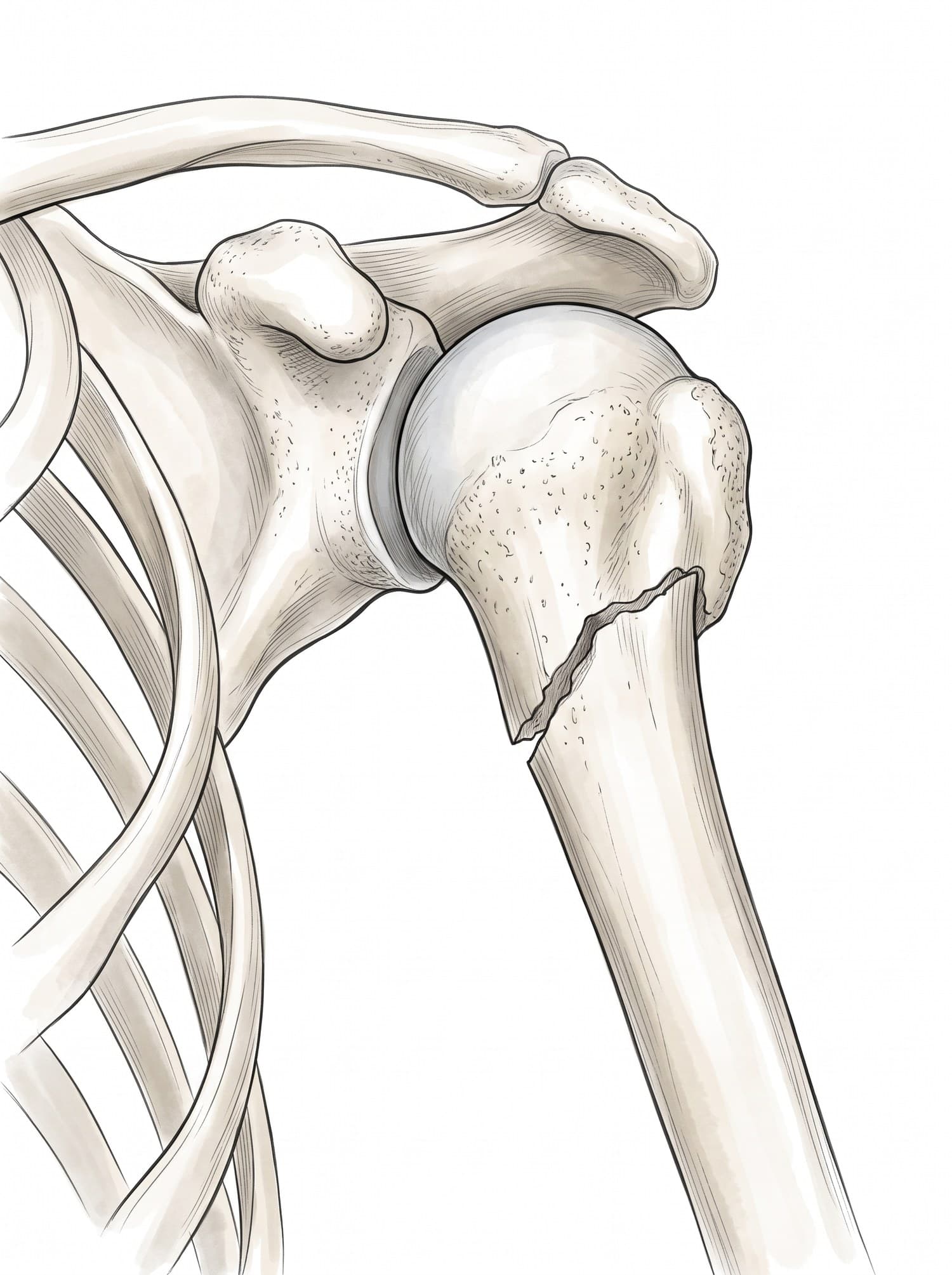
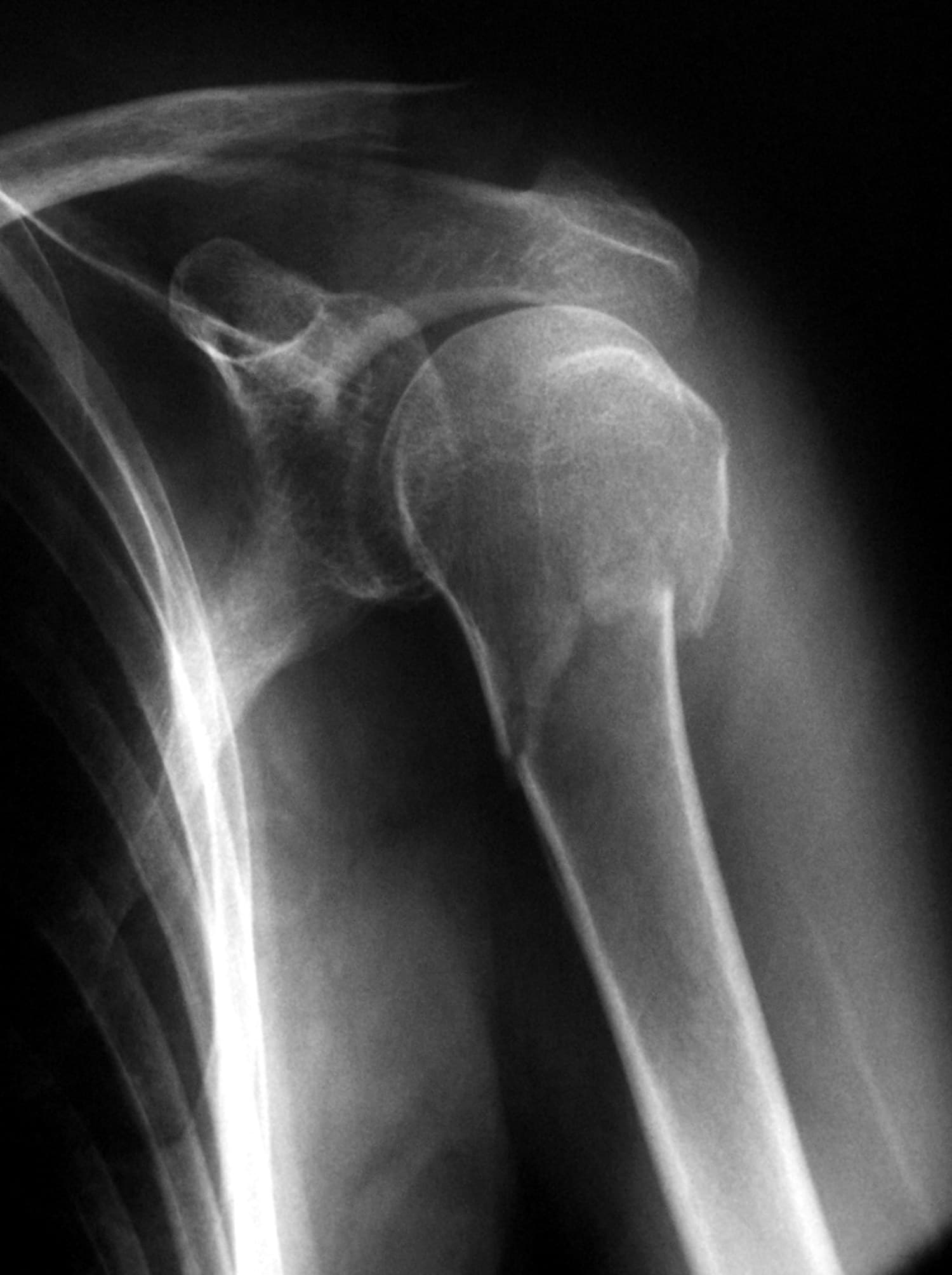
A proximal humerus fracture is a break at the top of the humerus, the upper arm bone, just below the shoulder joint. It is one of the most common fractures in older adults, usually from a fall onto an outstretched hand or directly onto the shoulder, and most heal without surgery. The figure above shows a real X-ray of a proximal humerus fracture with a medical illustration drawn from it: drag the slider to compare them.
The proximal humerus
The top of the humerus has four parts, which is how fractures are classified:
- Humeral head: the ball that sits against the glenoid of the shoulder blade.
- Greater tuberosity: the outer bump where most of the rotator cuff attaches.
- Lesser tuberosity: the front bump where the subscapularis attaches.
- Shaft, joined to the head and tuberosities at the surgical neck, the most common fracture site.
For the full anatomy of the shoulder, see shoulder anatomy.
Types of proximal humerus fracture
The Neer classification counts how many of the four parts are displaced (moved more than about 1 cm or angled more than 45 degrees):
| Type | Meaning |
|---|---|
| One-part | Fracture lines present but nothing displaced; the most common type |
| Two-part | One part displaced, most often a surgical neck fracture or a greater tuberosity fracture |
| Three-part | Two parts displaced |
| Four-part | All four parts displaced; highest risk to the blood supply of the head |
| Fracture-dislocation | The head is also dislocated from the glenoid |
Proximal humerus fracture on X-ray
A front (AP) view, a scapular Y view and an axillary view are taken; CT helps with complex fractures. On the X-ray above, the humerus is broken across the surgical neck, just below the head, and the shaft has shifted inward relative to the head. The head still sits in the glenoid. This is a displaced two-part surgical neck fracture.
| Finding | Why it matters |
|---|---|
| Number of displaced parts | Guides sling versus surgery |
| Greater tuberosity displacement | Even a few millimeters can block shoulder movement |
| Head position | A dislocated or split head changes treatment |
| Angulation of the head on the shaft | Severe tilt can limit lifting the arm |
How a proximal humerus fracture happens
Most occur in older adults with osteoporosis who fall from standing onto an outstretched hand or the side of the shoulder. In younger adults, they come from higher-energy injuries such as bicycle and car crashes and contact sports, and are more often displaced.
Symptoms
- Pain at the top of the arm and shoulder
- Inability to lift or rotate the arm
- Swelling and bruising that spreads down the arm and chest
- A grinding feeling when the arm moves
- Numbness over the outer shoulder if the axillary nerve is injured
Treatment
- Sling and early motion: for most minimally displaced fractures, with gentle pendulum exercises after 1 to 3 weeks.
- Plate and screws (ORIF) or an intramedullary nail: for displaced two-, three- and some four-part fractures in active patients.
- Reverse shoulder replacement: increasingly used for complex fractures in older adults.
- Physical therapy: the key to recovering motion, often for months.
Recovery time
The bone usually heals in about 6 to 8 weeks. Most people regain useful motion over 3 to 6 months, and improvement can continue for up to a year. Some loss of overhead reach is common in older adults.
Complications
- Shoulder stiffness
- Malunion, with the tuberosity or head healing out of position
- Avascular necrosis of the humeral head after complex fractures
- Axillary nerve injury
- Rotator cuff dysfunction
How a proximal humerus fracture is shown in a personal injury and nursing home case
Broken shoulders are common in falls on stairs, in stores and in care facilities, and in bicycle and car crashes. They often lead to months of therapy and some permanent loss of motion, which matters for damages. An illustration drawn from the patient's own X-ray, like the one above, shows which part of the humerus broke and how it moved. For how these images are used at trial, see demonstrative evidence and medical legal illustration.
Related pages
FAQ
How long does a broken shoulder take to heal?+
Most proximal humerus fractures heal in about 6 to 8 weeks. Gentle motion often starts within 1 to 3 weeks to prevent stiffness, but regaining strength and full movement takes 3 to 6 months, and some stiffness can last up to a year, especially in older adults.
Does a broken shoulder need surgery?+
Most do not. Around 4 in 5 proximal humerus fractures are minimally displaced and are treated in a sling with early physical therapy. Surgery (a plate and screws, a nail, or a shoulder replacement) is considered for badly displaced fractures, fracture-dislocations, and head-splitting fractures.
What is the best sleeping position with a broken humerus?+
Most people sleep best partly upright, in a recliner or propped on pillows, with the sling on and a pillow supporting the arm. Lying flat or on the injured side usually hurts in the first weeks.
What is a surgical neck fracture of the humerus?+
The surgical neck is the narrow part of the humerus just below the head and the two tuberosities. It is the most common site of a proximal humerus fracture, like the one on this page. The axillary nerve wraps around this area, so its function is checked after the injury.
Can a broken shoulder heal on its own?+
Many can. Minimally displaced fractures usually heal in a sling, with exercises started early to stop the shoulder from stiffening. Badly displaced or unstable fractures may heal crooked or not at all without surgery.
What are the symptoms of a fractured shoulder?+
Pain at the top of the arm after a fall, swelling, inability to lift the arm, and large bruising that spreads down the arm and chest over a few days. Numbness over the outer shoulder can mean the axillary nerve was injured.
What is the difference between a proximal and distal humerus fracture?+
A proximal humerus fracture is at the shoulder end of the upper arm bone, most common in older adults after a fall. A distal humerus fracture is at the elbow end, often from a fall or high-energy injury, and is covered with elbow injuries.
Need an illustration of a patient's own X-ray?
Upload an X-ray, CT or MRI and turn it into a clear, labeled medical illustration for a consult, a chart or a case exhibit.
Try Natomy →