ORIF Surgery: Plates, Screws & Recovery, Illustrated
ORIF surgery repairs a broken bone by putting the pieces back in place and holding them with plates and screws. See an ankle ORIF illustrated.
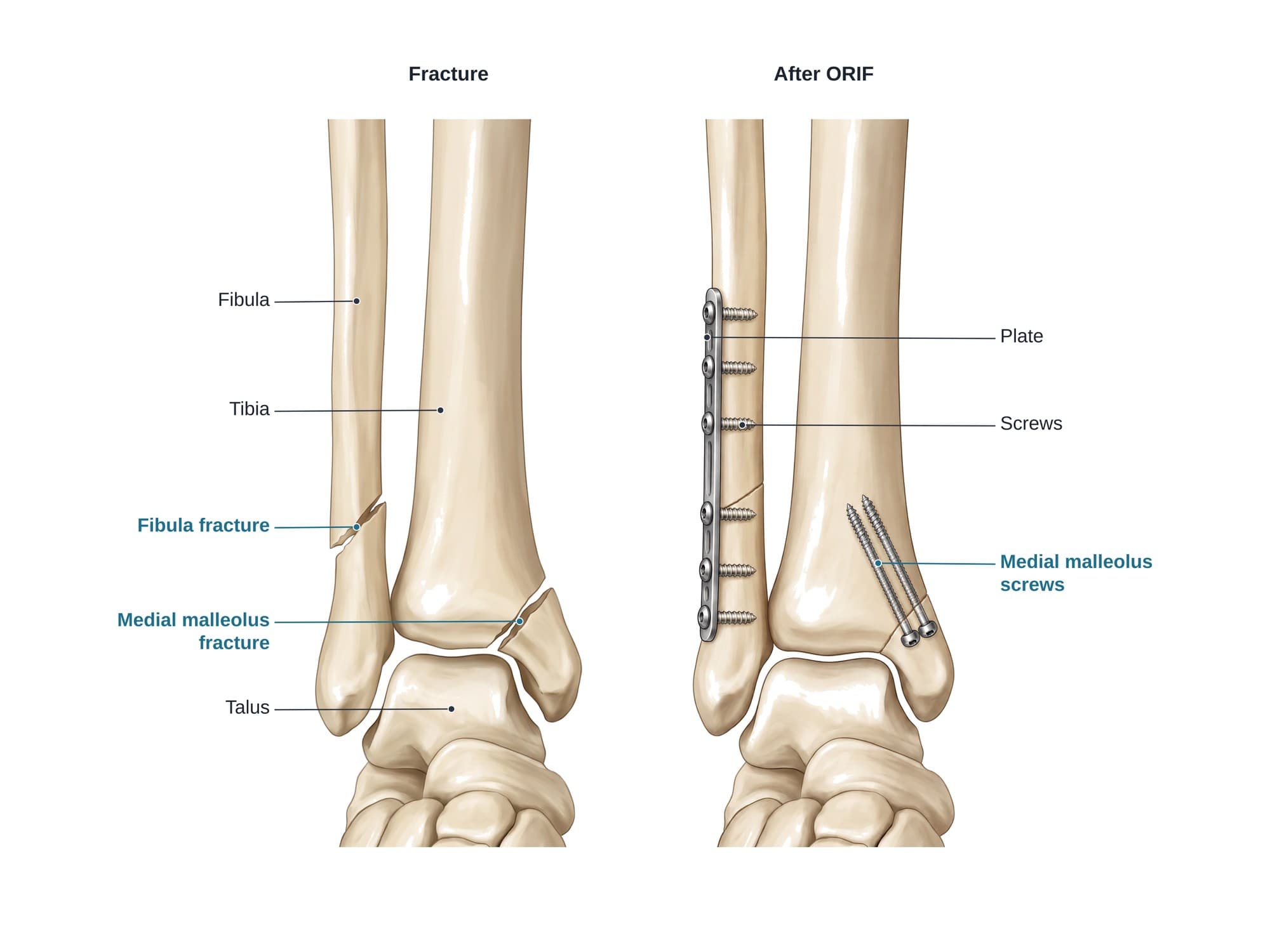
ORIF, short for open reduction and internal fixation, is surgery to repair a broken bone. Through an incision, the surgeon puts the broken pieces back in their normal position (reduction) and holds them there with metal implants such as plates and screws (internal fixation) while the bone heals. It is used for fractures that are displaced, unstable or run into a joint, and is one of the most common operations for an ankle fracture. The illustration above shows a bimalleolar ankle fracture before and after ORIF.
Why it is done
- Displaced fractures where the pieces have moved apart and cannot be held in line by a cast
- Unstable fractures that are likely to slip, such as an ankle broken on both sides (bimalleolar) or with torn syndesmosis ligaments
- Fractures into a joint, where even a small step in the joint surface leads to arthritis, as in many tibial plateau fractures and radial head fractures
- Fractures that failed non-surgical treatment
- Multiple injuries, where fixing the bones allows earlier movement
In the ankle, ORIF restores the mortise, the bracket formed by the tibia and fibula around the talus. If the talus shifts even a few millimeters, the contact area in the joint drops sharply and arthritis becomes more likely. For the anatomy, see ankle anatomy.
How the surgery is done
For an ankle fracture like the one illustrated:
- Anesthesia and positioning. General or regional anesthesia; a tourniquet is often placed on the thigh.
- Lateral incision. An incision over the outer side of the ankle exposes the fibula fracture.
- Reduction of the fibula. The surgeon cleans the fracture ends and brings the fragments back to their normal length and alignment, holding them with clamps.
- Fixation of the fibula. A lag screw may be placed across an oblique fracture to compress it, then a thin plate is laid along the fibula and fixed with screws above and below the fracture.
- Medial incision. A second incision over the inner ankle exposes the medial malleolus fracture.
- Fixation of the medial malleolus. The fragment is reduced and held with two parallel screws driven up into the tibia, or with wires and a tension band for small fragments.
- Checking the syndesmosis. The surgeon stresses the ankle under X-ray. If the tibia and fibula separate, one or two screws or a suture-button device are placed across the syndesmosis.
- Closing. X-rays confirm the position of the bones and implants, the incisions are closed, and the ankle is placed in a splint.
Hardware
| Implant | What it does |
|---|---|
| Plate | A shaped metal bar fixed to the bone surface with screws to hold the pieces in line |
| Lag screw | Compresses two fragments together across a fracture |
| Cortical and locking screws | Fix a plate to bone; locking screws thread into the plate for weak or osteoporotic bone |
| Cancellous screws | Larger threads for soft bone near joints, such as the medial malleolus |
| Syndesmotic screw or suture button | Holds the tibia and fibula together when the ligaments between them are torn |
| Kirschner wires and tension band | Wires and a figure-of-eight wire for small fragments |
Implants are usually stainless steel or titanium. Fractures of long bone shafts are often fixed with an intramedullary nail inside the bone instead of a plate.
Recovery
- First 2 weeks: splint, elevation, no weight on the foot, wound check and stitch removal at about 2 weeks.
- Weeks 2 to 6: a boot or cast, gentle ankle motion if the surgeon allows, usually little or no weight bearing.
- Weeks 6 to 12: gradual return to full weight bearing as X-rays show healing, with physical therapy for motion, strength and balance.
- 3 to 6 months: most people return to normal daily activity; swelling at the end of the day is common.
- Up to a year: full recovery for running and sport.
Driving is often possible at about 6 to 9 weeks after a right ankle ORIF, once the boot is off and the person can brake firmly.
Risks
- Wound problems and infection, more likely with smoking, diabetes or a fracture with heavy swelling
- Hardware irritation, the most common reason for a second operation to remove the plate
- Stiffness and swelling
- Malunion or nonunion: the bone heals out of position or does not heal
- Post-traumatic arthritis of the ankle, especially after severe or poorly reduced fractures
- Nerve injury, for example numbness from the superficial peroneal nerve near the lateral incision
- Blood clots (deep vein thrombosis) during the period of reduced walking
How ORIF is shown in a personal injury case
ORIF often follows the falls, car crashes and workplace injuries that bring a fracture case, and the surgery itself is evidence of how serious the break was. A before-and-after illustration like the one above lets a jury see the displaced bones, the plates and screws now in the leg, and why the person faced weeks off their feet, months of therapy and a risk of arthritis later. Postoperative X-rays can be drawn as clean illustrations so the hardware and the repaired fracture are easy to follow. For the injury itself, see ankle fracture. For how these images are used at trial, see demonstrative evidence and medical legal illustration.
Related pages
FAQ
What does ORIF stand for?+
Open reduction and internal fixation. Open means the surgeon makes an incision to see the fracture, reduction means putting the broken pieces back in their normal position, and internal fixation means holding them there with implants such as plates, screws, rods or wires under the skin.
How long is recovery after ORIF surgery?+
It depends on the bone. For an ankle, most people keep weight off the foot or wear a boot for about 6 weeks, then return to walking with physical therapy. Bone usually heals in about 6 to 12 weeks, but strength, swelling and stiffness often take 3 to 6 months or longer to settle.
Is ORIF a major surgery?+
It is a common operation, often done as day surgery or with a short hospital stay, under general or regional anesthesia. It usually takes about 1 to 3 hours depending on the fracture. Recovery is longer than the operation suggests because the bone still has to heal.
Do the plates and screws have to be removed?+
Usually not. Most stay in for life. They are removed if they irritate the tendons or skin, become infected, or in some cases of a screw placed across the ankle syndesmosis, which some surgeons take out after a few months.
Will metal implants set off airport security?+
Sometimes. Larger implants may trigger a metal detector or a body scanner alert. A short explanation to security staff is usually enough; cards from the surgeon are not required.
Is ORIF surgery painful?+
There is pain for the first several days, controlled with medicine, elevation and ice. Most people move from prescription to over-the-counter pain medicine within one to two weeks. Aching with weather changes or long days on the feet can last for months.
Why do some fractures need ORIF instead of a cast?+
A cast works when the pieces are already lined up and stable. ORIF is needed when the fracture is displaced, unstable, or involves a joint surface, because a cast cannot hold the pieces precisely enough for the joint to work well and heal in the right position.
Need a surgical illustration for consent or a case?
Describe the operation and get a clear, labeled medical illustration for patient consent, teaching or a case exhibit.
Try Natomy →