Lumbar Fusion Surgery: TLIF Steps, Recovery & Risks
Lumbar fusion joins two low back vertebrae with a cage, screws and rods. How TLIF (transforaminal lumbar interbody fusion) is done, recovery and risks.
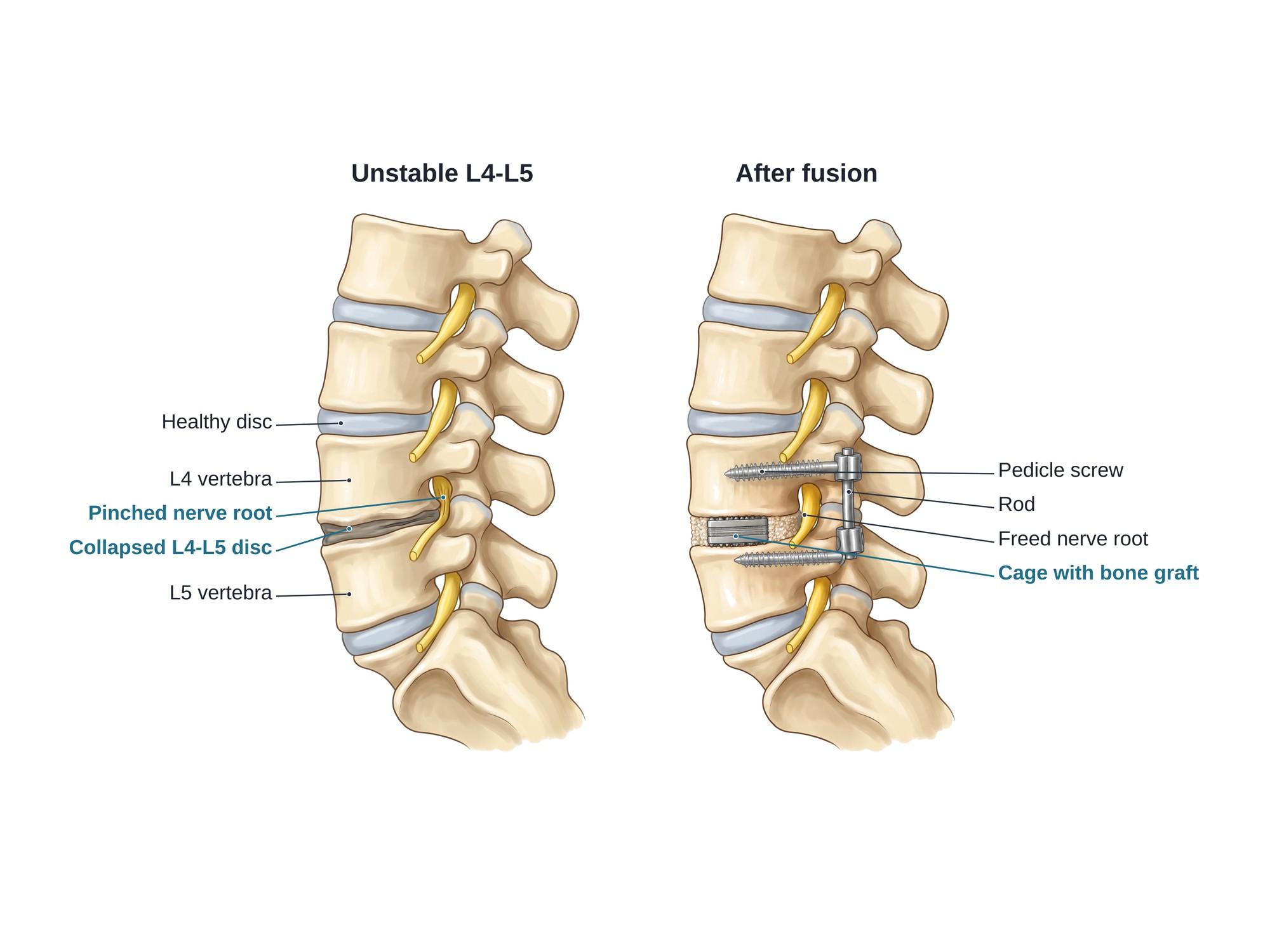
Lumbar fusion is surgery that joins two or more vertebrae in the low back so they heal into one solid bone. The lumbar spine has five vertebrae, L1 to L5, stacked above the sacrum. Between each pair sits a disc and two small facet joints, and a nerve root leaves through an opening on each side (see lumbar spine anatomy). When a level is unstable or worn out, fusion stops the painful motion and keeps the nerves free. A common form is TLIF, or transforaminal lumbar interbody fusion. A spacer called a cage fills the disc space, and pedicle screws and rods hold the bones still while they fuse. In the United States, about 273,000 lumbar fusions were done in hospitals in 2023, down from a peak of about 284,000 in 2016 (Martin et al., 2026). The illustration above shows an unstable L4-L5 level and the same level after TLIF.
Why it is done
Fusion treats problems where motion between two vertebrae causes pain or pinches nerves:
- Spondylolisthesis, where one vertebra slips forward on the one below. A forward slip is also called anterolisthesis. This is a common reason for fusion, usually at L4-L5 or L5-S1.
- Instability after injury, such as a fracture or torn ligaments after a car crash or fall
- Spinal stenosis with instability, where the canal is narrowed and the level also moves too much
- Recurrent disc herniation, when a lumbar disc herniation comes back after a microdiscectomy, often for the second or third time
- Scoliosis and other deformities, and some tumors and infections
It is usually offered after 3 to 6 months of physical therapy, medicine and injections have not helped. Weakness that gets worse, or loss of bladder control, can call for surgery sooner.
Fusion is not always needed. For stenosis with a mild slip, removing bone alone (a decompression) may be enough. In a Norwegian trial of 267 patients, 63% had at least a 30% drop in disability at five years with decompression alone, the same share as with decompression plus fusion (Kgomotso et al., 2024). Fusion is favored when the level is clearly unstable.
Types of lumbar fusion
Surgeons name the fusion by the path they take to the disc.
| Type | Approach | Main features |
|---|---|---|
| TLIF | From the back, through one side | Removes one facet joint to reach the disc; moves the nerves very little |
| PLIF | From the back, both sides | Cages placed on both sides of the nerve sac |
| ALIF | From the front, through the belly | Large cage; good for L5-S1; needs an access surgeon to move vessels |
| LLIF (XLIF) | From the side, through the flank | Passes through the psoas muscle; not used at L5-S1 |
| OLIF | From the front and side | Passes in front of the psoas muscle |
| Posterolateral fusion | From the back | Bone graft laid along the sides of the spine, no cage |
MIS TLIF is a minimally invasive TLIF done through small incisions and tubes. In a review of 7 randomized trials with 496 patients, it cut blood loss by about 200 mL and the hospital stay by about 2 days compared with open TLIF, with similar complication rates (Miller et al., 2020).
How the surgery is done
These are the TLIF procedure steps for a one-level L4-L5 fusion. It usually takes about 2 to 4 hours.
- Position. The patient lies face down on a padded frame under general anesthesia. X-ray confirms the level.
- Incision. The surgeon makes a cut down the middle of the low back, or two small cuts for MIS TLIF, and moves the muscles off the bone.
- Pedicle screws. A screw is placed through each pedicle, the short bony bridge from the back of the spine to the vertebral body, into L4 and L5 on both sides. X-ray or navigation guides each screw.
- Facetectomy. On the side with worse leg pain, the surgeon removes one facet joint. This opens a window through the nerve opening (the foramen) to the disc.
- Decompression. Bone and thickened ligament pressing on the nerve roots are removed, as in a foraminotomy.
- Discectomy. The surgeon removes the worn disc and scrapes the bony endplates so they will bleed and grow bone.
- Cage. Bone graft is packed into the disc space, and a cage filled with graft is tapped in. It restores the height of the disc and widens the nerve opening.
- Rods. Rods are locked onto the screw heads on each side. The surgeon can gently pull a slipped vertebra back into line before tightening them.
- Closing. More bone graft may be laid along the side of the spine. A drain may be left, and the skin is closed.
Hardware
| Part | What it does |
|---|---|
| Interbody cage | Fills the disc space, restores its height and holds bone graft; made of PEEK plastic or titanium |
| Bone graft | The patient's own bone, donor bone or a bone substitute that grows into a solid fusion |
| Pedicle screws | Titanium screws through the pedicles into each vertebral body, two per vertebra |
| Rods | Short titanium rods that lock to the screw heads and hold the level still |
The hardware usually stays in for life.
Recovery
- Walking starts the day of surgery or the next day.
- Most patients go home in 1 to 4 days.
- A physical therapist teaches safe ways to get out of bed, sit and walk.
- Bending, lifting and twisting are limited for about 6 to 12 weeks.
- Desk work often resumes in about 4 to 6 weeks. Heavy work may take 3 to 6 months.
- Smoking and nicotine slow bone growth, so surgeons ask patients to stop.
- The fusion becomes solid over about 6 to 12 months. X-rays or CT scans follow the healing.
Leg pain from a pinched nerve often improves soon after surgery. Back pain improves more slowly and less reliably.
Risks
- Non-union (pseudarthrosis), where the bones fail to fuse; more likely in smokers and with diabetes or weak bones
- Adjacent segment disease, wear of the level above or below the fusion. In a review of 791 fusion patients, 11% developed symptoms from it, and 7% needed another operation for it (Donnally et al., 2020).
- Hardware problems, such as a misplaced, loose or broken screw, or a cage that shifts
- Nerve root injury, causing new leg pain, numbness or weakness
- Dural tear, a tear in the sac around the nerves that leaks spinal fluid
- Infection, blood clots and bleeding
- Ongoing pain, sometimes called failed back surgery syndrome, which may be treated with a spinal cord stimulator
How lumbar fusion is shown in a personal injury case
Lumbar fusion is one of the largest surgeries in car crash and fall cases. It often follows a disc injury, a traumatic slip or a fracture at L4-L5 or L5-S1. In 2023, hospital costs averaged about $45,000 per stay (Martin et al., 2026), before rehab and lost work. The defense often argues that the disc wear or slip was there before the crash. The plaintiff's side shows that the crash caused the injury, or turned a silent condition into a painful one. Future costs matter too: adjacent segment disease can lead to a second fusion years later. In malpractice claims, the questions are often a misplaced screw that hit a nerve, or a fusion done when it was not needed. A medical illustration of the injured level beside the fused level shows a jury the cage, screws and rods now in the spine. For how these images are used at trial, see demonstrative evidence and medical legal illustration.
References
- Martin BI, Mirza SK, Karamian BA, et al. Cost and Utilization Trends of Lumbar Fusion. JAMA Network Open. 2026;9(3):e260452.
- Kgomotso EL, Hellum C, Fagerland MW, et al. Decompression alone or with fusion for degenerative lumbar spondylolisthesis (Nordsten-DS): five year follow-up of a randomised, multicentre, non-inferiority trial. BMJ. 2024;386:e079771.
- Miller LE, Bhattacharyya S, Pracyk J. Minimally Invasive Versus Open Transforaminal Lumbar Interbody Fusion for Single-Level Degenerative Disease: A Systematic Review and Meta-Analysis of Randomized Controlled Trials. World Neurosurgery. 2020;133:358-365.e4.
- Donnally CJ, Patel PD, Canseco JA, et al. Current incidence of adjacent segment pathology following lumbar fusion versus motion-preserving procedures: a systematic review and meta-analysis of recent projections. Spine Journal. 2020;20(10):1554-1565.
Related pages
- Lumbar spine anatomyThe normal anatomy of the lumbar spine.
- ForaminotomyA foraminotomy widens the opening where a spinal nerve root leaves the spine to relieve a pinched nerve.
- MicrodiscectomyMicrodiscectomy removes the piece of herniated disc pressing on a nerve root through a small window in the lamina.
FAQ
Why is lumbar fusion done?+
To stop painful motion at an unstable level and to keep pinched nerves free. Common reasons are spondylolisthesis (a slipped vertebra), instability after a fracture or injury, scoliosis, and a disc that has herniated again after earlier surgery. It is usually offered only after months of therapy have not helped, or sooner for weakness or instability.
What is the recovery time for lumbar spinal fusion surgery?+
Most people walk the day of surgery or the next day and go home in 1 to 4 days. Desk work often resumes in about 4 to 6 weeks. Bending, lifting and twisting are limited for about 6 to 12 weeks. The bone fusion takes about 6 to 12 months to become solid, and many people keep improving for a year.
Will I ever be normal after spinal fusion?+
Most people return to work, walking, driving and exercise. A one-level fusion removes motion at only one of five lumbar levels, so most daily movement feels close to normal. Some back pain often remains, and leg pain usually improves more than back pain. Surgeons may advise against heavy contact sports.
How long is the hospital stay after lumbar fusion?+
Usually 1 to 4 days after open surgery, and often shorter after minimally invasive TLIF. In a review of 7 randomized trials, minimally invasive TLIF shortened the hospital stay by about 2 days compared with open TLIF.
What is the difference between TLIF and PLIF?+
Both are done from the back and put a cage in the disc space. A PLIF (posterior lumbar interbody fusion) places cages on both sides of the nerve sac, so the nerves are moved more. A TLIF (transforaminal lumbar interbody fusion) goes in from one side through the nerve opening after removing one facet joint, so the nerves are moved less.
Are the screws and rods removed after fusion?+
Usually not. The hardware stays in for life once the bone has fused. It is removed only for a problem such as infection, a loose or broken screw, or pain clearly caused by the hardware.
Can the level above or below a fusion wear out?+
Yes. This is called adjacent segment disease. In a review of 791 fusion patients, about 11% developed symptoms from it and about 7% needed another operation for it. Older age, higher weight, damage to the facet joint above the fusion, and wear already present at the next level raise the risk.
Is lumbar fusion a major surgery?+
Yes. It is done under general anesthesia and usually takes 2 to 4 hours for one level. It is larger than a microdiscectomy, with more blood loss, a longer stay and a longer recovery, because bone must grow across the joint.
Need a surgical illustration for consent or a case?
Describe the operation and get a clear, labeled medical illustration for patient consent, teaching or a case exhibit.
Try Natomy →