Road Rash: Degrees, Healing Stages & Treatment
Road rash is a friction abrasion from sliding on pavement. Learn its degrees, healing stages, treatment and complications.
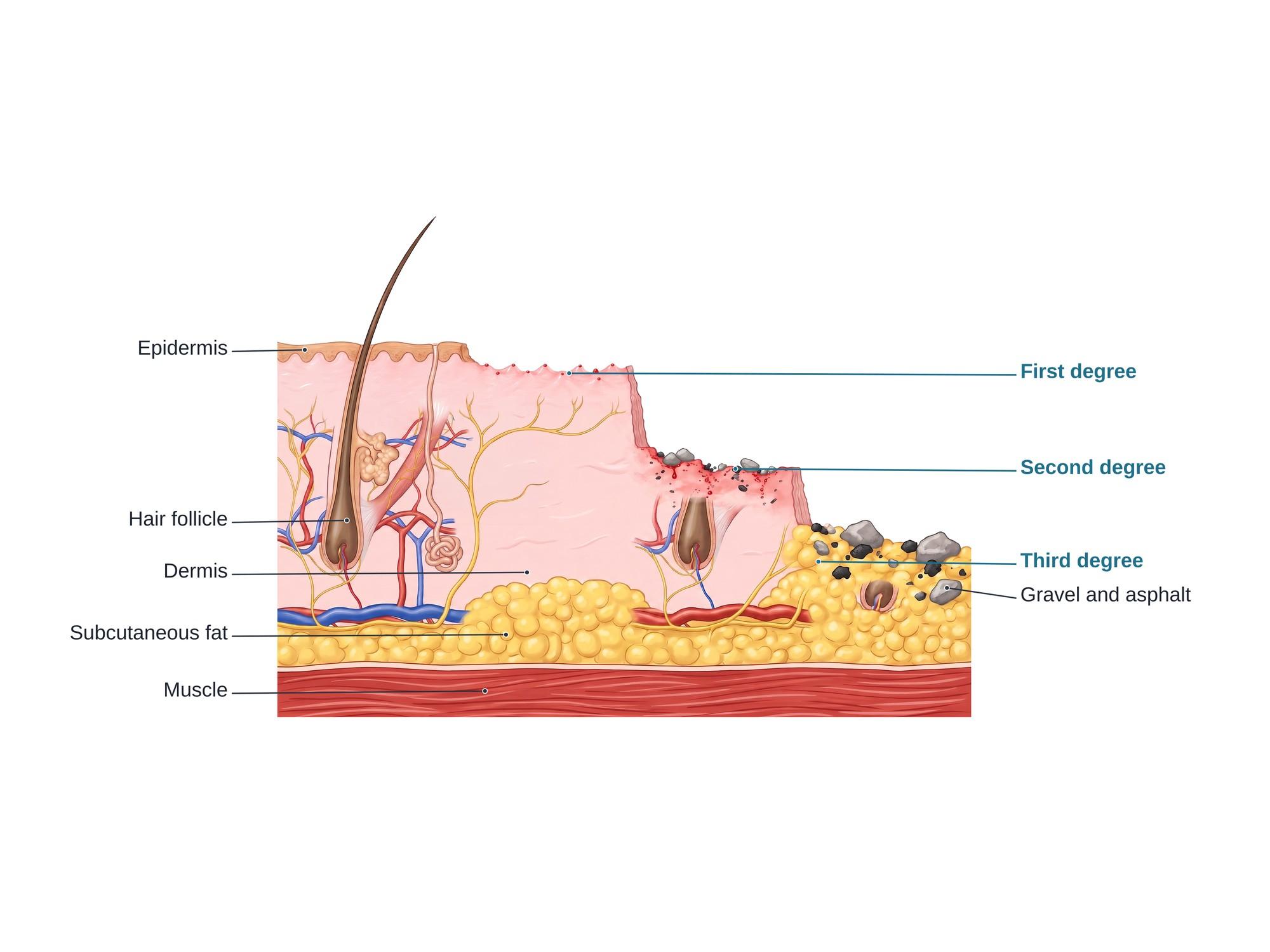
Road rash is a friction abrasion. It happens when skin slides across pavement, gravel or concrete during a crash or fall. The road scrapes away the epidermis, the thin outer layer of skin. Deeper road rash also removes the dermis, the thick layer below, and can reach the fat. Road grit is often pressed into the wound. Road rash is very common after bike crashes. In one study of commuter cyclists, abrasions were 42% of all crash injuries (de Geus et al., 2012). The figure above shows the three degrees of road rash side by side in one section of skin.
The anatomy
Skin has two layers over a bed of fat. The epidermis is the outer layer of cells. It has no blood vessels. The dermis lies below it. It is a tough layer of collagen with blood vessels, nerve endings, hair follicles and sweat glands. Under the dermis is the subcutaneous fat, also called the hypodermis. Deeper still are the fascia, muscle and bone.
Depth decides how road rash heals. Hair follicles and sweat glands reach deep into the dermis. When some dermis is left, new skin can grow up from these structures. When the full dermis is gone, new skin can only creep in from the wound edges. For a general look at scrapes of every kind, see abrasion.
Degrees of road rash
Doctors grade road rash by depth, much like burns. That is why it is often called a friction burn.
- Layers lost
- Epidermis only
- What it looks like
- Red or pink, moist, little bleeding
- Usual healing
- About 1 to 2 weeks, rarely scars
- Layers lost
- Epidermis and part of the dermis
- What it looks like
- Raw, wet, pinpoint bleeding, grit often stuck in it
- Usual healing
- About 2 to 3 weeks, may scar
- Layers lost
- All of the skin, into fat or deeper
- What it looks like
- Yellow fat, muscle or even bone visible
- Usual healing
- Weeks to months, often a skin graft
Third degree road rash is a surgical wound. Doctors treat it like a full-thickness burn.
Causes
Road rash comes from the body sliding on a hard, rough surface. Speed and distance decide how deep it goes.
- Motorcycle crashes, especially without a jacket, pants or gloves
- Bicycle crashes, from slipping, falls and collisions with cars
- Electric scooter, skateboard and inline skate falls
- Pedestrians thrown onto the road by a vehicle
- Being dragged, for example by a car or a horse
In one burn unit series of friction burns, 56 of 60 cases came from road traffic accidents. Most patients were men aged 21 to 30, and the leg was hurt most often (Agrawal et al., 2008). The forearms, elbows, hands, hips, knees and shins take most of the slide.
Symptoms
- A raw, red or bleeding patch of skin
- Burning or stinging pain, often severe in second degree road rash
- Clear or yellow fluid oozing from the wound
- Dirt, gravel or black asphalt specks in the skin
- Swelling and bruising around the wound
- In third degree road rash, less pain in the center, because the nerve endings there are destroyed
Pain from road rash is nociceptive pain, meaning it comes from injured tissue that triggers pain nerves. See nociceptive vs neuropathic pain for how this differs from nerve pain.
Diagnosis
Diagnosis is made by looking at the wound. The doctor measures its size and judges its depth. They look for debris. They check movement, strength and feeling below the wound, to rule out a cut tendon or nerve. Over a joint, they check whether the scrape has reached the joint. They also look for other crash injuries, such as fractures or a head injury.
X-rays may be taken when gravel or glass may be deep in the tissue, or when a fracture is likely. For a legal record, each wound is photographed with a ruler beside it.
Treatment
- Clean it well. The wound is rinsed with plenty of clean water or saline. All grit is removed, often with a soft brush or tweezers after numbing. This step matters most. Grit left in the skin causes infection and permanent tattooing.
- Remove dead tissue. Loose, dead skin is trimmed away. This is called debridement.
- Keep it moist and covered. A thin layer of petroleum jelly or an ointment goes under a non-stick dressing. Large wounds may get a special burn dressing.
- Prevent tetanus. A booster is needed for a dirty wound if the last tetanus shot was 5 or more years ago (CDC).
- Treat infection if it appears. Antibiotics are used only when there are signs of infection.
- Surgery for third degree road rash. Deep wounds are cleaned in the operating room. Many need a skin graft, where a thin sheet of skin is taken from another part of the body to cover the wound. Large areas may be treated in a burn unit.
Recovery and healing stages
Road rash heals in overlapping stages, like other wounds.
- Inflammation (days 1 to 4): The wound bleeds a little, weeps clear or yellow fluid and swells. This fluid is normal.
- New skin (about days 4 to 21): Pink, shiny new skin grows in from the wound edges and from hair follicles left in the dermis. Shallow road rash closes in one to two weeks. Second degree road rash often takes two to three weeks.
- Remodeling (weeks to months): The new skin thickens and slowly matches the skin around it. It often stays pink, red or dark for months. Sun protection helps the color fade evenly.
Gear makes a big difference. In one study of crashed motorcyclists, riders wearing motorcycle gloves were 59% less likely to be admitted to the hospital (relative risk 0.41). Motorcycle pants roughly halved the risk (relative risk 0.49) (de Rome et al., 2011).
Complications
- Infection, from dirt and bacteria driven into the wound
- Traumatic tattooing, permanent blue or black marks from asphalt left in the dermis
- Scarring, including raised hypertrophic scars and keloids
- Pigment changes, with skin that heals darker or lighter
- Scar contracture, a tight scar over a joint that limits movement
- Deeper injury, such as a laceration, an avulsion or a degloving injury, where the skin and fat are torn off the tissue below
Road rash also hides injuries under it. A scrape over the hip or thigh may sit on top of a deep contusion or a closed degloving injury.
How road rash is shown in a personal injury case
Road rash is one of the most common injuries in motorcycle and bicycle claims. Photos taken after cleaning show the surface, but they do not show depth. A medical illustration shows which skin layers were lost, why the wound needed scrubbing or surgery, and why it scarred. It can also show why gear matters. In one study, about 26% to 30% of motorcycle gloves, jackets and pants failed from material damage in the crash (de Rome et al., 2011). For how these images are used at trial, see demonstrative evidence and medical legal illustration.
References
- de Geus B, Vandenbulcke G, Int Panis L, et al. A prospective cohort study on minor accidents involving commuter cyclists in Belgium. Accident Analysis and Prevention. 2012.
- Agrawal A, Raibagkar SC, Vora HJ. Friction burns: epidemiology and prevention. Annals of Burns and Fire Disasters. 2008.
- Centers for Disease Control and Prevention. Clinical Guidance for Wound Management to Prevent Tetanus. CDC. 2024.
- de Rome L, Ivers R, Fitzharris M, et al. Motorcycle protective clothing: protection from injury or just the weather? Accident Analysis and Prevention. 2011.
FAQ
What type of injury is road rash?+
Road rash is an abrasion, also called a friction burn. It happens when skin slides across pavement, gravel or concrete, usually in a motorcycle, bicycle, scooter or skateboard crash. Friction scrapes away layers of skin, and the road surface often leaves grit in the wound.
How many degrees of road rash are there?+
Three. First degree road rash removes only the epidermis. Second degree goes into the dermis and often has gravel in it. Third degree removes all of the skin, so fat, muscle or bone may show. Third degree road rash usually needs surgery.
What does second degree road rash look like?+
It is raw, red and wet, with many tiny bleeding points and clear or yellow fluid. The skin is broken through the top layer into the dermis. Dirt and tiny stones are often stuck in it. It hurts a lot, because nerve endings in the dermis are exposed.
What are the healing stages of road rash?+
In the first days, the wound weeps fluid and bleeds a little, and the area swells. Over the next one to two weeks, new pink skin grows in from the edges and from hair follicles. Over the following months, the new skin thickens and its color slowly evens out.
How long does road rash take to heal?+
First degree road rash usually heals in one to two weeks. Second degree road rash often takes two to three weeks, longer if it gets infected. Third degree road rash can take weeks to months and often needs a skin graft.
How do you know if road rash is infected?+
Watch for redness that spreads past the wound edge, warmth, swelling, more pain after the first few days, pus, a bad smell, red streaks up the limb, or fever. An infected road rash should be seen by a doctor.
How do you heal road rash faster?+
Clean out all dirt early, then keep the wound moist and covered. A thin layer of petroleum jelly under a non-stick dressing works well. Change the dressing daily. Letting it dry into a hard scab slows healing and raises the risk of scarring.
Does road rash leave a scar?+
First degree road rash usually heals without a scar. Deep second degree and third degree road rash often scar. Gravel or asphalt left in the skin can leave permanent dark marks, called traumatic tattooing.
Need this illustration for a patient or a case?
Describe the injury or upload a scan and get a clear, labeled medical illustration for a consult, a chart or a case exhibit.
Try Natomy →