Avulsion Injury: Skin Avulsion vs Avulsion Fracture
An avulsion is tissue torn away from where it belongs: a flap of skin and fat, or a chip of bone pulled off by a tendon. See both illustrated.
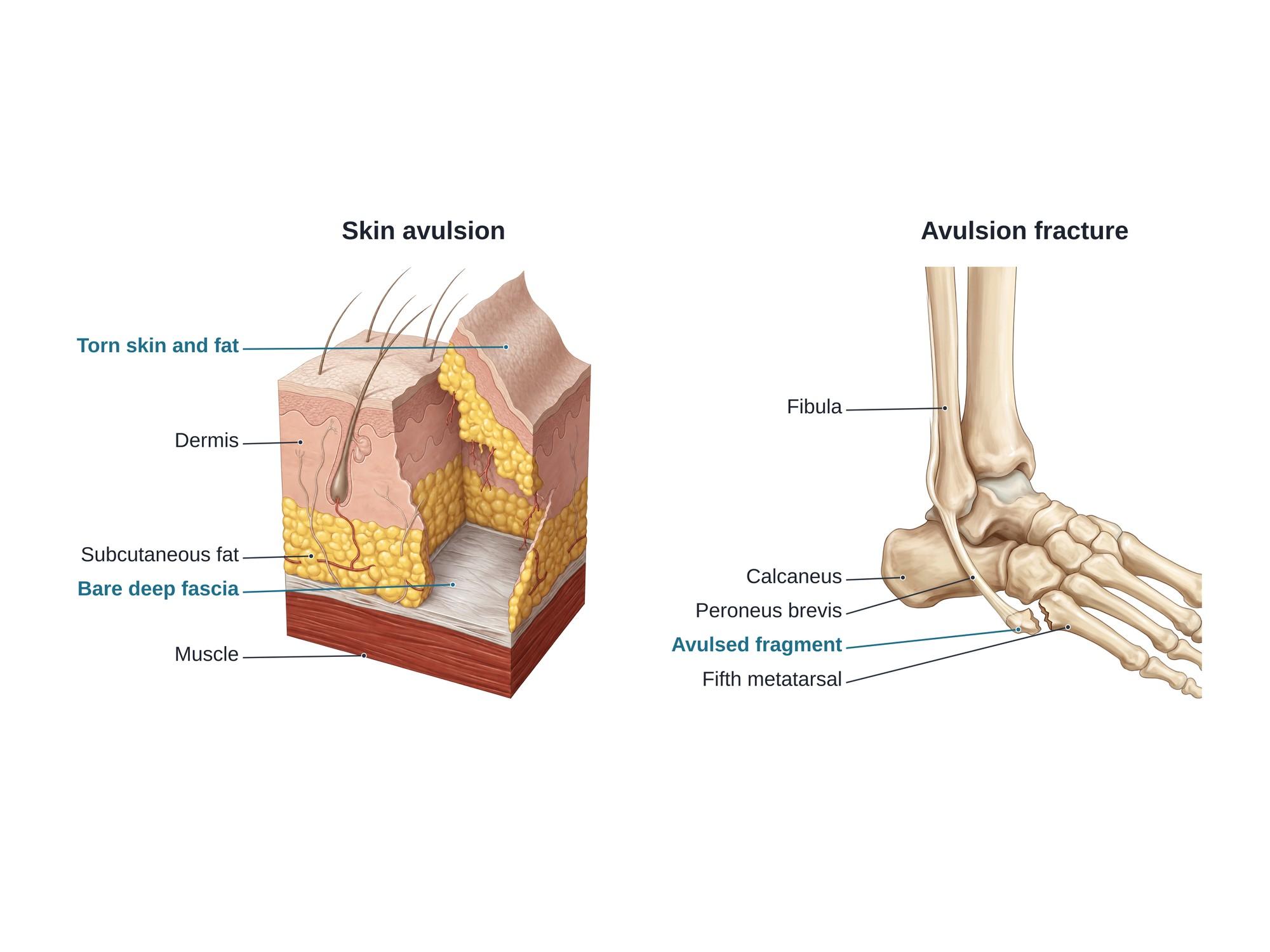
An avulsion injury is tissue torn away from where it is attached. In a soft tissue avulsion, a flap or patch of skin and the fat under it is ripped off the deeper layers. In an avulsion fracture, a tendon or ligament pulls a small piece of bone off with it. Both come from a strong pulling or shearing force, not a clean cut. The figure above shows a skin avulsion beside an avulsion fracture of the fifth metatarsal.
The anatomy
Skin has two layers. The thin outer epidermis sits on the thicker dermis, which holds the blood vessels, nerves and hair roots. Under the dermis is the subcutaneous fat (hypodermis). Below the fat, a tough sheet of deep fascia wraps the muscles. Small vessels pass up through the fat to feed the skin. In a skin avulsion, the skin and fat are pulled off along the fascia, and these feeding vessels tear.
Tendons join muscle to bone. Ligaments join bone to bone. Where they attach, their fibers blend into the bone. In an adult, the attachment can be stronger than the bone next to it. In children, the growth plate is weaker still. A sudden hard pull can therefore break off the bone instead of tearing the tendon. For the foot bones, see foot bones anatomy.
Types of avulsion injury
| Type | What is torn away | Common examples |
|---|---|---|
| Skin avulsion, partial | A flap of skin and fat, still attached along one edge | Shin, forearm or scalp flaps in falls and crashes |
| Skin avulsion, complete | A patch of skin torn fully off | Fingertip and hand injuries in machinery |
| Degloving | Skin and fat stripped off a large area, often all around a limb | Limb run over or caught in a wheel or roller |
| Avulsion fracture | A chip of bone pulled off by a tendon or ligament | Fifth metatarsal base, ankle, finger (mallet finger), pelvis |
| Nerve root avulsion | Nerve roots pulled out of the spinal cord | Brachial plexus injuries in motorcycle crashes |
A degloving injury is the most severe form of skin avulsion. It has its own page: degloving injury.
Avulsion fracture
The fifth metatarsal tip avulsion (also called a pseudo-Jones fracture) is one of the most common. The foot rolls inward. The peroneus brevis tendon, which runs behind the outer ankle bone, pulls hard on its attachment. A small piece of the tuberosity at the base of the fifth metatarsal breaks off, as shown in the figure. It is a different injury from a true Jones fracture, which is further along the bone and heals more slowly.
Other common avulsion fractures:
- Ankle: a ligament pulls a chip off the fibula or talus in an ankle sprain.
- Finger: the extensor tendon pulls a piece off the end bone (bony mallet finger).
- Pelvis and hip: in teenage athletes, a thigh muscle pulls off a piece of the pelvis at a growth plate.
- Knee: a ligament pulls a piece off the tibia, such as a Segond fracture with an ACL tear.
Causes
- Shearing and pulling forces on the skin: a limb dragged on the road, caught in a machine, or run over.
- Falls and car crashes, often on the shin, forearm, scalp and hands.
- Dog bites, which can tear tissue away.
- Ring injuries, when a ring catches and strips the skin of a finger.
- Sudden muscle pull or twist, for avulsion fractures: rolling an ankle, sprinting or kicking.
Thin, fragile skin tears more easily. Older adults and people on long-term steroids are at higher risk.
Symptoms
Skin avulsion:
- A flap or missing patch of skin, with fat or deeper tissue showing
- Bleeding, often heavier than from a small cut
- A flap that turns pale, blue or dark if its blood supply is lost
- Pain, though a large avulsion can be less painful than expected if nerves are torn
Avulsion fracture:
- Sudden sharp pain at the spot where a tendon attaches
- Swelling and bruising
- Pain when the muscle is used, such as turning the foot outward
- Trouble walking or bearing weight
Diagnosis
For a skin avulsion, the doctor looks at the size and depth of the wound and checks the flap's blood flow. A pink flap that bleeds when pricked is usually alive. A pale or dark flap is often not. They check nerves, tendons and blood vessels below the wound. X-rays look for broken bone and foreign material such as gravel or glass.
For an avulsion fracture, X-rays show a small piece of bone pulled away from the main bone, with a gap between them. Doctors check how far the fragment has moved and whether it touches a joint. CT can map a complex fragment. MRI shows the tendon or ligament attached to it. In children, a growth plate avulsion may need comparison views of the other side.
Treatment
Skin avulsion:
- Cleaning and irrigation to remove dirt and lower infection risk
- Debridement: removing dead or badly damaged tissue
- Putting the flap back and closing it loosely, if it is alive
- Skin grafts or flaps when the skin is missing or the flap dies
- Negative pressure wound therapy (a sealed vacuum dressing) to help the wound bed heal
- Tetanus shot and antibiotics when the wound is dirty or a bite
Avulsion fracture:
- Rest, ice and elevation for the first days
- Walking boot, splint or brace for most small fragments
- Protected weight bearing as advised
- Surgery with screws, wires or anchors when the fragment is large, widely pulled apart or part of a joint
- Physical therapy to regain strength and balance
Recovery
Small skin avulsions often heal in 2 to 6 weeks. Larger ones that need grafts or flaps can take a few months, and the scar keeps changing for up to a year or more. Most avulsion fractures heal in about 4 to 8 weeks. Full return to sport can take 2 to 3 months. Fractures fixed with surgery may take longer.
Complications
- Flap death (necrosis) when the torn flap loses its blood supply
- Infection, especially in dirty wounds and bites
- Scarring, including raised or tight scars that limit movement
- Nerve damage with numbness or lasting pain
- Nonunion: a bone fragment that never heals and stays painful
- Joint stiffness or instability when the fragment involves a joint
How an avulsion injury is shown in a personal injury case
Avulsion injuries are common in motorcycle and bicycle crashes, industrial and machinery accidents, dog attacks and falls. Records may say "avulsion," "flap laceration" or "avulsion fracture," words a jury may not know. A medical illustration like the one above shows what was torn away, which layers were exposed and why grafts, repeat surgery or a long recovery followed. For a bone avulsion, it shows how the tendon pulled the bone apart during the event. For related skin injuries, see laceration, abrasion and contusion. For how these images are used at trial, see demonstrative evidence and medical legal illustration.
Related pages
FAQ
What does avulsion mean in medical terms?+
Avulsion means tearing away. Doctors use it when a piece of tissue is forcibly pulled off the place it is attached. In the skin it means a flap or patch of skin and fat torn off. In bone it means a small piece of bone pulled off by a tendon or ligament.
What is the difference between a tear and an avulsion?+
A tear splits tissue apart, such as a cut-like tear in the skin or a torn ligament. An avulsion pulls tissue away from its base. The skin is lifted off the layer under it, or a tendon pulls its bony attachment off with it. Avulsions usually leave tissue with a poor blood supply, so they heal more slowly.
What is an avulsion fracture?+
An avulsion fracture happens when a tendon or ligament pulls so hard that it breaks off the small piece of bone it is attached to. The tendon stays whole, but the bone gives way. Common places are the base of the fifth metatarsal, the ankle, the finger tips and the pelvis in teenage athletes.
How long does it take for an avulsion wound to heal?+
A small skin avulsion that is cleaned and closed or left to heal from the edges often takes 2 to 6 weeks. Large avulsions that need skin grafts or flaps take longer, often several weeks to a few months, plus months for the scar to mature. Infection or a flap that loses its blood supply can slow healing.
How long does an avulsion fracture take to heal?+
Most avulsion fractures heal in about 4 to 8 weeks. A fifth metatarsal tip avulsion is often treated in a walking boot. Some pain with heavy activity can last a few months. Fragments that are large, badly displaced or part of a joint can need surgery and take longer.
Does an avulsion injury need surgery?+
Many do not. Small skin avulsions are cleaned and dressed, and small bone avulsions heal in a boot, splint or brace. Surgery is needed for large or dirty skin avulsions, flaps that are dying, and bone fragments that are widely pulled apart or that disturb a joint.
Can an avulsion fracture get worse?+
Yes. Walking on it too early or rolling the ankle again can pull the fragment further away. A fragment that does not heal can leave a painful, loose piece of bone (a nonunion). Following the weight-bearing plan lowers this risk.
Is a tooth avulsion the same thing?+
It uses the same word. A tooth avulsion is a tooth knocked fully out of its socket. It is a dental emergency, and the tooth has the best chance of saving if it is put back within about an hour. This page covers skin and bone avulsions.
Need this illustration for a patient or a case?
Describe the injury or upload a scan and get a clear, labeled medical illustration for a consult, a chart or a case exhibit.
Try Natomy →