Concussion: Symptoms, Recovery Time & Treatment
A concussion is a mild traumatic brain injury from a blow or jolt to the head. Learn the symptoms, recovery time, the 6 stages of return and treatment.
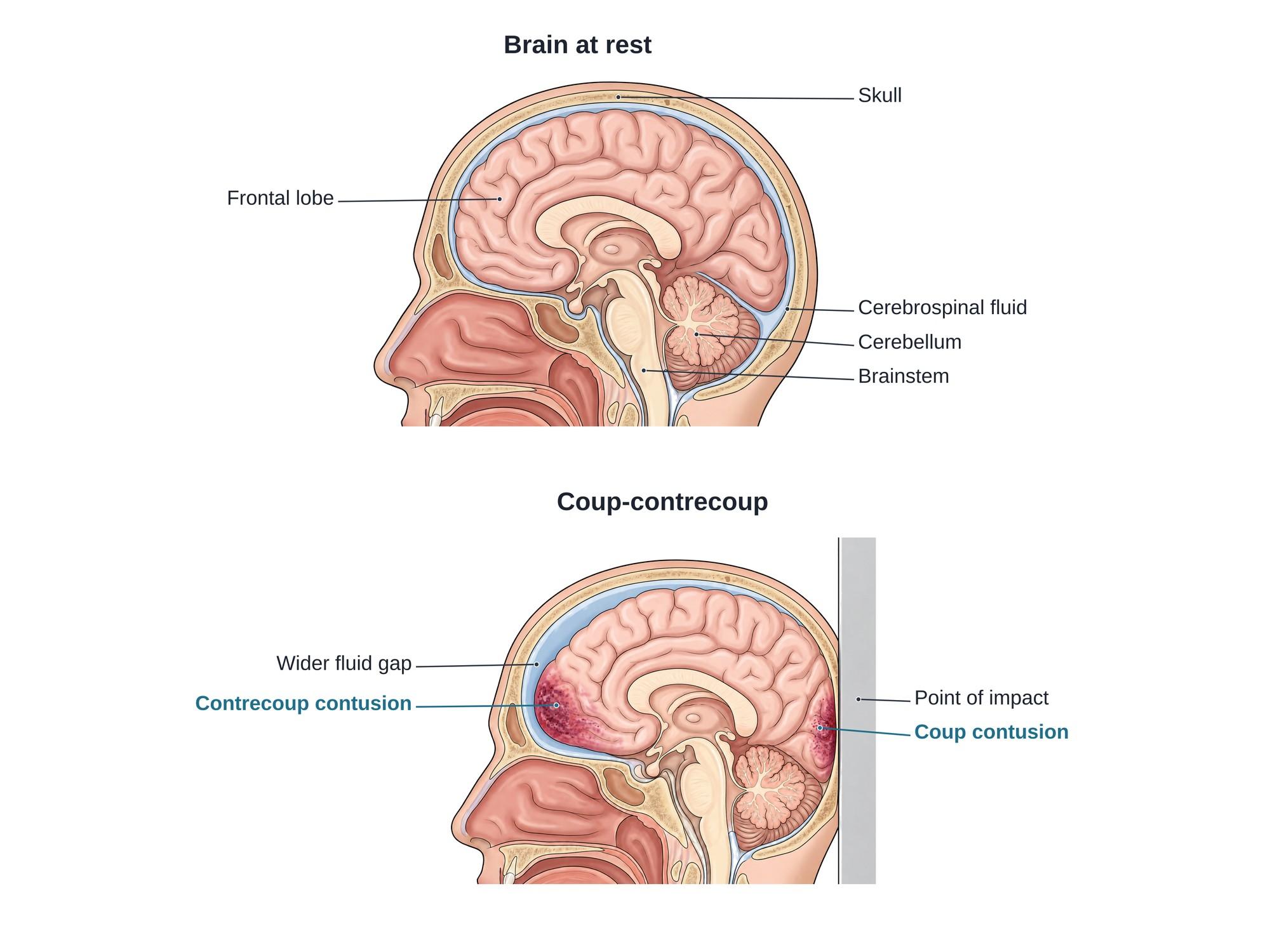
A concussion is a mild traumatic brain injury (TBI), caused by a blow to the head or a jolt that makes the head snap back and forth. The brain is soft and floats in cerebrospinal fluid (CSF) inside the hard skull (see brain anatomy). A sudden stop or hit makes the brain shift, twist and strike the inside of the skull. This stretches nerve fibers and briefly upsets how brain cells work. The result is a short-term change in brain function, such as confusion, memory loss or a headache. Most concussions do not show on a CT scan. About 69 million people worldwide sustain a TBI each year (Dewan et al., 2019). The illustration above shows the brain at rest and the coup-contrecoup movement that injures it.
Types
Doctors grade traumatic brain injury by the Glasgow Coma Scale (GCS), a 3 to 15 score that tests eye opening, speech and movement (try our GCS calculator). A concussion sits at the mild end. A TBI counts as mild when the GCS score is 13 to 15 at 30 minutes after the injury, the person was knocked out for less than 30 minutes (or not at all), and any post-traumatic amnesia ends within 24 hours (Lefevre-Dognin et al., 2021).
| Type | What it means |
|---|---|
| Concussion (mild TBI) | GCS 13 to 15, normal CT, symptoms from a change in brain function |
| Complicated mild TBI | GCS 13 to 15, but CT or MRI shows a bleed or bruise |
| Moderate TBI | GCS 9 to 12 |
| Severe TBI | GCS 8 or less |
Coup-contrecoup injury describes where the brain strikes the skull. The coup injury is at the point of impact. The contrecoup injury is on the opposite side, where the brain rebounds into the bone. In a fall onto the back of the head, the contrecoup bruise is usually in the frontal lobes, which sit against the rough floor of the skull.
Causes
Any force that moves the head fast and then stops it can cause a concussion. The head does not have to be hit.
- Car and motorcycle crashes, where the head whips forward and back even without striking anything
- Falls, the leading cause in young children and older adults
- Sports, especially football, ice hockey, wrestling, lacrosse and soccer
- Assaults and work injuries
- Blast injuries in military service
Rotational force, when the head twists, strains the long nerve fibers deep in the brain. This is why a punch to the jaw or a side impact can cause a concussion.
Symptoms
Most people with a concussion never lose consciousness. Symptoms can start right away or over the first few hours.
- Physical: headache, dizziness, nausea or vomiting, balance problems, tiredness, light and noise sensitivity
- Eyes: blurred or double vision, trouble focusing, eye strain when reading
- Thinking: feeling foggy or slowed down, poor focus, memory gaps for the event, repeating questions
- Mood: irritability, anxiety, sadness
- Sleep: sleeping more or less than usual, trouble falling asleep
Neck pain is common, especially after a crash. In a level I trauma center study of 95 patients with mild TBI, 68% reported neck pain within 72 hours (King et al., 2020). Those hurt in motor vehicle collisions were more likely to rate neck pain as their main symptom.
Red flags that need emergency care: a headache that gets worse, repeated vomiting, seizures, weakness or numbness, slurred speech, growing confusion or drowsiness, or one pupil larger than the other. These can mean bleeding around the brain, such as an epidural hematoma or a subdural hematoma.
Diagnosis
A concussion is a clinical diagnosis. The doctor asks how the injury happened and checks symptoms, memory, balance and eye movements.
- Neurological exam, including the GCS and a check of the pupils, strength and reflexes.
- Symptom checklists and sideline tools, such as the Sport Concussion Assessment Tool (SCAT6), used for athletes.
- CT scan of the head when there are warning signs, older age, blood thinners or a dangerous mechanism. In a concussion the CT is normal. CT is used to rule out a bleed, a subarachnoid hemorrhage or a skull fracture.
- Blood tests for brain proteins, such as glial fibrillary acidic protein (GFAP), can help decide whether a CT is needed after a mild TBI (Okonkwo et al., 2020).
- MRI can show small bleeds or bruises that CT misses. It is used when symptoms do not improve.
Treatment
There is no single cure for a concussion. Treatment protects the brain while it recovers.
- Relative rest for the first 24 to 48 hours. Strict rest in a dark room is no longer advised.
- Light activity early, such as walking, as long as it does not make symptoms clearly worse.
- Limit screens and reading at first, then add them back slowly.
- Headache care: acetaminophen is often used first. Daily pain pills for weeks can cause rebound headaches.
- Return to school or work gradually, with shorter days or breaks if needed.
- No contact sports until cleared by a doctor.
- Therapy for lasting symptoms: vestibular therapy for dizziness, vision therapy, neck therapy, and treatment for sleep, mood and headaches.
The 6 stages of concussion recovery (return to sport)
Athletes return to play step by step under the 2022 Amsterdam consensus (Patricios et al., 2023). Each step usually takes at least 24 hours. In steps 1 to 3, a mild rise in symptoms is allowed (no more than 2 points on a 0 to 10 scale, for less than an hour). If symptoms rise more than that, the athlete stops and tries the step again the next day. Steps 4 to 6 start only after symptoms and exam findings have cleared, including with exercise. If symptoms return in steps 4 to 6, the athlete goes back to step 3. A health professional confirms readiness in writing before full return to sport.
| Step | Activity |
|---|---|
| 1. Daily activity | Normal daily tasks that do not make symptoms worse |
| 2. Aerobic exercise | Walking or stationary cycling, light then moderate |
| 3. Sport-specific exercise | Running or skating drills, no head impact (medical OK first if there is any risk of head impact) |
| 4. Non-contact drills | Harder training and passing drills, no contact (only after symptoms have cleared) |
| 5. Full-contact practice | Normal training activities |
| 6. Return to sport | Normal game play |
Recovery
Recovery time varies. Many people feel better within days to a few weeks.
In a study of 241 adults treated in Canadian emergency departments, 20% still had three or more symptoms at 30 days. Injury in a bike or motor vehicle collision nearly tripled the odds of lasting symptoms (Varner et al., 2021).
A review of adults seen in emergency departments or trauma centers found that 31% still had post-concussion symptoms 3 to 6 months later (Cancelliere et al., 2023). That is nearly 1 in 3.
Recovery may be slower in people with prior concussions, migraines, anxiety or depression, and in those with severe symptoms at the start.
Complications
- Persistent post-concussion symptoms (post-concussion syndrome): headaches, dizziness, poor focus and fatigue that last for weeks to months. In the TRACK-TBI study of patients at US level I trauma centers, more than half of those with mild TBI still reported three or more symptoms worse than before the injury at 12 months (Machamer et al., 2022).
- Post-traumatic headache and migraine
- Dizziness and balance problems
- Anxiety, depression and post-traumatic stress
- Second impact syndrome, rare but often fatal brain swelling after a second hit before the first concussion has healed, mostly in teenagers
- Delayed bleeding, such as a subdural hematoma, especially in older adults on blood thinners
- Long-term problems after repeated head impacts, including chronic traumatic encephalopathy (CTE) in contact sports
How concussion is shown in a personal injury case
Concussions are among the most common injuries after car crashes, slip and fall accidents and assaults. They are also among the hardest to prove. The CT scan is often normal, and many people never lose consciousness. The case then rests on the history: how the head moved, what the person remembers, and the symptoms recorded in the emergency room and later visits. Neck pain from whiplash often occurs with the concussion, and lasting headaches, dizziness or memory problems may need months of care. A medical illustration of the brain shifting inside the skull, striking the bone in front and behind, shows a jury why a normal scan does not mean no injury. For how these images are used at trial, see demonstrative evidence and medical legal illustration.
References
- Dewan MC, Rattani A, Gupta S, et al. Estimating the global incidence of traumatic brain injury. Journal of Neurosurgery. 2019;130(4):1080-1097.
- Lefevre-Dognin C, Cogné M, Perdrieau V, et al. Definition and epidemiology of mild traumatic brain injury. Neuro-Chirurgie. 2021;67(3):218-221.
- King JA, McCrea MA, Nelson LD. Frequency of primary neck pain in mild traumatic brain injury/concussion patients. Archives of Physical Medicine and Rehabilitation. 2020;101(1):89-94.
- Okonkwo DO, Puffer RC, Puccio AM, et al. Point-of-care platform blood biomarker testing of glial fibrillary acidic protein versus S100 calcium-binding protein B for prediction of traumatic brain injuries: a TRACK-TBI study. Journal of Neurotrauma. 2020;37(23):2460-2467.
- Patricios JS, Schneider KJ, Dvorak J, et al. Consensus statement on concussion in sport: the 6th International Conference on Concussion in Sport, Amsterdam, October 2022. British Journal of Sports Medicine. 2023;57(11):695-711.
- Varner C, Thompson C, de Wit K, et al. Predictors of persistent concussion symptoms in adults with acute mild traumatic brain injury presenting to the emergency department. CJEM. 2021;23(3):365-373.
- Cancelliere C, Verville L, Stubbs JL, et al. Post-concussion symptoms and disability in adults with mild traumatic brain injury: a systematic review and meta-analysis. Journal of Neurotrauma. 2023;40(11-12):1045-1059.
- Machamer J, Temkin N, Dikmen S, et al. Symptom frequency and persistence in the first year after traumatic brain injury: a TRACK-TBI study. Journal of Neurotrauma. 2022;39(5-6):358-370.
Related pages
- Brain anatomyThe normal anatomy of the brain.
- Epidural hematomaAn epidural hematoma is bleeding between the skull and the dura, often from a torn artery under a skull fracture.
- Hemiplegic migraineHemiplegic migraine is a rare migraine with aura that causes weakness on one side of the body, often mistaken for a stroke.
- Horner syndromeHorner syndrome is a droopy eyelid, small pupil and less sweating on one side of the face. Learn the three-neuron pathway, causes and tests.
- Subarachnoid hemorrhageA subarachnoid hemorrhage is bleeding into the fluid-filled space around the brain, from a head injury or a burst aneurysm. See it beside normal anatomy.
- Subdural hematomaA subdural hematoma is blood trapped between the dura and the brain, often from a torn vein after a fall or crash. Learn the types and treatment.
FAQ
What is a mild traumatic brain injury?+
A mild traumatic brain injury (mild TBI) is a brain injury from a blow or jolt to the head with a Glasgow Coma Scale score of 13 to 15, less than 30 minutes knocked out (or none), and less than 24 hours of being unable to remember what happened after the injury (post-traumatic amnesia). Concussion and mild TBI are used for the same injury.
What are the symptoms of a concussion in adults?+
Common symptoms are headache, dizziness, nausea, feeling foggy or slowed down, trouble focusing, memory gaps for the event, blurred vision, light and noise sensitivity, poor sleep, irritability and low mood. Many adults also have neck pain after a crash or fall. Most people never lose consciousness.
How can I treat headaches after a concussion?+
Rest for the first day or two, then add light activity such as walking. Acetaminophen is often used first. Ask a doctor before taking ibuprofen or aspirin in the first days. Taking pain pills most days for weeks can cause rebound headaches. Headaches that get worse, or come with vomiting or confusion, need emergency care.
How long does a concussion last?+
Many people feel better within days to a few weeks. Some take longer. In one emergency department study, about 1 in 5 adults still had three or more symptoms at 30 days. A review found that nearly 1 in 3 adults seen in an emergency department or trauma center still had symptoms 3 to 6 months later.
How do you know when you've recovered from a concussion?+
You are back to your usual self at rest, during normal daily activity and during exercise, with no symptoms coming back. Thinking, balance and sleep are back to normal. Athletes also need a doctor's clearance after finishing a step-by-step return to sport.
What are the 6 stages of concussion recovery?+
Return to sport usually follows six steps: symptom-limited daily activity, light then moderate aerobic exercise, sport-specific exercise, non-contact training drills, full-contact practice, and then return to play. Each step usually takes at least 24 hours. In steps 1 to 3, a small, short rise in symptoms is allowed; a bigger rise means stopping and trying again the next day. Symptoms in steps 4 to 6 send the athlete back to step 3. A health professional clears the athlete before full return.
What are concussion symptoms in the eyes?+
Blurred or double vision, trouble focusing on near objects, eye strain when reading, and sensitivity to light are common. Pupils of different sizes are not a usual sign of a simple concussion. A large pupil on one side after a head injury can mean bleeding around the brain and needs emergency care.
Does a concussion show up on a CT scan?+
Usually not. A concussion is a change in how the brain works, not a visible break or bleed. CT is used to rule out bleeding, such as a subdural or epidural hematoma, or a skull fracture. When CT shows a bleed or bruise, doctors call it a complicated mild traumatic brain injury.
Need this illustration for a patient or a case?
Describe the injury or upload a scan and get a clear, labeled medical illustration for a consult, a chart or a case exhibit.
Try Natomy →