Hemiplegic Migraine: Symptoms, Causes & Treatment
Hemiplegic migraine is a rare migraine with aura that causes weakness on one side of the body, often mistaken for a stroke. See its symptoms illustrated.
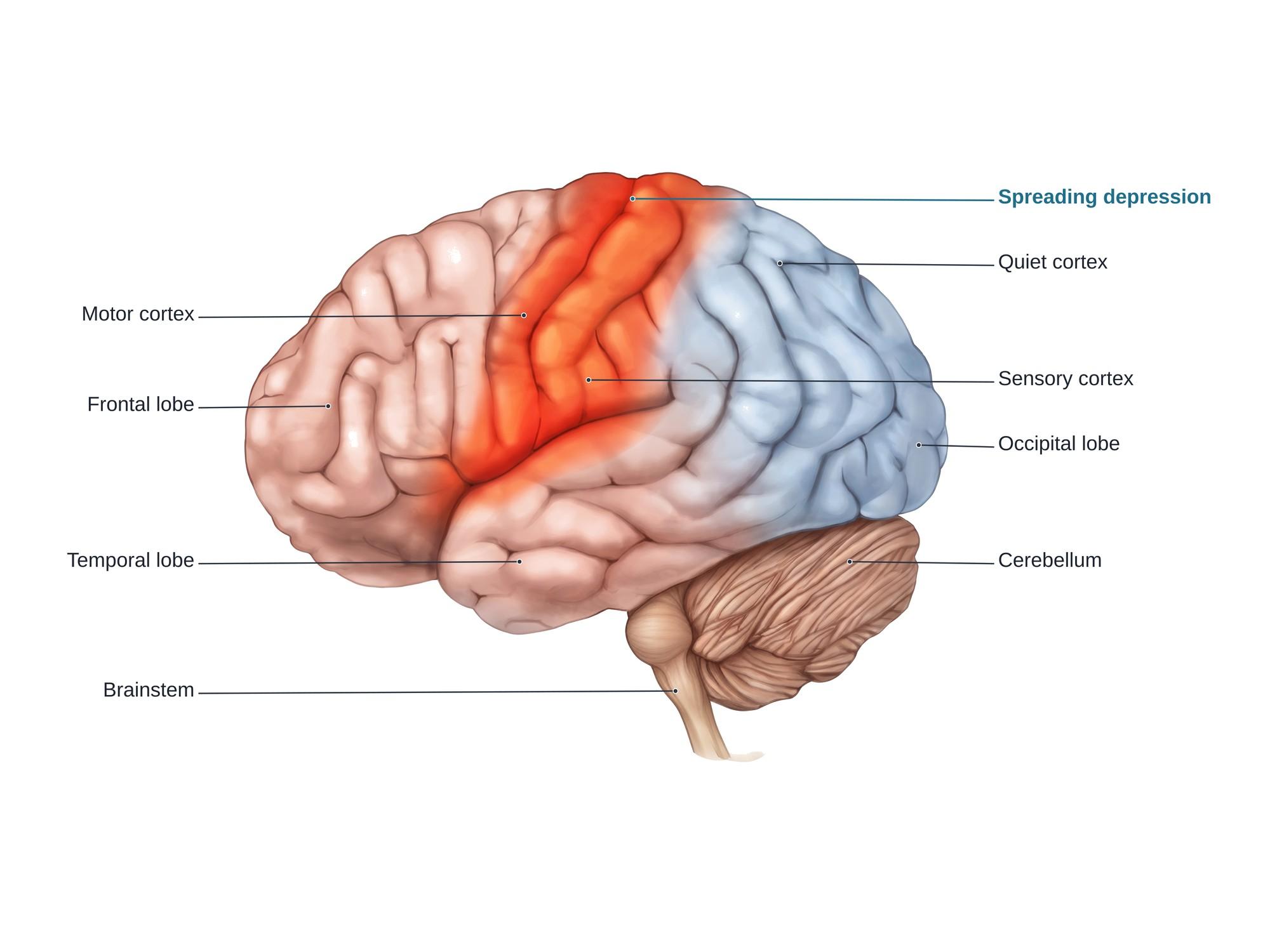
Hemiplegic migraine is a rare type of migraine with aura that causes temporary weakness on one side of the body. "Hemiplegic" means paralysis of one side. The weakness can affect the face, arm and leg, and it often comes with visual changes, numbness and trouble speaking. A headache may follow. The attack is caused by a slow wave of changed brain activity, called cortical spreading depression, that moves across one side of the brain. Because the symptoms look like a stroke, a first attack is treated as an emergency. The illustration above shows the wave moving across the left side of the brain.
The anatomy
The outer layer of the brain is the cerebral cortex. Different parts of it control different jobs. See brain anatomy for the full layout.
- The occipital lobe at the back handles vision. Most migraine auras start here, which is why flashing lights are common.
- The sensory cortex (postcentral gyrus) feels touch and position on the opposite side of the body.
- The motor cortex (precentral gyrus), just in front of it, controls movement on the opposite side.
- The frontal lobe and nearby areas help with speech, especially on the left side.
Each side of the brain controls the opposite side of the body. So a wave on the left side of the brain causes weakness on the right side of the body.
How the attack happens
Cortical spreading depression is a wave of strong nerve cell firing followed by a quiet period. It moves slowly across the cortex, about 2 to 6 millimeters a minute.
- The wave usually starts at the back of the brain, in the occipital lobe. This causes visual aura, such as zigzag lines or blind spots.
- It spreads forward. When it reaches the sensory cortex, tingling or numbness spreads up the hand, arm or face.
- When it reaches the motor cortex, the opposite side of the body becomes weak.
- Behind the wave, the cortex is quiet for a while before it recovers.
This slow spread is why symptoms build over several minutes and appear one after another. A stroke usually causes symptoms all at once.
Types
| Type | Who has it | Genes linked |
|---|---|---|
| Familial hemiplegic migraine (FHM) | At least one first- or second-degree relative also has attacks with weakness | FHM1 (CACNA1A), FHM2 (ATP1A2), FHM3 (SCN1A), and others |
| Sporadic hemiplegic migraine (SHM) | No affected close relative | Sometimes the same genes, as a new change |
These genes affect ion channels and pumps that control how easily nerve cells fire. Changes in them make spreading depression easier to start.
Causes and triggers
The underlying cause is a brain that is more easily excited, often because of a gene change. Attacks can be set off by:
- Emotional stress or poor sleep
- Bright or flashing light
- Some foods or skipped meals
- Hormone changes
- Mild head injury, a classic trigger in children and young adults
- Some medical procedures, such as cerebral angiography
Symptoms
Hemiplegic migraine symptoms usually build over 5 to 60 minutes:
- Weakness of one side of the face, arm or leg (motor aura)
- Visual aura: flashing lights, zigzag lines or blind spots
- Sensory aura: pins and needles or numbness that spreads
- Speech trouble: slurred speech or trouble finding words
- Headache, often throbbing and often on the side opposite the weakness, with nausea and light sensitivity
Some attacks also cause confusion, drowsiness, fever, or, rarely, seizures or coma. These severe attacks are more common after a head injury.
Diagnosis
There is no single test. The diagnosis is based on at least two attacks with typical symptoms that fully go away, and on ruling out other causes.
- Brain imaging (CT or MRI, often with images of the blood vessels) rules out stroke, bleeding or a tumor. During an attack, MRI can show swelling or changed blood flow on one side. Between attacks it is usually normal.
- EEG (a test of brain waves) may show slowing on the affected side.
- Genetic testing can confirm familial hemiplegic migraine in some families.
- Blood tests and heart tests may be done to rule out other causes of stroke-like symptoms.
Important look-alikes include stroke, transient ischemic attack, seizure followed by weakness (Todd's paralysis), and bleeding in the brain, such as a subarachnoid hemorrhage.
Treatment
- Emergency care for a first attack, to rule out stroke.
- Acute treatment: pain relievers, anti-nausea medicine, and rest in a dark room.
- Triptans and ergots have often been avoided because they narrow blood vessels. Newer evidence suggests triptans may be safe for some people, so this is a decision for a neurologist.
- Preventive medicines, such as verapamil, topiramate, lamotrigine, flunarizine or acetazolamide, to reduce how often attacks happen.
- Avoiding triggers, including head injuries in contact sports for people with familial hemiplegic migraine.
Recovery
Most attacks fully resolve within hours to a few days. Weakness rarely lasts more than a few days, though very rare prolonged attacks have lasted weeks. Attacks often become less frequent with age. Some people with certain gene changes develop slow, lasting balance problems from the cerebellum.
Complications
- Prolonged attacks with weakness that lasts days or weeks
- Severe attacks with confusion, fever, seizures or coma, sometimes after a minor head injury
- Lasting deficits, which are rare
- Misdiagnosis as a stroke, which can lead to stroke treatments the patient did not need
- Missed stroke, when a real stroke is assumed to be "just a migraine"
How hemiplegic migraine is shown in a personal injury case
Hemiplegic migraine comes up in two kinds of cases. In a personal injury case, a mild head injury from a crash, fall or sports collision can trigger a severe attack, and the defense may argue the symptoms came from a pre-existing condition rather than the injury. In a medical malpractice case, the question may be whether a real stroke was dismissed as a migraine, or whether a migraine was treated as a stroke. A medical illustration of the wave moving across one side of the brain shows a jury why the weakness appeared on the opposite side, and why the symptoms built slowly. For how these images are used at trial, see demonstrative evidence and medical legal illustration.
Related pages
- Brain anatomyThe normal anatomy of the brain.
- Horner syndromeHorner syndrome is a droopy eyelid, small pupil and less sweating on one side of the face from a damaged nerve pathway. See the pathway illustrated.
- Subarachnoid hemorrhageA subarachnoid hemorrhage is bleeding into the fluid-filled space around the brain, from a head injury or a burst aneurysm. See it beside normal anatomy.
FAQ
What are the symptoms of hemiplegic migraine?+
The main symptom is weakness of one side of the body, such as the face, arm or leg. It usually comes with other aura symptoms: flashing lights or blind spots, tingling or numbness that spreads, and trouble speaking. A headache often follows, but not always. Some people also have confusion, drowsiness or fever during severe attacks.
Can migraines cause slurred speech?+
Yes. Trouble speaking or finding words is a known aura symptom, especially in hemiplegic migraine. Slurred speech can also be a sign of a stroke, so new speech trouble, especially with weakness, should be treated as an emergency until a doctor rules out a stroke.
Is hemiplegic migraine a stroke?+
No, but it can look exactly like one. Both can cause sudden weakness on one side and trouble speaking. In hemiplegic migraine, symptoms usually spread slowly over minutes and then fully go away. A stroke usually starts suddenly. Because they can look the same, a first attack is treated as a possible stroke until imaging and tests rule it out.
What is the difference between familial and sporadic hemiplegic migraine?+
Familial hemiplegic migraine runs in families; at least one close relative also has attacks with weakness. Several genes have been linked to it, including CACNA1A, ATP1A2 and SCN1A. Sporadic hemiplegic migraine has the same symptoms, but no close relative is affected.
Can you have hemiplegic migraine without a headache?+
Yes. Some attacks cause the weakness and other aura symptoms with little or no headache. This makes them even easier to confuse with a stroke or a transient ischemic attack (a mini stroke).
How long does hemiplegic migraine weakness last?+
The weakness usually lasts from minutes to a few hours and often under 72 hours. In rare cases it lasts days to weeks. It almost always goes away completely, though rare severe attacks have left lasting problems.
What triggers hemiplegic migraine?+
Common triggers are stress, lack of sleep, bright light, certain foods, and hormone changes. Mild head injuries are a well-known trigger, especially in children and teens with familial hemiplegic migraine. Some medical procedures, such as cerebral angiography, have also triggered attacks.
What is MUMS migraine?+
MUMS stands for Migraine with Unilateral Motor Symptoms. It is a term some doctors use for people who have one-sided weakness with migraine but do not fully meet the formal criteria for hemiplegic migraine.
Need this illustration for a patient or a case?
Describe the injury or upload a scan and get a clear, labeled medical illustration for a consult, a chart or a case exhibit.
Try Natomy →