Jones Fracture: Fifth Metatarsal X-ray & Recovery
A Jones fracture is a break of the fifth metatarsal where its base meets the shaft, an area that heals slowly. See one on X-ray beside a labeled illustration.
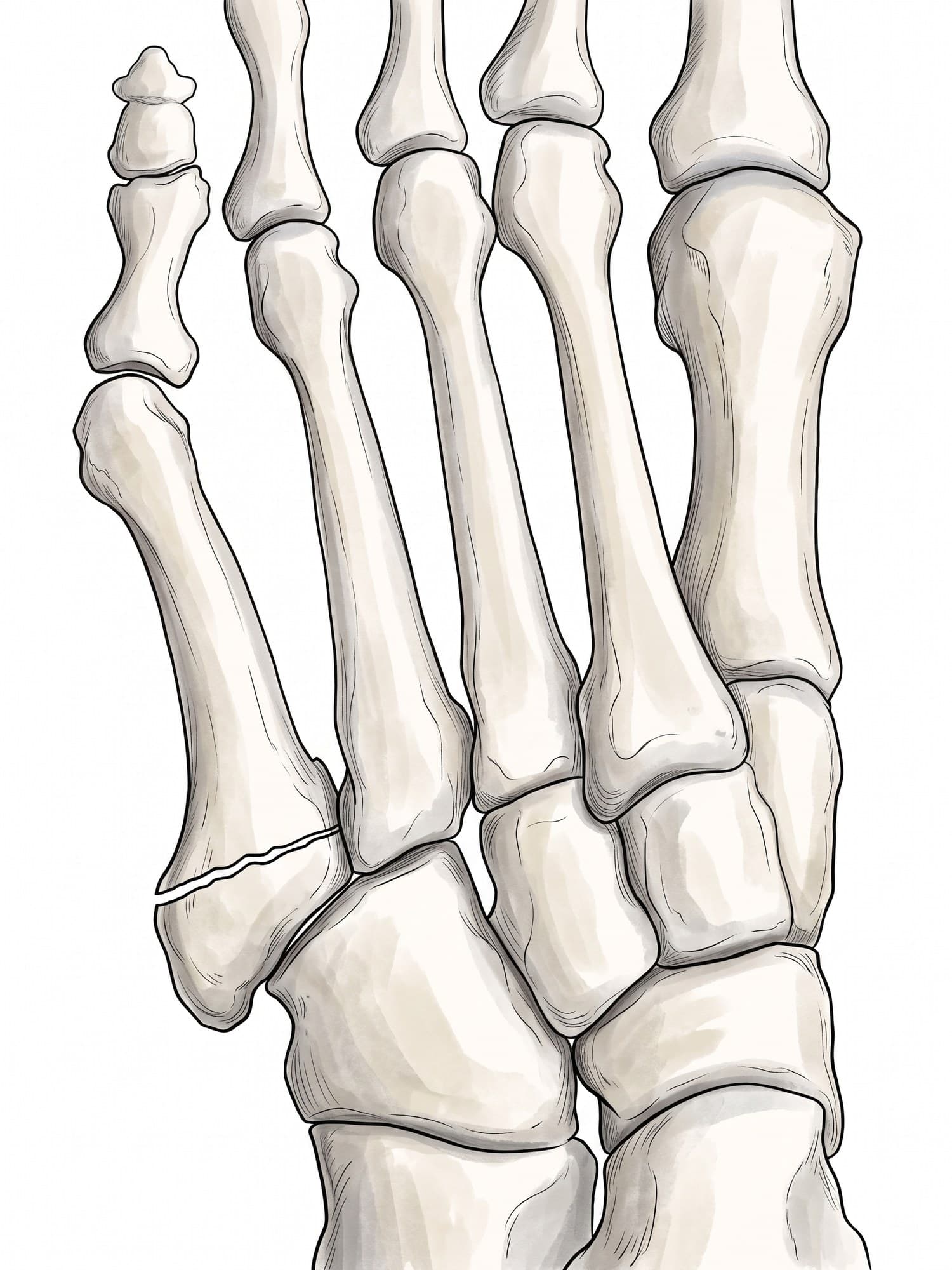
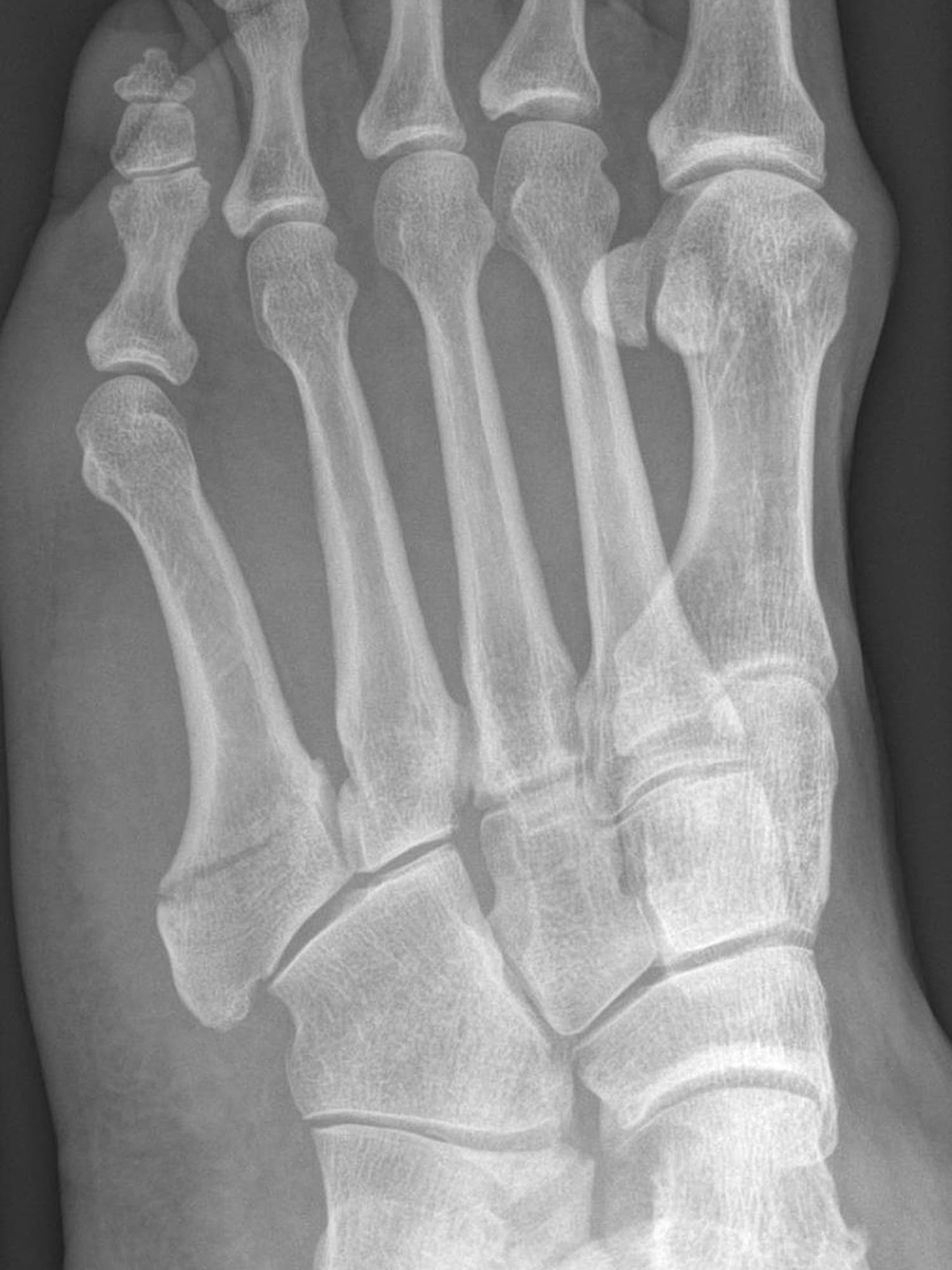
A Jones fracture is a break of the fifth metatarsal, the long bone on the outer edge of the foot, where its base meets the shaft. That small zone has a poor blood supply, so Jones fractures heal more slowly and fail to heal more often than other foot fractures. The figure above shows a real X-ray of a true Jones fracture with a medical illustration drawn from it: drag the slider to compare them.
The fifth metatarsal
The fifth metatarsal runs from the cuboid in the midfoot to the base of the little toe. Its base flares into a tuberosity, the bump you can feel halfway along the outer edge of the foot, where the peroneus brevis tendon attaches. Fractures of the base are grouped into three zones:
- Zone 1, avulsion (pseudo-Jones): the tip of the tuberosity is pulled off, usually in an ankle roll. The most common type, and it heals well.
- Zone 2, Jones fracture: at the junction of the base and shaft, reaching the joint between the fourth and fifth metatarsals. It heals slowly.
- Zone 3, proximal shaft stress fracture: just beyond the Jones zone, usually from repetitive stress in athletes.
For the normal bones of the foot, see foot bones anatomy.
Jones fracture on X-ray
Front, oblique and side views of the foot are taken. On the oblique view above, a transverse fracture crosses the fifth metatarsal at the junction of its base and shaft, about 2 cm from the tip of the tuberosity. It does not enter the joint with the cuboid, which separates it from the more common avulsion fracture.
| Finding | Why it matters |
|---|---|
| Zone (tuberosity tip, base-shaft junction, or shaft) | Decides how slowly it heals and whether surgery is advised |
| Joint involved (cuboid or fourth metatarsal) | Avulsion fractures enter the cuboid joint; Jones fractures reach the 4th-5th joint |
| Sclerosis or widened fracture line | Suggests a stress fracture or delayed healing |
| Displacement | Displaced fractures are more often fixed |
How a Jones fracture happens
The classic mechanism is a sudden turn or pivot with the heel off the ground, as in basketball, soccer and dancing, which loads the base of the fifth metatarsal. Some Jones fractures start as stress fractures from repeated running and jumping. Avulsion fractures, by contrast, usually follow rolling the ankle.
Symptoms
- Pain on the outer edge of the midfoot
- Swelling and bruising over the base of the fifth metatarsal
- Pain and limping when walking or pushing off
- Gradually worsening outer foot pain over weeks, when it is a stress fracture
Treatment
- Non-weight-bearing cast or boot: usually for 6 to 8 weeks, then a gradual return to walking.
- Intramedullary screw fixation: a screw placed down the center of the bone, often recommended for athletes, stress fractures and fractures that do not heal.
- Bone graft: added for nonunion.
Recovery time
Without surgery, healing often takes 8 to 12 weeks or more. After screw fixation, many athletes return to sport in about 6 to 12 weeks. Healing is confirmed on X-ray, and a return to running is gradual.
Complications
- Delayed union and nonunion: the main risk, because of the poor blood supply
- Refracture, especially with an early return to sport
- Hardware irritation after screw fixation
How a Jones fracture is shown in a personal injury case
Fifth metatarsal fractures follow slips, trips, missteps off curbs and stairs, and objects dropped on the foot at work. Whether the fracture is a true Jones fracture or an avulsion matters, because it changes the expected healing time and the risk of nonunion and surgery. An illustration drawn from the patient's own X-ray, like the one above, shows exactly where the break sits on the bone and why it heals slowly. For how these images are used at trial, see demonstrative evidence and medical legal illustration.
Related pages
FAQ
What is a Jones fracture?+
A Jones fracture is a break of the fifth metatarsal, the long bone on the outer edge of the foot, at the junction of its base and shaft, about 1.5 to 3 cm from the tip of the bony bump at its base. It is named after Sir Robert Jones, who described breaking his own foot this way in 1902.
What is the difference between a Jones fracture and an avulsion fracture?+
Both are fractures at the base of the fifth metatarsal. An avulsion fracture (sometimes called a pseudo-Jones fracture) pulls off the very tip of the tuberosity, usually heals well in a boot within weeks, and is far more common. A true Jones fracture is slightly further along the bone, in an area with a poor blood supply, so it heals more slowly and more often fails to heal.
Do you need a walking boot for a Jones fracture?+
A Jones fracture is usually treated in a cast or boot with little or no weight on the foot for about 6 to 8 weeks. Walking on it too early increases the risk that it will not heal. Avulsion fractures of the tip, by contrast, are often treated in a walking boot from the start.
How long does a Jones fracture take to heal?+
Without surgery, healing often takes 8 to 12 weeks or longer, and some never heal. With screw fixation, many athletes return to sport in about 6 to 12 weeks. Healing is confirmed on X-ray before full activity.
What are the symptoms of a Jones fracture?+
Pain and swelling on the outer edge of the midfoot, tenderness over the base of the fifth metatarsal, bruising, and difficulty walking. Some Jones fractures develop gradually as stress fractures, with outer foot pain that gets worse over weeks of running.
Does a Jones fracture need surgery?+
Not always. Many are treated in a non-weight-bearing cast. Surgery with a screw placed down the center of the bone is often recommended for athletes, for fractures that start as stress fractures, and for fractures that have not healed.
When can I run after a fifth metatarsal fracture?+
Running usually resumes only after the fracture has healed on X-ray and walking is pain free, commonly around 3 months for a Jones fracture treated without surgery and sooner after screw fixation. Avulsion fractures of the tip often allow running within 6 to 8 weeks.
Need an illustration of a patient's own X-ray?
Upload an X-ray, CT or MRI and turn it into a clear, labeled medical illustration for a consult, a chart or a case exhibit.
Try Natomy →