Tibia and Fibula Fracture: Broken Leg X-ray & Recovery
A tibia and fibula fracture is a break of both lower leg bones, often a spiral break of the tibia. See a spiral tibia fracture on a labeled X-ray.
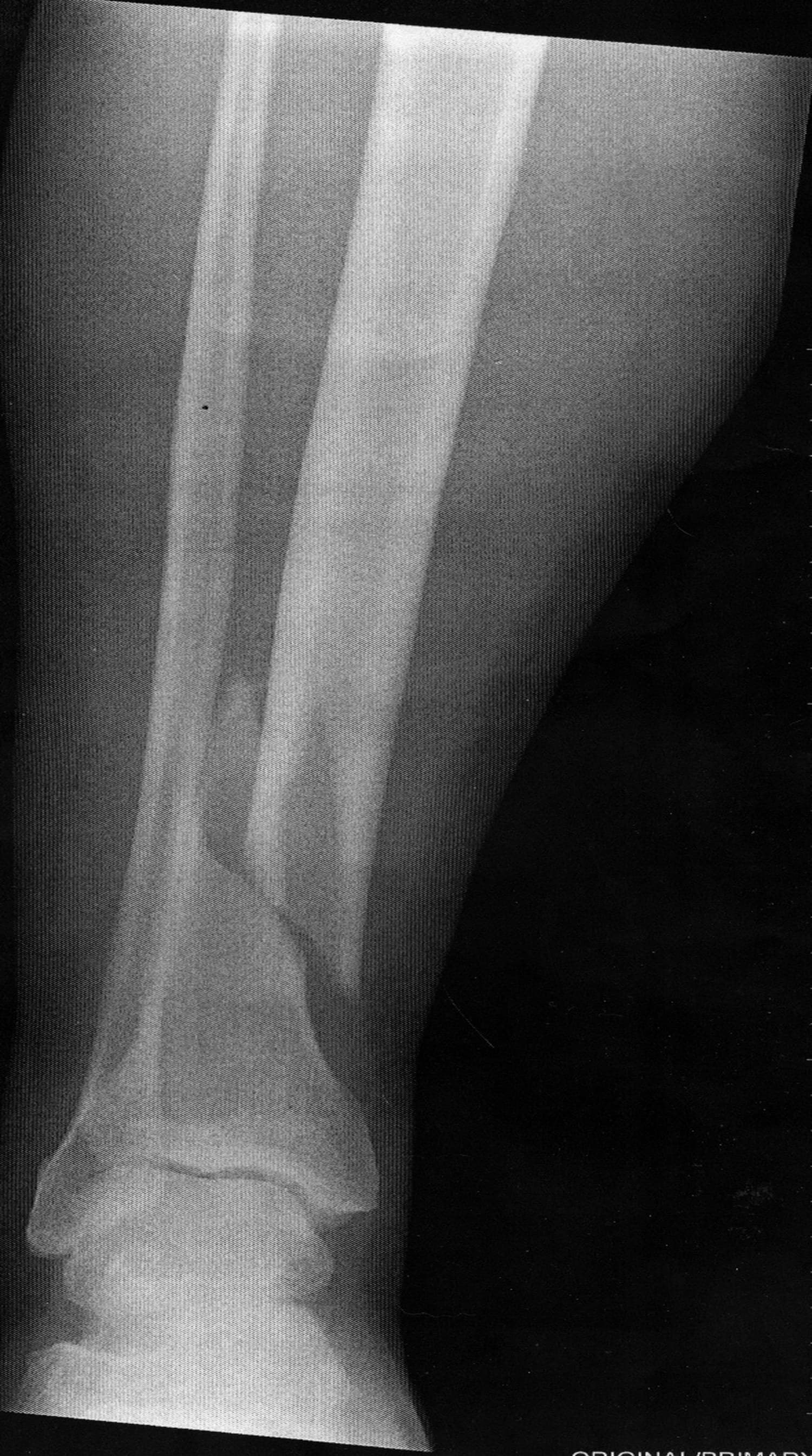
A tibia and fibula fracture is a break of both bones of the lower leg. The tibia (shinbone) carries most of the body's weight; the fibula is the thin bone on the outside of the leg. They often break together, and the tibia is the most commonly fractured long bone. The labeled X-ray above shows a displaced spiral fracture of the lower tibia.
The bones of the lower leg
- Tibia: the large inner bone, triangular in cross section, with its front edge just under the skin of the shin. That thin covering is why tibial fractures are often open (the bone breaks through the skin).
- Fibula: the slender outer bone, joined to the tibia at the knee and ankle and along its length by a membrane. Its lower end forms the lateral malleolus, the outer bump of the ankle.
For the bones of the ankle, see ankle anatomy and ankle fracture; for the knee end, see tibial plateau fracture.
Types of tibia and fibula fracture
| Pattern | Cause |
|---|---|
| Spiral | Twisting with the foot planted (skiing, football, falls with a twist) |
| Transverse | A direct blow (car bumper, kick, fall onto a hard edge) |
| Oblique | A combination of bending and twisting |
| Comminuted | High energy, broken into three or more pieces |
| Open (compound) | Bone through the skin, common at the shin because the bone is so close to the surface |
| Stress fracture | Repetitive loading in runners and recruits |
Tibia and fibula fracture on X-ray
X-rays of the whole leg are taken, including the knee and ankle, because a fracture of one bone can be paired with a break or ligament injury at the other end. On the X-ray above, a long spiral fracture runs through the lower third of the tibia, with the lower piece shifted slightly sideways. The fibula and the ankle joint appear intact on this view, which is why the whole leg is imaged: with a spiral tibia fracture, the fibula can break at a different level, sometimes up near the knee.
| Finding | Why it matters |
|---|---|
| Fracture pattern and level | Guides the choice between a cast, nail or plate |
| Displacement, shortening and angulation | Large deformity usually needs surgery |
| Extension into the knee or ankle joint | Changes treatment to a joint fracture |
| Open wound | An emergency: antibiotics and surgical cleaning |
| Fibula fracture near the knee with an ankle injury | Can signal a Maisonneuve injury of the ankle ligaments |
How a tibia and fibula fracture happens
High-energy injuries cause most adult tibial shaft fractures: car, motorcycle and pedestrian crashes, falls from a height and direct blows. Twisting injuries in skiing, football and soccer cause spiral fractures. Crush injuries at work can cause comminuted and open fractures.
Symptoms
- Severe pain and inability to bear weight
- Deformity or abnormal movement of the lower leg
- Swelling and bruising
- A wound over the shin with an open fracture
- Severe, increasing pain, tightness, or numbness in the foot, which can signal compartment syndrome and needs emergency care
Treatment
- Intramedullary nail: the standard surgery for most displaced adult tibial shaft fractures, a rod down the center of the bone.
- Plate and screws: for fractures near the knee or ankle.
- External fixation: for open fractures with severe soft tissue damage, before definitive fixation.
- Long leg cast and functional brace: for stable, minimally displaced fractures.
- The fibula: often heals without fixation once the tibia is stabilized, unless it is part of an ankle injury.
Recovery time
The tibia typically heals in about 4 to 6 months. With a nail, many people walk with crutches within days and progress to full weight over weeks. Return to work depends on the job, and full recovery for sport often takes 6 to 12 months. An isolated fibula shaft fracture usually heals in about 6 weeks.
Complications
- Compartment syndrome, a surgical emergency after tibial fractures
- Delayed union or nonunion, more common with open fractures and smoking
- Malunion, the bone healing angled or rotated
- Infection, especially after open fractures
- Knee pain after nailing
- Blood clots
How a tibia and fibula fracture is shown in a personal injury case
Broken legs are central to pedestrian, motorcycle and workplace claims. Juries need to understand the mechanism (a twist versus a direct strike), the surgery (a rod down the length of the bone), and the long healing time. Jurors struggle to read an X-ray like the one above. An illustration drawn from the patient's own X-ray shows the spiral course of the break and which bones are involved, and a series can show the nail placed at surgery. For how these images are used at trial, see demonstrative evidence and medical legal illustration.
Related pages
FAQ
How long does a broken fibula take to heal?+
An isolated break of the fibula shaft, away from the ankle, usually heals in about 6 weeks and is often treated with a boot and walking as comfort allows, because the fibula carries little body weight. Fibula fractures at the ankle are treated as ankle fractures and can take longer, especially if surgery is needed.
How long does a broken tibia take to heal?+
Tibial shaft fractures are slow to heal: usually about 4 to 6 months, and longer for open or comminuted fractures and in smokers. With a rod (intramedullary nail), many people walk with crutches within days, but full strength and return to sport often take 6 to 12 months.
What is a spiral fracture of the tibia?+
A fracture that winds around the bone like a corkscrew, caused by a twisting force with the foot planted, as in skiing, football or a fall with a twist. Spiral fractures of the lower tibia are often paired with a fibula fracture at a different level.
Can you walk on a broken tibia?+
Usually not. The tibia carries most of the body's weight, so a displaced tibial shaft fracture makes standing very painful or impossible. A broken fibula alone sometimes allows walking with pain, which is why it can be mistaken for a sprain.
Does a broken tibia need surgery?+
Many adult tibial shaft fractures are fixed with an intramedullary nail, a rod inserted down the center of the bone, because it allows early movement and lowers the risk of the bone healing crooked. Stable, minimally displaced fractures can be treated in a long leg cast and then a functional brace.
What is the difference between the tibia and fibula?+
The tibia (shinbone) is the large inner bone of the lower leg and carries most of the body's weight. The fibula is the thin outer bone; it carries little weight but forms the outer side of the ankle joint and anchors muscles and ligaments.
How can I speed up healing of a broken leg?+
Follow the weight-bearing plan, keep up physical therapy, stop smoking (which strongly slows bone healing), eat enough protein and calories, and keep vitamin D and calcium adequate. Avoid anti-inflammatory painkillers if your surgeon advises against them, and keep follow-up X-rays so delayed healing is caught early.
Need an illustration of a patient's own X-ray?
Upload an X-ray, CT or MRI and turn it into a clear, labeled medical illustration for a consult, a chart or a case exhibit.
Try Natomy →