Spinal Cord Injury: ASIA Grades, Types & Treatment
A spinal cord injury is damage to the cord inside the spine, often from a crash, fall or dive. Learn the ASIA grades, incomplete types and treatment.
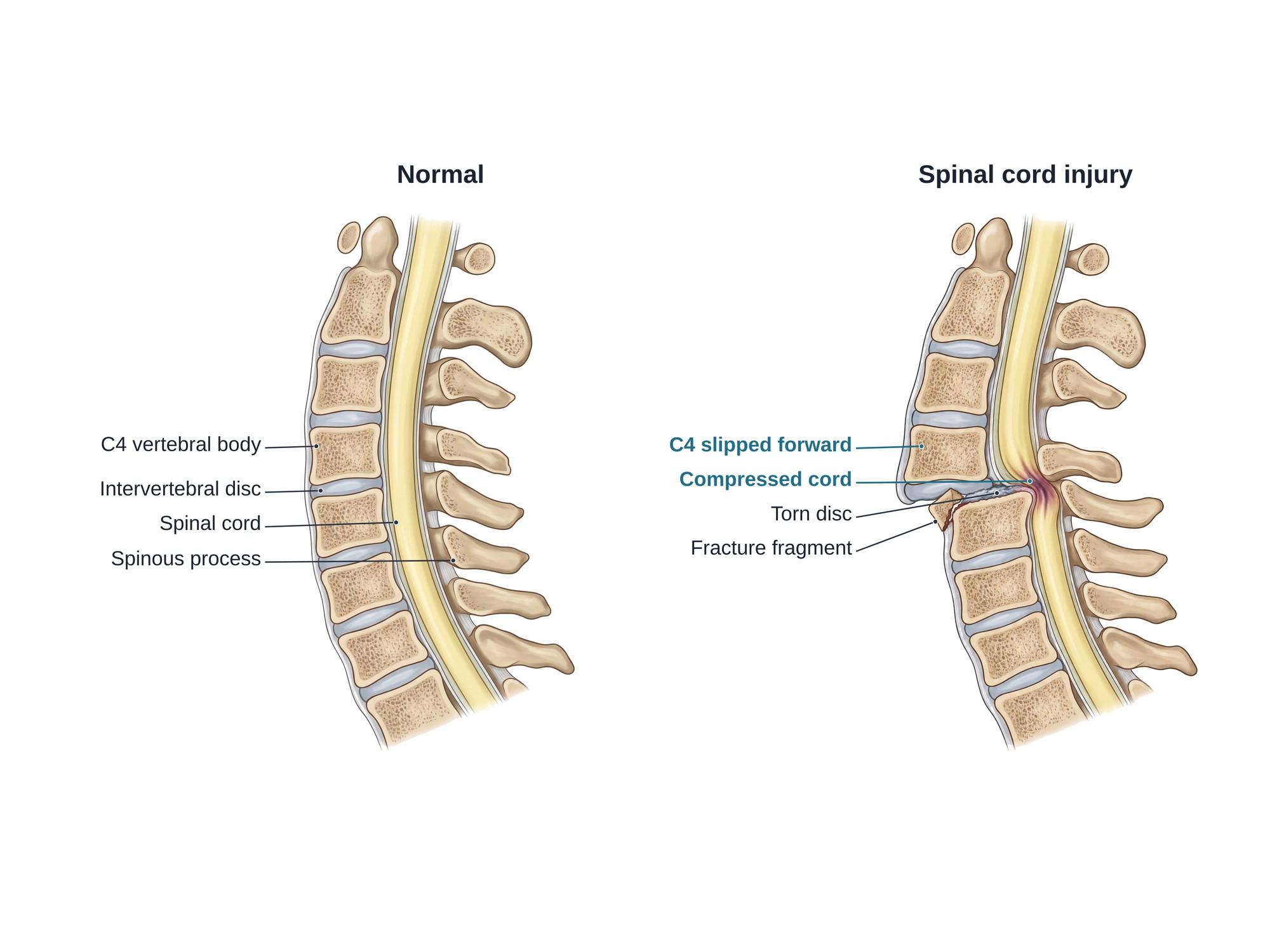
A spinal cord injury (SCI) is damage to the spinal cord, the bundle of nerve fibers that carries signals between the brain and the body. The cord runs down the vertebral canal, a tunnel formed by the stacked vertebrae (see cervical spine anatomy). Most injuries follow a car crash, a fall or a dive into shallow water that breaks or dislocates the spine. Bone, disc or ligament then presses on the cord and bruises or tears it. Below the injury, a person can lose movement, feeling, and bladder and bowel control. Worldwide, about 20.6 million people were living with a spinal cord injury in 2019, and about 0.9 million new cases occurred that year (GBD Spinal Cord Injuries Collaborators, 2023). The illustration above shows a normal neck beside a fracture-dislocation compressing the cord.
The anatomy
The spinal cord starts at the base of the brain and ends near the first or second lumbar vertebra. Below that, the nerve roots continue down as the cauda equina. Pairs of spinal nerves leave the cord at each level, and each level controls a band of skin and a set of muscles.
- Cervical cord (C1 to C8): breathing (C3 to C5 supply the diaphragm), arms and hands
- Thoracic cord (T1 to T12): chest and belly muscles, and blood pressure control
- Lumbar and sacral cord (L1 to S5): legs, bladder, bowel and sexual function
The neurological level of injury is the lowest level that still works normally on both sides. The higher the level, the more of the body is affected. An injury in the neck causes tetraplegia (quadriplegia), weakness or paralysis of the arms and legs. An injury lower down causes paraplegia, which spares the arms.
Complete vs incomplete injury
An injury is complete when no movement or feeling remains in the lowest sacral segments, S4-S5, around the anus. It is incomplete when some feeling or movement remains there. This "sacral sparing" means some signals still cross the injury. That is the strongest sign that more recovery is possible.
| Feature | Complete injury | Incomplete injury |
|---|---|---|
| Feeling at S4-S5 | None | Some feeling or movement remains |
| ASIA grade | A | B, C or D |
| Function below the injury | Lost on both sides | Partly kept, often unevenly |
| Chance of improving a grade | Low | Much higher |
ASIA grades
Doctors grade the injury with the ASIA Impairment Scale (AIS). It is part of the International Standards for Neurological Classification of Spinal Cord Injury (ISNCSCI). The exam tests strength in 10 key muscles and feeling at 28 points on each side of the body. An exam done 72 hours or more after injury, once the first shock to the cord settles, best predicts recovery. Grade E means the exam is normal in someone who had a spinal cord injury before.
| ASIA grade | Name | What the exam shows |
|---|---|---|
| A | Complete | No movement or feeling at S4-S5 |
| B | Sensory incomplete | Feeling but no movement below the injury, including at S4-S5 |
| C | Motor incomplete | Movement below the injury; fewer than half of the key muscles can lift against gravity |
| D | Motor incomplete | Movement below the injury; half or more of the key muscles can lift against gravity |
The first grade is the best guide to recovery. In a review of 114 studies with 19,913 patients, about 19% of grade A injuries improved by at least one grade. So did 74% of grade B injuries and 87% of grade C injuries (Khorasanizadeh et al., 2019).
Types of incomplete spinal cord injury
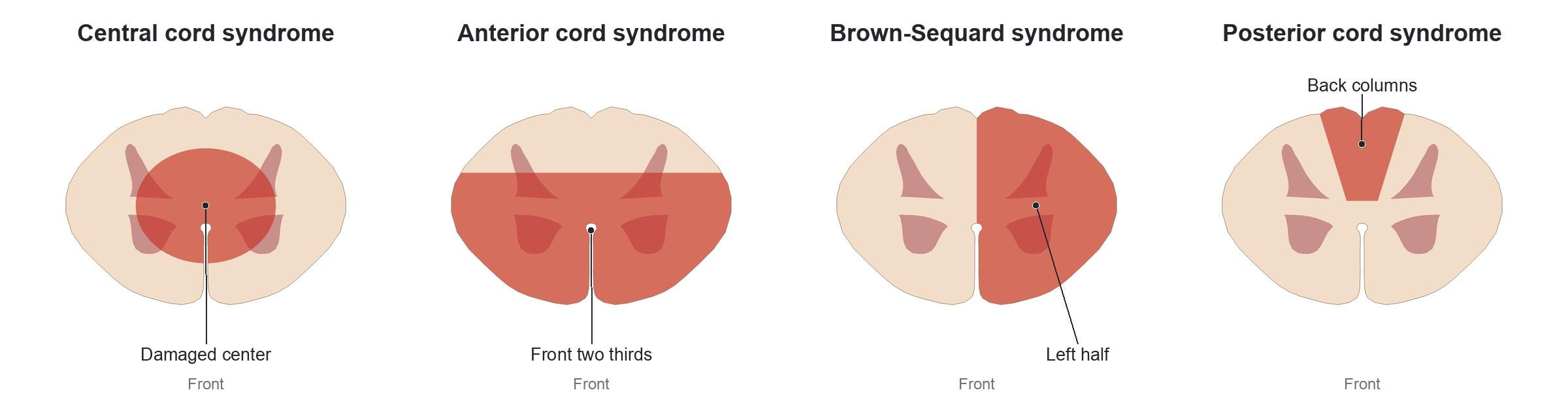
Incomplete injuries often follow a pattern, depending on which part of the cord is hit.
| Syndrome | Part of the cord | Typical result |
|---|---|---|
| Central cord syndrome | Center of the cervical cord | Arms and hands weaker than legs; common in older adults after a fall |
| Anterior cord syndrome | Front two thirds | Loss of movement and of pain and temperature sense; touch and position sense kept |
| Brown-Sequard syndrome | One half (left or right) | Weakness and loss of position sense on the injured side; loss of pain sense on the other side |
| Posterior cord syndrome | Back columns | Loss of position and vibration sense; strength kept; unsteady walking |
| Conus medullaris syndrome | Lowest end of the cord | Bladder, bowel and sexual problems, numbness around the buttocks |
Central cord syndrome is the most common pattern. Brown-Sequard syndrome usually has the best outlook. Damage to the nerve roots below the cord is a separate condition, cauda equina syndrome.
Causes
Traumatic spinal cord injury is far more common in men. In a review of 229 studies, traumatic SCI occurred in about 26 per million people per year, and men were 3.2 times more likely than women to have one (Lu et al., 2024). Worldwide, falls (about 477,000 cases) and road injuries (about 230,000 cases) were the two leading causes in 2019 (GBD Spinal Cord Injuries Collaborators, 2023).
Common causes include:
- Car and motorcycle crashes, where the neck snaps forward and back
- Falls, from a ladder or roof, or from standing in older adults
- Diving into shallow water, which drives the head into the bottom and buckles the neck
- Sports, such as football tackles, rugby, gymnastics, horse riding and skiing
- Violence, such as gunshot and stab wounds
- Non-traumatic causes, such as tumors, infections, a blocked blood supply or severe cervical disc herniation
How the cord is damaged. In a fracture-dislocation, the ligaments and joints that hold two vertebrae together tear, and the upper vertebra slides forward on the lower one. The canal narrows like scissors closing, and the cord is pinched between the back of one vertebral body and the lamina of the other. A burst fracture can also push bone fragments back into the canal. The first blow is the primary injury. Over the next hours and days, swelling, bleeding and poor blood flow cause a secondary injury that kills more nerve cells. Fast treatment aims to limit that second wave.
Symptoms
Symptoms depend on the level and on whether the injury is complete.
- Weakness or paralysis of the arms, legs or both
- Numbness, tingling or loss of feeling below the injury
- Loss of bladder and bowel control
- Neck or back pain, or an odd position of the head
- Trouble breathing, with injuries at C5 or higher
- Low blood pressure and a slow heart rate (neurogenic shock) after high injuries
- Muscle spasms and overactive reflexes later on
- Changes in sexual function
Right after injury, the cord can stop working for a time below the injury (spinal shock). Reflexes are absent and the limbs are floppy. This can last days to weeks, so the final picture becomes clearer only later.
Diagnosis
- Neurological exam: the ISNCSCI exam sets the level and the ASIA grade. It is repeated to track change.
- CT scan of the spine: shows fractures, dislocations and bone fragments in the canal. It is the first scan after major trauma.
- MRI of the spine: shows the cord itself. It reveals swelling, bleeding inside the cord, torn ligaments and a herniated disc pressing on the cord. Bleeding inside the cord is a sign of a more severe injury.
- X-rays: show alignment and are used to check the spine after surgery.
- CT angiography: checks the vertebral arteries, which can tear with neck fractures.
Treatment
At the scene. Paramedics keep the spine still and protect the airway. Moving an unstable spine can make the cord injury worse.
In the hospital. Doctors keep blood pressure up so the injured cord gets enough blood and oxygen. Patients with high injuries may need a breathing tube and a ventilator. Steroids (methylprednisolone) are debated. Some guidelines allow a 24-hour course started within 8 hours, and others advise against them.
Realignment. A dislocated neck can be pulled back into line with traction, weights attached to tongs fixed to the skull.
Surgery removes pressure from the cord (decompression) and makes the spine stable (stabilization). It also allows earlier sitting and rehabilitation.
- Anterior surgery: the surgeon reaches the spine from the front of the neck, removes the torn disc or broken bone, and fuses the level with a cage and plate. See ACDF surgery.
- Posterior surgery: the surgeon works from the back of the neck, removes the lamina if needed, and fixes the vertebrae with screws and rods.
- Lower back and chest injuries: a fusion with screws and rods, as in lumbar fusion.
Timing matters. In a pooled study of 1,548 patients, those who had surgery within 24 hours gained about 24 motor points by one year, compared with about 20 points with later surgery (Badhiwala et al., 2021).
Recovery
- Most recovery happens in the first 6 to 12 months, with the fastest change in the first 3 months.
- Incomplete injuries recover far more than complete ones.
- Rehabilitation in a spinal cord injury center starts as soon as the patient is stable.
- Physical and occupational therapy build strength, balance, transfers and daily skills.
- People learn bladder and bowel programs, skin checks and how to use a wheelchair or braces.
- Some patients later benefit from tendon or nerve transfers to improve hand function.
- Counseling and peer support groups help with mood, work and family life.
- Many people need lifelong care, equipment and home changes.
Complications
- Breathing problems and pneumonia, especially with neck injuries
- Blood clots in the legs and lungs (deep vein thrombosis and pulmonary embolism)
- Pressure injuries of the skin over the hips, tailbone and heels; see pressure ulcer
- Urinary tract infections and kidney problems from bladder dysfunction
- Autonomic dysreflexia, a sudden spike in blood pressure triggered by a full bladder or other irritation below a T6 or higher injury; it is an emergency
- Spasticity, stiff and jerking muscles
- Chronic nerve pain
- Bone loss and fractures in the paralyzed limbs
- Depression and anxiety
How spinal cord injury is shown in a personal injury case
A spinal cord injury is one of the most costly injuries in a personal injury case. Car and motorcycle crashes, falls from heights or on unsafe property, diving accidents and work injuries are common causes. The neurological level and the ASIA grade define what the person can and cannot do, and they drive the life care plan. Imaging links the event to the injury: the CT shows the fracture-dislocation, and the MRI shows the bruised cord. Malpractice claims often ask whether an unstable spine was moved without protection, whether a fracture was missed, or whether surgery was delayed. A medical illustration of a normal neck beside a fracture-dislocation shows a jury how the vertebra slid forward and pinched the cord. For how these images are used at trial, see demonstrative evidence and medical legal illustration.
References
- GBD Spinal Cord Injuries Collaborators. Global, regional, and national burden of spinal cord injury, 1990-2019: a systematic analysis for the Global Burden of Disease Study 2019. Lancet Neurology. 2023;22(11):1026-1047.
- Khorasanizadeh M, Yousefifard M, Eskian M, et al. Neurological recovery following traumatic spinal cord injury: a systematic review and meta-analysis. Journal of Neurosurgery: Spine. 2019;30(5):683-699.
- Lu Y, Shang Z, Zhang W, et al. Global incidence and characteristics of spinal cord injury since 2000-2021: a systematic review and meta-analysis. BMC Medicine. 2024;22(1):285.
- Badhiwala JH, Wilson JR, Witiw CD, et al. The influence of timing of surgical decompression for acute spinal cord injury: a pooled analysis of individual patient data. Lancet Neurology. 2021;20(2):117-126.
Related pages
FAQ
What are the different types of incomplete spinal cord injuries?+
The main incomplete patterns are central cord syndrome (arms weaker than legs), anterior cord syndrome (loss of movement and pain sense, with touch and position sense kept), Brown-Sequard syndrome (one half of the cord damaged, with weakness on one side and loss of pain sense on the other), and posterior cord syndrome (loss of position and vibration sense, with strength kept). Conus medullaris and cauda equina injuries affect the lowest end of the cord and the nerve roots below it.
How is posterior cord syndrome treated?+
Posterior cord syndrome is rare. Treatment depends on the cause: a fracture or a compressing mass is relieved with surgery, and a vitamin B12 or copper deficiency is treated with supplements. Rehabilitation focuses on balance and walking, because people lose the sense of where their feet are and often rely on their eyes to stay upright.
What is an ASIA A spinal cord injury?+
ASIA A is a complete injury. The person has no movement and no feeling in the lowest part of the spinal cord, the S4-S5 segments around the anus. It is the most severe grade on the ASIA Impairment Scale. In a large review, about 19% of people with an ASIA A injury improved by at least one grade.
What are the signs of recovery from a spinal cord injury?+
Early signs include feeling or movement returning in the toes, the legs or around the anus, especially in the first days to weeks. Any sacral sensation in the first exam is a good sign. Most recovery happens in the first 6 to 12 months, and smaller gains can continue for a year or more.
What is the best treatment for a spinal cord injury?+
There is no cure that repairs the cord yet. The best care is fast: keeping the spine still, keeping blood pressure up so the cord gets oxygen, and surgery to remove pressure and stabilize the spine, ideally within 24 hours. Early, intensive rehabilitation in a specialized spinal cord injury center gives the best long-term results.
Can a spinal cord injury heal on its own?+
The swelling and bruising can settle, and some nerve pathways that were stunned but not cut may recover. Nerve cells in the cord do not regrow well, though, so damage that destroys them is usually permanent. People with incomplete injuries recover much more than people with complete injuries.
Is a spinal cord injury always caused by a broken neck or back?+
No. A fracture or dislocation is the most common cause, but the cord can also be injured without a fracture. In older adults with narrow spinal canals, a fall that bends the neck backward can pinch the cord and cause central cord syndrome. Gunshot and stab wounds, tumors, infections and blocked blood supply can also damage the cord.
What is the difference between quadriplegia and paraplegia?+
Quadriplegia, also called tetraplegia, follows an injury in the neck and affects the arms, trunk, legs and pelvic organs. Paraplegia follows an injury in the chest, lower back or sacral part of the spine and affects the trunk, legs and pelvic organs, while the arms work normally.
Need this illustration for a patient or a case?
Describe the injury or upload a scan and get a clear, labeled medical illustration for a consult, a chart or a case exhibit.
Try Natomy →