Pressure Ulcer (Bed Sore): Stages, Causes & Treatment
A pressure ulcer (bed sore) is skin and tissue damage from staying in one position. Learn the 4 stages, causes, treatment and prevention.
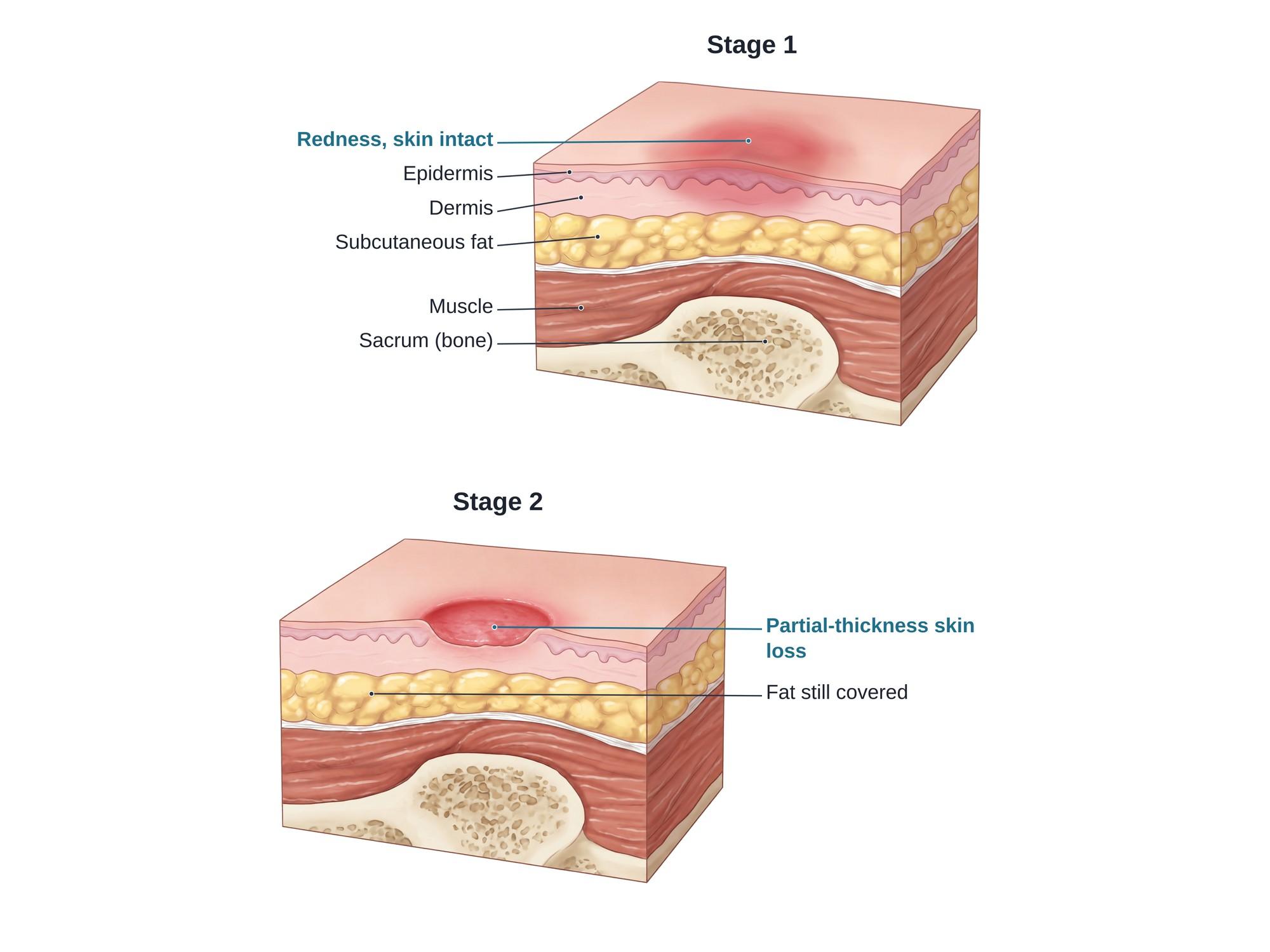
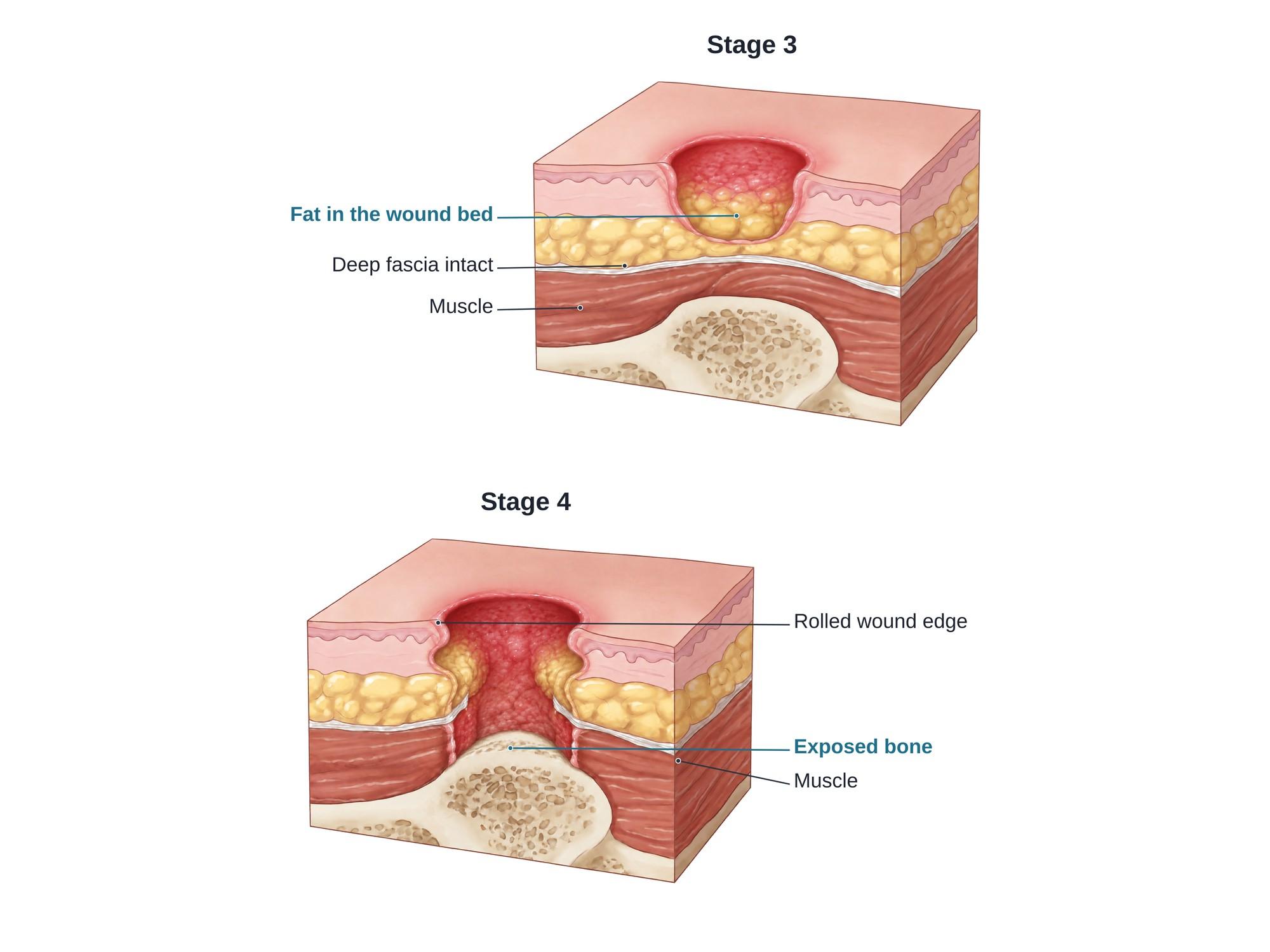
A pressure ulcer, also called a bed sore or pressure injury, is damage to the skin and the tissue under it caused by pressure that lasts too long. It usually forms over a bony prominence, a place where bone sits close to the skin, such as the sacrum at the base of the spine, the heels or the hips. When a person lies or sits in one position, their weight squeezes the skin between the bone and the bed or chair. This cuts off blood flow, and the tissue starts to die. Pressure ulcers affect about 13% of adults in hospital, and about 8% get one during their stay (Li et al., 2020). They are graded in four stages by how deep the damage goes. The figures show each stage as a block of skin and tissue over the sacrum.
Stages
Pressure ulcers are staged with the National Pressure Injury Advisory Panel (NPIAP) system. It was last revised in 2016 (Edsberg et al., 2016). The stage describes the deepest layer that is damaged. Two wounds sit outside the numbered stages. An unstageable ulcer is covered by slough (soft yellow dead tissue) or eschar (dry black or brown dead tissue), so its depth cannot be seen. A deep tissue pressure injury is a purple or maroon area, or a blood blister, over damaged deep tissue.
- What it looks like
- Red skin that does not fade when pressed; skin intact
- Layers damaged
- Epidermis and dermis, not broken
- What it looks like
- Shallow open sore or blister with a pink, moist base
- Layers damaged
- Epidermis and part of the dermis
- What it looks like
- Crater with fat visible in the base
- Layers damaged
- Full skin thickness into the fat
- What it looks like
- Deep crater with muscle, tendon or bone showing
- Layers damaged
- Skin, fat, fascia, muscle, often bone
Early ulcers are the most common. In a review of 12,041 pressure injuries in hospital, 44% were stage 1. Another 28% were stage 2 (Li et al., 2020).
Causes
Three forces cause pressure ulcers:
- Pressure. Body weight presses the skin against bone and squeezes the small blood vessels shut.
- Shear. The skin stays put while the bone slides, for example when a patient slides down in a raised bed. This stretches and tears deep vessels.
- Friction and moisture. Rubbing and wet skin from sweat or incontinence make the skin weaker.
Some people are at much higher risk:
- Older adults, especially those who are frail or thin
- People who cannot move or feel pain, such as those with a spinal cord injury, a stroke or dementia
- Patients in intensive care, on breathing machines or sedated
- People with poor nutrition, diabetes or poor blood flow
- People after long surgery or with an injury that keeps them in bed
In intensive care units (ICUs) the risk is high. In a one-day study of 13,254 ICU patients in 90 countries, 27% had a pressure ulcer. The sacrum (37%) and the heels (20%) were the most common sites (Labeau et al., 2021). Medical devices such as casts, breathing masks and tubes can also cause pressure ulcers where they press on the skin.
Symptoms
- A patch of red, purple or darker skin that does not fade when pressed
- Skin that feels warmer, cooler, firmer or softer than the skin around it
- Pain, itching or burning over a bony area
- A blister or a shallow open sore
- A deep wound, sometimes with yellow or black dead tissue
- Drainage, a bad smell or fever, which can mean infection
In darker skin, stage 1 redness can be hard to see. Changes in warmth, firmness or pain may be the first clue. People with nerve damage may feel nothing at all.
Diagnosis
A pressure ulcer is diagnosed by looking at the skin and the wound. A nurse or doctor checks the skin over bony areas and presses on any red patch. Redness that does not fade under a finger points to stage 1. For an open wound, they measure its length, width and depth. They look for tunnels and for undermining, where the wound goes further under the skin edge than it looks. They note what is in the wound bed.
Risk is often scored with the Braden scale. It rates feeling, moisture, activity, mobility, nutrition, and friction and shear. When a deep ulcer may have spread to bone, an MRI or a bone biopsy can check for osteomyelitis, an infection of the bone. The Wound Healing Society advises a bone biopsy for culture when bone infection is suspected (Gould et al., 2024).
Treatment
Treatment depends on the stage. The first step is always to take pressure off the wound. The Wound Healing Society's guideline puts it simply: "Establish a repositioning schedule and avoid positioning patients on pressure ulcers and bony prominences" (Gould et al., 2024).
- Pressure relief. Turn and reposition on a schedule, and use a pressure-relieving mattress or seat cushion.
- Wound cleaning and dressings. Clean the wound and keep it moist with the right dressing.
- Debridement. Dead tissue is removed so healthy tissue can grow. This can be done with a scalpel, with enzyme ointments, or with the body's own enzymes under a dressing.
- Nutrition. Enough calories, protein and fluids help the wound heal.
- Infection control. Local infection is treated with debridement and antimicrobial dressings. Antibiotics by mouth or IV are used when infection spreads into the nearby skin, reaches the bone or causes sepsis. Bone infection is usually treated for 6 weeks with antibiotics chosen from a culture (Gould et al., 2024).
- Negative pressure wound therapy. A sealed dressing attached to a gentle vacuum can help clean and close deep wounds.
- Surgery. Deep stage 3 and 4 ulcers may need surgery. The surgeon removes dead tissue and bone, then closes the hole with a flap, healthy skin and muscle moved from nearby.
Recovery
Stage 1 and 2 ulcers can heal once the pressure is gone and the wound is kept clean and moist. Stage 3 and 4 ulcers take much longer. Some only close with flap surgery. Healing is slower when the person cannot move, is poorly nourished, or has diabetes or poor circulation. Ulcers also come back often, so prevention must continue after the wound closes.
Complications
- Cellulitis, an infection of the skin and fat around the wound
- Osteomyelitis, infection of the bone under a stage 4 ulcer
- Sepsis, a life-threatening reaction to infection
- Septic arthritis, infection of a nearby joint such as the hip
- Sinus tracts and abscesses, tunnels and pockets of pus under the skin
- Scarring and contractures, including thick hypertrophic scars
- Death. In ICU patients, stage 3 or worse ulcers were linked with about 2.8 times the odds of dying in hospital (Labeau et al., 2021)
Pressure ulcers are also costly. Ulcers acquired in US hospitals may cost more than $26.8 billion a year. About 59% of that cost comes from the smaller number of stage 3 and 4 wounds (Padula and Delarmente, 2019).
How pressure ulcers are shown in a personal injury case
Pressure ulcers are a common basis for nursing home neglect and medical malpractice claims. Most are considered preventable with turning, skin checks, support surfaces and good nutrition. A claim often asks whether the facility assessed the patient's risk, followed a turning schedule, and treated the wound before it got worse. A stage 1 ulcer noted in the chart that later becomes stage 4 can be evidence that care fell short. Staging alone does not prove how a wound progressed, since deep damage can start before the skin breaks.
Lawyers often show the jury a staged medical illustration like the ones above. It explains how deep each layer of damage goes, why a stage 4 wound with exposed bone means months of treatment, and how infection can follow. Charting, wound photos and nursing notes are matched to the stages. See how demonstrative evidence is used at trial, and Natomy's medical-legal illustration for exhibits built from the medical records.
Related pages: burn degrees, compartment syndrome, abrasion and seroma.
References
- Li Z, Lin F, Thalib L, et al. Global prevalence and incidence of pressure injuries in hospitalised adult patients: a systematic review and meta-analysis. International Journal of Nursing Studies. 2020;105:103546.
- Edsberg LE, Black JM, Goldberg M, et al. Revised National Pressure Ulcer Advisory Panel Pressure Injury Staging System. Journal of Wound, Ostomy and Continence Nursing. 2016;43(6):585-597.
- Labeau SO, Afonso E, Benbenishty J, et al. Prevalence, associated factors and outcomes of pressure injuries in adult intensive care unit patients: the DecubICUs study. Intensive Care Medicine. 2021;47(2):160-169.
- Gould LJ, Alderden J, Aslam R, et al. WHS guidelines for the treatment of pressure ulcers, 2023 update. Wound Repair and Regeneration. 2024;32(1):6-33.
- Padula WV, Delarmente BA. The national cost of hospital-acquired pressure injuries in the United States. International Wound Journal. 2019;16(3):634-640.
FAQ
What are the 4 stages of pressure ulcers?+
Stage 1 is red skin that does not fade when pressed, with the skin still intact. Stage 2 is a shallow open sore or blister in the top layers of skin. Stage 3 goes through the full skin into the fat. Stage 4 goes through the fat to muscle, tendon or bone. Two more labels exist: unstageable, when dead tissue hides the depth, and deep tissue pressure injury, a purple or maroon area over damaged deep tissue.
Is there a stage 5 pressure ulcer?+
No. The staging system used in the US stops at stage 4. A wound covered by dead tissue so the depth cannot be seen is called unstageable, not stage 5. Once the dead tissue is removed, it is always found to be stage 3 or 4.
How do you prevent pressure sores?+
Relieve the pressure. Change position on a regular schedule, use a pressure-relieving mattress or cushion, keep the skin clean and dry, and check the skin over bony areas every day. Good nutrition and enough protein help the skin stay healthy.
How often should you move to prevent bed sores?+
There is no single interval that suits everyone. Many care plans turn bed-bound patients about every 2 hours. The Wound Healing Society notes that the interval can be stretched to about every 4 hours when a pressure-reducing mattress is used. The care team should set the schedule for each person.
How long does a pressure ulcer take to heal?+
Shallow ulcers (stage 1 and 2) can heal once pressure is taken off and the wound is cared for. Stage 3 and 4 ulcers take much longer, and some never fully close without surgery.
Can a stage 4 pressure ulcer kill you?+
It can contribute to death. Deep ulcers can lead to bone infection and sepsis, a life-threatening reaction to infection. In a study of 13,254 ICU patients, those with stage 3 or worse ulcers had about 2.8 times the odds of dying in hospital.
Where do bed sores usually form?+
Over bony areas that bear weight. The most common sites are the sacrum (the base of the spine), the heels and the hips. People in wheelchairs often get them over the sit bones (ischial tuberosities).
Are bed sores a sign of nursing home neglect?+
Not always, because some very sick people get pressure ulcers despite good care. But most are preventable. A deep ulcer that formed without turning, skin checks or a proper mattress can be evidence of neglect, and it is a common basis for nursing home and hospital claims.
Need this illustration for a patient or a case?
Describe the injury or upload a scan and get a clear, labeled medical illustration for a consult, a chart or a case exhibit.
Try Natomy →